
How Psychobiotics and the Gut-Brain Axis Are Reshaping Mental Health Nutrition
Emerging research reveals that the trillions of microbes in the human digestive tract directly influence mood, stress, and cognitive function. By adopting diets rich in fiber and fermented foods, individuals can actively bioengineer their microbiome to support mental well-being.
By Factlen Editorial Team

- Clinical Microbiologists
- Researchers focused on the precise, mechanistic pathways connecting specific bacterial strains to brain function.
- Nutritional Psychiatrists
- Medical professionals who advocate for whole-food dietary interventions as a primary tool for mental health.
- Commercial Biotics Industry
- Companies developing targeted probiotic and prebiotic supplements for cognitive performance and stress relief.
What's not represented
- · Patients with severe psychiatric disorders
- · Traditional psychiatric practitioners
Why this matters
Understanding the gut-brain connection empowers individuals to take an active role in their mental health through everyday dietary choices. It offers a low-cost, accessible complement to traditional psychiatric care, proving that what we eat directly fuels how we feel.
Key points
- The gut microbiome directly influences brain chemistry, mood, and stress levels through the gut-brain axis.
- Psychobiotics are beneficial microbes and fibers that confer specific mental health benefits.
- Gut bacteria produce essential mood-regulating neurotransmitters, including serotonin, dopamine, and GABA.
- Mediterranean-style diets rich in fiber and fermented foods actively support a brain-friendly microbiome.
- Researchers are shifting toward precision psychobiotics to target specific biological profiles and stress responses.
The human digestive tract hosts an estimated 100 trillion microorganisms, a bustling ecosystem that scientists increasingly refer to as the body's "second brain." While the gut's role in digestion and immunity has been understood for decades, a paradigm shift is currently sweeping through the fields of neuroscience and nutrition. Emerging research reveals that these microscopic residents do much more than break down food; they are in constant, dynamic conversation with the brain, profoundly influencing mood, stress levels, and cognitive function.[3][7]
This bidirectional communication network is known as the gut-brain axis. For the roughly one in seven people globally living with a mental health disorder, this connection offers a profound new avenue for empowerment and treatment. Rather than viewing mental well-being as something isolated entirely within the skull, researchers are discovering that the foundation of a resilient mind may actually be built in the kitchen.[1]
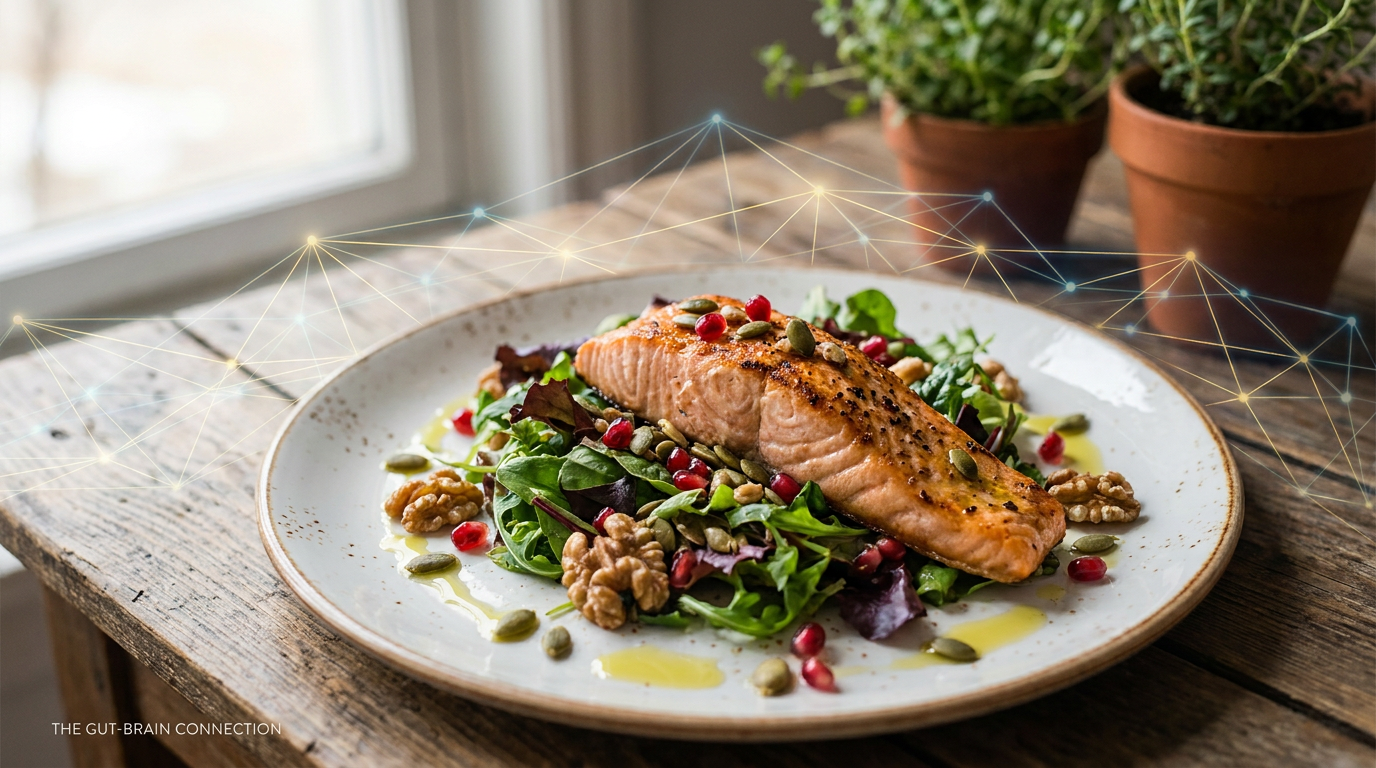
At the center of this nutritional revolution is the concept of "psychobiotics." Originally coined to describe specific probiotic strains that confer mental health benefits, the term has expanded to include prebiotics and natural fermented foods that support a brain-friendly microbiome. By intentionally shaping the bacterial communities in our gut through diet, we can effectively bioengineer our own internal pharmacies to produce neuroactive compounds that stimulate focus, relaxation, and emotional stability.[1][6]
To understand how a bowl of kimchi or a serving of high-fiber legumes can alter human emotion, it is necessary to map the physical and chemical highways connecting the gut to the brain. The most direct route is the vagus nerve, a massive neural cable that runs from the brainstem down to the abdomen. This nerve acts as a bidirectional text chain, transmitting signals from the gut's ecosystem directly to the brain's emotional centers, allowing microbial activity to trigger immediate neurological responses.[3][7]

Beyond the physical wiring, the gut microbiome operates as a prolific chemical factory. Trillions of microbes actively synthesize and regulate neurotransmitters—the chemical messengers that dictate our mood. Astonishingly, gut bacteria are responsible for producing significant quantities of gamma-aminobutyric acid (GABA), dopamine, and serotonin. When the microbiome is balanced and thriving, it ensures a steady supply of these crucial mood-stabilizing chemicals, directly buffering the brain against anxiety and depressive symptoms.[4][6]
The third critical pathway involves microbial metabolites, specifically short-chain fatty acids (SCFAs) like butyrate. When we consume dietary fiber that our own bodies cannot digest, our gut bacteria step in to ferment it, releasing SCFAs as a byproduct. These fatty acids are neuroprotective powerhouses. They cross the intestinal barrier, enter the bloodstream, and travel to the brain, where they actively reduce neuroinflammation and promote the growth of new, healthy neural connections.[3][4]
Furthermore, a healthy microbiome plays a vital role in regulating the hypothalamic-pituitary-adrenal (HPA) axis, the body's central stress response system. Chronic stress can throw the HPA axis into overdrive, flooding the body with cortisol. However, recent clinical reviews demonstrate that a robust, diverse gut microbiome can actually dampen this stress response, helping individuals maintain physiological calm even in high-pressure environments.[3][4]
Furthermore, a healthy microbiome plays a vital role in regulating the hypothalamic-pituitary-adrenal (HPA) axis, the body's central stress response system.
So, how does one cultivate a psychobiotic microbiome? The scientific consensus points overwhelmingly toward specific dietary patterns. Western diets, characterized by high intakes of ultra-processed foods, refined carbohydrates, and saturated fats, have been consistently linked to reduced microbial diversity, increased intestinal permeability, and a higher risk of mood disorders. These diets essentially starve the beneficial bacteria while feeding inflammatory strains that disrupt gut-brain signaling.[2][7]

In stark contrast, Mediterranean-style diets and those rich in natural psychobiotic foods offer a protective effect. Foods like kefir, kombucha, sauerkraut, tempeh, and polyphenol-rich fruits provide a dual benefit: they introduce live, beneficial microbes directly into the digestive tract while supplying the prebiotic fiber necessary for those microbes to thrive. Observational studies and randomized controlled trials increasingly show that transitioning to these dietary patterns can significantly improve outcomes for individuals experiencing mild to moderate anxiety and depression.[2][6]
The commercial sector is also racing to translate these findings into targeted interventions. The biotics industry is developing precision psychobiotic supplements designed to deliver specific, clinically tested bacterial strains. For instance, certain strains of Lactobacillus plantarum and Bifidobacterium longum have been selected for their unique ability to promote GABA production and alleviate perceived stress in human trials. These innovations aim to offer convenient, standardized doses of brain-boosting bacteria in formats ranging from capsules to functional gummies.[1][7]
However, leading researchers caution that the field must evolve beyond broad, generalized approaches. Speaking at the recent Probiota 2026 congress in Dublin, Dr. Gerard Clarke, a professor of neurobehavioral science who has studied the microbiome-brain axis for over two decades, emphasized the need for precision psychobiotics. He noted that microbial effects are highly strain-specific, meaning a probiotic that aids digestion might do absolutely nothing for cognitive health.[5]

The challenge of translation remains a significant hurdle. While animal models have provided breathtaking insights into how gut bacteria can reverse anxiety-like behaviors or improve memory, human biology is vastly more complex. Dr. Clarke highlighted that many positive preclinical findings fail to replicate in human trials, underscoring the need for more rigorous, large-scale studies that account for the diverse variables of human life.[5]
Individual variability is perhaps the greatest puzzle in psychobiotic research. Because every person's baseline microbiome is as unique as a fingerprint, a dietary intervention or probiotic supplement that works miracles for one individual might have a negligible effect on another. Factors such as genetics, baseline stress levels, sleep patterns, and even early-life microbial seeding all dictate how a person's gut will respond to new psychobiotic inputs.[6][7]

Despite these complexities, the trajectory of gut-brain research is overwhelmingly positive. The realization that mental health is not solely a product of brain chemistry, but rather a holistic ecosystem that includes the digestive tract, democratizes mental wellness. It offers accessible, low-cost, and culturally adaptable tools—like eating more fermented foods and dietary fiber—that complement traditional psychiatric care.[1]
As science continues to map the intricate dialogue between our microbes and our minds, the future of nutrition looks increasingly personalized. We are moving toward an era where diets are prescribed not just for cardiovascular health or weight management, but for cognitive resilience and emotional stability. By learning to feed our microbiome, we are discovering a powerful, everyday mechanism to nourish our minds.[7]
How we got here
2004
Early studies on germ-free mice demonstrate that the absence of gut microbes significantly alters the animals' stress responses and behavior.
2013
The term 'psychobiotics' is officially coined by researchers to describe live organisms that confer mental health benefits.
2022
Large-scale observational studies begin to strongly correlate Mediterranean-style diets with a lower risk of depression via microbiome modulation.
Early 2026
Leading neurobehavioral scientists call for a shift toward 'precision psychobiotics' tailored to individual biological profiles.
Viewpoints in depth
Clinical Microbiologists
Researchers focused on the precise, mechanistic pathways connecting specific bacterial strains to brain function.
This camp argues that the future of psychobiotics lies in rigorous, strain-specific science rather than broad dietary advice. They emphasize the need to map exactly how individual microbes interact with the vagus nerve or produce specific neurotransmitters. For these scientists, the priority is closing the translational gap between successful animal models and inconsistent human trials, advocating for 'precision psychobiotics' tailored to specific biological profiles like HPA-axis dysregulation or systemic inflammation.
Nutritional Psychiatrists
Medical professionals who advocate for whole-food dietary interventions as a primary tool for mental health.
Nutritional psychiatrists view the gut-brain axis through the lens of lifestyle and holistic health. They argue that while isolated probiotic supplements show promise, the most robust and sustainable way to improve mental well-being is through comprehensive dietary shifts. This camp champions the Mediterranean diet and the regular consumption of naturally fermented foods—like kefir and kimchi—arguing that whole foods provide a complex matrix of prebiotics, polyphenols, and diverse microbes that a single pill cannot replicate.
Commercial Biotics Industry
Companies developing targeted probiotic and prebiotic supplements for cognitive performance and stress relief.
The commercial sector is focused on accessibility, convenience, and standardized dosing. Industry leaders argue that in a fast-paced world where adherence to a perfect diet is difficult, bioengineered psychobiotic supplements offer a practical solution. They invest heavily in clinical trials for specific proprietary strains, aiming to deliver measurable improvements in focus, memory, and relaxation through consumer-friendly formats like functional gummies and fortified foods.
What we don't know
- Whether changes in gut bacteria actively drive severe mental illnesses or merely mirror what is happening elsewhere in the body.
- The exact dose-response relationship required for natural fermented foods to produce a clinical psychological benefit.
- How individual genetic differences and baseline microbiome diversity affect a person's response to specific psychobiotic strains.
Key terms
- Gut-Brain Axis
- The bidirectional communication network linking the central nervous system in the brain to the enteric nervous system in the digestive tract.
- Psychobiotics
- Live microorganisms or prebiotic fibers that, when ingested in adequate amounts, produce a mental health benefit.
- Vagus Nerve
- A major cranial nerve that serves as the primary physical highway for transmitting signals between the gut and the brain.
- Short-Chain Fatty Acids (SCFAs)
- Metabolic byproducts created when gut bacteria ferment dietary fiber, known to reduce neuroinflammation and protect brain health.
- HPA Axis
- The hypothalamic-pituitary-adrenal axis, which is the body's central system for regulating stress responses and cortisol levels.
Frequently asked
What is a psychobiotic?
A psychobiotic is a type of probiotic or prebiotic—found in supplements or fermented foods—that provides a mental health benefit by positively interacting with the gut-brain axis.
Can changing my diet really improve my mood?
Yes. Clinical trials show that adopting a high-fiber, Mediterranean-style diet can improve symptoms of mild to moderate anxiety and depression by fostering a healthier gut microbiome.
How does the gut communicate with the brain?
The gut and brain communicate through three main channels: the physical vagus nerve, the production of chemical neurotransmitters like serotonin, and the release of metabolic byproducts like short-chain fatty acids.
Are psychobiotic supplements better than fermented foods?
Not necessarily. Supplements offer precise, standardized doses of specific bacterial strains, while fermented foods provide a broader diversity of microbes along with beneficial prebiotic fibers.
Sources
Source coverage
7 outlets
3 viewpoints surfaced






[1]Nutrition InsightCommercial Biotics Industry
A review provides evidence that the gut microbiome directly influences brain chemistry
Read on Nutrition Insight →[2]Current Psychiatry ReportsNutritional Psychiatrists
Diet, the Gut Microbiome, and Mental Health
Read on Current Psychiatry Reports →[3]Frontiers in NeuroscienceClinical Microbiologists
The human gut microbiome has emerged as a pivotal modulator of brain function
Read on Frontiers in Neuroscience →Gut Microbiome, Diet and Depression: Literature Review of Microbiological, Nutritional and Neuroscientific Aspects
Read on Current Nutrition Reports →[5]NutraIngredientsClinical Microbiologists
The emerging field of psychobiotics must shift to precise, mechanism-driven interventions
Read on NutraIngredients →[6]Vascular & Endovascular ReviewNutritional Psychiatrists
Natural Psychobiotic Foods and Their Role in Gut–Brain Axis Modulation
Read on Vascular & Endovascular Review →[7]Factlen Editorial TeamClinical Microbiologists
Synthesis by Factlen editorial team
Read on Factlen Editorial Team →
More in health
See all 9 stories →Dementia Research
The Shingles Vaccine Is Emerging as a Powerful Shield Against Dementia
7 sources

Exercise Mimetics
The Science of 'Exercise in a Pill': How New Longevity Drugs Mimic Physical Activity
7 sources
Brain Health
How Deep Sleep Washes the Brain: The Science of the Glymphatic System
7 sources

Longevity Science
The Postbiotic Promise: How Urolithin A Recycles Aging Cells
6 sources
Every angle. Every day.
Get health stories with full source coverage and perspective breakdowns delivered to your inbox.