
How North America's Expanding Wildlife Corridors Are Saving Billions and Rewilding the Continent
A massive surge in wildlife crossing infrastructure across the U.S. and Canada is drastically reducing vehicle collisions, saving billions of dollars, and reconnecting fragmented ecosystems.
By Factlen Editorial Team
- Transportation & Safety Officials
- Prioritize the dramatic reduction in fatal vehicle collisions and the long-term cost savings for motorists and state agencies.
- Conservation Biologists
- Focus on the ecological benefits of reconnecting fragmented habitats and restoring genetic diversity among isolated animal populations.
- Fiscal Analysts
- Emphasize the strong return on investment, noting that the infrastructure pays for itself by preventing billions in property damage.
- Indigenous Leadership
- Advocate for large-landscape conservation and the protection of traditional ecological corridors that have existed for millennia.
What's not represented
- · Auto Insurance Industry
- · Local Highway Construction Contractors
Why this matters
Wildlife-vehicle collisions cost Americans $8 billion annually and result in hundreds of human fatalities. The rapid expansion of wildlife crossings is proving to be a rare win-win solution, saving taxpayer money, protecting drivers, and rescuing isolated animal populations from decline.
Key points
- Wildlife-vehicle collisions cost the U.S. $8 billion annually and cause roughly 200 human fatalities.
- Purpose-built wildlife crossings reduce these collisions by 80% to 96% in hotspot areas.
- The Yellowstone to Yukon Initiative has successfully implemented 204 crossings across its 2,000-mile corridor.
- Because collisions are so expensive, crossings typically pay for themselves in under 10 years.
- The U.S. government recently distributed $350 million in grants to accelerate crossing construction nationwide.
The North American highway system is a marvel of human engineering, but for the continent's wildlife, it represents a deadly and impassable grid. Every year, an estimated one to two million motorists in the United States collide with large animals. These accidents result in roughly 200 human fatalities, 26,000 injuries, and a staggering $8 billion in property damage and emergency response costs.[2][3]
For decades, conservationists and transportation officials viewed this carnage as an unavoidable byproduct of modern infrastructure. However, a quiet revolution in civil engineering and landscape ecology is proving otherwise. Across the United States and Canada, a massive expansion of "wildlife crossings"—purpose-built bridges and tunnels designed exclusively for animals—is reconnecting fragmented ecosystems and virtually eliminating collisions in hotspot areas.[1][7]
The mechanism behind these crossings relies on a combination of structural engineering and behavioral ecology. Wildlife crossings are not simply bridges dropped randomly over highways; they are carefully sited using GPS collar data that tracks historical migration routes and identifies exactly where animals are already attempting to cross. Once a crossing is built, miles of specialized exclusion fencing are installed along the highway to funnel roaming animals toward the safe passage.[3][5]
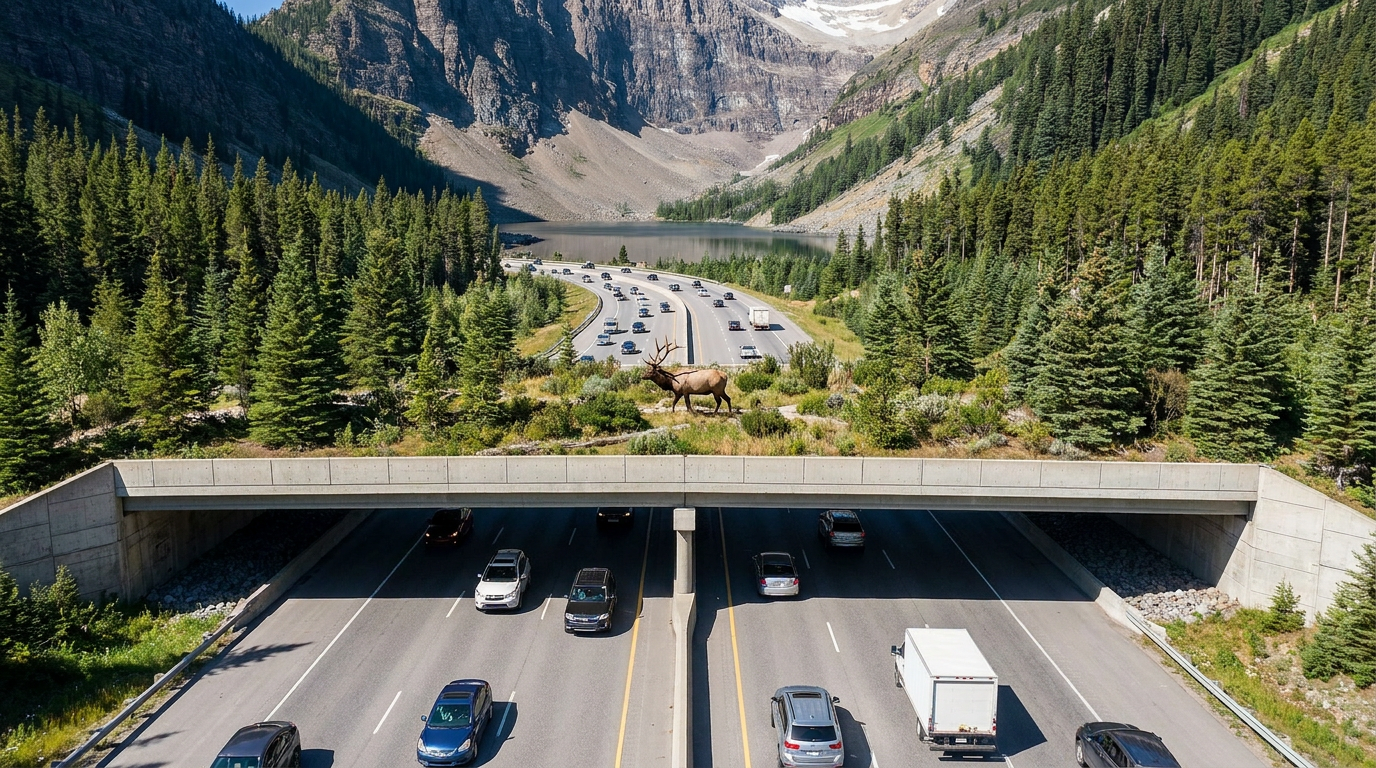
The infrastructure comes in two primary forms: overpasses and underpasses. Overpasses are wide, vegetated bridges covered in soil, native grasses, and trees, favored by prey species like elk and moose that require open sightlines to spot predators. Underpasses, ranging from large concrete arches to smaller culverts, are often preferred by predators like cougars and black bears, as well as amphibians and small mammals seeking cover.[4][6]

The evidence supporting these structures is overwhelming, with the most robust data emerging from Canada's Banff National Park. Since 1996, Banff has constructed over 40 crossing structures along the Trans-Canada Highway. Long-term monitoring reveals that these crossings have reduced wildlife-vehicle collisions by more than 80% overall, and by an astonishing 96% for deer and elk specifically.[6]
This localized success has inspired continental-scale ambitions, most notably the Yellowstone to Yukon (Y2Y) Conservation Initiative. Stretching 2,000 miles from Wyoming to the Canadian Arctic, the Y2Y region is one of the world's most ambitious rewilding projects. As of early 2026, the initiative and its partners have successfully implemented 204 wildlife underpasses and overpasses across the corridor.[1]
This localized success has inspired continental-scale ambitions, most notably the Yellowstone to Yukon (Y2Y) Conservation Initiative.
The impact of the Y2Y corridor is measurable in both lives saved and genetic diversity restored. By linking isolated protected areas, the crossings have allowed grizzly bear populations to intermingle, shrinking the geographic gaps between isolated groups from 150 miles down to less than 45 miles. This genetic mixing is crucial for the long-term resilience of the species against disease and the shifting habitats caused by climate change.[1][4]

The momentum is now spreading far beyond the Rocky Mountains. In Southern California, the Wallis Annenberg Wildlife Crossing—the largest in the world—is nearing completion, spanning ten lanes of traffic over U.S. Route 101 to save a genetically isolated population of mountain lions. Meanwhile, the "Reconnecting the Rockies" project in British Columbia is retrofitting Highway 3 with a continuous 36-kilometer network of fencing, underpasses, and a massive new overpass.[5][6]
In the eastern United States, the Appalachian mountain range serves as the region's largest migration corridor. States like Virginia and North Carolina are increasingly retrofitting existing stream culverts and bridges to serve double-duty as wildlife underpasses, a highly cost-effective strategy that avoids the expense of building new standalone structures.[2]
The primary uncertainty surrounding wildlife crossings has historically been their steep upfront cost. A single vegetated overpass can cost anywhere from $5 million to over $20 million, depending on the terrain and highway width. For cash-strapped transportation departments, justifying this expense for animal welfare alone was often a political non-starter.[5][7]

However, the economic calculus has shifted dramatically. Research consistently demonstrates that because wildlife collisions are so incredibly expensive—costing thousands of dollars per incident in vehicle damage, medical bills, and road closures—crossings in high-traffic corridors typically pay for themselves in less than a decade. The societal cost of doing nothing now demonstrably exceeds the cost of construction.[1][2]
Recognizing this return on investment, federal and state governments are unlocking unprecedented funding. The U.S. Infrastructure Investment and Jobs Act dedicated $350 million specifically for a Wildlife Crossings Pilot Program, distributing grants to states and tribal nations. States like Florida, New Mexico, and Wyoming have also passed dedicated legislation, allocating hundreds of millions of dollars to protect corridors and build crossings.[3]
Challenges remain, particularly in retrofitting older highways where adjacent land has already been heavily developed. Furthermore, while animals adapt to the structures remarkably quickly, it can take several years for a local population to fully trust and utilize a new crossing, requiring patience from monitoring teams.[2][7]
Despite these hurdles, the proliferation of wildlife crossings represents a rare, unifying triumph in modern public policy. By merging the priorities of conservation biologists, fiscal conservatives, and public safety advocates, North America is proving that human infrastructure and wild ecosystems can safely coexist.[7]
How we got here
1996
Banff National Park begins constructing its world-renowned network of wildlife crossings over the Trans-Canada Highway.
2021
The US Infrastructure Investment and Jobs Act allocates $350 million specifically for wildlife crossing grants.
2025
The Yellowstone to Yukon Initiative reports the completion of its 204th wildlife crossing structure.
2026
Construction advances on the Wallis Annenberg Wildlife Crossing in California, the largest of its kind in the world.
Viewpoints in depth
Conservation Biologists' view
Viewing crossings as an essential tool for species survival and genetic health.
For ecologists, the primary value of wildlife crossings extends far beyond preventing roadkill. Highways act as concrete walls that divide animal populations, leading to genetic isolation and inbreeding. By reconnecting these fragmented landscapes, biologists argue that crossings allow species like grizzly bears and mountain lions to share genetic material, making the overall population more resilient to disease and the shifting habitats caused by climate change.
Transportation Officials' view
Focusing on the infrastructure's ability to save human lives and reduce economic waste.
From the perspective of highway planners and safety advocates, wildlife crossings are a highly effective solution to a deadly and expensive public safety crisis. With over a million animal collisions occurring annually in the U.S., transportation officials point to the 80% to 96% reduction in accidents at crossing sites as proof of concept. They argue that the steep upfront construction costs are easily justified by the billions of dollars saved in avoided property damage, medical bills, and emergency response deployments.
Indigenous Leadership's view
Integrating modern infrastructure with traditional ecological knowledge.
Indigenous communities and First Nations have long advocated for the protection of large, interconnected landscapes. For these groups, wildlife crossings are a modern tool to restore the ancient migration routes that their cultures and local ecosystems have relied upon for millennia. Leaders in initiatives like the Yellowstone to Yukon project emphasize that successful conservation must be Indigenous-led, ensuring that infrastructure respects both animal movement and traditional land stewardship.
What we don't know
- How quickly animals will adapt to newly constructed crossings in highly urbanized areas like Los Angeles.
- Whether future federal funding will be sufficient to retrofit the thousands of existing highway hotspots across the continent.
Key terms
- Wildlife Crossing
- A purpose-built bridge or tunnel designed to allow animals to safely navigate across human-made barriers like highways.
- Habitat Fragmentation
- The division of large, continuous natural landscapes into smaller, isolated patches, usually by roads or human development.
- Exclusion Fencing
- Tall, specialized fences built along highways that prevent animals from entering the road and funnel them toward safe crossing structures.
- Genetic Isolation
- When a population of animals is cut off from others of its species, leading to inbreeding and a higher vulnerability to disease.
Frequently asked
Do animals actually know how to use the crossings?
Yes. While it can take a few years for a local population to fully adapt, studies show animals learn quickly, often guided by miles of exclusion fencing that funnel them toward the safe passage.
Why are some crossings bridges and others tunnels?
Different species have different instincts. Prey animals like elk prefer wide, open bridges where they can see predators, while predators like cougars prefer the cover of tunnels.
Are wildlife crossings a waste of taxpayer money?
No. Research shows that in high-collision areas, the crossings pay for themselves in under a decade by eliminating the massive costs associated with vehicle damage and medical emergencies.
Sources
Source coverage
7 outlets
4 viewpoints surfaced







[1]Yellowstone to Yukon Conservation InitiativeIndigenous Leadership
2025 Impact Report: Reconnecting Fragmented Landscapes
Read on Yellowstone to Yukon Conservation Initiative →[2]The Pew Charitable TrustsFiscal Analysts
Wildlife crossings are a smart public investment
Read on The Pew Charitable Trusts →[3]National Conference of State LegislaturesTransportation & Safety Officials
State Action on Wildlife Corridors
Read on National Conference of State Legislatures →[4]Rewilding MagazineConservation Biologists
Yellowstone to Yukon's interconnected corridors are making a massive impact
Read on Rewilding Magazine →[5]Canadian GeographicFiscal Analysts
Reconnecting the Rockies: The most ambitious wildlife crossing system ever attempted in Canada
Read on Canadian Geographic →[6]Conservation CorridorConservation Biologists
Global Wildlife Crossing Examples
Read on Conservation Corridor →[7]Factlen Editorial TeamFiscal Analysts
Synthesis by Factlen editorial team
Read on Factlen Editorial Team →

Every angle. Every day.
Get world stories with full source coverage and perspective breakdowns delivered to your inbox.