
How Multi-Agent AI Systems Work: When AI Models Collaborate to Solve Complex Problems
Single AI agents are giving way to multi-agent systems, where specialized AI models work together like a digital workforce. By dividing tasks, communicating directly, and verifying each other's work, these systems are tackling enterprise workflows too complex for any single model.
By Factlen Editorial Team
- Enterprise Architects
- Prioritizing scalability, structured workflows, and strict governance over open-ended AI experimentation.
- AI Researchers
- Focusing on the underlying reinforcement learning algorithms that teach agents how to collaborate autonomously.
- Open-Source Developers
- Championing accessible, role-based frameworks that allow rapid prototyping of complex AI workflows.
What's not represented
- · Human workers whose daily operational tasks are being automated by these multi-agent workflows.
- · Hardware providers tasked with supplying the immense compute required for multi-agent reinforcement learning.
Why this matters
As AI moves from answering simple questions to executing multi-step business processes, multi-agent architecture is the bridge that makes autonomous systems reliable, scalable, and secure. Understanding this shift is crucial for anyone looking to automate complex workflows or deploy AI in production environments.
Key points
- Multi-agent systems divide complex tasks among specialized AI models, preventing the hallucination and tool-overload common in single agents.
- Frameworks like CrewAI and LangGraph have standardized how these agents delegate work, moving from open-ended chat to structured, graph-based workflows.
- Breakthroughs in Reinforcement Learning with Verifiable Rewards (RLVR) are teaching agents to self-correct and collaborate without human feedback.
- Enterprises are adopting zero-trust security models and the new A2A protocol to safely manage the expanded attack surface of multi-agent networks.
For the past few years, the AI industry has been obsessed with the "everything model"—a single, monolithic agent expected to write code, analyze financial data, and draft legal emails all at once. But a single AI agent operates against one context window, one tool set, and one instruction set at a time. When tasked with a complex, multi-step enterprise workflow, a lone agent quickly becomes overwhelmed, hallucinating or losing track of its original goal as the cognitive load exceeds its architectural limits.[5]
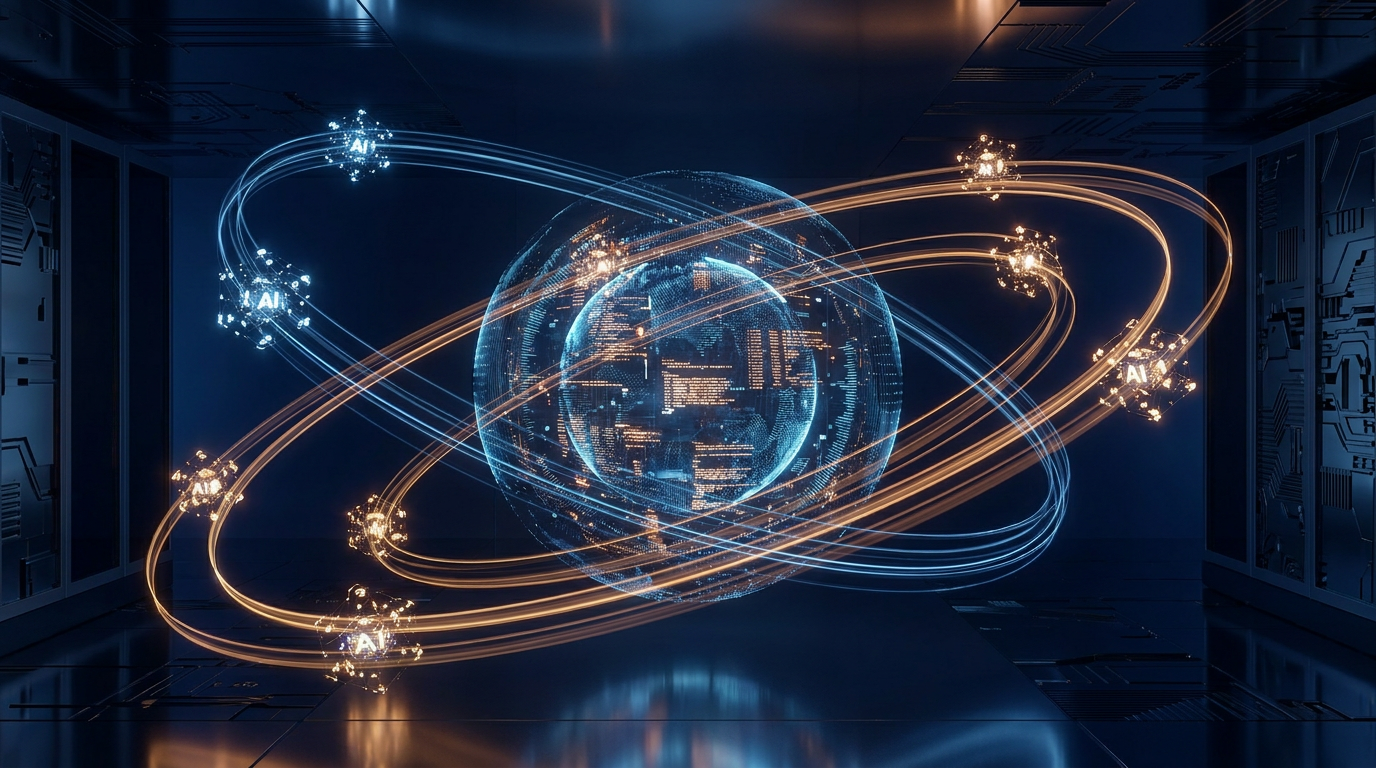
The solution, which has rapidly become the enterprise standard in 2026, is the Multi-Agent System (MAS). Instead of relying on one generalist model, a multi-agent system deploys a network of autonomous, specialized AI agents. Each agent is assigned a narrow role, a specific set of tools, and explicitly constrained permissions. They work together to complete tasks that no single agent could handle efficiently or reliably on its own, fundamentally changing how AI is deployed in production.[5]
Think of a multi-agent system like a corporate department. You wouldn't expect one person to handle legal review, financial modeling, and customer outreach simultaneously. In a multi-agent software environment, a user request is intercepted by a "Planner" agent, which breaks the overarching goal into sub-tasks. It then delegates these tasks to specialist workers—perhaps a "Researcher" agent equipped with web-browsing tools, a "Coder" agent operating in a secure execution sandbox, and a "Reviewer" agent that checks the final output against the original prompt.[4][5]

The defining characteristic of a multi-agent system is its topology—how the agents are wired together to communicate and pass data. This architecture dictates how decisions are distributed and how the system organizes itself to complete tasks. By 2026, the distinction between an individual "agent" and an "agentic workflow" has settled; the agent is simply the unit of work, while the multi-agent system is the runtime environment that governs their collaboration, handoffs, and error recovery.[1][3][4]
Developers rely on specialized frameworks to build these topologies, and CrewAI has emerged as a dominant choice for role-based orchestration. It leans heavily into the workplace metaphor, allowing developers to define each agent with a specific name, role, goal, backstory, and toolset. CrewAI orchestrates how tasks pass from one agent to the next, emphasizing structured delegation and explicit hand-offs, making it highly intuitive for mapping existing business workflows into software.[7][9]
For more complex, conditional workflows, LangGraph has become the go-to open-source framework. It uses a graph-based architecture where workflows are represented as nodes and edges. This allows engineering teams to define exactly how an agent should move through a process, maintain state, loop back for corrections, and involve human overseers at specific checkpoints. Its transparency and predictability make it ideal for strict production environments where debugging and workflow control are paramount.[3][9]
Earlier frameworks like Microsoft's AutoGen popularized the conversational model, where agents interact via open-ended chat to negotiate task execution. While highly flexible and capable of dynamic adaptation based on the conversation flow, this approach can introduce unpredictability when multiple agents begin debating a solution. As a result, many enterprise deployments have shifted toward the structured graphs of LangGraph or the role-based delegation of CrewAI, though conversational models remain popular for research and code-execution sandboxes.[6][8][9]

Earlier frameworks like Microsoft's AutoGen popularized the conversational model, where agents interact via open-ended chat to negotiate task execution.
As these systems scale, the way agents talk to each other has required standardization. In early 2026, the Agent-to-Agent (A2A) protocol reached version 1.0. Backed by major tech consortiums, A2A allows agents to bypass traditional tool-calling and communicate directly. They publish structured "Agent Cards" that describe their capabilities, authentication requirements, and task lifecycle states, enabling seamless, secure handoffs across different platforms and vendor ecosystems without human intervention.[5]
The intelligence driving these collaborative systems has also evolved, heavily influenced by breakthroughs in Reinforcement Learning (RL). In 2025, models like DeepSeek-R1 proved that Reinforcement Learning with Verifiable Rewards (RLVR) could dramatically improve reasoning. Instead of relying on subjective human preference data, RLVR uses rule-based verification—like a compiler checking code or a math engine verifying an equation—to provide a binary correct or incorrect signal, forcing the model to develop its own chain-of-thought logic.[10]
This verifiable reward structure has been adapted specifically for multi-agent collaboration. Algorithms like Multi-Agent Group Relative Policy Optimization (MAGRPO) treat LLM collaboration as a cooperative reinforcement learning problem. By fine-tuning models specifically for coordination, these algorithms teach agents how to effectively divide labor, share context, and generate high-quality responses through teamwork, rather than just optimizing their individual performance in a vacuum.[11]
Because multi-agent systems are dynamic and capable of self-correction, they cannot be safely debugged in live production environments. Enterprises have shifted to using simulated RL environments as a staging layer. These sandboxes are compressed versions of reality, complete with historical tickets, mock APIs, and synthetic customer journeys. Agents are free to act, fail, and improve, with every action logged and scored before they ever touch live customer data or revenue streams.[12]

The practical benefits of this architecture are already visible across industries. In urban infrastructure, multi-agent systems are being deployed for traffic management, where decentralized agents coordinate signals based on local views, improving urban traffic flow by up to 25%. In software development, multi-agent pipelines are automating complex coding, testing, and deployment cycles, while in finance, they handle deterministic compliance audits that require data from dozens of siloed systems simultaneously.[2][8]
However, the shift to multi-agent architecture introduces significant security challenges. A multi-agent system has a vastly larger attack surface than a single model; every tool, handoff, and memory write is a potential vulnerability. The standard security policy in 2026 requires zero-trust between agents, meaning every handoff must be cryptographically signed and audited, ensuring that a compromised agent cannot escalate its privileges across the network.[1]
Furthermore, allowing autonomous agents to accumulate persistent, high-privilege access across sessions is a major enterprise risk. Organizations that fail to maintain a live, centralized catalog of every active agent—tracking its owner, purpose, data access level, and risk category—often find themselves dealing with "shadow AI" deployments. These ungoverned agent networks operate outside of IT oversight, making them difficult to audit and easy to exploit.[5]
Despite the governance hurdles, multi-agent systems represent the most practical way to scale AI across complex, distributed environments. By combining specialized models that collaborate, adapt, and reason together, MAS architecture offers a level of flexibility and resilience that monolithic models simply cannot match. As these systems continue to mature, they are transforming AI from a tool that answers questions into a digital workforce capable of executing entire business operations.[3][13]
How we got here
Late 2023
Microsoft releases AutoGen, popularizing the concept of conversational multi-agent systems.
2024
Role-based frameworks like CrewAI and graph-based orchestrators like LangGraph emerge to provide more structured workflows.
Jan 2025
DeepSeek-R1 proves the efficacy of Reinforcement Learning with Verifiable Rewards (RLVR) for advanced reasoning.
Late 2025
Researchers publish breakthroughs in Multi-Agent Group Relative Policy Optimization (MAGRPO), teaching agents to collaborate natively.
Early 2026
The Agent-to-Agent (A2A) protocol reaches version 1.0, standardizing secure communication between enterprise AI agents.
Viewpoints in depth
Enterprise Architects
Prioritizing scalability, structured workflows, and strict governance over open-ended AI experimentation.
For enterprise IT leaders, the appeal of multi-agent systems lies in control. They favor frameworks like LangGraph that offer deterministic, graph-based routing, ensuring that AI agents follow strict business logic. This camp views the Agent-to-Agent (A2A) protocol and zero-trust security models as mandatory prerequisites for production, arguing that without strict audit logs and explicit hand-offs, multi-agent systems risk becoming unmanageable 'shadow AI'.
AI Researchers
Focusing on the underlying reinforcement learning algorithms that teach agents how to collaborate autonomously.
The research community is less concerned with enterprise routing and more focused on how agents learn to work together. By applying Multi-Agent Group Relative Policy Optimization (MAGRPO) and verifiable rewards, researchers are proving that models can develop emergent collaborative behaviors. They argue that the true breakthrough of 2026 isn't just wiring agents together, but training them in simulated environments where they can self-correct and optimize their joint output without human intervention.
Open-Source Developers
Championing accessible, role-based frameworks that allow rapid prototyping of complex AI workflows.
For the open-source community and startup ecosystem, frameworks like CrewAI represent the democratization of advanced AI. This camp values intuitive, workplace-inspired metaphors where developers can simply assign a 'role' and a 'backstory' to an agent and let the framework handle the orchestration. They view multi-agent systems as a way for small teams to punch above their weight, deploying digital workforces that can iterate on code, generate content, and solve problems at unprecedented speeds.
What we don't know
- How quickly legacy enterprise software vendors will natively adopt the Agent-to-Agent (A2A) protocol for seamless integration.
- The long-term infrastructure costs of running continuous multi-agent reinforcement learning environments at scale.
- Whether conversational agent architectures will see a resurgence as underlying models become better at zero-shot orchestration.
Key terms
- Multi-Agent System (MAS)
- A network of autonomous, specialized AI agents that collaborate, delegate, or compete to complete complex workflows.
- Agent-to-Agent Protocol (A2A)
- A standardized communication protocol that allows AI agents to securely exchange data and task instructions directly.
- LangGraph
- An open-source framework that uses a graph-based architecture to orchestrate highly structured, conditional AI workflows.
- CrewAI
- A popular role-based framework that organizes AI agents into a 'crew,' assigning each a specific job title, backstory, and set of tools.
- Reinforcement Learning with Verifiable Rewards (RLVR)
- A training technique where AI models improve their reasoning by receiving objective pass/fail feedback directly from an environment.
Frequently asked
What is the difference between a single agent and a multi-agent system?
A single agent relies on one AI model to handle all tasks sequentially. A multi-agent system divides the work among specialized agents that operate in parallel, each with its own specific tools and permissions.
How do AI agents communicate with each other?
Agents use standardized frameworks or protocols like the Agent-to-Agent (A2A) protocol to pass structured data, code, and task statuses directly to one another, bypassing traditional human-in-the-loop chat interfaces.
Are multi-agent systems safe for enterprise use?
Yes, provided they are deployed with strict governance. Modern setups use zero-trust architectures, where every agent handoff is cryptographically signed and logged to prevent unauthorized actions and 'shadow AI' sprawl.
What is Reinforcement Learning with Verifiable Rewards (RLVR)?
It is a training method where AI agents learn by receiving binary correct/incorrect signals from an environment (like a code compiler) rather than relying on subjective human feedback, dramatically improving their reasoning skills.
Sources
Source coverage
13 outlets
3 viewpoints surfaced












[1]FutureAGIEnterprise Architects
Multi-Agent AI Systems in 2026: Frameworks, Patterns, and Production Observability
Read on FutureAGI →[2]Kanerika
Understand multi agent AI systems key features, architecture types
Read on Kanerika →[3]CognizantEnterprise Architects
What is a multi-agent system in simple terms?
Read on Cognizant →[4]Tech Jack Solutions
Multi-Agent Systems — in 5 minutes
Read on Tech Jack Solutions →[5]CogitxEnterprise Architects
What a Multi-Agent System Is and How It Works
Read on Cogitx →[6]AutoGen DocumentationOpen-Source Developers
AutoGen offers a unified multi-agent conversation framework
Read on AutoGen Documentation →[7]MediumOpen-Source Developers
CrewAI vs AutoGen: The Multi-Agent AI Ecosystem
Read on Medium →[8]Seller ShortsOpen-Source Developers
AutoGen and CrewAI: The practical comparison for 2026
Read on Seller Shorts →[9]DataCampOpen-Source Developers
Overview of CrewAI, LangGraph, and AutoGen
Read on DataCamp →[10]Daily Dose of Data ScienceAI Researchers
DeepSeek R1 breakthrough using verifiable rewards
Read on Daily Dose of Data Science →[11]NeurIPSAI Researchers
Improved Multi-Agent Collaboration with Multi-Turn Reinforcement Learning
Read on NeurIPS →[12]Invisible TechAI Researchers
RL environments become the new enterprise testbed
Read on Invisible Tech →[13]Factlen Editorial Team
Synthesis by Factlen editorial team
Read on Factlen Editorial Team →

More in ai
See all 7 stories →Edge AI
How On-Device AI and Quantization Are Moving LLMs Out of the Cloud
6 sources

Agentic AI
Agentic AI: How Large Action Models Are Automating Digital Chores
7 sources
Global AI Governance
EU Delays Key AI Act Enforcement as 'Brussels Effect' Fractures Under US Deregulation
8 sources
Drug Discovery
New AI Model Accelerates Molecular Simulations 10,000-Fold, Promising Faster Drug Discovery
6 sources
Every angle. Every day.
Get ai stories with full source coverage and perspective breakdowns delivered to your inbox.