
How Millions of Abandoned Oil Wells Could Become Clean Geothermal Energy Hubs
Advances in retrofitting technology are allowing energy companies to transform depleted oil and gas wells into zero-emission geothermal power sources. By sidestepping massive drilling costs, the approach offers a viable path to scale baseload clean energy while repurposing fossil fuel infrastructure.
By Factlen Editorial Team
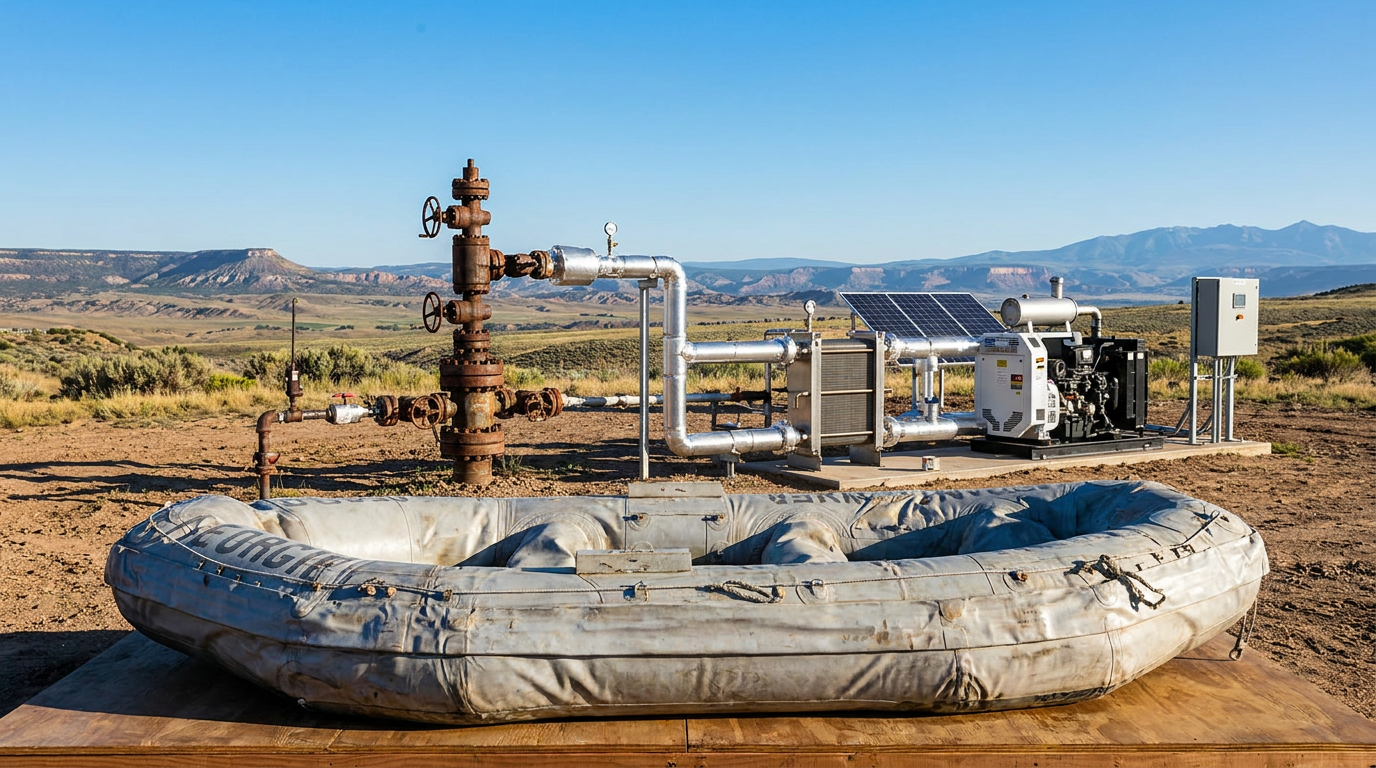
- Geothermal Innovators
- View abandoned wells as a massive, immediate unlock for scaling baseload clean energy.
- Oil & Gas Operators
- See retrofitting as a strategy to turn plugging liabilities into revenue-generating assets.
- Environmental Regulators
- Cautious that repurposing could be used to delay necessary environmental cleanups.
What's not represented
- · Surface Landowners
- · Local Municipalities
Why this matters
Drilling accounts for up to half the cost of a new geothermal plant, historically bottlenecking the industry. Repurposing the millions of existing oil and gas wells globally bypasses this financial hurdle, turning environmental liabilities into a 24/7 clean energy source and providing a direct transition path for fossil-fuel workers.
Key points
- Millions of abandoned oil and gas wells present a massive environmental liability due to methane leaks and deteriorating cement.
- Startups are retrofitting these wells into closed-loop geothermal heat exchangers, bypassing the massive drilling costs that typically hinder geothermal projects.
- Co-production technology allows active wells to skim heat from the 98% wastewater they produce, generating zero-emission electricity.
- The U.S. Department of Energy is actively funding pilot projects to prove the commercial viability of hydrocarbon well retrofits.
- Legal ambiguities regarding who owns the subsurface heat—surface landowners or mineral rights holders—remain a significant hurdle to scaling.
Across the United States, millions of idle and abandoned oil and gas wells dot the landscape, remnants of a century of aggressive fossil fuel extraction. Historically, these deep steel straws have been viewed as a massive environmental liability. When a well runs dry, it is prone to leaking methane—a potent greenhouse gas—and requires expensive, labor-intensive decommissioning procedures. The ordinary cement used to seal these legacy wells deteriorates over time, posing serious health and environmental hazards to surrounding communities and water tables. For decades, the only solution has been to spend millions plugging the holes and walking away.[2]
But a paradigm shift is underway in the energy sector. Instead of viewing these abandoned sites purely as liabilities, engineers and energy startups are looking down these 10,000-foot shafts and seeing a massive, untapped thermal battery. Advances in retrofitting technology are allowing energy companies to transform depleted fossil fuel infrastructure into zero-emission geothermal power sources. By repurposing the existing architecture, the industry is finding a way to generate clean electricity while simultaneously mitigating the environmental hazards of uncapped wells.[3]
Geothermal energy has long been considered the holy grail of renewable power generation. Unlike wind or solar power, which are intrinsically intermittent and require massive battery storage infrastructure to maintain grid stability, geothermal provides baseload, 24/7 power. It achieves this by continuously harnessing the constant, immense heat radiating from the Earth's crust. However, despite its obvious environmental and reliability advantages, the geothermal industry has historically been bottlenecked by the sheer financial cost and geological risk associated with drilling deep enough to reach that subterranean heat.[4]
Drilling deep enough to access commercial-grade geothermal temperatures is a prohibitively expensive endeavor. In a standard project, the drilling phase alone often accounts for 30% to 50% of the total capital expenditure for a new power plant. This massive upfront financial hurdle has kept geothermal energy relegated to a niche role, primarily viable only in highly active volcanic regions. By utilizing an existing oil or gas well that has already been drilled, that massive capital cost drops to zero, fundamentally altering the economics of the project and opening up new geographic regions to geothermal development.[6]

The transformation of these wells generally takes one of two primary forms, depending on the state of the reservoir. The first method is known as co-production. Many active or late-stage oil wells actually produce very little usable petroleum; they might pump 98% boiling water and just 2% crude oil to the surface. Co-production technology actively skims the thermal energy off that massive volume of wastewater to generate electricity, before safely injecting the cooled fluid back underground to maintain reservoir pressure.[1][3]
The second method involves closed-loop retrofits, often referred to in the industry as Borehole Heat Exchangers, which are deployed in wells that are completely dry or abandoned. In this system, engineers insert a sealed, highly conductive pipe down the existing well casing. A working fluid circulates down the inner pipe, absorbs the ambient geological heat from the surrounding rock, and returns to the surface to power a thermoelectric generator. Because it is a closed loop, the system extracts pure heat without ever touching the underground water or releasing subsurface gases.[2]
The specific applications for this extracted energy scale directly with the depth and temperature of the repurposed well. While some ultra-deep wells reach temperatures high enough to spin traditional electrical turbines, shallower wells producing water between 40°C and 73°C are perfectly suited for what the industry calls 'direct use'. This lower-grade heat is highly valuable for providing district heating for residential neighborhoods, warming large-scale agricultural greenhouses, or maintaining optimal temperatures for commercial aquaculture facilities, drastically reducing the local reliance on natural gas.[2]
The specific applications for this extracted energy scale directly with the depth and temperature of the repurposed well.
Real-world deployment of this technology is already proving the model's commercial viability outside of the laboratory. Startups like Gradient Geothermal are actively demonstrating the technology's potential to revitalize rural energy grids. In Pierce, Colorado, the company is utilizing oil wells that sat completely abandoned for six years to power the local community with zero-emission electricity. Their ongoing operations across Colorado and North Dakota are proving that co-production and well retrofitting can generate entirely new, sustainable revenue streams while simultaneously reducing regional carbon emissions and providing energy independence to small towns.[3]

The federal government has aggressively accelerated this infrastructure shift through targeted funding and research support. The U.S. Department of Energy's Wells of Opportunity (WOO) initiative has been instrumental in this push, funding multiple pilot projects across Texas, California, and Nevada. These federal grants are specifically designed to establish the commercial viability of geothermal extraction from existing hydrocarbon fields, providing the necessary capital for companies to test novel thermoelectric generation cells and advanced heat engines in real-world environments.[1]
The concept of repurposing fossil fuel infrastructure is also moving beyond onshore fields and into the open ocean. The Gulf Offshore Research Institute recently secured a landmark $20 million grant to convert aging Gulf of Mexico oil platforms into multi-use clean-energy hubs. Instead of dismantling the massive steel structures, the initiative aims to integrate geothermal heat extraction alongside green hydrogen production and offshore aquaculture, proving that even the most complex offshore drilling assets can find a second life in the green economy.[5]
This infrastructure pivot is closely tied to the broader rise of Enhanced Geothermal Systems (EGS), which is currently revolutionizing the sector. Companies like Fervo Energy are taking the horizontal drilling and hydraulic fracturing techniques perfected during the shale oil boom and applying them to hot, dry rock to create artificial geothermal reservoirs. While EGS involves drilling new wells, the technological crossover proves that the hardware, techniques, and engineering principles of the oil and gas industry are the exact tools needed to unlock next-generation geothermal power.[4]
Crucially, this transition is as much about labor as it is about physical infrastructure. The skills required to operate a modern geothermal well—advanced reservoir engineering, complex fluid dynamics, and heavy rig operation—are nearly identical to those utilized daily in the oil and gas industry. This overlap offers a direct, highly paid transition path for the existing fossil fuel workforce. By repurposing wells, the industry can retain its specialized blue-collar and PhD-level talent, redirecting their expertise toward building a sustainable baseload energy grid.[5]

Despite the immense promise of this technological pivot, significant engineering challenges remain before it can be scaled globally. Decades-old wells were originally designed to extract hydrocarbons, not to operate as permanent, high-efficiency heat exchangers. The ordinary cement used in legacy well casings naturally degrades over time. Furthermore, the intense thermal stress of continuous heating and cooling cycles can exacerbate structural failures in the steel casing, requiring expensive remediation before a well can be safely certified for long-term geothermal use.[2]
Beyond the engineering hurdles, the legal landscape surrounding geothermal retrofits remains a complex gray area. In many jurisdictions, subsurface mineral rights—the ownership of the oil and gas—are legally severed from the surface land rights. If a company retrofits a well to extract ambient heat rather than physical hydrocarbons, regulatory frameworks are currently struggling to determine who legally owns that geothermal energy. Resolving whether the surface owner or the mineral estate holder deserves the royalties is a critical bottleneck for widespread commercialization.[5]
Environmental watchdogs and state regulators are cautiously optimistic about the technology but warn of potential legal loopholes. They emphasize that 'evaluating a well for geothermal potential' must not become a convenient legal excuse for oil and gas operators to indefinitely postpone their obligations to permanently seal leaking, end-of-life wells. Regulators are working to draft strict oversight rules to ensure that only viable wells are kept open, preventing the repurposing narrative from being used to delay necessary environmental cleanups.[6]
Even with these regulatory and technical hurdles, the sheer scale of the opportunity is undeniable. Experts estimate that of the 2 to 3 million disused oil wells scattered across the United States, over 500,000 possess the necessary depth and thermal profile to be suitable for geothermal conversion. If fully utilized, these abandoned assets represent up to 13 gigawatts of untapped, zero-emission clean energy capacity. Through innovative engineering, the fossil fuel infrastructure of the 20th century may very well become the clean energy engine of the 21st.[3][6]
How we got here
2021
The US Department of Energy updates its Wells of Opportunity (WOO) initiative to fund hydrocarbon well retrofits.
2023
Fervo Energy successfully demonstrates commercial-scale Enhanced Geothermal Systems (EGS) using oil and gas drilling techniques.
2025
Gradient Geothermal successfully repurposes abandoned wells in Pierce, Colorado, to provide zero-emission electricity.
Early 2026
The Gulf Offshore Research Institute receives a $20 million grant to convert aging Gulf of Mexico platforms into geothermal hubs.
Viewpoints in depth
Geothermal Innovators & Startups
View abandoned wells as a massive, immediate unlock for scaling baseload clean energy.
Companies like Gradient Geothermal and researchers backed by the DOE argue that bypassing the drilling phase fundamentally changes the economics of geothermal power. By utilizing existing infrastructure, they believe geothermal can move from a niche energy source limited to volcanic regions into a ubiquitous, nationwide baseload power provider.
Oil & Gas Operators
See retrofitting as a strategy to turn plugging liabilities into revenue-generating assets.
For fossil fuel companies, end-of-life wells represent a massive financial liability, with plugging and abandonment costs running into the millions per site. Repurposing these assets for geothermal energy or direct-use heating allows operators to keep the leases active, generate new revenue streams, and provide a seamless transition for their highly skilled drilling and reservoir engineering workforce.
Regulatory & Environmental Watchdogs
Cautious that repurposing could be used to delay necessary environmental cleanups.
While supportive of clean energy, environmental groups and state regulators warn that decades-old well casings may lack the structural integrity to safely handle continuous thermal cycling. They emphasize the need for strict oversight to ensure that 'evaluating for geothermal' doesn't become a legal loophole for operators to indefinitely postpone their obligations to permanently seal leaking, methane-emitting wells.
What we don't know
- How quickly state legislatures will resolve the legal ambiguity between mineral rights and surface heat rights.
- The long-term structural integrity of 50-year-old cement casings subjected to continuous thermal cycling.
Key terms
- Borehole Heat Exchanger (BHE)
- A closed-loop system inserted into a well that circulates fluid to absorb the Earth's heat without extracting any underground water or gases.
- Co-production
- The process of capturing the heat from the massive volumes of hot wastewater naturally brought to the surface during active oil and gas extraction.
- Enhanced Geothermal Systems (EGS)
- A technology that uses hydraulic fracturing techniques to create artificial permeability in hot, dry rock, allowing water to circulate and absorb heat.
- Baseload Power
- The minimum amount of electric power needed to be supplied to the electrical grid at any given time, a role geothermal is uniquely suited to fill 24/7.
Frequently asked
Can any abandoned oil well be used for geothermal energy?
No. Wells must have intact cement casings, reach sufficient depths to access high temperatures, and be located near infrastructure that can utilize the heat or electricity.
Does this process involve fracking?
Retrofitting existing wells with closed-loop heat exchangers does not require fracking. However, Enhanced Geothermal Systems (EGS) do use hydraulic fracturing to crack deep, hot rocks.
Who owns the heat extracted from an oil well?
This remains a legal gray area. In many jurisdictions, it is currently unclear whether the surface landowner or the subsurface mineral rights owner holds the legal right to the geothermal heat.
Sources
Source coverage
6 outlets
3 viewpoints surfaced






[1]U.S. Department of EnergyEnvironmental Regulators
Wells of Opportunity (WOO) Initiative
Read on U.S. Department of Energy →[2]Renewable Energy JournalEnvironmental Regulators
Reuse of abandoned oil and gas wells for geothermal energy production
Read on Renewable Energy Journal →[3]Climate Adaptation PlatformGeothermal Innovators
A US start-up is giving disused wells a second life by transforming them into geothermal energy sources
Read on Climate Adaptation Platform →[4]Information Technology and Innovation FoundationGeothermal Innovators
Advanced Geothermal Energy: EGS and the Future of Baseload Power
Read on Information Technology and Innovation Foundation →[5]Geothermal Unleashed PodcastOil & Gas Operators
Geothermal Unleashed: Repurposing Offshore Infrastructure
Read on Geothermal Unleashed Podcast →[6]Factlen Editorial TeamGeothermal Innovators
Synthesis by Factlen editorial team
Read on Factlen Editorial Team →
Every angle. Every day.
Get energy stories with full source coverage and perspective breakdowns delivered to your inbox.