
How 'Libraries of Things' Are Transforming Neighborhoods and the Sharing Economy
Community-run lending hubs are allowing residents to borrow tools and equipment instead of buying them, saving money and reducing waste.
By Factlen Editorial Team
- Sharing Economy Advocates
- Argue that pooling resources builds community resilience and combats the isolation of hyper-consumerism.
- Sustainability Researchers
- Emphasize the measurable environmental benefits of reducing manufacturing and raw material extraction.
- Pragmatic Organizers
- Focus on the operational realities of maintenance, funding, and the need for institutional support.
What's not represented
- · Hardware manufacturers and retailers whose sales models rely on individual ownership.
- · Traditional public librarians navigating the shift toward lending non-traditional, high-maintenance items.
Why this matters
By shifting from individual ownership to community sharing, neighborhoods are lowering the financial barriers to home maintenance while drastically reducing their environmental footprint.
Key points
- Libraries of Things (LoTs) lend physical objects like tools and appliances, operating similarly to traditional book libraries.
- The model provides significant economic relief, saving members hundreds of dollars on equipment they rarely use.
- By maximizing the use of existing items, LoTs reduce the need for new manufacturing and lower carbon emissions.
- Beyond lending, these spaces serve as community hubs that foster peer-to-peer skill sharing and social connection.
- Maintaining heavily used equipment and securing physical space remain the primary operational challenges for organizers.
The average power drill is used for roughly 13 minutes over its entire lifetime. Yet, in millions of households across the globe, these tools sit idle in garages and closets, gathering dust alongside camping tents, specialized baking pans, and pressure washers. This hyper-consumerist model—where every individual household must purchase, store, and maintain its own set of rarely used equipment—has long been the default. But a growing grassroots movement is challenging the logic of individual ownership, arguing that communities can thrive by sharing resources rather than hoarding them.[1][8]
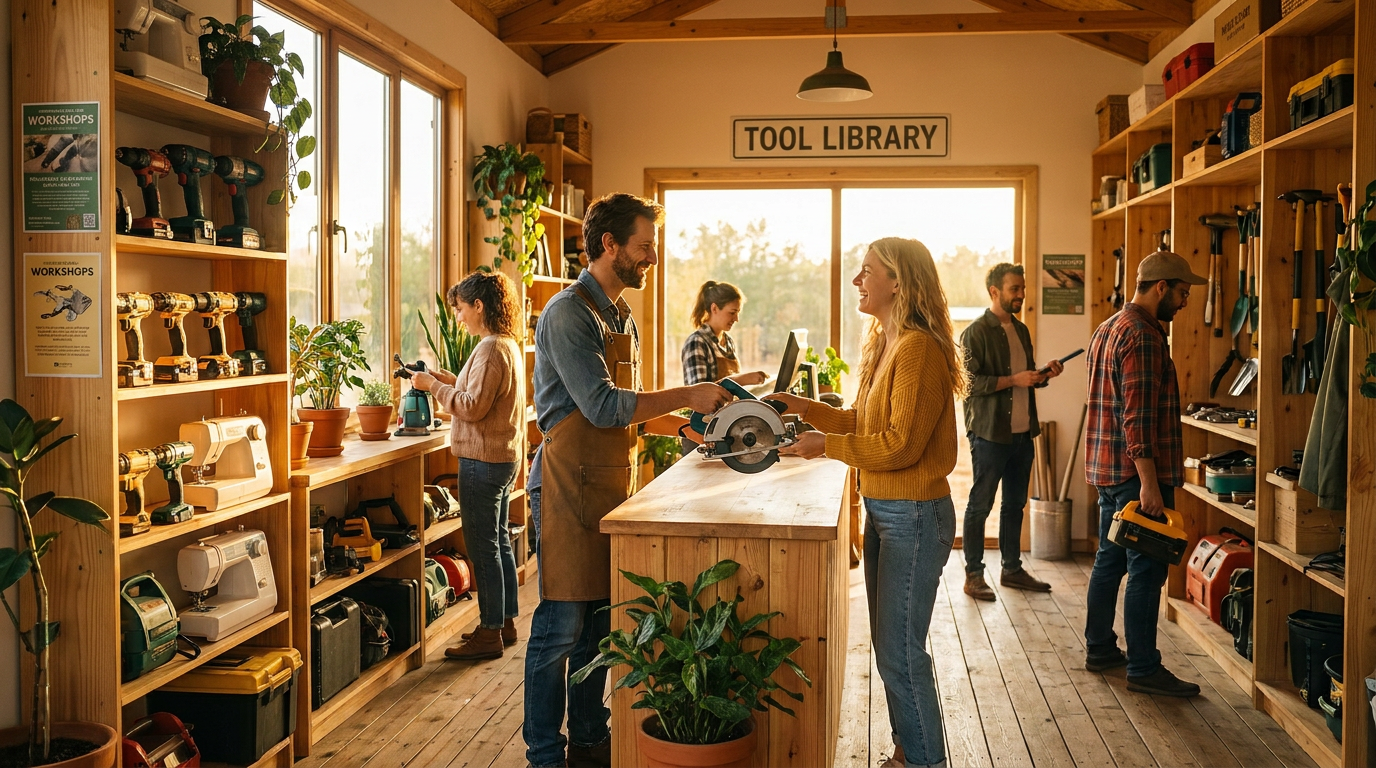
Enter the "Library of Things" (LoT). Operating on the exact same mechanics as a traditional public book library, these community hubs lend out physical objects rather than literature. From sewing machines and miter saws to disco balls and cider presses, LoTs are transforming how neighborhoods access the tools they need to maintain their homes, pursue hobbies, and host events. The premise is remarkably simple: instead of a hundred neighbors buying a hundred drills, the neighborhood collectively owns a few high-quality drills that circulate as needed.[1][4]
The concept itself is not entirely novel. Toy libraries emerged in the United States during the Great Depression to support struggling families, and the Berkeley Public Library launched a highly successful tool lending program in 1979. However, the modern iteration of the Library of Things has exploded in recent years, driven by a convergence of economic pressures, environmental awareness, and a post-pandemic desire for local community connection. Today, there are an estimated 2,000 formally established LoTs worldwide, operating alongside countless informal neighborhood sharing networks.[2][8]
The operational mechanism of a Library of Things is straightforward but requires meticulous community coordination. A local organization—often a nonprofit, a neighborhood block club, or an existing public library—secures a physical space. Community members donate gently used items, or the organization uses grant funding to purchase high-demand, durable equipment. Once the inventory is assembled, volunteers or staff catalog the items, test them for safety, and prepare them for public circulation.[2][7]

Once cataloged, these items become available for borrowing. Members typically pay a sliding-scale or "pay-what-you-can" annual fee, which grants them access to the entire inventory without any per-item rental charges. A user might check out a tile saw for a weekend bathroom renovation, return it on Tuesday, and check out a food dehydrator the following week. This system completely bypasses the traditional rental market, which often charges exorbitant daily rates that price out low-income residents.[4][5]
The most immediate and tangible benefit of the LoT model is economic relief. High-quality tools and specialized equipment are prohibitively expensive for many families. By removing the financial barrier to access, tool libraries democratize home repair, gardening, and creative pursuits. Renters who previously could not afford the equipment to fix a broken fixture or build a garden box are suddenly empowered to take control of their living spaces.[4][5]
The cost savings generated by these hubs are substantial. In Portland, Oregon, members of the North Portland Tool Library reported that access to shared equipment saved them an estimated $447,000 collectively—averaging out to roughly $60 saved per individual tool loan. For a household living paycheck to paycheck, this access can mean the difference between living with a deteriorating home environment and being able to maintain it independently and affordably.[5]
Beyond individual wallets, the model serves as a powerful engine for the circular economy. The traditional linear economy relies on a relentless cycle of extraction, manufacturing, consumption, and disposal. The European Union estimates that half of all global greenhouse gas emissions and over 90% of biodiversity loss stem directly from resource extraction and processing. Every new item manufactured carries a hidden ecological cost that is rarely factored into its retail price.[1]
Beyond individual wallets, the model serves as a powerful engine for the circular economy.
By maximizing the utility of a single manufactured object, LoTs drastically reduce the need for new production. The UK-based Library of Things organization calculates that 50% of their borrows directly prevent a new retail purchase. According to their internal impact metrics, avoiding the manufacture of a single average item in their catalog prevents the release of 14 kilograms of carbon dioxide equivalent (CO2e). Scaled across thousands of borrows, a single library can offset tons of emissions annually.[6]

But organizers are quick to point out that the environmental and economic metrics only tell half the story. The true power of a Library of Things lies in its capacity to weave social fabric. In an era marked by increasing social isolation and digital fragmentation, these physical spaces become vital community hubs where neighbors interact, collaborate, and share expertise in the real world.[2][8]
"I'm the least likely candidate to run a tool library," noted one organizer in Evanston, Illinois, who started a lending hub in his garage with a neighborhood block grant. "But that's what you find. You find neighbors who do know the tools and can teach you." This peer-to-peer skill sharing transforms a simple transaction into a relationship-building exercise, breaking down barriers between residents of different ages and backgrounds.[7]
Many LoTs have evolved beyond mere lending desks to host repair cafes, DIY workshops, and community gardens. When a borrower comes in to check out a sewing machine, they might also receive a 10-minute tutorial from a volunteer on how to thread the bobbin. This culture of mutual support fosters a sense of collective resilience that cannot be purchased at a big-box hardware store, proving that communities are stronger when they rely on one another.[2][7]
Despite the overwhelming benefits, running a Library of Things is not without significant operational hurdles. The most pressing challenge is maintenance. Unlike books, which simply sit on a shelf and require minimal upkeep, power tools and mechanical equipment endure heavy wear and tear. Ensuring that a returned item is clean, safe, and fully functional requires manual intervention and technical expertise from dedicated volunteers.[3][5]
A 2023 study published by the Association for Computing Machinery (ACM) highlighted the unique human-computer interaction challenges of managing "tangible collections." Because the items are non-uniform in shape, size, and function, cataloging them requires specialized software that traditional libraries do not use. Tracking the maintenance history, warranty status, and safety instructions for a diverse inventory of physical objects is a complex logistical puzzle.[3]

To mitigate these maintenance burdens, some libraries have had to adapt their inventories through trial and error. The Safety Harbor Public Library in Florida, for instance, eventually phased out battery-operated tools entirely, finding that the batteries degraded too quickly under communal use and were too expensive to replace. They now prioritize durable, corded equipment and maintain strict warranty records to ensure the longevity of their collection.[5]
Space is another critical constraint. As inventories grow from a few dozen hand tools to thousands of items—including bulky equipment like rototillers, extension ladders, and carpet cleaners—securing affordable, accessible real estate becomes a bottleneck. Some organizations have turned to mobile libraries, retrofitted shipping containers, or automated self-serve kiosks to expand their footprint without taking on massive commercial leases.[2][8]
Looking ahead, the Library of Things movement is poised for institutional integration. While many LoTs operate as scrappy, independent nonprofits reliant on volunteer labor, there is a growing push to incorporate tangible lending into the core mandate of municipal public library systems. Advocates argue that sustainable funding and professional staffing are necessary for the model to reach its full potential and serve broader populations.[4][8]
As communities increasingly recognize that access to physical resources is just as crucial as access to information, the definition of public infrastructure is expanding. By shifting the cultural default from "buy and store" to "borrow and share," the Library of Things is quietly building a more sustainable, equitable, and connected future. It is a powerful reminder that we already have everything we need, as long as we are willing to share it.[1][8]
How we got here
1943
The first recorded tool library opens in Grosse Pointe Farms, Michigan, to offer training to young people.
1979
The Berkeley Public Library launches its Tool Lending Library, becoming one of the longest-running modern programs.
2010s
The sharing economy boom accelerates the creation of independent, volunteer-run Libraries of Things globally.
2024
Impact data reveals that established lending hubs are preventing thousands of kilograms of CO2 emissions annually.
Viewpoints in depth
Sharing Economy Advocates
Focus on community resilience and anti-consumerism.
Advocates for the sharing economy view the Library of Things as a fundamental disruption to hyper-consumerism. They argue that the current economic model, which demands endless growth through the constant purchasing of new goods, is inherently unsustainable and isolates individuals. By pooling resources, they believe neighborhoods can build genuine resilience, ensuring that everyone has access to the tools they need regardless of their personal income. For this camp, the primary victory is the social connection and mutual aid that emerges when neighbors rely on one another rather than big-box retailers.
Sustainability Researchers
Focus on the circular economy and measurable emissions reductions.
Environmental scientists and sustainability researchers analyze these libraries through the lens of resource optimization. Their focus is on the hard data: the kilograms of CO2 equivalent prevented by avoiding new manufacturing, the reduction in raw material extraction, and the diversion of broken items from landfills. This perspective emphasizes that while community building is a positive byproduct, the urgent necessity of the model lies in its ability to drastically lower the carbon footprint of domestic life by maximizing the lifecycle of manufactured goods.
Pragmatic Organizers
Focus on operational viability, maintenance, and accessibility.
For the volunteers and librarians running these spaces day-to-day, the focus is highly practical. They are concerned with the logistics of cataloging non-uniform items, the cost of repairing heavily used power tools, and the challenge of securing affordable physical space. This camp often advocates for integrating tool lending into existing, well-funded municipal library systems rather than relying entirely on volunteer labor, arguing that sustainable funding and professional maintenance are required for the model to scale successfully.
What we don't know
- Whether municipal governments will widely adopt and fund tool libraries as standard public infrastructure.
- How the model will adapt to the increasing prevalence of software-locked or digitally restricted smart appliances.
- The long-term lifespan of consumer-grade power tools when subjected to continuous communal use.
Key terms
- Library of Things (LoT)
- A community-based organization that lends out physical objects, such as tools and appliances, rather than books.
- Circular Economy
- An economic system aimed at eliminating waste and the continual use of resources by reusing, repairing, and recycling existing materials.
- Linear Economy
- The traditional economic model based on a 'take, make, dispose' pattern of resource consumption.
- CO2 Equivalent (CO2e)
- A standard unit for measuring carbon footprints, expressing the impact of different greenhouse gases in terms of the amount of CO2 that would create the same amount of warming.
Frequently asked
How much does it cost to join a tool library?
Most operate on a sliding scale or pay-what-you-can annual membership model, typically ranging from free to $50 per year.
What happens if a tool breaks while I am using it?
Libraries generally expect normal wear and tear and will repair the item themselves. Borrowers are usually only held responsible if the item is lost or damaged through clear negligence.
Can I donate my old tools to a Library of Things?
Yes, most libraries rely heavily on community donations, though they often have specific guidelines and may decline gas-powered or heavily degraded items.
Sources
Source coverage
8 outlets
3 viewpoints surfaced








[1]Active SustainabilitySustainability Researchers
What is the Library of Things and how does it work?
Read on Active Sustainability →[2]Upstream SolutionsSharing Economy Advocates
Join the REAL sharing economy with a Library of Things
Read on Upstream Solutions →[3]ACMPragmatic Organizers
Libraries of Things: Understanding the Challenges of Sharing Tangible Collections
Read on ACM →[4]Apartment TherapyPragmatic Organizers
Never Buy (or Store!) a Tool Again with This Renter-Friendly Resource
Read on Apartment Therapy →[5]EcoFarming DailyPragmatic Organizers
5 Tips for a Successful Tool Lending Library
Read on EcoFarming Daily →[6]Library of Things UKSustainability Researchers
How we calculate our impact (2024 update)
Read on Library of Things UK →[7]United Way of Metro ChicagoPragmatic Organizers
Evanston Builds Strong Community, One Tool at a Time
Read on United Way of Metro Chicago →[8]Factlen Editorial TeamSharing Economy Advocates
Synthesis by Factlen editorial team
Read on Factlen Editorial Team →
Every angle. Every day.
Get community stories with full source coverage and perspective breakdowns delivered to your inbox.