
How Kinetic Floors and Massive Batteries Are Decarbonizing the Live Music Industry
Following breakthrough experiments by mega-artists and climate scientists, the live music industry is rapidly adopting renewable energy, kinetic dance floors, and plant-based logistics to slash its massive carbon footprint.
By Factlen Editorial Team
- Climate Researchers
- Academic analysts stress that the industry must focus on audience travel and agricultural footprints rather than just flashy on-stage technology.
- Stadium Touring Acts
- Mega-artists argue that their massive scale gives them the leverage and capital to force systemic changes in venue infrastructure.
- Independent Venues
- Grassroots promoters emphasize that without financial subsidies, the transition to green infrastructure could bankrupt smaller cultural spaces.
- Sustainability Technologists
- Engineers and innovators focus on creating closed-loop systems that turn human movement and recycled materials into usable venue power.
What's not represented
- · Local municipal transit authorities
- · Agricultural suppliers for major venues
Why this matters
The live entertainment sector has historically been a massive contributor to global carbon emissions. By proving that large-scale events can operate on renewable energy and sustainable logistics, the music industry is creating a scalable blueprint for decarbonizing other massive logistical operations.
Key points
- The live music industry is shifting away from diesel generators toward renewable battery arrays and kinetic energy harvesting.
- Kinetic dance floors can convert the movement of a concert crowd into usable electricity, generating up to 35 watts per tile.
- MIT research reveals that audience travel and food consumption are the two largest contributors to a concert's carbon footprint.
- Artists are increasingly using 'green riders' to legally force venues to adopt plant-based catering and eliminate single-use plastics.
For decades, the global live music industry operated on a simple, high-polluting formula that prioritized spectacle over sustainability. Massive stadium tours required fleets of diesel-guzzling semi-trucks to haul staging across continents, while the venues themselves relied on banks of heavy diesel generators to power millions of watts of lighting and sound. Add in the environmental cost of tens of thousands of fans driving to concrete stadiums, and the carbon footprint became staggering. In the United Kingdom alone, the live music sector historically generated an estimated 540,000 tonnes of carbon dioxide equivalent annually. As the realities of climate change have become impossible to ignore, both artists and audiences have begun to question whether the joy of live entertainment justifies its immense ecological cost.[2]
But as the climate crisis accelerates and public pressure mounts, the soundtrack of the summer touring season is fundamentally changing. A unique coalition of stadium-filling mega-artists, academic climate scientists, and global ticketing giants has spent the last few years quietly re-engineering how a global tour operates from the ground up. Rather than relying on vague carbon offset programs—which have faced intense scrutiny for over-promising and under-delivering—the industry is now focusing on absolute emissions reductions. This means fundamentally changing the physical infrastructure of how a show is powered, how equipment is moved, and how fans interact with the venue.[8]
The results of these early, high-profile experiments are now arriving, and they prove that the live entertainment industry can drastically cut its carbon footprint without sacrificing the massive, immersive spectacle that fans expect. The shift relies on a fascinating mix of futuristic on-stage technology and a radical rethinking of backstage logistics, food supply chains, and fan behavior. By turning concerts into testing grounds for renewable energy grids and sustainable transport, the music industry is attempting to model a low-carbon future that other sectors of the economy might eventually adopt.[8]
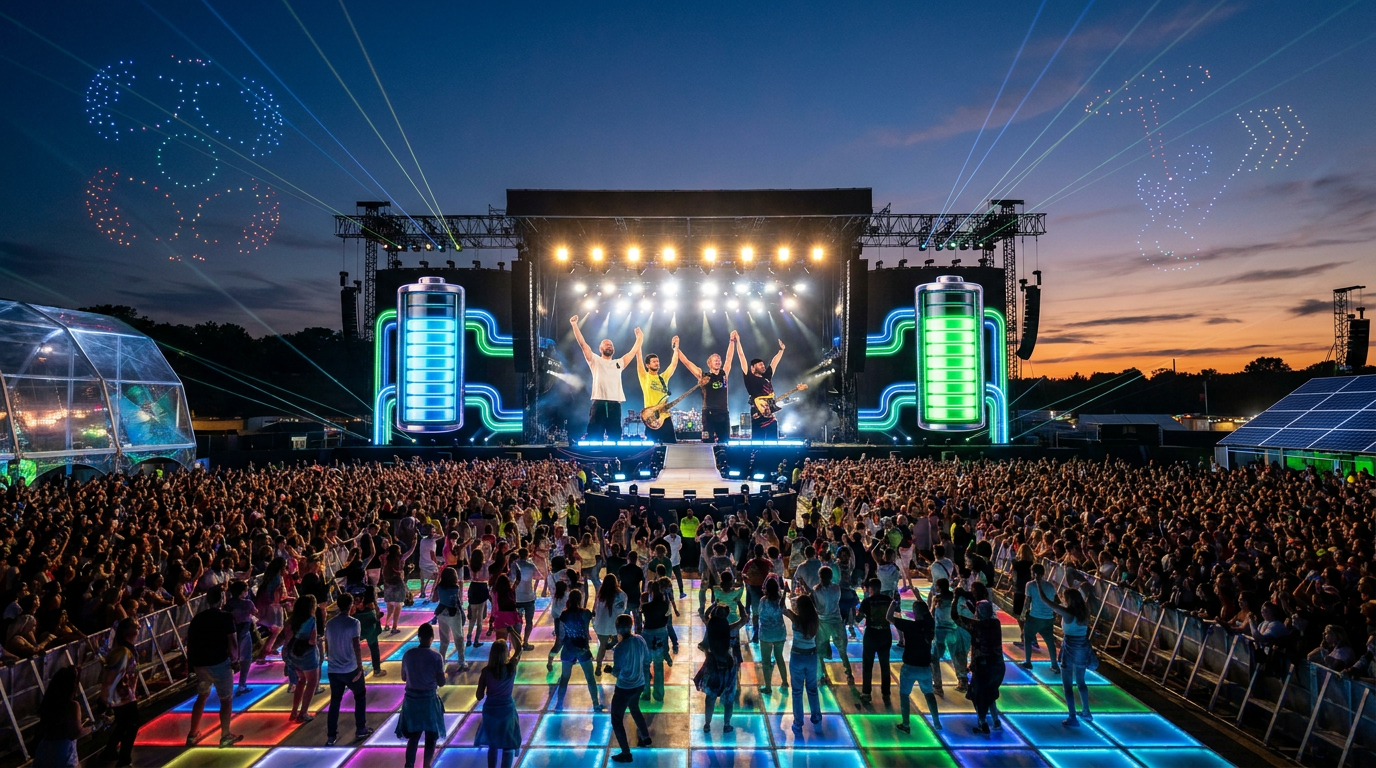
The most visible and interactive symbol of this green revolution is the kinetic dance floor. Pioneered by sustainability technologists like the Dutch company Energy Floors, these custom-built tiles are designed to convert the ecstatic, rhythmic movement of a concert crowd into usable electricity. The concept transforms the audience from passive consumers of energy into active generators, creating a closed-loop system where the excitement of the crowd literally helps keep the lights on.[3][6]

The mechanics behind the kinetic floor are an elegant application of physics. Each individual tile is mounted on a spring mechanism and depresses slightly—less than an inch—when stepped on by a dancer. This downward motion drives an internal electromagnetic generator, converting the kinetic energy of the human body into cyclic energy, and ultimately into electricity. A single tile can produce up to 35 watts of sustained energy, which is immediately fed into the venue's localized power grid or stored in on-site batteries for later use.[3][6]
During Coldplay's recent Music of the Spheres world tour, the band brought this technology to the mainstream by installing dozens of these kinetic tiles in the general admission standing areas. They paired the floors with rows of stationary power bikes, encouraging fans to literally pedal and jump throughout the performance. By harnessing this human kinetic energy and combining it with temporary in-venue solar installations, the tour generated an average of 17 kilowatt-hours of clean power per show—enough to entirely run the band's secondary "C-stage" performance each night.[3][8]
Beyond the interactive dance floors, the tour tackled the heavy lifting of stage power by replacing traditional, highly polluting diesel generators with a first-of-its-kind mobile battery system. Developed in partnership with automotive manufacturers, these massive, rechargeable power banks were built entirely from repurposed, end-of-life BMW i3 electric vehicle batteries. The batteries were charged using renewable energy sources before each show, allowing the production to run complex lighting rigs and massive audio arrays without burning a single drop of fossil fuel on site.[8]
The data from these massive logistical shifts has been rigorously analyzed to ensure the industry isn't just engaging in greenwashing. In late 2025, the Massachusetts Institute of Technology’s Environmental Solutions Initiative independently audited the tour's data. The researchers verified that the band had achieved a remarkable 59% reduction in direct carbon emissions compared to their previous stadium tour. This figure represented actual, absolute reductions in greenhouse gases, entirely separate from any purchased carbon offsets, setting a rigorous new benchmark for the live entertainment sector.[1]

The data from these massive logistical shifts has been rigorously analyzed to ensure the industry isn't just engaging in greenwashing.
Yet, while kinetic floors and recycled electric vehicle batteries make for excellent stagecraft and compelling headlines, climate scientists are quick to point out that the bulk of a concert's environmental impact actually happens far away from the stage. The energy required to power amplifiers and laser shows is relatively small compared to the massive logistical footprint required to move people and supplies to a specific geographic location for a single evening.[2]
A comprehensive white paper published by MIT's Climate Machine—co-funded by major industry players including Warner Music Group and Live Nation—analyzed environmental data from over 80,000 live shows across the United States and the United Kingdom. The researchers concluded that the flashy on-stage technology, while helpful, ignores the elephant in the room. The two largest sources of live music emissions, by a massive margin, are audience travel to and from the venue, and the agricultural footprint of the food and beverages consumed on site.[1][4]
"Studies have shown that moving toward a plant-based menu, and away from a meat-based menu, can reduce emissions enormously," the MIT report noted, highlighting that agricultural emissions are a massive blind spot for event promoters. The researchers suggested that a transition to low-carbon, plant-based menus could lower food-related emissions at festivals by up to 90%. Addressing these Scope 3 emissions—the indirect emissions that occur in a company's value chain—is now considered the final frontier in sustainable touring.[4]
To test this theory at a massive scale, the pioneering trip-hop group Massive Attack staged a climate action accelerator event dubbed "Act 1.5" in their hometown of Bristol. Working directly alongside climate analysts from the Tyndall Centre for Climate Change Research, the band designed the outdoor festival specifically to tackle the hardest-to-abate emissions that the MIT report had identified. The goal was to prove that a massive, 30,000-person event could operate without relying on the carbon-heavy infrastructure that usually defines outdoor festivals.[2][7]

To address the massive footprint of audience travel, the organizers made a radical logistical decision: they eliminated the venue's car park entirely. By removing the option to drive, they forced attendees to utilize public transit or active transport. To facilitate this, the festival chartered a massive fleet of free electric shuttle buses and partnered with regional rail operators to run extra, high-capacity trains. Furthermore, ticket presales were geographically restricted to local residents for the first 48 hours, ensuring the crowd was drawn from the immediate area rather than flying in from abroad.[2][7]
Inside the festival gates, the organizers tackled the agricultural footprint with equal aggression. All food vendors operating at the event were contractually required to serve 100% plant-based meals, with ingredients sourced from local farms to minimize transport emissions. Single-use plastics were strictly banned across the entire site, and a comprehensive composting system ensured that virtually zero waste was sent to local landfills.[4][7]
The main stage itself was a marvel of temporary renewable infrastructure. Instead of the standard array of diesel generators, the entire production was powered by a massive 3-megawatt-hour battery array provided by Grid Faeries. These batteries were charged entirely by off-site wind and solar power prior to the event. The result was widely celebrated by environmental groups as the lowest-carbon concert of its size in history, proving that the Tyndall Centre's theoretical "Roadmap to Super Low Carbon Live Music" was practically viable in the real world.[2][7]
However, scaling these bespoke, high-tech solutions across the entire music industry presents a significant economic and logistical challenge. While stadium-filling acts like Coldplay and Massive Attack have the financial leverage to commission custom battery rigs and dictate strict environmental terms to massive venues, the reality is very different at the bottom of the touring ladder. Grassroots clubs, mid-sized theaters, and independent touring bands operate on razor-thin financial margins, where the upfront cost of installing solar panels or kinetic floors is simply out of reach.[5]

Organizations like the Music Sustainability Alliance and the LIVE Trust are stepping in to bridge this widening gap. They are creating open-source resource guides, aggregating sustainable vendors, and establishing funding mechanisms to help smaller venues upgrade their infrastructure without going bankrupt. A small levy on mega-tour tickets is even being proposed to create a subsidy fund, ensuring that the transition to green energy doesn't become a luxury available only to the top one percent of touring artists.[5]
The industry is also seeing a massive shift in standard contractual norms. "Green riders"—specific clauses in an artist's performance contract that demand environmental protocols—are becoming standard across major booking agencies. These riders allow artists to legally require venues to provide plant-based catering, eliminate single-use plastics backstage, and source a percentage of their power from renewable grids. By baking these demands into legal contracts, artists are forcing venues to permanently upgrade their practices.[8]
As the 2026 touring season hits its stride, the definition of a successful global tour has permanently expanded. It is no longer judged solely by gross ticket sales, merchandise revenue, and attendance records. Success is now increasingly measured by an artist's ability to prove that the communal joy of live music does not have to come at the expense of the planet's future. The blueprint for sustainable touring has been written; the challenge now is ensuring every venue in the world has the resources to follow it.[8]
How we got here
2008
The first kinetic dance floor is installed in a nightclub in Rotterdam, proving human movement can generate usable electricity.
2021
Coldplay announces their Music of the Spheres tour with a pledge to cut direct carbon emissions by 50% using renewable tech.
August 2024
Massive Attack stages the Act 1.5 Climate Action Accelerator in Bristol, creating the lowest-carbon concert of its size in history.
December 2025
MIT's Climate Machine publishes a landmark report identifying fan travel and food as the largest sources of live music emissions.
Viewpoints in depth
Stadium Touring Acts
Mega-artists argue that their massive scale gives them the leverage and capital to force systemic changes in venue infrastructure.
For artists operating at the stadium level, sustainability is viewed as an economy of scale. They argue that by investing millions into R&D for technologies like tourable battery arrays and kinetic floors, they are subsidizing the creation of a green supply chain that will eventually become cheap enough for smaller acts to use. They leverage their massive ticket sales to force corporate venues into adopting green riders, knowing that a stadium will overhaul its waste management system rather than lose a multi-million-dollar booking.
Independent Venues
Grassroots promoters emphasize that without financial subsidies, the transition to green infrastructure could bankrupt smaller cultural spaces.
Operators of 200- to 1,000-capacity rooms point out a stark economic reality: they cannot afford to install solar arrays or purchase multi-megawatt batteries. They argue that the narrative around sustainable touring is too heavily focused on the budgets of global superstars. From their perspective, true industry-wide sustainability requires systemic government grants or a wealth-transfer system where a percentage of stadium ticket sales subsidizes green infrastructure upgrades for the grassroots venues that incubate future talent.
Climate Researchers
Academic analysts stress that the industry must focus on audience travel and agricultural footprints rather than just flashy on-stage technology.
Scientists from institutions like MIT and the Tyndall Centre view the live music sector through the cold lens of emissions data. While they applaud innovations like kinetic dance floors, they caution against 'techno-optimism' that ignores the massive Scope 3 emissions of a tour. Their research consistently shows that unless festivals fundamentally change how fans travel to the site and what they eat while there, the industry will never hit its Paris Agreement climate targets, regardless of how the stage is powered.
What we don't know
- Whether the massive upfront costs of renewable battery arrays will drop fast enough for mid-sized venues to adopt them before the end of the decade.
- How consistently fans will adhere to public transit mandates when attending festivals in rural or infrastructure-poor areas.
- If the industry can agree on a standardized, centrally-mandated methodology for reporting emissions to prevent corporate greenwashing.
Key terms
- Kinetic Dance Floor
- A specialized flooring system that captures the physical energy of people jumping or dancing and converts it into usable electricity.
- Scope 3 Emissions
- Indirect greenhouse gas emissions that occur in a company's value chain, which for concerts primarily includes the travel footprint of the fans attending the show.
- Green Rider
- A set of environmental demands attached to an artist's performance contract, dictating sustainable practices the venue must follow.
- Carbon Dioxide Equivalent (CO2e)
- A standard unit for measuring carbon footprints, expressing the impact of different greenhouse gases in terms of the amount of CO2 that would create the same amount of warming.
Frequently asked
How much energy does a kinetic dance floor generate?
Each individual tile can produce up to 35 watts of sustained energy from the movement of dancers, which is then fed into the venue's power grid.
What is the biggest source of emissions at a concert?
According to MIT researchers, audience travel and food consumption are the two largest sources of greenhouse gas emissions for live music events.
Can a large festival run without diesel generators?
Yes. Recent events, such as Massive Attack's Act 1.5 concert, have successfully powered massive main stages entirely using multi-megawatt-hour battery arrays charged by off-site wind and solar.
What is a green rider?
A green rider is a clause in an artist's contract that requires the venue to implement specific environmental practices, such as banning single-use plastics or providing plant-based catering.
Sources
Source coverage
8 outlets
4 viewpoints surfaced








[1]MIT Environmental Solutions InitiativeClimate Researchers
Assessment Report of Live Music and Climate Change
Read on MIT Environmental Solutions Initiative →[2]Tyndall Centre for Climate Change ResearchClimate Researchers
Roadmap to Super Low Carbon Live Music
Read on Tyndall Centre for Climate Change Research →[3]Energy FloorsSustainability Technologists
Kinetic Dancefloor Technology and Tour Integration
Read on Energy Floors →[4]Green QueenSustainability Technologists
Fan Travel & Food the Largest Sources of Live Music's Climate Footprint
Read on Green Queen →[5]PollstarIndependent Venues
Sustainable Touring Resource Guide
Read on Pollstar →[6]ForbesSustainability Technologists
People Power: Kinetic Dance Floors To Power Clubs And Concerts
Read on Forbes →[7]A Greener FutureClimate Researchers
Massive Attack's Act 1.5 Climate Action Accelerator
Read on A Greener Future →[8]Factlen Editorial TeamStadium Touring Acts
Synthesis by Factlen editorial team
Read on Factlen Editorial Team →

Every angle. Every day.
Get entertainment stories with full source coverage and perspective breakdowns delivered to your inbox.