
How Front-of-Package Warning Labels Are Rewiring Global Grocery Habits
A decade after Chile pioneered stark black warning labels for unhealthy foods, new data reveals how the policy successfully forced corporate recipe changes and shifted consumer diets.
By Factlen Editorial Team
- Public Health Advocates
- Argue that stark, interpretive warnings are necessary to combat deceptive food marketing and empower consumers.
- Food & Beverage Industry
- Argue that black octagons demonize individual foods and fail to educate consumers on building a balanced overall diet.
- Behavioral Economists
- Focus on the subconscious nudges of package design and monitor the long-term risks of consumer label fatigue.
What's not represented
- · Small-scale food producers
- · Low-income consumers navigating price vs. health
Why this matters
Understanding how food packaging influences our subconscious choices allows consumers to navigate grocery aisles more effectively. As these stark warning labels spread globally, they are fundamentally changing not just what we buy, but how food manufacturers formulate their products.
Key points
- Chile's pioneering use of black octagon warning labels on unhealthy foods has proven highly effective over the past decade.
- Data shows a 24% drop in sugary drink purchases and widespread recipe reformulation by food manufacturers.
- The World Health Organization heavily endorses the model, prompting rapid adoption across Latin America.
- Canada is rolling out its own warning system, while the US FDA continues to debate its upcoming labeling rules.
The modern grocery store is a masterpiece of psychological engineering. Every aisle, endcap, and package design is meticulously crafted to capture attention and drive purchasing decisions in a matter of seconds. For decades, the food industry has leveraged this environment to market highly processed products, often masking poor nutritional profiles behind bright colors, cartoon characters, and vague health halos like 'all natural' or 'part of a balanced breakfast.' In this asymmetrical information war, consumers have historically been left to fend for themselves, forced to flip boxes over and decipher complex, microscopic nutrition facts panels while navigating crowded aisles.[6]
Recognizing that the traditional back-of-package nutrition label was failing to stem the tide of diet-related non-communicable diseases, public health officials began searching for a more disruptive intervention. The goal was not to ban unhealthy foods, but to level the playing field by providing instant, unavoidable transparency at the exact moment of decision. This concept, known as front-of-package (FOP) labeling, shifts the cognitive burden away from the shopper. Instead of requiring consumers to calculate percentages of daily values or understand the difference between naturally occurring and added sugars, FOP systems do the math for them.[2]
In 2016, the South American nation of Chile decided to change the global rules of engagement with a radical, first-of-its-kind experiment: the Law of Food Labeling and Advertising. Facing soaring rates of childhood obesity and related metabolic conditions, Chilean lawmakers bypassed the subtle, industry-friendly labeling systems used in Europe and opted for a stark, unambiguous approach. The legislation mandated that any packaged food or beverage exceeding strict, science-based thresholds for added sugar, sodium, saturated fat, or overall calories had to bear a prominent warning label.[4]
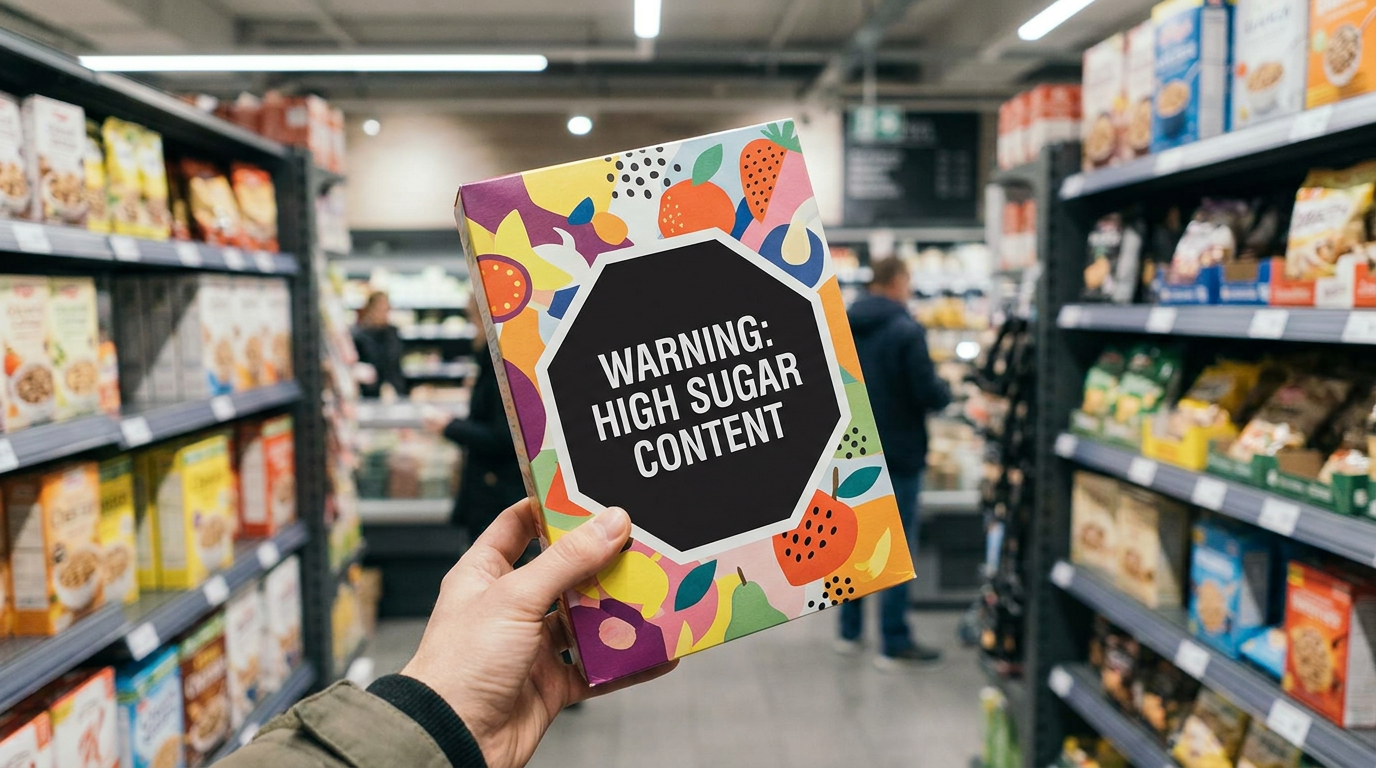
The mechanism chosen by Chile was intentionally aggressive and impossible to miss. The government designed a series of stark, black stop-sign octagons featuring bold white text that reads 'HIGH IN SUGAR' or 'HIGH IN SODIUM,' accompanied by the Ministry of Health's stark seal. These labels were required to be placed on the upper front quadrant of the packaging, scaling in size relative to the box. If a product exceeded the thresholds in multiple categories, it received multiple black octagons, turning the front of some ultra-processed snacks into a billboard of health warnings.[4]

Ten years after the law's initial rollout, comprehensive data has finally emerged, painting a clear and highly encouraging picture of behavioral change at a population level. Recent figures released by health ministries and analyzed by global health researchers highlight the long-term efficacy of these warning labels. Unlike many public health interventions that show a brief novelty effect before fading into the background, the Chilean model has demonstrated a sustained, measurable impact on both consumer purchasing habits and the broader food supply chain over the course of a decade.[1][6]
The most dramatic and immediate shift occurred in the beverage aisle, a primary vector for added sugars in the modern diet. According to comprehensive analyses of household purchasing data, sales of sugar-sweetened beverages plummeted by nearly a quarter in the years immediately following the law's implementation. This 24 percent drop represents a massive reduction in empty caloric intake across the population. Crucially, this decline was observed across all socioeconomic groups, suggesting that the visual simplicity of the black octagons successfully transcended educational and income barriers that often limit the reach of traditional health campaigns.[3]

However, the true, compounding success of the Chilean policy was not merely in changing consumer choices at the register—it was in forcing widespread corporate reformulation. Faced with the prospect of their flagship products being plastered with multiple black warning signs, multinational food and beverage manufacturers quietly went to work in their test kitchens. The threat of the label proved to be a far more powerful motivator for the industry than decades of voluntary public health guidelines or consumer advocacy campaigns.[4][6]
Within the first two years of the law taking effect, an estimated 20 percent of all packaged foods sold in Chile were reformulated by their manufacturers to fall just below the government's warning thresholds. Companies slashed sodium in breads and soups, swapped out saturated fats in baked goods, and aggressively reduced added sugars in cereals and dairy products. This massive overhaul of the food supply was driven entirely by the desire to maintain a 'clean' package front, free from the stigmatizing black octagons.[3]
This phenomenon, often referred to by researchers as the 'stealth health' effect, represents a massive victory for public health infrastructure. Because the baseline nutritional quality of the food supply improved, even consumers who actively ignore the warning labels or do not care about nutrition are inadvertently eating less sodium, sugar, and saturated fat. The environment itself became healthier, reducing the amount of willpower and nutritional literacy required for a citizen to maintain a baseline level of metabolic health.[6]
This phenomenon, often referred to by researchers as the 'stealth health' effect, represents a massive victory for public health infrastructure.
The undeniable success of the Chilean experiment has not gone unnoticed on the global stage. The World Health Organization has heavily endorsed front-of-package warning labels, classifying them as a highly recommended 'best buy' policy for nations struggling to combat the rising tide of non-communicable diseases like diabetes and hypertension. The WHO's framework manual explicitly points to interpretive warning labels—those that provide a clear judgment on the healthfulness of a product, rather than just raw numbers—as the most effective tool for changing behavior.[2]
Following this guidance, the Pan American Health Organization reports that the warning label model has rapidly cascaded across Latin America. Mexico, facing its own severe public health crisis related to ultra-processed foods, adopted a nearly identical black octagon system in 2020, adding specific warning legends for products containing caffeine or artificial sweeteners to protect children. Peru, Uruguay, Argentina, and Colombia have all followed suit, creating a unified regulatory bloc that is forcing multinational food conglomerates to adapt their regional product lines.[5]
The regulatory momentum is now pushing steadily into North America. Canada recently finalized its own mandatory front-of-package warning label requirements, which will go into full effect in early 2026. Rather than black octagons, the Canadian system utilizes a stark black-and-white magnifying glass design to highlight items that are high in sodium, sugar, or saturated fat. This visual cue is designed to quickly draw the shopper's eye to the most critical health risks associated with a given product, mirroring the psychological mechanism proven in South America.[6]

In the United States, the Food and Drug Administration is currently in the late stages of developing its own standardized front-of-pack labeling system. However, the agency faces fierce, well-funded lobbying from the food and beverage industry. The central battle revolves around whether the US labels should be interpretive warnings, like the Chilean octagons, or purely informational designs that simply move the back-of-box calories and percentages to the front without passing judgment. Public health advocates argue that informational labels are vastly inferior to stark warnings.[6]
Despite the overwhelming successes documented in the data, uncertainties and challenges remain as these policies mature. Behavioral economists and public health researchers continue to monitor whether 'label fatigue' will eventually set in. There is a legitimate concern that as consumers become accustomed to seeing black octagons on a large percentage of grocery store items, the shock value will wear off, and shoppers will simply tune out the warnings and revert to their previous purchasing habits over a longer time horizon.[1][6]
Furthermore, the binary nature of strict nutritional thresholds can sometimes create unintended consequences and nutritional blind spots. In the rush to avoid a 'High in Sugar' label, many beverage and snack manufacturers have simply replaced natural sugars with a cocktail of artificial and non-nutritive sweeteners. While this successfully avoids the warning octagon, some nutritionists worry that it merely trades one known health risk for another set of unknowns regarding the long-term metabolic effects of heavy artificial sweetener consumption.[3]
There is also the ongoing challenge of categorizing naturally occurring fats and sugars. Under rigid threshold systems, nutrient-dense whole foods like certain nuts, seeds, or full-fat dairy products can sometimes trigger warning labels for saturated fat or calories. This dynamic can deeply confuse well-intentioned shoppers who are actively trying to consume a whole-foods diet, inadvertently pushing them toward highly processed 'diet' foods that have been chemically engineered to slide just under the government's warning thresholds, despite offering far less actual nutritional value than the penalized whole foods.[4]
To address these nuances, newer iterations of the policy in other countries are actively refining their nutrient profiling algorithms. Policymakers are working to exempt single-ingredient whole foods from the labeling requirements entirely, focusing the regulatory firepower strictly on ultra-processed items where added sugars and hidden sodium are most prevalent. This evolution in regulatory design reflects a growing scientific consensus that the source, matrix, and processing level of nutrients matter just as much as the raw caloric math, ensuring that the labels target industrial food engineering rather than natural agriculture.[5]

Ultimately, the accelerating global shift toward mandatory front-of-package warnings represents a fundamental transfer of power and information in the modern food system. For decades, the carefully engineered environment of the grocery store has heavily favored the manufacturer, allowing corporate marketing departments to dictate the narrative around health, wellness, and nutrition. These new regulatory policies forcibly reclaim that highly valuable visual real estate on the package, prioritizing unambiguous public health transparency over corporate branding and profit margins.[6]
By stripping away the carefully crafted marketing spin and presenting stark, unavoidable nutritional facts at the exact moment of purchase, these warning labels are giving everyday consumers the split-second clarity they need to make choices aligned with their actual health goals. It is a remarkably rare example of a sweeping public health intervention that works precisely because it requires almost zero effort, education, or time from the general public to understand and utilize effectively.[6]
As more nations adopt and refine these systems, the cumulative pressure on the global food industry will only intensify. The era of hiding poor nutritional profiles in the fine print is rapidly drawing to a close, replaced by a new standard of radical transparency that promises to reshape not just how we shop, but the very composition of the food we eat. This quiet revolution in the grocery aisles stands as one of the most effective, empowering public health victories of the modern era.[6]
How we got here
2016
Chile implements the world's first mandatory national front-of-package black octagon warning label system.
2020
Mexico adopts a similar warning label law, adding specific legends to protect children from caffeine and artificial sweeteners.
2022
Canada announces its own mandatory FOP labeling regulations, utilizing a magnifying glass design.
June 2026
New comprehensive data confirms the long-term efficacy of the Chilean model in driving sustained behavioral change and product reformulation.
Viewpoints in depth
Public Health Advocates
Argue that stark, interpretive warnings are necessary to combat deceptive food marketing and empower consumers.
Public health organizations, including the WHO and PAHO, view interpretive front-of-package labels as a critical tool in the fight against non-communicable diseases. They argue that the modern food environment is inherently deceptive, with highly processed foods often marketed using health halos that obscure their true nutritional profile. By mandating stark, unavoidable warnings, advocates believe governments are simply leveling the playing field, giving consumers the split-second transparency required to make informed choices without needing a degree in nutrition.
Food & Beverage Industry
Argue that black octagons demonize individual foods and fail to educate consumers on building a balanced overall diet.
Industry lobbying groups frequently push back against interpretive warning labels, arguing that they are overly simplistic and punitive. They contend that a black octagon unfairly demonizes specific products while ignoring the broader context of a consumer's overall diet and lifestyle. Instead of warnings, the industry generally advocates for purely informational labels—such as the Guideline Daily Amounts (GDA) system—which display raw calories and percentages, arguing this approach respects consumer autonomy and provides more comprehensive education.
Behavioral Economists
Focus on the subconscious nudges of package design and monitor the long-term risks of consumer label fatigue.
Researchers studying consumer behavior are fascinated by the immediate efficacy of the Chilean model, noting that it successfully disrupts the subconscious, automatic purchasing habits that drive most grocery shopping. However, they caution that the long-term success of the policy is not guaranteed. A primary concern is 'label fatigue'—the psychological phenomenon where consumers eventually become desensitized to a ubiquitous warning sign, causing the black octagons to blend into the background noise of the supermarket aisle over time.
What we don't know
- Whether consumers will eventually develop 'label fatigue' and begin ignoring the warnings after years of exposure.
- The long-term health impacts of food manufacturers swapping natural sugars for artificial sweeteners to avoid the warning labels.
Key terms
- Front-of-Package (FOP) Labeling
- Nutritional information or health warnings placed on the main display panel of a product to provide instant guidance to shoppers.
- Reformulation
- The process by which food manufacturers alter a product's recipe, often to reduce unhealthy ingredients and avoid regulatory warning labels.
- Nutrient Profiling Model
- The scientific algorithm and specific thresholds used by governments to determine whether a food is healthy enough to avoid a warning label.
- Ultra-processed Foods
- Industrial formulations made entirely or mostly from substances extracted from foods, often containing additives, artificial flavors, and high levels of sugar or sodium.
Frequently asked
What do the black octagon labels mean?
They are government-mandated warnings indicating that a packaged food or beverage exceeds strict health thresholds for added sugar, sodium, saturated fat, or overall calories.
Did the labels actually change what people buy?
Yes. Long-term data from Chile shows significant drops in the purchase of unhealthy items, including a 24% reduction in sugar-sweetened beverage sales.
Are these warning labels coming to the United States?
The FDA is currently developing a standardized front-of-package labeling system, though it is still being debated whether it will feature stark warnings or purely informational numbers.
Sources
Source coverage
6 outlets
3 viewpoints surfaced






[1]STAT NewsBehavioral Economists
Chile offers new data on food warning label efficacy
Read on STAT News →[2]World Health OrganizationPublic Health Advocates
Guiding principles and framework manual for front-of-pack labelling
Read on World Health Organization →[3]PLOS MedicineBehavioral Economists
Changes in food purchases after the Chilean policies on food labelling
Read on PLOS Medicine →[4]UNC Global Food Research ProgramPublic Health Advocates
Chile's Law of Food Labeling and Advertising
Read on UNC Global Food Research Program →[5]Pan American Health OrganizationPublic Health Advocates
Front-of-package warning labels
Read on Pan American Health Organization →[6]Factlen Editorial TeamBehavioral Economists
Synthesis by Factlen editorial team
Read on Factlen Editorial Team →

More in health
See all 114 stories →Mental Health Interventions
The Evidence Pack: Why Exercise Is Becoming a First-Line Prescription for Depression
6 sources

Nutrition Labels
Chile's Strict Food Warning Labels Successfully Reduce Childhood Obesity Risk, New Data Shows
8 sources
Autoimmune Breakthrough
Revolutionary 'Immune Reset' Therapy Puts Severe Lupus Into Drug-Free Remission
7 sources

Adaptogen Science
The Emerging Science of Adaptogens: How Ashwagandha and Rhodiola Rewire the Stress Response
6 sources

Every angle. Every day.
Get health stories with full source coverage and perspective breakdowns delivered to your inbox.