
How Formula 1's 2026 Engine Rules Are Pioneering the Future of Sustainable Road Cars
Formula 1 has introduced a radical 50/50 hybrid power split and 100% sustainable drop-in fuels for the 2026 season, turning the sport into a high-speed laboratory for climate technology.
By Factlen Editorial Team
- Automotive Manufacturers
- View the new regulations as a vital R&D platform to develop high-density batteries and sustainable fuels for consumer road cars.
- Motorsport Purists
- Focus on how the 50/50 power split and the new 'Manual Override' system will change the tactical nature of wheel-to-wheel racing.
- Environmental Technologists
- Emphasize the potential of synthetic e-fuels to decarbonize existing combustion engines, while acknowledging the current high costs of direct air capture.
What's not represented
- · Consumer road car drivers
- · Renewable energy grid operators
Why this matters
The billions of dollars invested by automotive giants into Formula 1's 2026 regulations are directly funding the development of high-density batteries and synthetic fuels that will eventually power everyday consumer vehicles, offering a viable alternative to pure electric cars.
Key points
- Formula 1's 2026 regulations introduce a 50/50 power split between the combustion engine and electrical systems.
- The electrical output of the MGU-K has nearly tripled to 350 kilowatts.
- All cars must run on 100% Advanced Sustainable Fuel, achieving net-zero carbon emissions.
- The complex and expensive MGU-H exhaust generator has been permanently banned.
- A new 'Manual Override' system gives chasing drivers an electrical boost to aid overtaking.
- The road-relevant technology has attracted major manufacturers like Audi and Ford to the sport.
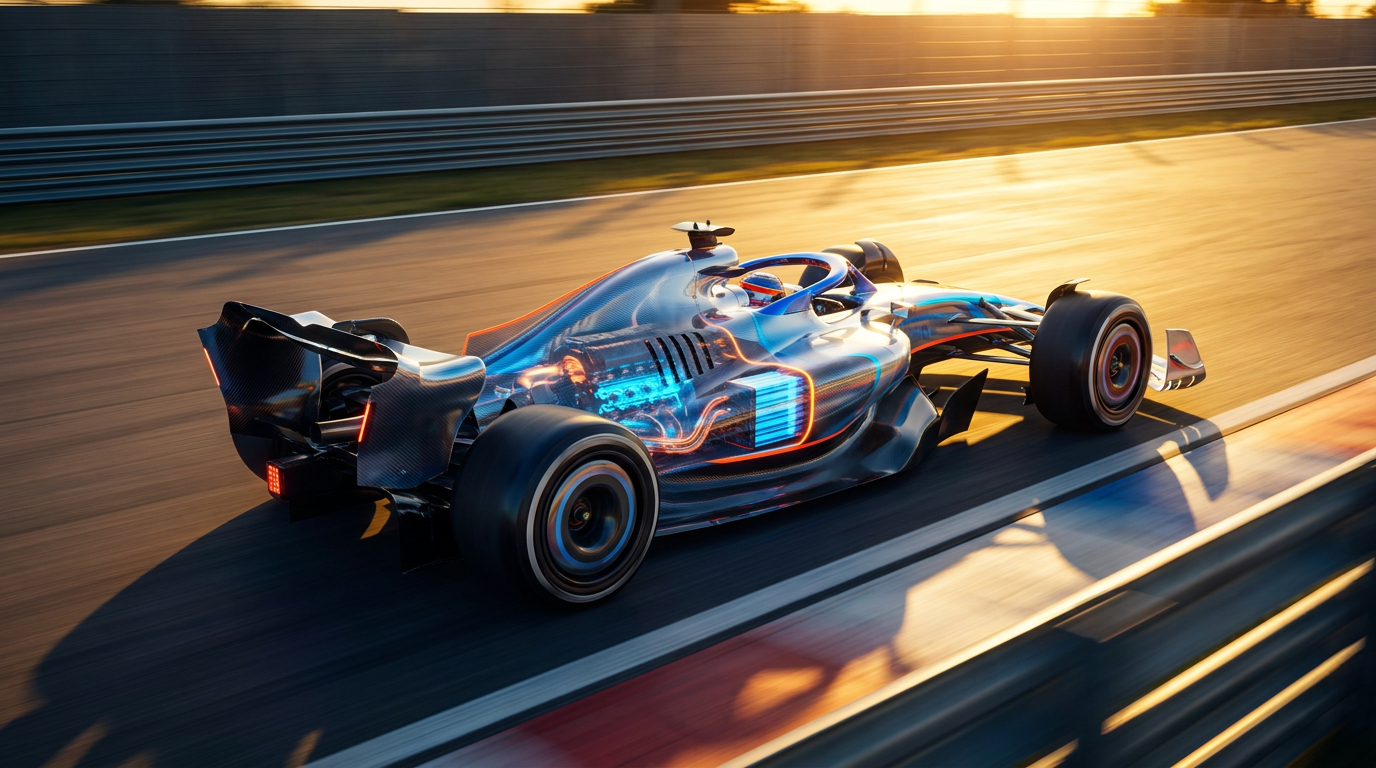
Formula 1 has officially entered its most transformative era in over a decade. As the 2026 season gets underway, the sport has introduced a radical overhaul of its power unit regulations, marking the most significant shift in automotive racing architecture since the dawn of the hybrid era in 2014. The screaming engines remain, but the underlying philosophy has been entirely rewritten. This is no longer just about building the fastest car on the grid; it is about turning the pinnacle of motorsport into a high-speed laboratory for the future of global transportation.[1][3]
The 2026 regulations were born out of a dual mandate from the FIA and Formula 1 management: improve the quality of wheel-to-wheel racing while drastically reducing the sport's environmental footprint. With Formula 1 committed to achieving a net-zero carbon footprint by 2030, the cars themselves had to evolve. The new rulebook forces engineering teams to extract maximum performance from strictly limited energy resources, pushing the boundaries of battery density, electrical efficiency, and synthetic chemistry.[1][5]
At the heart of this revolution is the "50/50 power split." For the past twelve years, the internal combustion engine has been the undisputed primary source of propulsion, with electrical systems acting as a supplementary boost. In 2026, that hierarchy has been flattened. The new power units are designed so that the combustion engine and the electrical system contribute almost equally to the car's total performance, fundamentally altering how a Formula 1 car delivers its speed to the tarmac.[3][5]

The traditional Internal Combustion Engine (ICE) has not been abandoned, but its role has been recalibrated. The cars still utilize a 1.6-liter turbocharged V6 architecture, preserving the acoustic drama that fans expect. However, strict new fuel flow limits have intentionally throttled its maximum output. Where the previous generation of combustion engines produced roughly 550 kilowatts of power, the 2026 iterations are capped at approximately 400 kilowatts. This reduction was engineered specifically to make room for a massive expansion in electrical power.[3][6]
To achieve the 50/50 split, the sport has dramatically scaled up the Motor Generator Unit - Kinetic (MGU-K). This electric motor, connected directly to the drivetrain, harvests kinetic energy under braking and deploys it for acceleration. Under the new regulations, the MGU-K's maximum electrical output has nearly tripled, jumping from 120 kilowatts to a staggering 350 kilowatts. At certain speeds, nearly half of the thrust pushing the car forward is entirely electric, making the 2026 machines the most electrified vehicles in Formula 1 history.[3][5]
To make room for this electrical expansion, Formula 1 has officially banned the Motor Generator Unit - Heat (MGU-H). For years, this highly complex generator sat on the turbocharger shaft, harvesting energy from exhaust gases. While it was an engineering marvel, it was exorbitantly expensive and had almost zero relevance to consumer road cars—the Mercedes AMG One supercar was one of the only production vehicles to ever attempt using it. Scrapping the MGU-H simplifies the power unit, reduces costs, and aligns the sport's technology with the broader automotive industry.[3][5]
With the exhaust generator gone, the burden of electrical generation falls entirely on the MGU-K, requiring a massive leap in energy recovery capabilities. The 2026 systems can now recover up to 9 megajoules of energy per lap under braking and deceleration—more than quadruple the 2 megajoule limit of the previous era. This turns kinetic energy into a highly tactical resource. Drivers and race engineers must constantly calculate when to harvest energy and when to deploy it, turning every lap into a high-stakes chess match of thermal and electrical management.[5][6]

With the exhaust generator gone, the burden of electrical generation falls entirely on the MGU-K, requiring a massive leap in energy recovery capabilities.
This tactical energy management introduces a brand-new overtaking mechanic known as "Manual Override." Designed to replace the sport's heavy reliance on the Drag Reduction System (DRS), Manual Override gives the chasing driver a distinct electrical advantage. If a driver is within one second of the car ahead at a designated activation point, they are granted an extra 0.5 megajoules of electrical energy to deploy on the following lap. This burst of power provides a crucial speed differential, forcing defending drivers to strategically hoard their own battery reserves to fight off attacks.[3]
While the electrical upgrades are profound, the most globally significant breakthrough in the 2026 regulations is the fuel burning inside the combustion engine. Formula 1 has completely banned conventional fossil fuels. Every car on the grid is now mandated to run on 100% Advanced Sustainable Fuel. This marks a monumental milestone in the sport's history, proving that high-performance combustion engines can operate without pulling new carbon out of the earth's crust.[1][2]
Advanced Sustainable Fuel is a marvel of modern chemistry. Rather than refining crude oil, fuel suppliers are synthesizing hydrocarbons from alternative sources. The regulations permit fuels derived from non-food biomass—such as agricultural waste and rice husks—or municipal waste, including used cooking oil. By utilizing organic matter that would otherwise decompose or be discarded, the fuel cycle repurposes existing carbon rather than introducing new greenhouse gases into the atmosphere.[1][2]
The most cutting-edge variant of this new fuel is known as a Renewable Fuel of Non-Biological Origin (RFNBO), commonly referred to as a synthetic e-fuel. This process involves using renewable electricity to split water into green hydrogen, which is then chemically bonded with carbon dioxide captured directly from the atmosphere or industrial exhaust. When the Formula 1 car burns this e-fuel on the track, it only releases the exact amount of carbon dioxide that was originally captured to create it, resulting in a net-zero carbon loop.[2][4]

Crucially, these advanced sustainable fuels are engineered as "drop-in" solutions. This means they are chemically identical to traditional petrol in their performance characteristics—boasting high energy density and optimal octane ratings—but require absolutely no modifications to a standard internal combustion engine. The fuel powering a 2026 Formula 1 car could, theoretically, be pumped directly into a standard family sedan without changing a single valve or injector.[1][2]
Despite the optimism, the transition to synthetic fuels is not without its skeptics and scientific hurdles. Environmental technologists point out that Direct Air Capture (DAC)—the process of sucking CO2 out of the atmosphere to make e-fuels—is currently highly inefficient and exorbitantly expensive. Furthermore, producing the green hydrogen required for the chemical synthesis demands massive amounts of renewable electricity. Critics argue that until the global renewable energy grid expands significantly, producing synthetic fuels at a commercial scale remains a daunting logistical challenge.[4][7]
Nevertheless, the automotive industry has overwhelmingly embraced Formula 1's new direction. The promise of developing road-relevant battery technology and pioneering drop-in sustainable fuels has triggered a manufacturer boom. Audi has officially entered the sport as a full works team, and Ford has returned to partner with Red Bull Powertrains. These automotive giants are investing billions not just to win races, but to secure the intellectual property that will power their consumer fleets in the coming decades.[3][4]
The 2026 Formula 1 season represents a rare convergence of elite sporting entertainment and vital climate technology. By forcing the brightest engineering minds in the world to solve the complex puzzle of a 50/50 hybrid split and synthetic fuel combustion, the sport is accelerating innovations that will inevitably trickle down to the global highways. The cars may look different, and the energy strategies may be vastly more complex, but the ultimate victory will be measured in breakthroughs that extend far beyond the checkered flag.[1][7]

How we got here
2014
Formula 1 introduces the V6 turbo-hybrid era, utilizing both MGU-K and MGU-H systems.
2022
The FIA officially signs off on the 2026 power unit regulations, attracting Audi and Ford to the sport.
2023
F1's feeder series (F2 and F3) begin testing 55% sustainable bio-sourced fuels in race conditions.
January 2026
Teams unveil their radically redesigned 2026 chassis and power units to the public.
March 2026
The new 100% sustainable, 50/50 hybrid era officially debuts at the season opener.
Viewpoints in depth
Automotive Manufacturers' view
Major car brands see the 2026 regulations as a vital R&D platform for consumer vehicles.
For automotive giants like Honda, Mercedes, Audi, and Ford, Formula 1 is no longer just a marketing exercise; it is a high-speed research laboratory. The mandate to achieve a 50/50 power split forces teams to develop incredibly power-dense batteries and highly efficient electric motors. Because the MGU-H was banned—a technology with almost no road relevance—every dollar spent on the 2026 power units directly translates to intellectual property that can be used in consumer hybrid vehicles. Furthermore, the development of 'drop-in' sustainable fuels offers these manufacturers a lifeline to keep internal combustion engines alive in a world increasingly hostile to fossil fuels.
Motorsport Purists' view
Racing analysts are focused on how the new energy management rules will alter the fundamental tactics of the sport.
From a purely sporting perspective, the 2026 regulations represent a massive paradigm shift in how a driver attacks a lap. With the internal combustion engine's power capped and the electrical output tripled, energy management is now the defining factor of a race. Purists are particularly intrigued by the new 'Manual Override' system, which replaces the passive DRS with an active tactical weapon. Because drivers can recover up to 9 megajoules of energy per lap, the battle on track will become a high-speed chess match of hoarding and deploying electrical reserves, fundamentally changing the art of overtaking in Formula 1.
Environmental Technologists' view
Climate scientists praise the net-zero ambition but warn of the massive energy costs required to scale synthetic fuels.
Environmental experts applaud Formula 1's commitment to 100% sustainable fuels, noting that proving the viability of synthetic e-fuels at 200 mph is a powerful statement for the global transportation sector. However, they remain cautious about the scalability of the technology. Creating Renewable Fuels of Non-Biological Origin (RFNBO) requires Direct Air Capture to source the carbon and massive amounts of green hydrogen. Both processes are currently highly inefficient and require vast amounts of renewable electricity. Technologists argue that while F1 can afford bespoke batches of this fuel, rolling it out to billions of consumer cars will require a monumental expansion of the global renewable energy grid.
What we don't know
- Whether the new aerodynamic regulations combined with the 50/50 power split will actually result in closer wheel-to-wheel racing.
- How quickly the cost of producing synthetic e-fuels can be reduced to make them viable for everyday consumers.
- Which engine manufacturer has best interpreted the new regulations to gain an early advantage in the 2026 season.
Key terms
- MGU-K
- Motor Generator Unit - Kinetic. The electric motor that recovers energy under braking and deploys it for acceleration.
- ICE
- Internal Combustion Engine. The traditional 1.6-liter V6 turbocharged engine that burns the fuel.
- MGU-H
- Motor Generator Unit - Heat. A complex exhaust-driven generator used in previous F1 cars, now banned for 2026 to reduce costs.
- Advanced Sustainable Fuel
- A 'drop-in' fuel made from non-food biomass, waste, or captured carbon that does not add new fossil CO2 to the atmosphere.
- RFNBO
- Renewable Fuel of Non-Biological Origin. Synthetic e-fuels created by combining green hydrogen with captured carbon dioxide.
Frequently asked
Will the 2026 F1 cars sound different?
They will still feature high-revving 1.6-liter V6 turbo engines, so the classic combustion sound remains, though the acoustic profile may shift slightly due to the new sustainable fuels and the removal of the exhaust-driven MGU-H.
Can sustainable F1 fuel be used in normal cars?
Yes. The 2026 regulations mandate 'drop-in' fuels, meaning they are chemically designed to work in standard internal combustion engines without requiring any mechanical modifications.
Why did Formula 1 ban the MGU-H?
The exhaust-driven MGU-H was incredibly expensive, highly complex, and had almost no relevance to consumer road cars, which deterred new engine manufacturers from entering the sport.
How does the new overtaking system work?
Replacing traditional DRS reliance, the 'Manual Override' system gives a driver an extra 0.5 megajoules of electrical energy to deploy on the next lap if they are within one second of the car ahead.
Sources
Source coverage
7 outlets
3 viewpoints surfaced







[1]Formula 1Environmental Technologists
Formula 1 is introducing Advanced Sustainable Fuels from 2026
Read on Formula 1 →[2]Mercedes-AMG PETRONAS F1 TeamAutomotive Manufacturers
What Is Advanced Sustainable Fuel?
Read on Mercedes-AMG PETRONAS F1 Team →[3]The RaceMotorsport Purists
F1's 2026 engine rules explained: 50/50 split and overtake mode
Read on The Race →[4]BlackBook MotorsportEnvironmental Technologists
The environmental formula: F1's sustainable fuel future
Read on BlackBook Motorsport →[5]Honda GlobalAutomotive Manufacturers
2026 F1 Technical Regulations: Enhanced Electrification
Read on Honda Global →[6]AutosportMotorsport Purists
F1 2026 engine regulations: What are they and why are they changing?
Read on Autosport →[7]Factlen Editorial TeamEnvironmental Technologists
Synthesis by Factlen editorial team
Read on Factlen Editorial Team →

More in sports
See all 13 stories →Women's Football
Women's soccer shatters global attendance records as 2026 expansion boom takes hold
7 sources

Storyline
USMNT Clinches Group D with Dominant 2-0 Win Over Australia at 2026 World Cup
6 sources

NWSL Expansion
NWSL Launches 'Summer of Soccer' Tour to Capitalize on World Cup Fever
7 sources

Women's Sports
NWSL Shatters Global Attendance Records as Mid-Season Crowds Surpass Two Million
7 sources

Every angle. Every day.
Get sports stories with full source coverage and perspective breakdowns delivered to your inbox.