
How Bidirectional Charging is Turning 2026 EVs into Whole-Home Batteries
Vehicle-to-Home (V2H) technology is moving from niche experiment to mainstream feature, allowing electric vehicles to power houses during outages and sell energy back to the grid.
By Factlen Editorial Team
- Home Energy Integrators
- Views the EV as the ultimate home battery, offering massive capacity for a fraction of the cost of dedicated storage.
- Charging Infrastructure Providers
- Focuses on the technical hurdles of safely moving power, emphasizing standardized communication and professional installation.
- Energy Market Analysts
- Highlights the macro grid benefits of V2G, noting that millions of parked EVs could act as a decentralized power plant.
What's not represented
- · Independent Electricians
- · Used EV Buyers
Why this matters
An electric vehicle battery holds roughly ten times the energy of a standard home backup battery. Unlocking that power can save homeowners thousands of dollars on backup generators and dedicated storage while providing days of resilience during grid blackouts.
Key points
- Bidirectional charging allows EVs to send power back to homes or the grid.
- A modern EV battery holds roughly ten times the energy of a standard home battery.
- Vehicle-to-Home (V2H) setups can power an average house for three to ten days during an outage.
- Installing the required bidirectional charger and islanding switch costs between $4,000 and $8,000.
- Roughly 60% of new 2026 EV models support some form of bidirectional power flow.
- Interoperability and battery degradation concerns remain the primary hurdles to mass adoption.
The largest battery you will ever own is likely sitting in your driveway. A standard home backup battery, like the Tesla Powerwall, holds about 13.5 kilowatt-hours (kWh) of energy. Meanwhile, a modern electric vehicle like the Ford F-150 Lightning carries a massive 131 kWh battery—nearly ten times the capacity.[1]
For years, that massive energy reserve was a one-way street: power flowed from the grid into the car, and stayed there until it was used to drive. But in 2026, the automotive and energy industries have reached a tipping point with the mainstream arrival of bidirectional charging.[6]
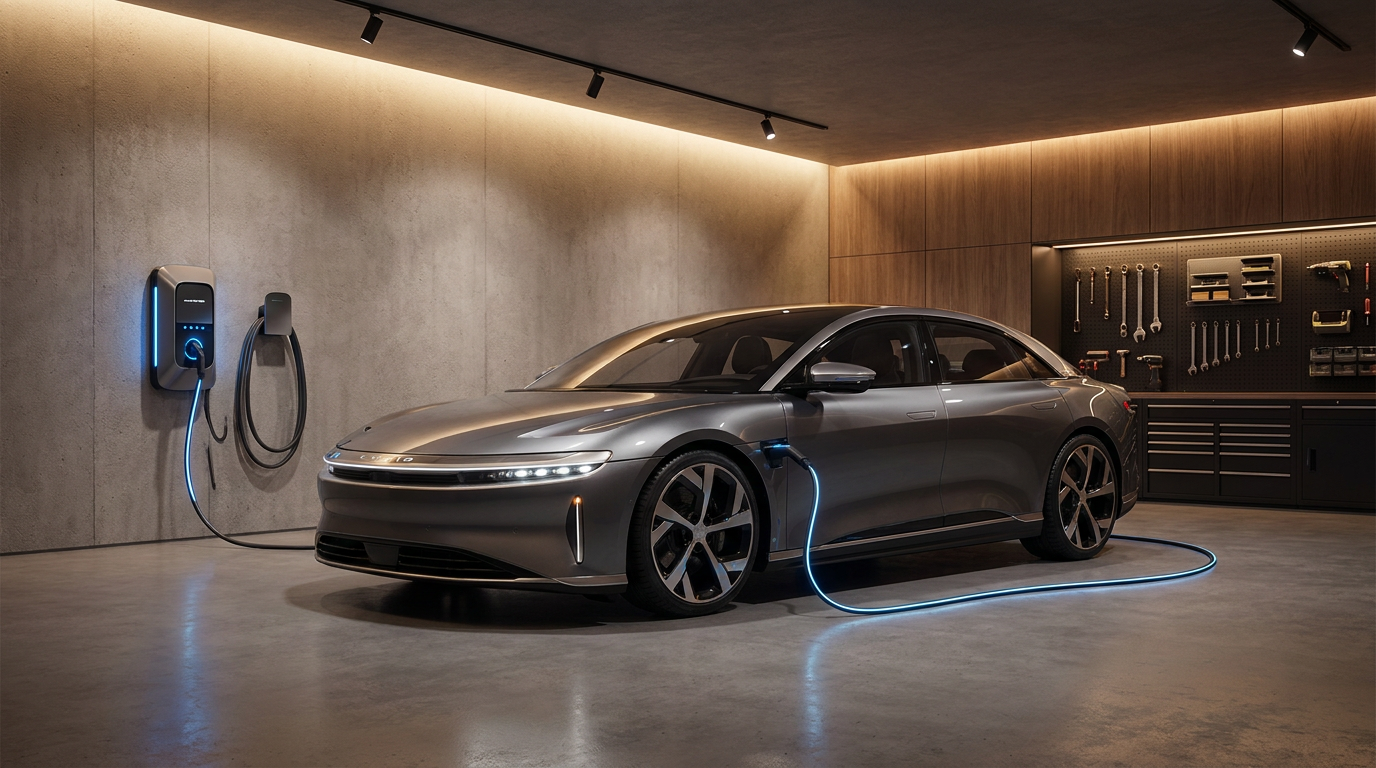
Bidirectional charging allows energy to flow both into and out of an electric vehicle's battery. Instead of merely consuming electricity, the car becomes a mobile power plant capable of running a job site, keeping a house illuminated during a multi-day blackout, or even selling power back to the utility company.[3][6]

While the concept made its global debut over a decade ago with the CHAdeMO-equipped Nissan Leaf, it remained a niche experiment. Now, it is becoming an industry standard. General Motors has committed to making bidirectional hardware standard across its entire Ultium EV lineup by 2026, and roughly 60% of all new EV models released this year feature some form of two-way power flow.[2][7]
To understand the landscape, buyers need to navigate three distinct flavors of the technology, often grouped under the umbrella term "V2X" or Vehicle-to-Everything. The most common and accessible entry point is Vehicle-to-Load, commonly abbreviated as V2L.[1][3]
V2L requires no special home installation. It simply provides a standard 120-volt or 240-volt outlet built directly into the car or accessed via a charge-port adapter. Delivering between 3.6 and 6.6 kilowatts of power, V2L is perfect for running power tools, camping equipment, or essential household appliances like a refrigerator and a few lamps during a brief power cut.[1][2][3]
The second tier, Vehicle-to-Home (V2H), is where the technology truly replaces a dedicated home battery. V2H integrates the vehicle directly into the home's electrical panel. During a grid outage, a fully charged EV can power an entire average household—including heating, cooling, and large appliances—for three to ten days without requiring any lifestyle compromises.[1][2]

The second tier, Vehicle-to-Home (V2H), is where the technology truly replaces a dedicated home battery.
However, V2H requires significant hardware upgrades. A standard Level 2 home charger only converts alternating current (AC) from the grid into direct current (DC) for the car's battery. A bidirectional charger must do the reverse, converting the car's DC power back into AC that the house can actually use.[4][5]
Furthermore, a V2H setup requires a microgrid interconnection device, often called an islanding switch. This crucial safety mechanism automatically disconnects the house from the broader utility grid during a blackout, ensuring that the EV doesn't accidentally send live electricity back into the neighborhood power lines and endanger utility repair crews.[4][5]
The third and most complex tier is Vehicle-to-Grid (V2G). This allows the homeowner to export stored energy beyond their own electrical panel and back to the public grid during peak demand hours, effectively selling electricity when market prices are highest.[1][3]
Utilities are increasingly eager to tap into this distributed energy resource. If thousands of EVs discharge just a fraction of their batteries during a summer heatwave, it can prevent rolling blackouts and offset the need to fire up dirty fossil-fuel peaker plants. In exchange, pilot programs in California, the UK, and the Netherlands are currently offering EV owners between $420 and $780 in annual incentives for V2G access.[2][7]

Despite the immense promise, the economics of bidirectional charging in 2026 require careful calculation. Installing a bidirectional charger and the necessary electrical panel upgrades typically costs between $4,000 and $8,000, depending on the home's existing infrastructure.[1][2]
While that is a steep premium over a standard $600 smart charger, it remains significantly cheaper than buying a dedicated stationary home battery, which often exceeds $12,000 fully installed. For homeowners who already own a compatible EV, V2H offers a heavily discounted path to whole-home energy resilience.[1][3][8]
The technology is also a perfect match for rooftop solar arrays. A homeowner can charge their EV using free, abundant solar energy during the midday sun, and then use the car to power the house in the evening when utility rates spike—a strategy known as time-of-use arbitrage.[1][5]

Yet, hurdles remain. Interoperability is a persistent headache, as some automakers prefer closed ecosystems that force buyers to use proprietary chargers. The industry is slowly rallying around the ISO 15118-20 communication standard to ensure any car can securely talk to any charger, but universal plug-and-play compatibility is still a work in progress.[4][7]
Finally, there is the psychological barrier of battery degradation. Many consumers worry that using their car to power their home will prematurely wear out the vehicle's most expensive component. While early data suggests that the shallow micro-cycling used for home backup has a negligible impact on battery health, automakers are still figuring out how to structure warranties to ease consumer anxiety.[2][8]
How we got here
2013
Nissan introduces the Leaf with CHAdeMO bidirectional capability, pioneering early V2H concepts.
2022
Ford launches the F-150 Lightning with Intelligent Backup Power, bringing whole-home V2H to the US mainstream.
2024
Major automakers begin adopting the NACS plug and standardizing bidirectional communication protocols.
2026
Bidirectional capability becomes a standard feature on roughly 60% of all newly released EV models.
Viewpoints in depth
Home Energy Integrators
Views the EV as the ultimate home battery, offering massive capacity for a fraction of the cost of dedicated storage.
This camp argues that the math heavily favors bidirectional charging for homeowners. Because consumers are already paying for a massive battery when they purchase an EV, buying a secondary, smaller battery just for the house is economically inefficient. Integrators emphasize that pairing a V2H-capable vehicle with rooftop solar creates a highly resilient microgrid, allowing homeowners to bypass expensive peak utility rates and survive multi-day outages without relying on noisy gas generators.
Charging Infrastructure Providers
Focuses on the technical hurdles of safely moving power, emphasizing standardized communication and professional installation.
Hardware manufacturers and installers stress that bidirectional charging is not a simple plug-and-play solution. They point out that moving high-voltage DC power out of a car and safely converting it to AC power for a home requires sophisticated, expensive equipment. This camp advocates strongly for the universal adoption of the ISO 15118-20 communication standard, warning that proprietary ecosystems will only frustrate consumers and slow down the broader adoption of vehicle-to-grid technologies.
Energy Market Analysts
Highlights the macro grid benefits of V2G, noting that millions of parked EVs could act as a decentralized power plant.
From a macro perspective, analysts view EVs as a critical tool for stabilizing the broader electrical grid. They argue that because cars are parked 95% of the time, their batteries represent a massive, untapped distributed energy resource. By offering financial incentives for EV owners to export power during peak demand, utilities can avoid building expensive, polluting peaker plants. However, this camp notes that regulatory red tape and utility interconnection delays remain significant bottlenecks to realizing this vision.
What we don't know
- How long it will take for universal interoperability standards like ISO 15118-20 to eliminate proprietary charger ecosystems.
- The long-term impact of daily Vehicle-to-Grid (V2G) micro-cycling on 10-year EV battery warranties.
- Whether utility companies will standardize V2G compensation rates across different regional markets.
Key terms
- Bidirectional Charging
- Technology that allows electricity to flow both into an EV battery from the grid, and out of the battery to power external loads.
- V2H (Vehicle-to-Home)
- A setup where an electric vehicle supplies power directly to a home's electrical panel, often used for backup power during outages.
- V2G (Vehicle-to-Grid)
- A system that allows an electric vehicle to export stored energy back to the public utility grid, often in exchange for financial credits.
- V2L (Vehicle-to-Load)
- A feature providing standard electrical outlets on the vehicle itself, allowing users to plug in appliances or tools directly.
- Islanding
- A safety mechanism that physically disconnects a home from the utility grid during a blackout, preventing backup power from back-feeding into public power lines.
- ISO 15118-20
- The international communication standard that allows electric vehicles and charging stations to securely manage bidirectional power transfer.
Frequently asked
Can any electric vehicle power my home?
No. Both the vehicle and your home charging equipment must specifically support bidirectional charging (V2H), and many older or entry-level EVs lack the necessary hardware.
Will powering my house void my EV battery warranty?
Automakers are updating warranties to account for bidirectional use, but policies vary. Most early data shows that the shallow discharging used for home backup causes negligible battery degradation.
Does bidirectional charging work during a blackout?
Yes, provided your home is equipped with an islanding switch (microgrid interconnection device) that safely disconnects your house from the dead utility grid.
What is the difference between V2L and V2H?
V2L (Vehicle-to-Load) lets you plug standard appliances directly into the car's outlets. V2H (Vehicle-to-Home) connects the car to your home's electrical panel to power the entire house.
Sources
Source coverage
8 outlets
3 viewpoints surfaced







[1]NuWatt EngineeringHome Energy Integrators
Bidirectional EV Charging & V2H in 2026: Can Your EV Replace a Home Battery?
Read on NuWatt Engineering →[2]Energy Solutions IntelligenceEnergy Market Analysts
Bidirectional EV Charging 2026: Which Cars Can Power Your Home and the Grid?
Read on Energy Solutions Intelligence →[3]AMP RenewablesCharging Infrastructure Providers
Which EVs support V2H in the UK in 2026?
Read on AMP Renewables →[4]NeoChargeCharging Infrastructure Providers
Bidirectional charging standard 2026
Read on NeoCharge →[5]American Solar Energy SocietyHome Energy Integrators
Vehicle-to-Home (V2H) Technology
Read on American Solar Energy Society →[6]EcoFlowHome Energy Integrators
What Is Bidirectional Charging and Why It Matters in 2026
Read on EcoFlow →[7]DriivzCharging Infrastructure Providers
The future of EV charging is clearly a two-way street
Read on Driivz →[8]Factlen Editorial TeamHome Energy Integrators
Synthesis by Factlen editorial team
Read on Factlen Editorial Team →


Every angle. Every day.
Get shopping stories with full source coverage and perspective breakdowns delivered to your inbox.