
How Apple's Rebuilt Siri AI in iOS 27 Actually Works
Apple's iOS 27 introduces a rebuilt, Gemini-powered Siri that finally delivers on long-delayed promises of personal context and cross-app automation. The update shifts Siri from a basic voice assistant to a system-wide agent, backed by new privacy architecture.
By Factlen Editorial Team
- Apple Ecosystem Users
- Value the seamless integration and the ability to finally have a conversational assistant that understands personal context without requiring third-party apps.
- Privacy Advocates
- Cautiously optimistic about the Private Cloud Compute architecture, but remain vigilant about the shift toward processing personal data on external servers.
- Industry Analysts
- View the overhaul as a necessary, albeit delayed, move to maintain Apple's competitive edge in the smartphone market.
- App Developers
- Facing a significant technical burden to migrate from legacy SiriKit to the newly mandatory App Intents framework.
What's not represented
- · Android users comparing the new features to existing Google Assistant capabilities
- · European consumers facing delayed access to the features due to regulatory hurdles
Why this matters
After years of lagging behind rivals, Apple's new AI integration fundamentally changes how users interact with their devices. By allowing Siri to securely search personal data and control third-party apps, the iPhone is transforming from a grid of isolated apps into a unified, context-aware digital assistant.
Key points
- Apple's iOS 27 introduces a completely rebuilt Siri powered by a custom 1.2-trillion-parameter Gemini model.
- A new standalone Siri app syncs conversation history across iPhone, iPad, and Mac via iCloud.
- Siri AI can now search personal context, including photos, emails, and messages, to answer highly specific queries.
- Complex requests are routed through Private Cloud Compute, which cryptographically destroys data after processing.
- The new features require an iPhone 15 Pro or newer, or a Mac equipped with an M1 chip or later.
For years, Apple's virtual assistant served as the punchline of the artificial intelligence boom. While competitors launched sophisticated conversational agents capable of writing code, drafting essays, and synthesizing complex research, Siri often struggled to set multiple timers or accurately parse basic web queries. The assistant's rigid architecture left it trailing far behind the generative AI curve, frustrating users who expected their premium devices to feature cutting-edge software. That era of stagnation officially ended at the 2026 Worldwide Developers Conference (WWDC). With the unveiling of iOS 27, Apple introduced "Siri AI," a completely rebuilt assistant designed to finally bridge the gap between basic voice commands and true artificial intelligence.
The update represents the most significant architectural shift in the iPhone's history, replacing the legacy voice recognition system with a custom 1.2-trillion-parameter Google Gemini model. According to Bloomberg's Mark Gurman, the massive overhaul is "good enough to help ease Apple out of its AI crisis," delivering on the ambitious personal context features the company first teased two years ago. Rather than simply bolting a chatbot onto the side of the operating system, Apple has deeply integrated the large language model into the core of iOS 27, allowing it to interact natively with the file system, notifications, and core applications.[1][4]
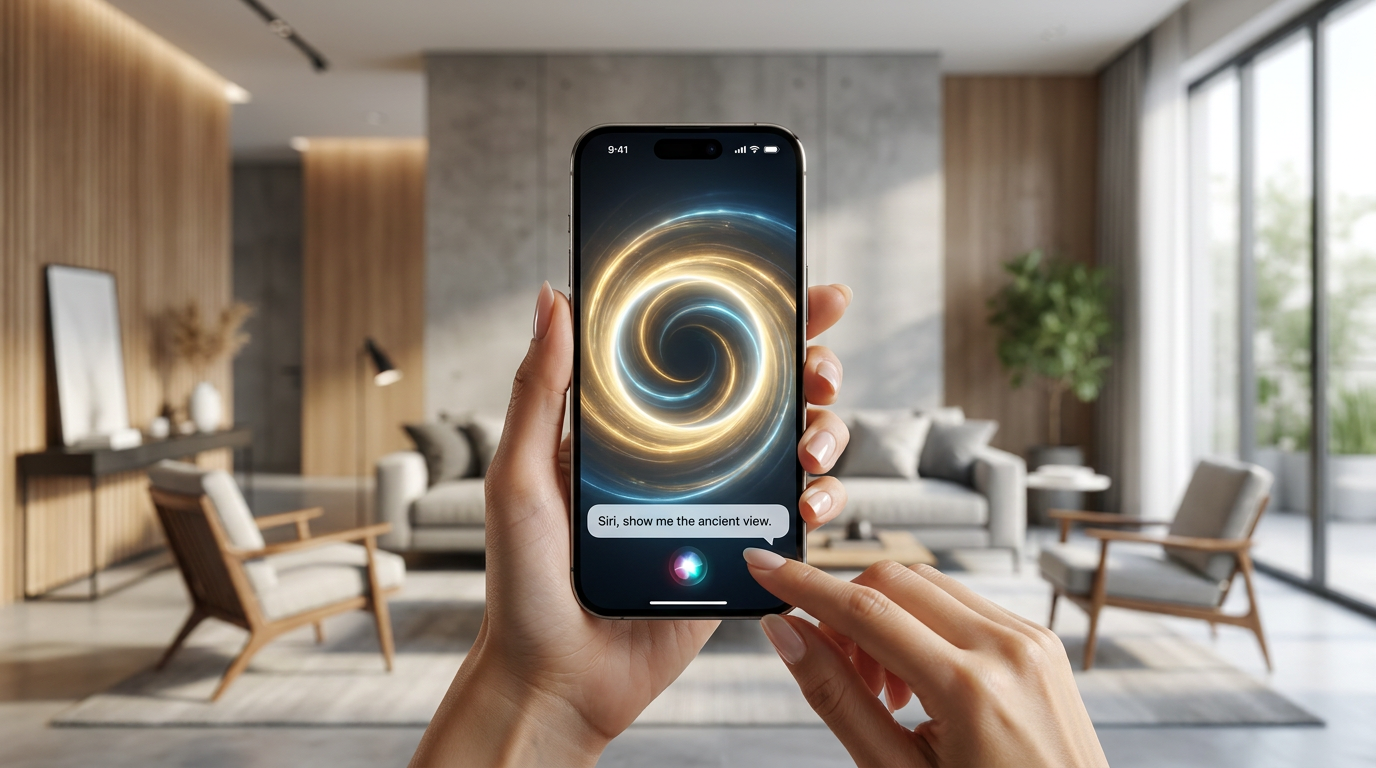
The most visible change in iOS 27 is the introduction of a standalone Siri application. For the first time since its inception, Siri is not just a transient voice overlay that disappears when a task is finished, but a permanent fixture on the Home Screen. The app features a familiar chat-style interface that maintains a persistent history of interactions, allowing users to scroll back through previous queries, upload documents for analysis, and type requests silently when speaking aloud is inconvenient.[3]

Because this conversation history syncs seamlessly via iCloud, it transforms Siri into a continuous cross-device workspace. A user can begin a complex research query on their iPhone during a commute, continue refining the parameters on their iPad, and eventually drag the synthesized results directly into a presentation on their Mac. When invoked outside the dedicated app, the assistant now surfaces in the Dynamic Island with a new "Search or Ask" prompt and a glowing cursor, signaling its readiness to handle complex, multi-step commands.[3][4]
But the real power of the rebuilt assistant lies in its "personal context awareness." Instead of merely querying the open web for generic information, Siri AI can now index and cross-reference a user's private data silos. The system can search through years of photos, parse buried email threads, scan text messages, and check calendar events to synthesize highly specific answers. It understands the relationships between contacts, the timeline of events, and the context of past conversations.[2]
This capability enables a fundamentally new type of interaction. For example, a user can ask Siri to "find the hotel address Sarah sent me last week and map a route there." Instead of requiring the user to open Messages, search for Sarah's name, scroll to find the address, copy the text, and paste it into Apple Maps, the assistant locates the specific iMessage, extracts the relevant address data, and seamlessly launches the navigation route in a single fluid motion.[2]
This capability enables a fundamentally new type of interaction.
This deep integration is paired with a feature Apple calls "on-screen awareness," which allows the assistant to "see" and understand exactly what is currently displayed on the device's active screen. If a user is looking at a photograph of a historical landmark in Safari, they can simply ask, "When was this built?" Siri AI will parse the visual context of the image, identify the landmark, and provide the answer without the user ever needing to specify what they are looking at.[2]

To make this level of cross-app automation possible, Apple is forcing a massive under-the-hood migration for its developer ecosystem. The legacy SiriKit framework, which developers previously used to build voice commands, is being officially deprecated. In its place, Apple has made "App Intents" the mandatory protocol for allowing Siri to understand and control the functions of third-party applications. This shift requires developers to explicitly define the actions their apps can perform, allowing the AI to string together complex workflows across multiple different software environments.[4]
Processing this level of complex, highly personal data requires immense computational power, which immediately raises significant privacy concerns. Apple's solution is a bifurcated processing model that relies heavily on the neural engines built into its latest custom silicon. Basic queries, text generation, and personal context searches are handled entirely on-device. This ensures that sensitive data—like private text messages, local photos, and personal emails—never leaves the iPhone's local storage.[2]
Because on-device processing is so resource-intensive, Apple has drawn a strict hardware line in the sand. Siri AI requires an iPhone 15 Pro or newer, or an iPad or Mac equipped with an M1 chip or later. Older devices simply lack the necessary neural processing units and unified memory required to run the massive foundation models locally without draining the battery or causing severe system lag. This hardware requirement means millions of existing Apple customers will need to upgrade their devices to access the new capabilities, potentially driving a massive super-cycle of hardware sales later this year.[2]
For more complex requests that exceed the device's local processing capabilities, iOS 27 utilizes a new infrastructure called "Private Cloud Compute." This system routes the query to Apple-managed servers running custom Apple Silicon. However, Apple has implemented strict cryptographic guarantees ensuring that the data sent to the cloud is never stored, logged, or accessible to Apple employees. Once the server processes the request and returns the answer, the data is permanently destroyed and is never used to train future foundation models.[2]

The rollout of Siri AI comes at a critical juncture for Apple's corporate reputation. In May 2026, the company reached a reported $250 million class-action settlement with iPhone buyers who alleged that Apple had falsely advertised AI-powered features that were repeatedly delayed and failed to materialize. The Gemini-powered assistant unveiled at WWDC is, quite literally, the product that the settlement was waiting on, representing a massive financial and engineering effort to make good on past promises.[4]
Despite the impressive technical showcase, the launch will not be entirely global. Apple has confirmed that Siri AI will be delayed in the European Union and China as the company navigates complex local data privacy regulations and strict competition laws. Furthermore, while the core Siri AI experience will launch with iOS 27, Apple is reportedly holding back at least three additional AI-driven features for subsequent updates later in the fall, staggering the release to ensure server stability and minimize early bugs.[2][5]
Ultimately, iOS 27 marks a fundamental shift in how consumers will interact with their Apple devices. By transitioning Siri from a basic voice command utility into a deeply integrated, context-aware digital workspace, Apple is betting that its privacy-first approach to artificial intelligence is the key to maintaining its smartphone dominance. If the real-world performance matches the WWDC demonstrations, the days of Siri apologizing for not understanding a basic request may finally be over, ushering in an era where the iPhone truly acts as a proactive digital assistant.[1][3]
How we got here
June 2024
Apple first previews its Apple Intelligence ambitions, promising deep personal context features.
May 2026
Apple settles a $250 million class-action lawsuit regarding delayed AI capabilities.
June 8, 2026
Apple officially unveils iOS 27 and the rebuilt Siri AI at the Worldwide Developers Conference.
Fall 2026
iOS 27 and the standalone Siri app are scheduled to launch to the public.
Viewpoints in depth
Industry Analysts
Market watchers view the Siri AI overhaul as a necessary, albeit delayed, move to maintain Apple's competitive edge.
Analysts argue that Apple's 'AI crisis' was less about a lack of technical capability and more about a failure to ship consumer-facing features quickly. By integrating a custom Gemini model and deeply embedding it into the OS, Apple has effectively neutralized the advantage held by competitors like Google and Samsung. However, analysts warn that the strict hardware requirements could frustrate users who are unwilling to upgrade to the iPhone 15 Pro or newer.
App Developers
Software creators face a massive technical migration to support the new AI features.
For developers, iOS 27 represents one of the most architecturally significant updates in years. The deprecation of SiriKit forces teams to completely rewrite their voice command integrations using the new App Intents framework. While this will ultimately allow Siri to perform complex, multi-step actions across different apps, developers are concerned about the immediate workload and the tight timeline to get their apps ready before the public launch in the fall.
What we don't know
- It remains unclear exactly when Siri AI will become available in the European Union and China due to ongoing regulatory negotiations.
- Apple has not detailed the exact pricing or potential future subscription tiers for advanced Apple Intelligence features.
Key terms
- Siri AI
- The completely rebuilt version of Apple's virtual assistant, powered by large language models and capable of natural conversation and cross-app actions.
- Private Cloud Compute
- Apple's secure server infrastructure designed to process complex AI requests without storing, logging, or retaining user data.
- App Intents
- The mandatory developer framework in iOS 27 that allows Siri to understand and control the functions of third-party applications.
- On-Screen Awareness
- Siri's new ability to analyze and understand the text, images, and context currently displayed on the device's active screen.
Frequently asked
Which devices support the new Siri AI?
Siri AI requires an iPhone 15 Pro or newer, or an iPad or Mac equipped with an M1 chip or later, due to the heavy processing demands of the local foundation models.
Will Apple use my personal data to train its AI?
No. Apple has stated that data processed through its Private Cloud Compute servers is cryptographically destroyed after the request is fulfilled and is never used to train foundation models.
Is the new Siri app available globally?
Not initially. Due to regulatory hurdles regarding data privacy and competition laws, Siri AI will be delayed in the European Union and China at launch.
Sources
Source coverage
5 outlets
4 viewpoints surfaced





[1]BloombergIndustry Analysts
Apple's New Siri Is Just Good Enough to Ease Its AI Crisis
Read on Bloomberg →[2]ApplePrivacy Advocates
Apple introduces Siri AI, a profoundly more capable and personal assistant
Read on Apple →[3]9to5MacApple Ecosystem Users
iOS 27 adds an all-new app to your iPhone's Home Screen
Read on 9to5Mac →[4]LushbinaryApp Developers
WWDC 2026: iOS 27, New Siri & Dev Tools
Read on Lushbinary →[5]EngadgetIndustry Analysts
Apple reportedly has three more iOS 27 features coming in the fall
Read on Engadget →
More in technology
See all 5 stories →

Every angle. Every day.
Get technology stories with full source coverage and perspective breakdowns delivered to your inbox.