
How AI Video Generators Are Democratizing Indie Filmmaking in 2026
A new generation of AI video models has transformed cinematic production, allowing independent creators to produce studio-quality short films at a fraction of the traditional cost.
By Factlen Editorial Team
- Indie Creators & AI Advocates
- View AI as a democratizing force that removes financial barriers and allows pure storytelling to thrive.
- Tech Platform Developers
- Focus on the rapid technical milestones achieved, viewing AI as the ultimate creative engine.
- Factlen Editorial Analysis
- Synthesizes the workflow shifts, noting that while technical barriers fall, human taste remains the differentiator.
What's not represented
- · Traditional below-the-line crew members (gaffers, grips, set designers)
- · Actors' unions navigating digital likeness rights
Why this matters
By lowering the financial barriers to high-end visual production, AI video tools are enabling diverse, niche stories that traditional studios would deem too risky to fund, fundamentally shifting who gets to be a filmmaker.
Key points
- AI video generation in 2026 has reached 'cinematic parity,' producing footage that rivals traditional 35mm film.
- The cost of generating high-fidelity video has plummeted, ranging from $0.10 to $0.75 per second.
- Advanced models now feature native synchronized audio and perfect temporal consistency across multiple shots.
- Independent creators are leveraging these tools to produce up to ten short films a year, bypassing traditional studio funding.
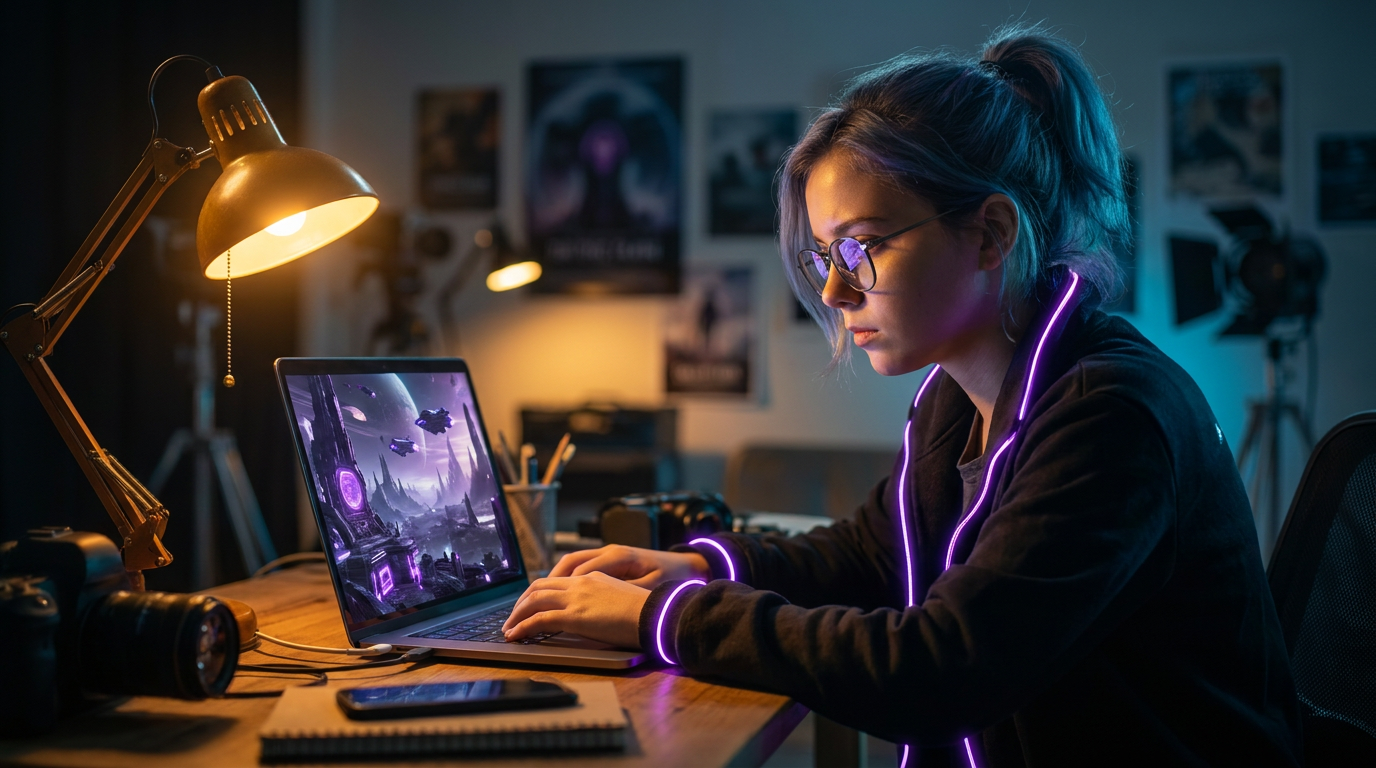
The era of the million-dollar independent short film is quietly drawing to a close. In 2026, the primary barrier to cinematic storytelling is no longer access to expensive camera packages, lighting crews, or rendering farms, but simply a laptop and a subscription. A new ecosystem of generative tools has collapsed the traditional production pipeline, allowing solo creators to execute visions that previously required a small army of technicians.[7]
Just two years ago, AI-generated video was characterized by surreal, morphing artifacts and a distinct lack of physical logic. Today, the industry has reached what experts call "cinematic parity," a threshold where AI-generated footage is virtually indistinguishable from 35mm film in controlled environments. The focus has shifted entirely from experimental novelty to professional-grade narrative storytelling.[3]
This rapid maturation was catalyzed by a wave of foundational model releases in early 2026. Platforms like Google's Veo 3.1, Kuaishou's Kling 3.0, OpenAI's Sora 2, and Runway's Gen-4.5 have transformed the landscape. These engines now offer native 4K resolution, multi-shot storytelling capabilities, and granular creative control that rivals traditional post-production software.[1][2]

To understand this democratization, one must look at the new production workflow, which compresses months of work into days. In pre-production, solo creators utilize large language models to rapidly iterate on scripts and generate comprehensive storyboards. This allows a single director to map out dozens of concepts and visual treatments before a single frame is ever rendered.[3]
The core engine of this revolution is visual generation. Creators use multimodal prompting—combining text descriptions with reference images—to generate highly specific scenes. Crucially, the 2026 generation of models solved the "temporal consistency" problem, allowing a character's face, clothing, and environment to remain perfectly identical across multiple camera angles and scene changes.[1][3]
Visuals alone do not make a film; audio has historically been a major bottleneck for independent creators. However, models like Veo 3.1 and Sora 2 now feature native, synchronized audio generation directly tied to the visual output. For more complex soundscapes, filmmakers integrate specialized tools like ElevenLabs to generate spatial audio that perfectly matches the environment, such as the distinct sound of tires on a wet Tokyo street.[1][3]
Post-production has similarly been streamlined. Instead of wrestling with complex timelines and keyframes, creators use AI-driven natural language editing to adjust lighting, remove objects, or automate tedious tasks like rotoscoping. The software handles the technical execution, leaving the filmmaker to focus entirely on pacing and emotional resonance.[7]
The software handles the technical execution, leaving the filmmaker to focus entirely on pacing and emotional resonance.
The economic implications of this workflow are staggering. Generating high-fidelity cinematic video now costs between $0.10 per second on Kling 3.0 and $0.75 per second on Sora 2. This collapse in production costs means a five-minute short film can be visually realized for less than the cost of a single day's catering on a traditional Hollywood set.[2]

For independent directors, this translates to an unprecedented increase in creative output. Creators who previously spent years fundraising and organizing logistics for a single project can now produce up to ten short films a year. Industry analysts estimate that these tools reduce overall production time by up to 80 percent.[3][5]
Because the financial risk of production has been effectively neutralized, niche storytelling is thriving. Filmmakers are greenlighting complex, highly specific narratives—such as a sci-fi exploration of depression recovery—that traditional studios would routinely reject as too narrow to guarantee a return on investment.[5]
The traditional film establishment is beginning to recognize this shift. Dedicated events like the AI Short Film Showcase at the "AI on the Lot" conference in Los Angeles and the "Frame Forward AI Animated Film Festival" are providing communal, physical venues for these digital creations, treating them with the same reverence as live-action cinema.[3][6]

Major technology companies are also actively funding this emerging ecosystem. Google recently partnered with Range Media Partners to launch "AI on Screen," a program commissioning original short films from visionary directors to explore the complex relationship between humanity and intelligent machines, signaling institutional support for the medium.[4]
The artistic acceptance of AI cinema reached a significant milestone at the 2025 Venice Film Festival, which hosted the screening of "The Pirate Queen," a film featuring a fully AI-generated cast. This inclusion signaled to the broader industry that generative tools are valid instruments of artistic expression, capable of standing alongside traditional filmmaking.[5]

Despite the heavy automation, industry consensus emphasizes the absolute necessity of the "human-in-the-loop." AI models excel at generating visual drafts and executing technical tasks, but human directors are required to shape the narrative arc, dictate the emotional pacing, and make the final editorial choices that give a film its soul.[3]
Ultimately, the rise of AI video generators in 2026 is not about replacing filmmakers, but empowering them. By removing the friction and prohibitive costs of traditional production, these tools have leveled the playing field, ensuring that the defining metric of a successful film is the quality of its story, not the size of its budget.[7]
How we got here
Early 2024
OpenAI announces Sora, demonstrating the potential of long-form, physics-aware AI video.
September 2025
The Venice Film Festival screens 'The Pirate Queen,' a film featuring a fully AI-generated cast.
January 2026
Google releases Veo 3.1, introducing native synchronized audio to high-fidelity video generation.
April 2026
Google and Range Media launch the 'AI on Screen' program to fund AI-driven short films.
Viewpoints in depth
Independent Filmmakers
Emphasizes the freedom from budget constraints and the ability to tell niche stories without studio interference.
For independent creators, the AI video revolution is fundamentally about artistic liberation. By removing the need for million-dollar budgets, filmmakers are no longer beholden to studio executives or risk-averse investors. This allows for the exploration of highly specific, niche narratives that would otherwise never see the light of day. The focus shifts entirely from logistical management to pure storytelling and emotional resonance.
Technology Developers
Focuses on the rapid technical milestones achieved, viewing AI as the ultimate creative engine.
Platform developers point to the staggering pace of innovation over the last two years as proof of AI's potential. By solving complex technical hurdles like temporal consistency and native audio generation, they argue that AI is not just a tool, but a collaborative creative engine. Their goal is to continue lowering the barrier to entry until anyone with an idea can instantly visualize it in 4K resolution.
Traditional Film Industry
Acknowledges the efficiency gains but remains cautious about the loss of below-the-line jobs and human performance.
While traditional studios and guilds acknowledge the undeniable efficiency of AI workflows, they maintain significant reservations. There is deep concern over the displacement of below-the-line crew members—such as gaffers, set designers, and sound mixers—whose livelihoods depend on physical production. Furthermore, many industry veterans argue that while AI can replicate the look of cinema, it cannot yet capture the spontaneous magic of a live human performance.
What we don't know
- How major streaming platforms will formally categorize and monetize fully AI-generated indie films.
- The long-term impact on below-the-line crew jobs as virtual production replaces physical sets.
- Whether copyright offices will establish clear protections for AI films generated via highly specific human prompting.
Key terms
- Temporal Consistency
- The ability of an AI model to keep a character's appearance and environment identical across different shots and camera angles.
- Neural Rendering
- The process of using artificial intelligence to generate photorealistic 2D images and video from text or 3D data.
- Native Audio Generation
- AI models that generate synchronized sound effects and dialogue simultaneously with the video, rather than adding it in post-production.
- Rotoscoping
- A traditional visual effects technique used to trace over motion picture footage frame by frame, which is now largely automated by AI.
Frequently asked
How much does it cost to generate AI video?
In 2026, premium models charge between $0.10 and $0.75 per second of generated video, making it highly affordable for independent creators.
Can AI models generate consistent characters?
Yes. The latest 2026 models use reference images to maintain perfect character identity and temporal consistency across multiple scene changes.
Do AI videos have sound?
Leading models like Google Veo 3.1 and OpenAI Sora 2 now feature native audio generation, producing synchronized sound alongside the video.
Are AI films accepted at film festivals?
Yes. Dedicated events like the AI Short Film Showcase exist, and major traditional festivals like Venice have begun screening AI-assisted projects.
Sources
Source coverage
7 outlets
3 viewpoints surfaced







[1]HedraTech Platform Developers
The 10 best AI video generators for 2026
Read on Hedra →[2]GetAIPerksTech Platform Developers
AI Video Generator Pricing and Quality 2026
Read on GetAIPerks →[3]DigenIndie Creators & AI Advocates
Finding the best AI for short films in 2026
Read on Digen →[4]Google BlogTech Platform Developers
A short film program to explore AI on screen
Read on Google Blog →[5]NE GlobalIndie Creators & AI Advocates
AI can push a 'democratization' in film production
Read on NE Global →[6]AI on the LotIndie Creators & AI Advocates
AI Short Film Showcase 2026
Read on AI on the Lot →[7]Factlen Editorial TeamFactlen Editorial Analysis
Synthesis by Factlen editorial team
Read on Factlen Editorial Team →
More in ai
See all 7 stories →Edge AI
How On-Device AI and Quantization Are Moving LLMs Out of the Cloud
6 sources

Agentic AI
Agentic AI: How Large Action Models Are Automating Digital Chores
7 sources

Global AI Governance
EU Delays Key AI Act Enforcement as 'Brussels Effect' Fractures Under US Deregulation
8 sources
Drug Discovery
New AI Model Accelerates Molecular Simulations 10,000-Fold, Promising Faster Drug Discovery
6 sources
Every angle. Every day.
Get ai stories with full source coverage and perspective breakdowns delivered to your inbox.