
How AI-Powered Drone Swarms Are Accelerating Global Landmine Clearance
A new generation of autonomous drones equipped with synthetic aperture radar, thermal imaging, and machine learning is transforming humanitarian demining, allowing organizations to clear post-conflict zones faster and safer than ever before.
By Factlen Editorial Team
- Humanitarian Demining Organizations
- Prioritize civilian safety, operational reliability, and rapid area reduction.
- Defense Technology Innovators
- Focus on sensor fusion, cloud computing, and replacing legacy metal detectors.
- Academic Researchers
- Emphasize rigorous testing, multi-spectral imaging, and mitigating false positives.
What's not represented
- · Local farmers and civilians whose livelihoods depend on trusting the accuracy of AI-cleared land.
- · Policy makers responsible for regulating the deployment of autonomous systems in post-conflict zones.
Why this matters
With over 110 million landmines buried across 60 countries, traditional clearance methods are dangerously slow. Integrating AI and drone technology dramatically accelerates the return of safe land to farmers and displaced civilians, turning a decades-long humanitarian crisis into a solvable engineering challenge.
Key points
- Over 110 million landmines remain buried across 60 countries, posing a massive humanitarian and economic crisis.
- Traditional metal detectors are slow and prone to false positives, struggling to locate modern plastic-cased explosives.
- AI-equipped drones use optical, thermal, and radar sensors to rapidly map hazardous areas and identify threats.
- Machine learning models have achieved over 90% accuracy in detecting specific ordnance types during field trials.
- Demining organizations use this technology for 'area reduction,' shrinking suspected danger zones so human sappers can work faster and safer.
- While highly effective, AI remains an auxiliary tool that requires human verification due to environmental limitations like dense vegetation.
The scale of the global landmine crisis is staggering, with an estimated 110 million explosive devices embedded in the soil across more than 60 countries. For decades, the primary method of clearing these post-conflict zones has relied on human sappers wielding electromagnetic induction (EMI) metal detectors. This traditional approach is perilous, painstakingly slow, and increasingly ineffective against modern munitions. Because conflict zones are often littered with harmless metallic shrapnel, EMI sensors generate a constant stream of false positives that force deminers to stop and manually excavate harmless debris. Furthermore, many modern landmines are designed specifically to evade these legacy tools by utilizing plastic casings with minimal metal content, rendering them nearly invisible to standard sweeps. The result is a widening gap between the speed at which explosives are deployed and the rate at which they can be safely removed, leaving vast tracts of agricultural land unusable.[4][6]
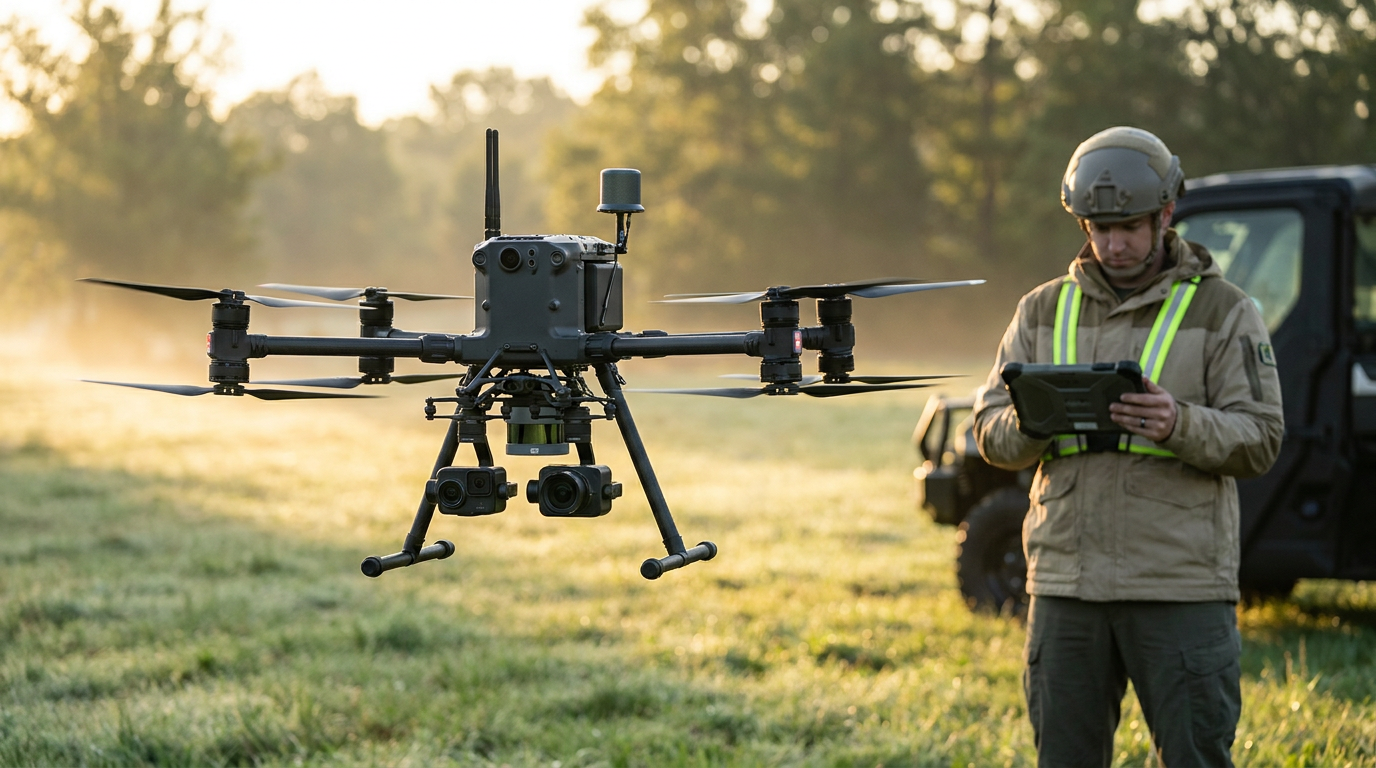
Humanitarian demining is currently experiencing a technological renaissance that promises to close this gap. Driven by the urgent needs in heavily contaminated conflict zones like Ukraine, a coalition of non-governmental organizations, academic researchers, and defense technology startups are deploying AI-powered drone swarms to map and clear hazardous areas at unprecedented speeds. By moving the initial detection phase from the ground to the air, these organizations are fundamentally altering the risk calculus for human operators, allowing technology to absorb the most dangerous aspects of the survey process.[1][5]
The core of this transformation is a concept known as aerial area reduction. According to the UN Mine Action Service (UNMAS), modern conflicts increasingly rely on remotely deployed mines scattered by artillery, rockets, or drones, rather than those buried by hand. Because these munitions often sit directly on or just below the surface, they are prime targets for aerial detection. Exploiting this deployment weakness allows demining teams to rapidly scan vast environments without ever setting foot in the danger zone.[2]
Drones equipped with high-resolution cameras can survey massive tracts of land in a fraction of the time it takes a human team. By pairing this aerial imagery with advanced machine learning models, organizations can shrink suspected hazardous areas from the size of a football pitch down to a few square meters. This efficiency ensures that when human sappers are eventually deployed, they are walking into confirmed threat zones rather than wasting weeks sweeping empty fields, drastically quickening the return of land to productive purposes.[2]

The empirical evidence supporting optical AI detection is highly robust. Safe Pro Group's SpotlightAi platform, fueled by Amazon Web Services cloud computing, utilizes an exclusive dataset of over 100,000 labeled images encompassing more than 150 distinct types of landmines and unexploded ordnance. By processing sub-centimeter-level data captured by off-the-shelf commercial drones, the system rapidly categorizes surface threats and assigns precise GPS coordinates, generating actionable intelligence reports for government bodies and NGOs.[4]
In rigorous academic trials published in the MDPI Sensors journal, researchers deployed Convolutional Neural Networks (CNNs) to identify PFM-1 "butterfly" mines—notoriously difficult plastic explosives that are often scattered aerially. By training the models on high-resolution drone imagery, the research team achieved a 91.8% successful detection rate in active field trials. When tested in highly controlled environments with partially withheld datasets, the models peaked at an extraordinary 99.3% accuracy. This evidence demonstrates that machine learning algorithms can reliably distinguish between lethal plastic ordnance and natural environmental clutter.[6]
However, optical cameras are inherently limited by dense vegetation and subsurface burial. To counter these environmental blind spots, researchers are layering multi-modal sensors onto drone platforms. Waseda University, in partnership with the International Committee of the Red Cross (ICRC), has pioneered the use of thermal infrared (IR) sensing to detect threats that are completely hidden from the naked eye.[3]
However, optical cameras are inherently limited by dense vegetation and subsurface burial.
Because landmines absorb and radiate thermal energy differently than the surrounding soil, thermal cameras can detect their distinct heat signatures. In field experiments conducted in Denmark, the Waseda AI system correctly predicted the locations of all buried test mines based purely on thermal data. By shifting the detection parameter from visual shape to thermal radiation, the system bypasses the camouflage of topsoil and scattered debris.[3]
For even deeper threats, the Lithuanian defense technology firm Broswarm has integrated the world's lightest synthetic aperture radar (X-SAR) onto autonomous drone swarms. This technology penetrates up to 0.5 meters below the surface, identifying both metallic and plastic-cased threats by analyzing the ground layer by layer. By merging this radar data with optical surface detection, the AI constructs a comprehensive 3D spatial reconstruction of the minefield.[7]

The HALO Trust, the world's largest landmine clearance organization, is actively synthesizing these disparate technologies in the field. Supported by a $4 million grant from Amazon Web Services, HALO is piloting advanced machine learning workflows in Ukraine. The organization overlays its own drone imagery and satellite data with field observations to continuously train and validate highly accurate AI models tailored to specific regional biomes.[1][5]
The results of this data-driven approach are already tangible. To date, HALO has utilized these advanced mapping techniques in conjunction with Esri's ArcGIS software to identify 13,000 danger zones, systematically confirming them safe for civilian use and agriculture. By providing visual, data-backed proof that a field is clear, the technology helps overcome the deep psychological fear that prevents farmers from returning to their land.[5]
Beyond aerial drones, the evidence pack for next-generation demining includes groundbreaking ground-based innovations. HALO is currently testing magnetic resonance detectors developed by the Australian company MRead. Unlike traditional models that beep at any scrap of iron, these new devices identify the specific molecular signature of explosive compounds in the earth, entirely eliminating false positives from battlefield scrap and successfully detecting low-metal mines.[1]

Despite the overwhelming promise of these technologies, transparent uncertainty remains regarding their fully autonomous deployment. Academic researchers note that AI models still struggle with false positives generated by dense vegetation, complex terrain, and unusual rocks. If an AI system flags too many harmless objects as potential mines, it can inadvertently divert critical human resources and slow down the overall clearance operation.[3][6]
Furthermore, environmental factors such as high drone altitudes and adverse weather conditions can severely degrade sensor fidelity. Consequently, the current consensus among demining experts is that AI serves as a powerful auxiliary tool for mapping and area reduction, rather than a wholesale replacement for human verification. Technology is adopted and integrated into workflows only once it is proven mature and robust enough to handle the deadly realities of the field.[2][5]

Ultimately, the integration of AI, multi-modal sensors, and drone swarms represents the most significant leap in humanitarian demining in decades. By transforming a perilous, inch-by-inch human endeavor into a scalable, data-driven operation, this technology is actively saving lives. It accelerates the day when displaced families can safely return to their homes, proving that the same technological advancements that complicate modern warfare can also be harnessed to heal its aftermath.[1][8]
How we got here
1979–1989
Millions of plastic-cased PFM-1 'butterfly' mines are aerially dispersed during the Soviet-Afghan War, establishing a long-term detection challenge.
2018
Waseda University and the International Committee of the Red Cross sign a cooperation agreement to develop advanced drone-based mine detection.
2021
Academic researchers publish breakthroughs in using Convolutional Neural Networks to automate the detection of surface-scattered plastic mines.
Late 2023
Defense tech startups begin deploying commercial AI platforms, processing massive datasets of drone imagery to identify over 150 ordnance types.
2024–2026
The HALO Trust scales AI and drone operations in Ukraine, utilizing advanced mapping to clear thousands of danger zones for civilian use.
Viewpoints in depth
Humanitarian Demining Organizations
Focused on maximizing civilian safety and accelerating the return of agricultural land.
Groups like The HALO Trust and the UN Mine Action Service view AI as a critical force multiplier, not a replacement for human expertise. Their primary metric for success is 'area reduction'—using drones to quickly rule out safe zones so that highly trained human sappers can focus their dangerous, time-consuming work strictly on confirmed hazardous areas. They emphasize that technology must be robust enough to handle the chaotic realities of active conflict zones like Ukraine.
Defense Technology Innovators
Focused on sensor fusion, machine learning accuracy, and scalable cloud processing.
Commercial startups and defense contractors argue that traditional electromagnetic induction (metal detecting) is fundamentally obsolete against modern plastic explosives. By layering optical, thermal, and synthetic aperture radar data into cloud-based neural networks, these innovators believe they can eventually automate the entire detection pipeline, turning a manual humanitarian crisis into a solvable data engineering challenge.
Academic Researchers
Focused on rigorous empirical testing, edge-case mitigation, and reducing false positives.
University research teams emphasize the gap between controlled testing environments and real-world deployment. While celebrating high detection rates in sterile trials, academics caution that dense vegetation, unpredictable weather, and varied soil compositions still trigger false positives. Their current focus is on expanding training datasets across diverse biomes to ensure AI models do not dangerously misclassify lethal ordnance as harmless rocks or debris.
What we don't know
- How effectively these AI models will scale across entirely different biomes, such as dense jungles or heavily flooded regions, where sensor penetration is severely limited.
- The long-term funding models required to ensure these advanced, cloud-dependent technologies remain accessible to demining organizations in developing nations.
- When fully autonomous ground robots will be reliable enough to handle the physical neutralization of mines without human intervention.
Key terms
- Electromagnetic Induction (EMI)
- The geophysical principle used by traditional metal detectors to locate buried objects, which struggles to differentiate between lethal mines and harmless scrap metal.
- Synthetic Aperture Radar (X-SAR)
- An advanced radar technology that can penetrate the ground to detect buried objects, including non-metallic plastic explosives, up to 0.5 meters deep.
- Area Reduction
- The process of surveying a large suspected hazardous area to quickly rule out safe zones, thereby shrinking the actual area that requires slow, manual clearance.
- Convolutional Neural Network (CNN)
- A type of artificial intelligence specifically designed to analyze visual imagery, used in this context to recognize the specific shapes and boundaries of landmines.
- PFM-1 Mine
- A small, aerially dispersed anti-personnel landmine made largely of plastic, notoriously difficult to detect with traditional methods and highly dangerous to civilians.
Frequently asked
Can AI drones physically remove the landmines?
No. Currently, drones are used for mapping and detection. Once a threat is identified and its GPS coordinates are logged, highly trained human sappers or specialized ground robots are deployed to safely neutralize or remove the explosive.
Why are traditional metal detectors no longer sufficient?
Many modern landmines, such as the PFM-1 'butterfly' mine, are made almost entirely of plastic and contain very little metal. Additionally, conflict zones are often littered with harmless metal shrapnel, which causes traditional detectors to register constant false positives.
How does thermal imaging find buried explosives?
Landmines absorb and retain heat differently than the surrounding soil. Thermal infrared cameras mounted on drones can detect these subtle temperature differences, revealing the outline of a buried object even when it is completely hidden from the naked eye.
Is this technology currently being used in active conflict zones?
Yes. Organizations like The HALO Trust are actively piloting these AI and drone systems in Ukraine to map hazardous areas and accelerate the return of agricultural land to civilians.
Sources
Source coverage
8 outlets
3 viewpoints surfaced








[1]The HALO TrustHumanitarian Demining Organizations
As technology transforms warfare, HALO deploys AI, drones and robots to save lives
Read on The HALO Trust →[2]United NationsHumanitarian Demining Organizations
Artificial Intelligence, a booster for mine action
Read on United Nations →[3]Waseda UniversityAcademic Researchers
Thermal sensing and machine learning improve accuracy of landmine detection
Read on Waseda University →[4]Emergency Drone ResponderDefense Technology Innovators
Revolutionizing Landmine Clearance through Advanced Drone Technology and AI Precision
Read on Emergency Drone Responder →[5]National Defense MagazineDefense Technology Innovators
HALO Trust, Esri Advancing AI in Landmine Detection
Read on National Defense Magazine →[6]MDPI SensorsAcademic Researchers
Automated Detection of PFM-1 Landmines using UAVs and CNNs
Read on MDPI Sensors →[7]BroswarmDefense Technology Innovators
Broswarm – Revolutionizing Underground Object Detection
Read on Broswarm →[8]Factlen Editorial TeamAcademic Researchers
Synthesis by Factlen editorial team
Read on Factlen Editorial Team →

Every angle. Every day.
Get defense security stories with full source coverage and perspective breakdowns delivered to your inbox.