
How AI Dubbing is Helping Independent Creators Build Global Empires Overnight
Advancements in AI voice cloning and lip-sync technology are allowing independent video creators to seamlessly translate their content into dozens of languages, breaking down global barriers that once required massive studio budgets.
By Factlen Editorial Team
- Independent Creators
- Value the ability to reach global audiences and unlock new revenue streams without prohibitive production costs.
- Localization Professionals
- Emphasize that while AI accelerates translation, human oversight is still required to navigate complex cultural nuances and slang.
- AI Platform Developers
- Focus on pushing the boundaries of synthetic media, prioritizing emotional preservation and visual synchronization.
- Global Audiences
- Prioritize immersive, native-language viewing experiences over reading subtitles, driving higher engagement.
What's not represented
- · Traditional voice actors facing industry disruption
- · Non-English creators expanding into the US market
Why this matters
For years, the internet was heavily siloed by language, limiting the reach of educational and entertainment content. This technological shift democratizes global distribution, allowing a solo creator in Ohio to seamlessly teach a student in Tokyo in their native tongue.
Key points
- YouTube's Multi-Language Audio feature allows creators to upload dozens of language tracks to a single video.
- Third-party AI tools can now clone a creator's voice to preserve emotion and pacing across languages.
- Advanced platforms use phoneme-level mapping to visually sync a creator's lips to the new translated audio.
- Independent creators are using these tools to turn their English-only back catalogs into global media assets.
For the first two decades of the creator economy, independent video producers faced a hard ceiling: language. Conquering the English-speaking market was a monumental task, but expanding beyond it required a luxury reserved for massive Hollywood studios or top-tier creators like MrBeast. Going global meant hiring casting directors, voice actors, translators, and audio engineers to painstakingly recreate content for new demographics.[4][7]
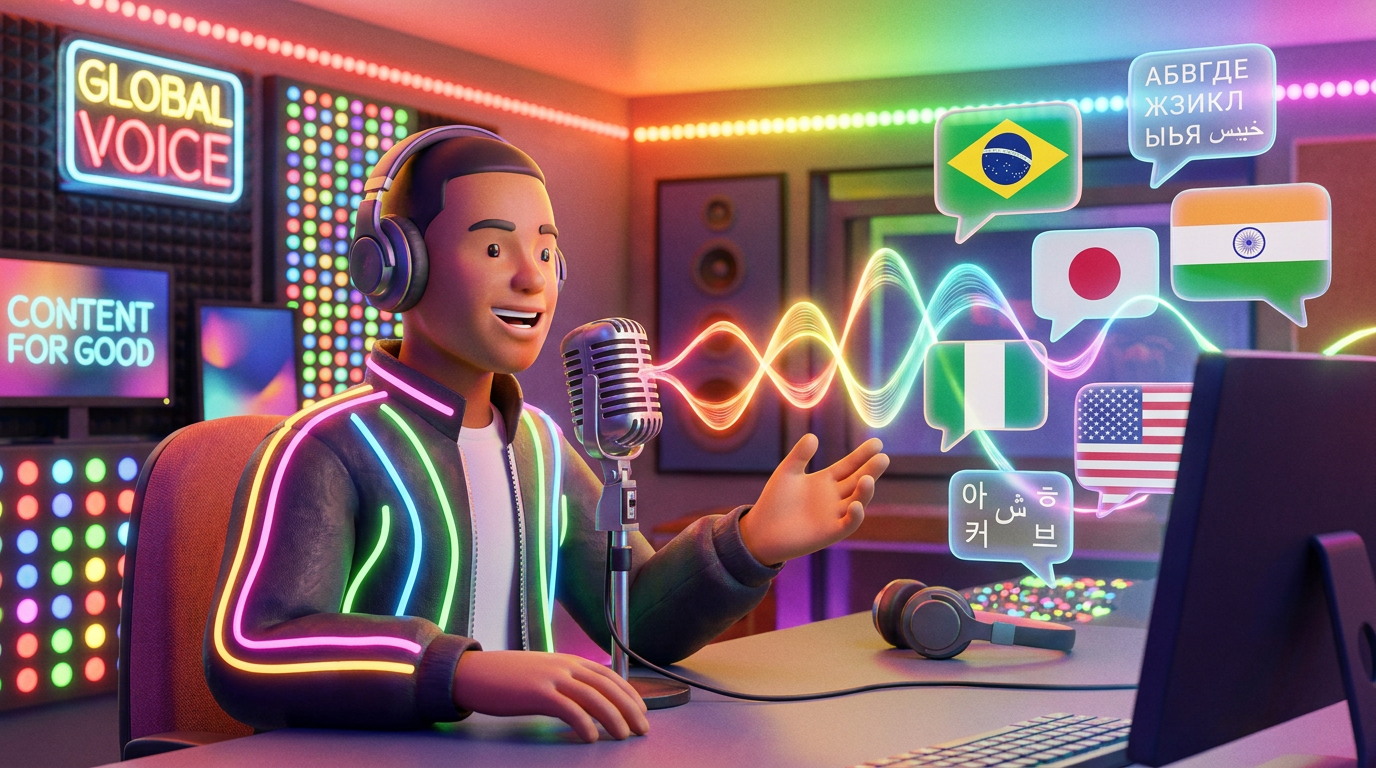
That reality has fractured entirely over the last year. In late 2025, YouTube expanded its Multi-Language Audio (MLA) feature to millions of creators across its platform. The feature allows a single video upload to house dozens of different audio tracks, seamlessly serving a Spanish voiceover to a viewer in Mexico City while simultaneously delivering Japanese audio to a viewer in Tokyo.[1]
The results of this architectural shift were immediate and staggering. YouTube reported that creators utilizing the MLA feature saw over 25% of their total watch time originate from non-primary languages. High-profile early adopters, such as chef Jamie Oliver, saw their viewership triple after adding Spanish, Portuguese, and Hindi tracks to their existing catalogs.[1]
However, the initial rollout was not without friction. YouTube's native auto-dubbing tool, while free and widely accessible, faced early criticism from audiences and creators alike. Many described the first wave of AI-generated voices as "robotic" and "cringe," noting that they fundamentally lacked the emotional nuance and pacing required for engaging digital storytelling.[1][5]
This quality gap birthed a booming ecosystem of third-party AI localization platforms. Companies like ElevenLabs, HeyGen, and Vozo stepped in to provide professional-grade dubbing that independent creators could actually afford, effectively democratizing the kind of global distribution that once cost tens of thousands of dollars per video.[2][3][4]

The mechanism behind this revolution is a multi-step pipeline that begins with context-aware transcription and translation. Unlike basic text translators of the past, modern AI localization tools analyze the script for cultural context. They ensure that industry jargon, regional slang, and complex metaphors are adapted conceptually rather than translated literally, preserving the core message.[5][6]
The next step—voice cloning—represents the most significant technological leap in the process. Advanced models, such as ElevenLabs' Dubbing v2, do not simply synthesize a generic foreign voice reading a script. Instead, they condition the AI directly on the creator's original on-camera performance.[2]
The next step—voice cloning—represents the most significant technological leap in the process.
This conditioning means the newly generated translated speech retains the creator's unique pitch, pacing, breath patterns, and emotional delivery. An enthusiastic, high-energy shout in English translates into an equally energetic shout in French, preserving the vital parasocial connection and authenticity that drives YouTube engagement.[2][4]

Yet, achieving perfect audio creates a secondary problem: the visual disconnect. When a creator speaks fluent German but their mouth is clearly forming English words, the viewer experiences a jarring "uncanny valley" effect. For high-retention content, this visual friction can easily break immersion and cause viewers to click away.[4][5]
To solve this, platforms like HeyGen introduced phoneme-level mapping and AI lip-syncing. This technology analyzes the new audio track and subtly alters the pixels around the creator's mouth in the original video file, matching their lip movements to the newly generated foreign-language syllables.[3][4]
The result is a seamless, native-feeling localization experience. A viewer doesn't just hear a localized voiceover; they see the creator naturally speaking their language. This level of visual and auditory polish allows solo creators to present themselves as global media brands without ever leaving their home studios.[3][7]
Despite these technological marvels, the system is not entirely foolproof. Localization professionals consistently warn that AI still struggles with deep cultural nuances. A direct translation of a sarcastic joke might fall flat, or a casual phrase might inadvertently offend a different demographic if the AI lacks the specific cultural context.[6][7]

For this reason, hybrid workflows are rapidly emerging as the gold standard for larger channels. Services like ElevenLabs Productions pair the raw speed and efficiency of AI generation with human linguists who review scripts for cultural accuracy and brand safety before the final audio is synthesized.[2][6]
There is also a massive strategic advantage in how platforms handle discoverability. YouTube's algorithm treats newly added language tracks as fresh content for that specific demographic. This means a creator can breathe new life into a three-year-old back catalog simply by uploading Arabic or Korean audio tracks, triggering a new wave of algorithmic distribution.[1][4]
The implications for the broader creator economy are profound. The traditional advice—to niche down and conquer one specific geographic demographic—is being entirely rewritten. Creators are realizing that their back catalogs are no longer dead archives, but highly exportable assets waiting to be unlocked.[4][7]
As the internet moves definitively past the "subtitle era," high-quality audio localization is quickly becoming the baseline expectation for digital video. For independent creators, the language barrier has finally fallen, unlocking billions of potential new viewers and fundamentally changing how knowledge, entertainment, and culture are shared across borders.[5][7]

How we got here
Early 2023
YouTube launches a limited pilot of Multi-Language Audio with top creators like MrBeast.
December 2024
YouTube rolls out its native auto-dubbing feature powered by Google Translate.
September 2025
Multi-Language Audio upload capabilities expand to millions of creators globally.
Mid 2026
Third-party tools introduce advanced voice cloning and phoneme-level lip-syncing for indie creators.
Viewpoints in depth
Independent Creators
Solo YouTubers are treating their back catalogs as highly exportable global assets.
For independent creators, the math of content production has fundamentally changed. Instead of spending weeks conceptualizing, filming, and editing a brand new video to chase marginal growth in their home country, they can spend a few hours running their best-performing historical videos through an AI localization pipeline. This strategy allows them to tap into massive, underserved markets in Latin America, Europe, and Asia without increasing their production workload, effectively turning a single successful video into a global franchise.
Localization Professionals
Linguists advocate for a hybrid model where AI does the heavy lifting but humans ensure cultural safety.
While AI has solved the speed and cost bottlenecks of translation, localization experts warn that language is inherently cultural. Direct translations of idioms, pop-culture references, or sarcastic humor often fail to land—or worse, cause accidental offense—in foreign markets. Professional localization agencies are pivoting to a 'human-in-the-loop' model, where AI generates the initial translation and voice clone, but native-speaking linguists review and tweak the script to ensure the creator's brand remains culturally resonant and safe.
AI Platform Developers
Tech companies are focused on solving the 'uncanny valley' of synthetic media.
For the engineers building these tools, the frontier is no longer just accurate translation; it is emotional preservation and visual cohesion. Developers at companies like ElevenLabs and HeyGen are training models to recognize when a creator is whispering, shouting, or laughing, and to carry that exact acoustic energy into the target language. Simultaneously, they are refining phoneme-mapping algorithms to ensure that the visual manipulation of the creator's mouth looks entirely natural, eliminating the jarring disconnect of traditional dubbing.
Global Audiences
International viewers are rewarding dubbed content with significantly higher retention rates.
The data indicates a massive shift in viewer preference away from subtitles. Audiences increasingly consume content on mobile devices while multitasking, making it difficult to read along with fast-paced videos. High-quality dubbing provides a frictionless, immersive experience that allows viewers to connect with the creator's personality rather than focusing on text at the bottom of the screen. This preference is reflected in the metrics, with dubbed videos routinely seeing viewers stay engaged 60% longer than subtitled equivalents.
What we don't know
- How YouTube's algorithm will balance the influx of newly dubbed content against native-language creators in local markets.
- Whether audiences will eventually develop 'AI fatigue' if synthetic voices become too ubiquitous.
- How copyright and intellectual property laws will adapt to protect creators' cloned voices from unauthorized use.
Key terms
- Multi-Language Audio (MLA)
- A YouTube feature allowing creators to upload multiple language audio tracks to a single video, which viewers can toggle between.
- Voice Cloning
- AI technology that analyzes a speaker's voice and generates synthetic speech matching their unique tone, pitch, and emotional delivery.
- Phoneme-level Mapping
- The process of using AI to subtly alter a video's pixels so the speaker's mouth movements visually match a translated audio track.
- Localization
- Adapting content not just by translating the words, but by adjusting cultural references, slang, and tone to feel native to a specific region.
Frequently asked
Can viewers tell if a video is AI-dubbed?
Yes, YouTube requires auto-dubbed videos to carry an 'auto-dubbed' label in the player so viewers understand they are hearing AI-generated audio.
Does YouTube penalize videos for adding languages later?
No. YouTube's algorithm treats newly added multilingual audio tracks as fresh content for that specific demographic, meaning there is no penalty for uploading dubs weeks or months after the original video.
Is AI dubbing expensive for small creators?
While premium enterprise solutions exist, many AI dubbing tools offer credit-based subscriptions starting as low as $5 to $20 a month, making it highly accessible for independent creators.
Does AI dubbing change the creator's voice?
Modern tools use voice cloning to preserve the creator's original pitch, tone, and emotional delivery, ensuring they sound like themselves even when speaking a foreign language.
Sources
Source coverage
7 outlets
4 viewpoints surfaced







[1]SlatorGlobal Audiences
YouTube rolls out Multi-Language Audio to millions of creators
Read on Slator →[2]ElevenLabsAI Platform Developers
A major breakthrough in AI dubbing
Read on ElevenLabs →[3]HeyGenAI Platform Developers
Unlock global markets with AI video localisation
Read on HeyGen →[4]MetaMuseIndependent Creators
Going Global Overnight: The New Creator Advantage
Read on MetaMuse →[5]3Play MediaLocalization Professionals
The Professional Guide to Localizing YouTube Content
Read on 3Play Media →[6]VerbitLocalization Professionals
AI dubbing and global content localization: What creators need to know
Read on Verbit →[7]Factlen Editorial TeamIndependent Creators
Synthesis by Factlen editorial team
Read on Factlen Editorial Team →
Every angle. Every day.
Get entertainment stories with full source coverage and perspective breakdowns delivered to your inbox.