
How AI and Wearable Tech Are Tackling the ACL Crisis in Women's Soccer
A new wave of artificial intelligence and wearable sensors is helping researchers and clubs predict and prevent the devastating knee injuries that disproportionately affect female players.
By Factlen Editorial Team
- Sports Scientists & Biomechanists
- Advocate for individualized, data-driven biomechanical interventions over generalized male-centric protocols.
- Player Unions & Advocates
- Argue that environmental factors like workload, travel, and facility quality are primary drivers of the injury crisis.
- Technology Developers
- Focus on improving the accuracy and real-time predictive capabilities of wearable sensors and AI models.
What's not represented
- · Grassroots and amateur coaches
- · Orthopedic surgeons
Why this matters
For years, female athletes have suffered career-altering injuries under training protocols designed for men. The integration of AI and real-time biomechanical tracking is finally providing sex-specific data to keep the world's best players on the pitch.
Key points
- Female soccer players face a two to six times higher risk of ACL injuries compared to male players.
- Roughly 66% of ACL tears in women's soccer occur without any physical contact.
- A global initiative called Project ACL is tracking player workload, biomechanics, and environmental factors to find solutions.
- Wearable sensors and AI are being used to monitor real-time kinematic data and flag high-risk movement patterns.
- Early studies show that wearable neuromuscular devices can significantly improve joint stability and reduce injury risk.
The ACL tear has long been the most feared acronym in women's soccer. For decades, female players have watched their seasons—and sometimes their careers—evaporate in agonizing, non-contact moments on the pitch.[4]
The statistics surrounding the crisis are glaring. Female athletes are two to six times more likely to suffer an anterior cruciate ligament injury than their male counterparts. In professional soccer, roughly 66% of these injuries occur without any physical contact, often during routine decelerations, sudden changes of direction, or awkward landings.[1]
For years, the sports science community relied on standardized injury prevention protocols that were largely based on the male phenotype. But a paradigm shift is currently underway. A coalition of global soccer unions, researchers, and technology companies is deploying artificial intelligence and wearable sensors to finally understand and mitigate the unique biomechanical and environmental risks facing female players.[3][4]

At the forefront of this movement is "Project ACL," a three-year initiative launched by FIFPRO, the Professional Footballers Association, Nike, and Leeds Beckett University. Originally piloted in England's Women's Super League, the project recently expanded to the United States, partnering with the National Women's Soccer League (NWSL) and its players' association.[1]
Project ACL represents a departure from the traditional focus solely on female anatomy—such as wider hips or hormonal fluctuations—and instead examines the "multifactorial" causes of injury. This includes tracking the professional environment: player workload, travel fatigue, and the resources available at club facilities.[1]
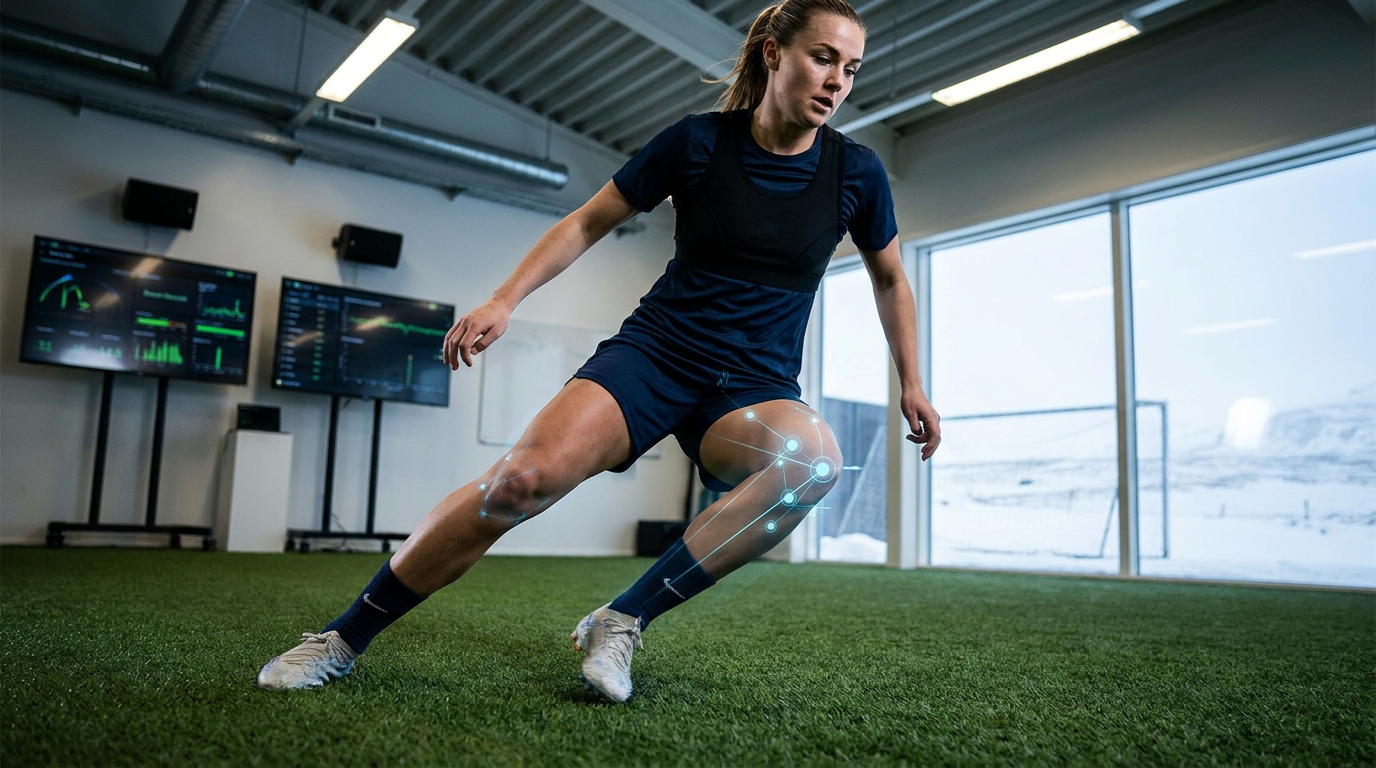
To gather this granular data, researchers are turning to advanced wearable technology. Inertial measurement units (IMUs) and GPS vests are now standard equipment on the training ground. These devices capture thousands of data points per session, measuring everything from tibial acceleration and stride asymmetry to heart rate variability and sleep quality.[3]
To gather this granular data, researchers are turning to advanced wearable technology.
The sheer volume of data generated by these wearables is where artificial intelligence becomes crucial. Machine learning algorithms can process real-time kinematic data to identify subtle compensatory movements or signs of neuromuscular fatigue that human coaches might easily miss.[3]
By establishing a baseline for each player's healthy movement patterns, AI models can flag when an athlete begins to exhibit high-risk biomechanics, such as an increased knee abduction angle or "dynamic valgus." This allows medical staff to intervene and adjust training loads before a catastrophic ligament failure occurs.[3][4]
Wearable neuromuscular (WNM) devices are also moving from the laboratory to the pitch. Recent clinical studies have demonstrated that training with WNM devices—which apply targeted topical pressure to the quadriceps and hamstrings—can significantly improve postural control and reduce peak medial ground reaction forces during landings.[2]

In one study involving 79 elite youth and collegiate female soccer players, athletes who trained with a WNM device for seven to nine weeks showed marked improvements in balance and joint stability without any loss of athletic performance. Crucially, none of the athletes utilizing the device sustained an ACL injury during the subsequent season.[2]
The integration of AI extends beyond prevention and into rehabilitation. For players recovering from surgery, computer vision and machine learning can track recovery progress with remarkable precision. These systems adjust rehabilitation protocols dynamically, ensuring players do not return to the pitch prematurely while minimizing unnecessary downtime.[3]
Despite the technological optimism, systemic challenges remain. The sports science industry still suffers from a profound gender data gap; historically, as little as 8% of sports science research has focused exclusively on female athletes, leaving a massive deficit in foundational knowledge.[1]

Furthermore, the implementation of AI and wearable tech requires significant financial investment, which highlights the ongoing funding disparities between men's and women's professional sports. Ensuring that these advanced preventative tools reach players outside the wealthiest top-tier clubs will be a critical hurdle in the coming years.[4]
Nevertheless, the momentum is undeniable. By moving away from male-centric models and embracing personalized, data-driven insights, the soccer world is finally treating the female ACL crisis with the scientific rigor it demands. The ultimate goal is a future where the world's best players spend less time in the rehabilitation room and more time defining the beautiful game.[4]
How we got here
June 2023
Nike releases the Phantom Luna, a soccer boot specifically engineered for female biomechanics to reduce rotational traction.
April 2024
FIFPRO, the PFA, and academic partners officially launch Project ACL in the English Women's Super League.
April 2026
The NWSL and its players' association join Project ACL, expanding the research to the United States.
Viewpoints in depth
Sports Scientists & Biomechanists
Advocate for individualized, data-driven biomechanical interventions over generalized male-centric protocols.
For years, the scientific community focused heavily on static anatomical differences—such as the Q-angle of female hips—to explain the ACL disparity. Today, biomechanists argue that this approach is too fatalistic. By utilizing AI and wearable sensors, they are shifting the focus to dynamic, modifiable risk factors. They believe that if a player's unique movement patterns and fatigue levels can be tracked in real-time, interventions can be highly individualized, moving away from the blanket prevention protocols that have historically failed female athletes.
Player Unions & Advocates
Argue that environmental factors like workload, travel, and facility quality are primary drivers of the injury crisis.
Organizations like FIFPRO and the NWSLPA view the ACL epidemic not just as a medical issue, but as a labor and equity issue. They argue that female players are often subjected to grueling fixture congestion, substandard travel conditions, and unequal access to elite recovery facilities compared to their male counterparts. From this perspective, technological interventions are only part of the solution; true prevention requires systemic changes to the professional environment in which these athletes operate.
Technology Developers
Focus on improving the accuracy and real-time predictive capabilities of wearable sensors and AI models.
Engineers and data scientists see the ACL crisis as a complex pattern-recognition problem that can be solved with better hardware and smarter algorithms. Their primary focus is on refining the accuracy of Inertial Measurement Units (IMUs) and reducing the latency of machine learning models. The ultimate goal for this camp is to develop systems that provide real-time, on-pitch haptic feedback to players, physically prompting them to correct dangerous biomechanical movements before an injury can occur.
What we don't know
- How quickly these advanced AI and wearable technologies can be scaled down to youth and amateur levels where resources are scarce.
- The exact degree to which hormonal fluctuations during the menstrual cycle interact with biomechanical risks, as longitudinal data is still being collected.
Key terms
- Anterior Cruciate Ligament (ACL)
- A key ligament that stabilizes the knee joint, highly susceptible to tearing during sudden deceleration or changes in direction.
- Dynamic Valgus
- A biomechanical movement pattern where the knee collapses inward during a jump or landing, significantly increasing the risk of an ACL tear.
- Inertial Measurement Unit (IMU)
- A wearable electronic device that uses accelerometers and gyroscopes to measure a player's specific movement patterns and forces.
- Wearable Neuromuscular (WNM) Device
- A specialized garment that applies targeted pressure to specific muscles to improve joint stability and postural control.
Frequently asked
Why are female soccer players more prone to ACL injuries?
The risk is multifactorial, involving biomechanical differences, hormonal fluctuations, and environmental factors like training protocols historically designed for men.
How does AI help prevent these injuries?
AI analyzes real-time data from wearable sensors to identify dangerous movement patterns and signs of fatigue, allowing coaches to intervene before an injury occurs.
What is Project ACL?
It is a global research initiative led by player unions and academics to study the specific causes of ACL injuries in professional women's soccer.
Sources
Source coverage
4 outlets
3 viewpoints surfaced




[1]FIFPROPlayer Unions & Advocates
Project ACL: Research on ACL Injuries in Women's Football
Read on FIFPRO →[2]National Institutes of HealthSports Scientists & Biomechanists
Wearable Neuromuscular Device Reduces ACL Injury Risk in Female Soccer Athletes
Read on National Institutes of Health →[3]Premier ScienceSports Scientists & Biomechanists
AI and Wearables in Injury Prediction and Performance Optimization
Read on Premier Science →[4]Factlen Editorial TeamTechnology Developers
Synthesis by Factlen editorial team
Read on Factlen Editorial Team →

Every angle. Every day.
Get sports stories with full source coverage and perspective breakdowns delivered to your inbox.