
How AI and Nanotechnology Are Revolutionizing Art Restoration
Modern art conservation has traded harsh solvents and guesswork for artificial intelligence, multispectral imaging, and microscopic nanogels.
By Factlen Editorial Team
- Modern Conservationists
- Embrace AI, advanced imaging, and nanotechnology as essential tools to safely restore, understand, and authenticate historical art.
- Materials Scientists
- Focus on the chemical interactions of new treatments, advocating for green chemistry and rigorous long-term testing of nanogels and polymers.
- Historical Purists
- Believe the aging process is an intrinsic part of an artwork's history and are wary of cosmetic restorations that erase the patina of time.
What's not represented
- · Museum Curators
- · Private Art Collectors
Why this matters
The preservation of humanity's cultural heritage is no longer reliant on guesswork and harsh chemicals. By merging artificial intelligence with nanotechnology, we can now save deteriorating masterpieces, uncover hidden histories, and ensure that centuries-old art survives intact for future generations.
Key points
- Multispectral imaging allows conservators to see hidden underdrawings and alterations without touching the artwork.
- AI algorithms can analyze brushstrokes to authenticate paintings and predict the original colors of faded pigments.
- New AI-generated polymer masks can visually restore damaged paintings while remaining 100% reversible.
- Nanogels and calcium hydroxide nanoparticles are replacing harsh, toxic solvents for cleaning delicate frescoes and canvases.
For centuries, the world of art restoration has been a nerve-wracking discipline defined by cotton swabs, scraping tools, and the pungent smell of harsh chemical solvents. Conservators carried the immense burden of physically altering priceless masterpieces, knowing that a single miscalculated brushstroke or overly aggressive cleaning solution could permanently erase a piece of history.[1]
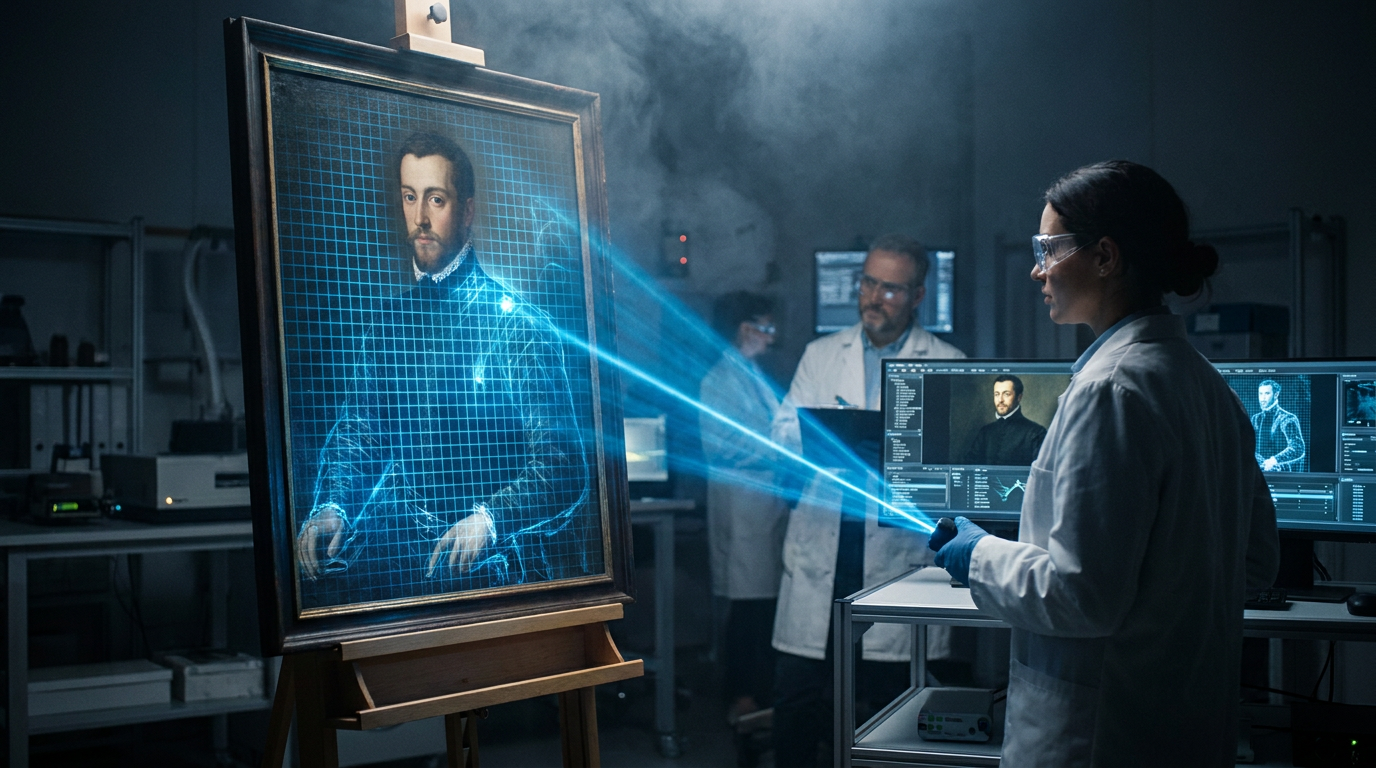
Today, that paradigm is shifting entirely. The modern conservation laboratory looks less like an artist's studio and more like a Silicon Valley cleanroom. The integration of artificial intelligence, nanotechnology, and advanced imaging is fundamentally rewriting how we preserve cultural heritage, replacing invasive guesswork with microscopic precision.[1][3]
The first step in modern restoration is no longer physical; it is entirely digital. Before a single swab touches a canvas, conservators must see what lies beneath the centuries of accumulated grime, oxidized varnish, and previous, often clumsy, restoration attempts.[4]
Enter multispectral and hyperspectral imaging. These advanced technologies scan artworks across various wavelengths of light, penetrating the upper layers of paint to reveal the artwork's structural secrets without ever making physical contact with the fragile surface.[1]

This non-invasive imaging frequently uncovers pentimenti—the hidden sketches and alterations made by the artist before the final paint was applied. It allows art historians to track the creative process in real-time, seeing exactly where a master changed the angle of a hand, the drape of a fabric, or the position of a figure.[6]
But seeing the hidden layers is only half the battle; interpreting them is where artificial intelligence steps in. Machine learning models, specifically Convolutional Neural Networks (CNNs), are now being trained on vast datasets of authenticated masterpieces to recognize the microscopic topography of an artist's specific brushstrokes.[7]
These AI systems can analyze those brushstrokes to authenticate works or identify historical anomalies. For instance, researchers recently used a custom ResNet50 algorithm to analyze Raphael's debated masterpiece, the Madonna della Rosa. The AI confirmed long-held suspicions among scholars that while the majority of the painting was Raphael's work, the face of St. Joseph was likely painted by a different hand.[7]
Artificial intelligence is also solving one of conservation's most daunting challenges: predicting lost colors. By studying patterns in pigment degradation and cross-referencing chemical analyses, algorithms can digitally reconstruct the vivid, original hues that have faded over centuries of light exposure.[1]
Artificial intelligence is also solving one of conservation's most daunting challenges: predicting lost colors.
Taking this a step further, researchers at the Massachusetts Institute of Technology have developed a way to physically apply these AI predictions without permanently altering the artwork. Mechanical engineer Alex Kachkine pioneered a system using AI-generated digital masks to restore canvases that have suffered severe physical loss.[2]
In this process, an AI reconstructs the damaged or missing sections of a painting. These high-fidelity digital repairs are then printed onto a precision polymer film, which is laid over the original canvas like a custom graphic wrap, perfectly aligning with the surviving paint.[2]

The beauty of the polymer mask is its absolute reversibility. It visually restores the painting to its former glory while leaving the underlying physical damage untouched. If future conservators develop better techniques, the mask can simply be peeled away, perfectly aligning with modern conservation ethics.[2]
When physical cleaning is unavoidable, the chemistry itself has undergone a revolution. For decades, conservators relied on toxic, unpredictable solvents that risked seeping deep into the canvas and breaking down the chemical bonds of the original paint.[6]
Today, interfacial chemistry and nanotechnology offer a targeted, environmentally friendly alternative. Scientists have developed colloidal dispersions and nanogels that act with microscopic precision, fundamentally changing how dirt and varnish are removed.[4]
Calcium hydroxide nanoparticles, measuring just 10 to 100 nanometers, can be suspended in soft nanostructured gels. When applied to a fragile fresco, these gels draw out soluble salts and dirt while leaving the original pigments and binders completely undisturbed.[3]

Because the nanogels are highly porous and their viscosity can be strictly controlled, the cleaning agents remain confined to the very surface of the artwork. They do not soak into the underlying paper or canvas, drastically reducing the risk of structural damage.[3][4]
In some cases, the solutions are entirely biological. Conservators have begun deploying specific strains of harmless bacteria that produce enzymes designed to eat away inorganic crusts and animal glues from ancient frescoes, acting as a microscopic, highly targeted cleaning crew.[6]
Despite these incredible breakthroughs, the high-tech era of restoration is not without debate. Some historical purists argue that the aging process—the cracks, the fading, the patina—is an intrinsic part of an artwork's life cycle that should not be erased by predictive algorithms or cosmetic overlays.[6]

Furthermore, materials scientists urge caution regarding the long-term stability of new nanomaterials. Because these treatments have a relatively short application history, rigorous life-cycle testing and standardized protocols are essential to ensure they do not introduce new, unforeseen risks over the next century.[3]
Ultimately, the fusion of art and science is not about erasing history, but illuminating it. By combining the analytical power of AI with the gentle precision of nanotechnology, modern conservators are ensuring that humanity's greatest masterpieces will survive—and be understood—for generations to come.[1][5]
How we got here
1940s
Art conservation begins adopting a more systematic, scientific approach to physical care, moving away from purely aesthetic touch-ups.
2012
The Belgian Royal Institute begins a massive, high-tech restoration of the Ghent Altarpiece, utilizing advanced imaging techniques.
2024
An AI algorithm successfully identifies the specific brushstrokes of Raphael in a debated masterpiece, confirming the presence of a second artist.
2025
MIT researchers debut fully reversible, AI-generated polymer masks designed to overlay and visually repair damaged canvases.
Viewpoints in depth
Technological Conservators
Embrace AI and nanotech for unprecedented precision and reversibility.
This camp views the integration of artificial intelligence and nanotechnology as the greatest leap forward in the history of art conservation. They argue that traditional methods, which relied heavily on the subjective eye of the restorer and the unpredictable nature of liquid solvents, inherently put masterpieces at risk. By using AI to predict lost pigments and nanogels to confine cleaning agents strictly to the surface, conservators can now achieve a level of fidelity to the artist's original vision that was previously impossible, all while adhering to the strict ethical mandate of reversibility.
Materials Scientists
Focus on the chemical stability and long-term safety of interventions.
While supportive of moving away from toxic traditional solvents, materials scientists emphasize the need for extreme caution when introducing novel compounds to centuries-old artifacts. They point out that because nanogels, polymer films, and calcium hydroxide nanoparticles have a relatively short application history, their century-long degradation patterns remain unknown. This group advocates for rigorous, standardized life-cycle testing and continuous monitoring to ensure that today's high-tech solutions do not become tomorrow's conservation disasters.
Historical Purists
Argue that the aging process is an intrinsic part of the artwork's history.
Historical purists approach high-tech restoration with a degree of philosophical skepticism. They argue that the physical degradation of an artwork—the fading of colors, the cracking of the varnish, the accumulation of patina—is a testament to its journey through time. From this perspective, using AI to predict and artificially restore a painting to its 'day one' appearance risks creating a sterilized, ahistorical version of the piece. They caution against treating art conservation as cosmetic surgery, advocating instead for stabilization over visual perfection.
What we don't know
- The century-long chemical stability of newly developed nanogels and polymer films.
- Whether AI predictive models might inadvertently introduce modern aesthetic biases into classical works.
- How climate change and shifting museum environments will interact with these new nanomaterials over time.
Key terms
- Multispectral Imaging
- A scanning technique that captures image data at specific frequencies across the electromagnetic spectrum, revealing hidden layers beneath a painting's surface.
- Pentimenti
- Alterations in a painting, evidenced by traces of previous work, showing that the artist changed their mind during the creative process.
- Nanogel
- A highly porous, microscopic polymer network used by conservators to apply cleaning agents with extreme precision, preventing moisture from seeping into delicate canvases.
- Convolutional Neural Network (CNN)
- A type of artificial intelligence algorithm particularly adept at analyzing visual imagery and recognizing complex patterns, such as an artist's specific brushstrokes.
- Reversibility
- A core ethical principle in modern art conservation dictating that any treatment or addition applied to an artwork must be fully removable without damaging the original material.
Frequently asked
Can AI replace human art restorers?
No. AI acts as an advanced diagnostic and predictive tool, but the physical application of treatments and the final ethical judgments still require highly trained human conservators.
How do nanoparticles clean paintings?
Nanoparticles, such as calcium hydroxide, are suspended in gels and applied to the artwork. Because of their microscopic size, they can penetrate pores to neutralize acids or dissolve dirt without soaking the underlying canvas.
What is an AI-generated digital mask?
It is a reversible, custom-printed polymer film that overlays a damaged painting. AI predicts the missing visual information, which is printed on the film, hiding the damage without altering the original paint.
Sources
Source coverage
7 outlets
3 viewpoints surfaced







[1]Factlen Editorial TeamModern Conservationists
Synthesis by Factlen editorial team
Read on Factlen Editorial Team →[2]The Art NewspaperMaterials Scientists
Mechanical engineer develops AI-generated digital masks to restore damaged paintings
Read on The Art Newspaper →[3]AZoNanoMaterials Scientists
Nanotechnology in Art Restoration
Read on AZoNano →[4]National Institutes of HealthMaterials Scientists
Colloidal systems for art conservation
Read on National Institutes of Health →[5]NewsweekModern Conservationists
AI Can Point the Way—But Experts Still Matter
Read on Newsweek →[6]University of Southern CaliforniaHistorical Purists
The Beauty of Science: New Technologies in Art Restoration
Read on University of Southern California →[7]TweakTownModern Conservationists
AI algorithm discovers hidden details in debated artwork
Read on TweakTown →
Every angle. Every day.
Get culture stories with full source coverage and perspective breakdowns delivered to your inbox.