
The Science of Sleep: How the Brain Washes Itself During Deep Rest
During slow-wave sleep, the brain activates a hidden plumbing network called the glymphatic system to flush out toxic metabolic waste. Understanding this nightly wash cycle is revolutionizing how scientists view cognitive longevity and dementia prevention.
By Factlen Editorial Team
- Neuroscientists & Sleep Researchers
- Focus on the mechanical discovery of the glymphatic system and the link between slow-wave sleep and dementia prevention.
- Public Health Advocates
- Emphasize sleep as a critical, non-negotiable pillar of preventative health.
- Clinical Neurologists
- View the glymphatic system as a potential therapeutic target for treating neurodegenerative diseases.
What's not represented
- · Shift workers who cannot maintain a regular circadian rhythm
- · Individuals with chronic insomnia or sleep apnea
Why this matters
Sleep is not just passive downtime; it is an active, biological cleaning cycle that protects your cognitive longevity. Optimizing your deep sleep is one of the most effective, evidence-based ways to clear neurotoxins and reduce the long-term risk of Alzheimer's disease.
Key points
- The glymphatic system acts as a biological dishwasher, clearing metabolic waste from the brain.
- This clearance process is most active during slow-wave (deep) sleep, when brain cells shrink to allow fluid to flow.
- Toxic proteins like amyloid-beta, linked to Alzheimer's disease, are washed away during this cycle.
- Aging naturally reduces deep sleep, making sleep hygiene critical for cognitive longevity.
- Keeping the bedroom cool, exercising during the day, and avoiding alcohol before bed can increase deep sleep.
We spend roughly a third of our lives unconscious, a state that historically baffled evolutionary biologists. But sleep is not merely a period of inactivity or a passive "switching off." Instead, the moment your eyes close and your breathing slows, your brain goes to work, initiating one of the most critical biological processes in the human body.[5]
For decades, scientists understood that the body used the lymphatic system to clear cellular waste from organs and tissues. Yet, the brain—the most metabolically demanding organ in the body—appeared to lack this plumbing. It wasn't until the early 2010s that researchers discovered the brain's hidden waste-clearance network: the glymphatic system.[1][3]
The glymphatic system functions essentially as a biological dishwasher for the central nervous system. Throughout the day, as your brain cells consume energy to help you think, move, and process emotions, they leave behind metabolic byproducts. If left unchecked, this cellular trash would accumulate, clogging neural pathways and impairing cognitive function.[1][5]
The magic of the glymphatic system lies in its elegant mechanics. The brain is densely packed with neurons and star-shaped support cells called astrocytes. During wakefulness, this dense network leaves little room for fluid to move. But when you fall asleep, the astrocytes actually shrink in size, expanding the interstitial space between brain cells by up to 60 percent.[3]

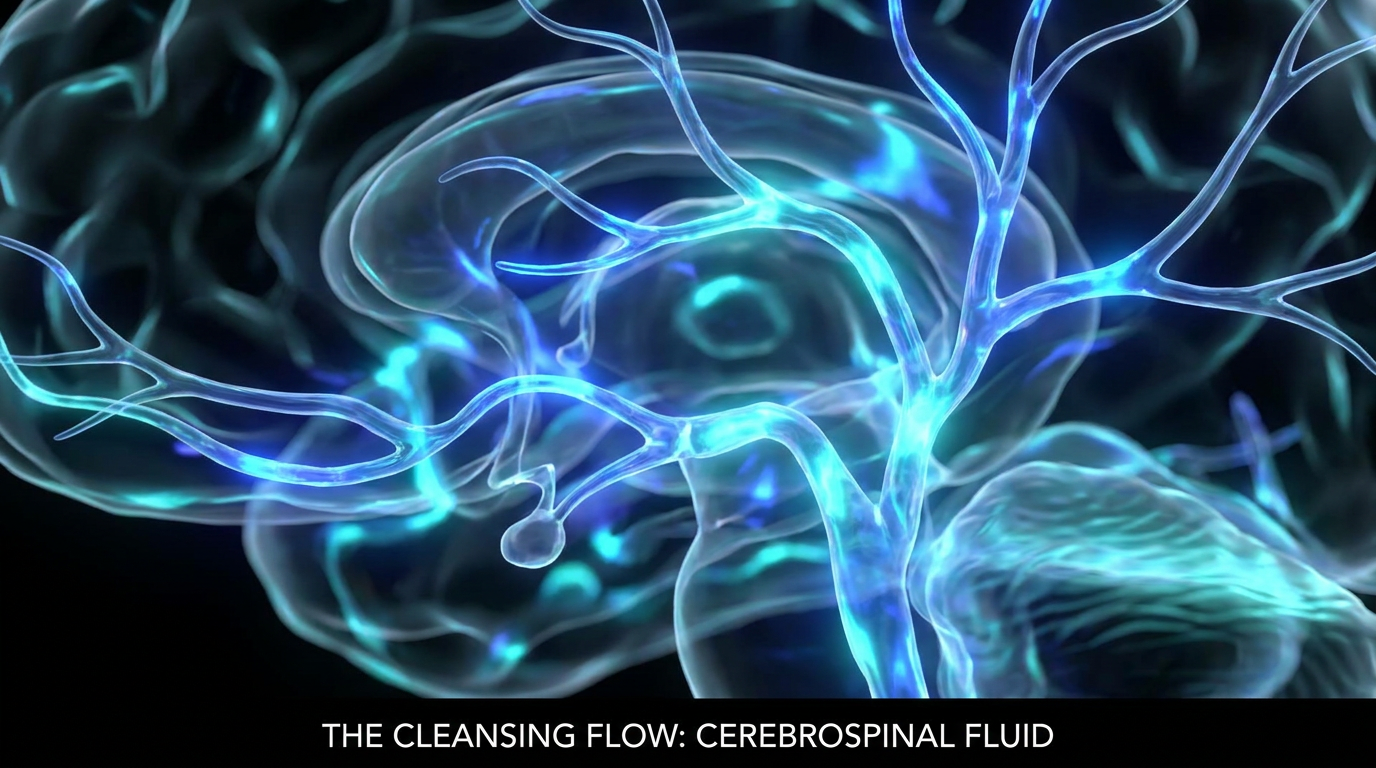
With the pathways widened, cerebrospinal fluid (CSF)—the clear liquid that surrounds the brain and spinal cord—rushes into the brain tissue. It washes over the cells, collecting metabolic waste, and then drains out of the brain toward the body's peripheral lymphatic system, where it is ultimately processed and removed.[2][3]
Among the most critical pieces of waste cleared during this nightly wash cycle are amyloid-beta and tau proteins. These proteins are normal byproducts of neural activity, but they are highly toxic if they are allowed to accumulate. In fact, the buildup of misfolded amyloid-beta into plaques is one of the primary pathological hallmarks of Alzheimer's disease.[1][5]
However, the brain's dishwasher does not run continuously throughout the night. Research indicates that glymphatic clearance is highly dependent on a specific phase of rest: slow-wave sleep, commonly known as deep sleep. Occurring primarily in the first half of the night, deep sleep is characterized by a dramatic drop in heart rate, relaxed muscles, and highly synchronized brain waves.[5][6]
During this deep sleep stage, the synchronized firing of neurons actually helps drive the fluid pumps. Recent studies have demonstrated that the rhythmic electrical activity of the brain during slow-wave sleep creates the necessary momentum to push the cerebrospinal fluid through the dense brain tissue. As researchers have summarized the phenomenon: "Neurons that fire together, shower together."[6]

During this deep sleep stage, the synchronized firing of neurons actually helps drive the fluid pumps.
The reliance on deep sleep presents a significant challenge as we age. Older adults naturally experience a decline in the total amount of slow-wave sleep they get each night. With less time spent in this critical restorative phase, the brain's wash cycle is cut short, leaving more metabolic waste behind.[2][6]
This age-related decline in deep sleep is increasingly viewed as a major risk factor for cognitive decline. While a single night of poor sleep does not cause dementia, chronic sleep deprivation deprives the glymphatic system of the time it needs to clear neurotoxins, potentially accelerating the onset of neurodegenerative conditions over decades.[5]
Fortunately, sleep architecture is not entirely out of our control. Sleep scientists and neurologists have identified several evidence-based strategies to maximize the amount of deep sleep we get, thereby optimizing the brain's nightly cleaning cycle.[4][5]
The most powerful lever for inducing slow-wave sleep is temperature regulation. To enter deep sleep, your core body temperature must drop by a few degrees. Keeping your bedroom cool—ideally between 65 and 72 degrees Fahrenheit—facilitates this process. Paradoxically, taking a warm bath or shower an hour before bed can also help; the warm water brings blood to the surface of your skin, allowing your body to dump heat rapidly once you step out.[4]
Exercise is another potent trigger for deep sleep. Moderate aerobic activity has been shown to significantly boost the duration and stability of slow-wave sleep. However, timing is critical. Because exercise raises core body temperature and releases endorphins, working out within two hours of bedtime can actually delay the onset of sleep.[2][4]

What you consume also dictates the quality of your brain's wash cycle. While alcohol is a sedative that might help you lose consciousness faster, it severely disrupts sleep architecture. Alcohol suppresses both REM sleep and deep sleep, meaning you may spend eight hours in bed but wake up with a brain that hasn't been properly cleaned.[5]
Environmental factors, particularly light exposure, play a crucial role. Slow-wave sleep is highly sensitive to light. Exposure to blue light from screens in the hour before bed suppresses the release of melatonin, the hormone that signals to your brain that it is time to sleep. Maintaining a pitch-black bedroom ensures that the slow waves remain robust and uninterrupted.[4]
Interestingly, even your physical posture in bed may influence how well your brain clears waste. Some studies suggest that sleeping in the lateral position—on your side—is the most anatomically efficient posture for the glymphatic system, allowing cerebrospinal fluid to circulate and drain more easily than sleeping on your back or stomach.[5]

For decades, modern culture has often treated sleep as a luxury, a sign of laziness, or a biological inconvenience to be minimized with caffeine. But the discovery of the glymphatic system fundamentally rewrites that narrative.[7]
Sleep is an active, essential state of biological maintenance. By prioritizing consistent, high-quality deep sleep, we are not just resting our bodies; we are actively protecting our cognitive longevity and giving our brains the time they need to wash away the debris of the day.[7]
How we got here
Prior to 2012
The mechanism of how the brain cleared its metabolic waste remained largely a mystery to neuroscientists.
2012–2013
Researchers officially discover and name the 'glymphatic system,' observing its function in animal models.
2019
Studies confirm that glymphatic clearance is most active specifically during the slow-wave (deep) phase of sleep.
2024
New research demonstrates that the synchronized firing of neurons during deep sleep actually drives the fluid pumps that wash the brain.
Viewpoints in depth
Neuroscientists & Sleep Researchers
Focus on the mechanical discovery of the glymphatic system and the link between slow-wave sleep and dementia prevention.
For the scientific community, the discovery of the glymphatic system solved a decades-old mystery of how the brain maintains homeostasis without a traditional lymphatic network. Researchers emphasize that the mechanical flushing of amyloid-beta and tau proteins provides a clear, biological mechanism linking chronic sleep deprivation to Alzheimer's disease. Their current focus is on developing non-invasive ways to artificially enhance slow-wave sleep in aging populations to stave off cognitive decline.
Public Health Advocates
Emphasize sleep as a critical, non-negotiable pillar of preventative health.
Public health experts view the science of the glymphatic system as the ultimate counter-argument to 'hustle culture,' which often glorifies sleep deprivation as a badge of dedication. By framing sleep not as passive rest but as an active, necessary biological cleaning cycle, advocates hope to shift public policy and workplace norms. They argue that prioritizing sleep hygiene is as critical to long-term population health as nutrition and exercise.
Clinical Neurologists
View the glymphatic system as a potential therapeutic target for treating neurodegenerative diseases.
Physicians treating patients with cognitive decline are increasingly incorporating sleep architecture into their clinical assessments. Rather than just prescribing medications to manage symptoms of dementia, neurologists are looking at interventions—from temperature regulation to continuous positive airway pressure (CPAP) for sleep apnea—that can protect and extend the deep sleep phase. They view optimizing the brain's natural wash cycle as a frontline defense in preserving cognitive longevity.
What we don't know
- Exactly how much the glymphatic system's efficiency varies from person to person based on genetics.
- Whether artificially inducing slow-wave sleep through electrical stimulation can fully replicate natural glymphatic clearance.
- The precise degree to which improving sleep in late adulthood can reverse existing amyloid-beta buildup.
Key terms
- Glymphatic System
- The brain's waste-clearance network that uses cerebrospinal fluid to wash away metabolic byproducts, primarily during deep sleep.
- Slow-Wave Sleep
- The deepest stage of non-REM sleep, characterized by synchronized brain waves, when physical restoration and brain washing peak.
- Cerebrospinal Fluid (CSF)
- The clear fluid surrounding the brain and spinal cord that acts as the cleaning agent in the glymphatic wash cycle.
- Amyloid-beta
- A metabolic waste protein that, if not cleared properly, can build up into plaques associated with Alzheimer's disease.
- Astrocytes
- Star-shaped support cells in the brain that shrink during sleep to allow fluid to flow through the brain tissue.
Frequently asked
Does taking a nap help clear brain waste?
While short naps can improve alertness and reduce fatigue, they typically do not last long enough to reach the deep, slow-wave sleep required for the glymphatic system to perform a full wash cycle.
Can I catch up on deep sleep on the weekends?
The brain has some capacity for "rebound" deep sleep after a night of deprivation, but chronic sleep debt cannot be fully erased by sleeping in on weekends. Consistent, nightly slow-wave sleep is required for optimal waste clearance.
How do I know if I am getting enough deep sleep?
Healthy adults typically spend 10 to 20 percent of their night in deep sleep. Waking up feeling unrefreshed, experiencing daytime brain fog, or relying heavily on caffeine are common signs that your slow-wave sleep may be lacking.
Does alcohol help you get into deep sleep faster?
No. While alcohol is a sedative that can make you fall asleep quickly, it severely disrupts sleep architecture, suppressing both REM and the restorative deep sleep needed for glymphatic clearance.
Sources
Source coverage
7 outlets
3 viewpoints surfaced







[1]Cleveland ClinicClinical Neurologists
What Is the Glymphatic System?
Read on Cleveland Clinic →[2]National Institutes of HealthNeuroscientists & Sleep Researchers
The glymphatic system: A beginner's guide
Read on National Institutes of Health →[3]Society for NeuroscienceNeuroscientists & Sleep Researchers
The Glymphatic System
Read on Society for Neuroscience →[4]Johns Hopkins MedicineClinical Neurologists
Tips for Better Sleep
Read on Johns Hopkins Medicine →[5]Baycrest FoundationPublic Health Advocates
The Brain's Overnight Cleaning System
Read on Baycrest Foundation →[6]University of WashingtonNeuroscientists & Sleep Researchers
Slow Wave Sleep and the Aging Brain
Read on University of Washington →[7]Factlen Editorial TeamPublic Health Advocates
Synthesis by Factlen editorial team
Read on Factlen Editorial Team →

Every angle. Every day.
Get guides stories with full source coverage and perspective breakdowns delivered to your inbox.