
How Agentic Workflows Are Moving AI From Chatbots to Autonomous Action
In 2026, artificial intelligence is shifting from conversational assistants to autonomous agents capable of planning, using tools, and executing complex workflows. This 'agentic' architecture is replacing brittle traditional automation by allowing AI to reason through unexpected challenges.
By Factlen Editorial Team
- Enterprise Integrators
- Focus on how agentic workflows can replace brittle RPA systems, reduce operational costs, and handle unstructured data at scale.
- AI Researchers & Builders
- Emphasize the architectural breakthroughs—like multi-agent collaboration and reflection loops—that enable models to reason through complex tasks.
- Governance Advocates
- Stress the necessity of human-in-the-loop guardrails to prevent autonomous systems from executing harmful or hallucinated actions.
What's not represented
- · Frontline workers whose daily tasks are being automated
- · Cybersecurity experts defending against malicious autonomous agents
Why this matters
Understanding agentic workflows is critical for navigating the next phase of the digital economy. As AI transitions from answering questions to executing real-world tasks, professionals who learn to manage and orchestrate these autonomous systems will hold a significant advantage.
Key points
- AI development in 2026 has shifted from conversational chatbots to autonomous 'agentic workflows.'
- Unlike traditional automation, agentic systems can adapt to unexpected errors and process unstructured data.
- The architecture relies on a continuous loop of perceiving, planning, acting, and reflecting.
- AI pioneer Andrew Ng identifies tool use, reflection, planning, and multi-agent collaboration as core design patterns.
- Analysts project that up to 40% of business applications will feature embedded autonomous agents by 2028.
- Most enterprise deployments currently use 'human-in-the-loop' guardrails to prevent hallucinated actions.
For the past three years, the defining image of artificial intelligence has been the chat box. A human types a prompt, and a large language model generates a response. But in 2026, the frontier of AI has quietly shifted away from conversational assistants toward something far more capable: the "agentic workflow." Instead of waiting for step-by-step instructions, these systems are given a high-level goal and left to figure out the execution on their own.[1][2]
The transition from chatbots to autonomous agents represents a fundamental redesign of how work gets done. An AI agent is not simply a smarter text generator; it is a software entity equipped with a reasoning engine and access to digital tools. When handed a complex objective, an agentic workflow breaks the problem down, selects the necessary applications, executes the steps, and—crucially—adapts when it encounters an error.[2][3]
To understand why this matters, it helps to look at the limitations of traditional automation. For years, businesses have relied on Robotic Process Automation (RPA) to handle repetitive digital chores. RPA operates on strict "if this, then that" logic. It works flawlessly when the world cooperates, but the moment an input is unstructured or a website changes its layout, the brittle script breaks and a human must intervene.[4][5]
Agentic workflows solve this fragility by replacing hard-coded rules with dynamic reasoning. According to industry analysts, traditional RPA can only effectively handle about 20 to 30 percent of business processes. Agentic systems, by contrast, are designed to tackle the remaining 70 to 80 percent of work where context matters, exceptions are common, and rigid flowcharts fail.[5]

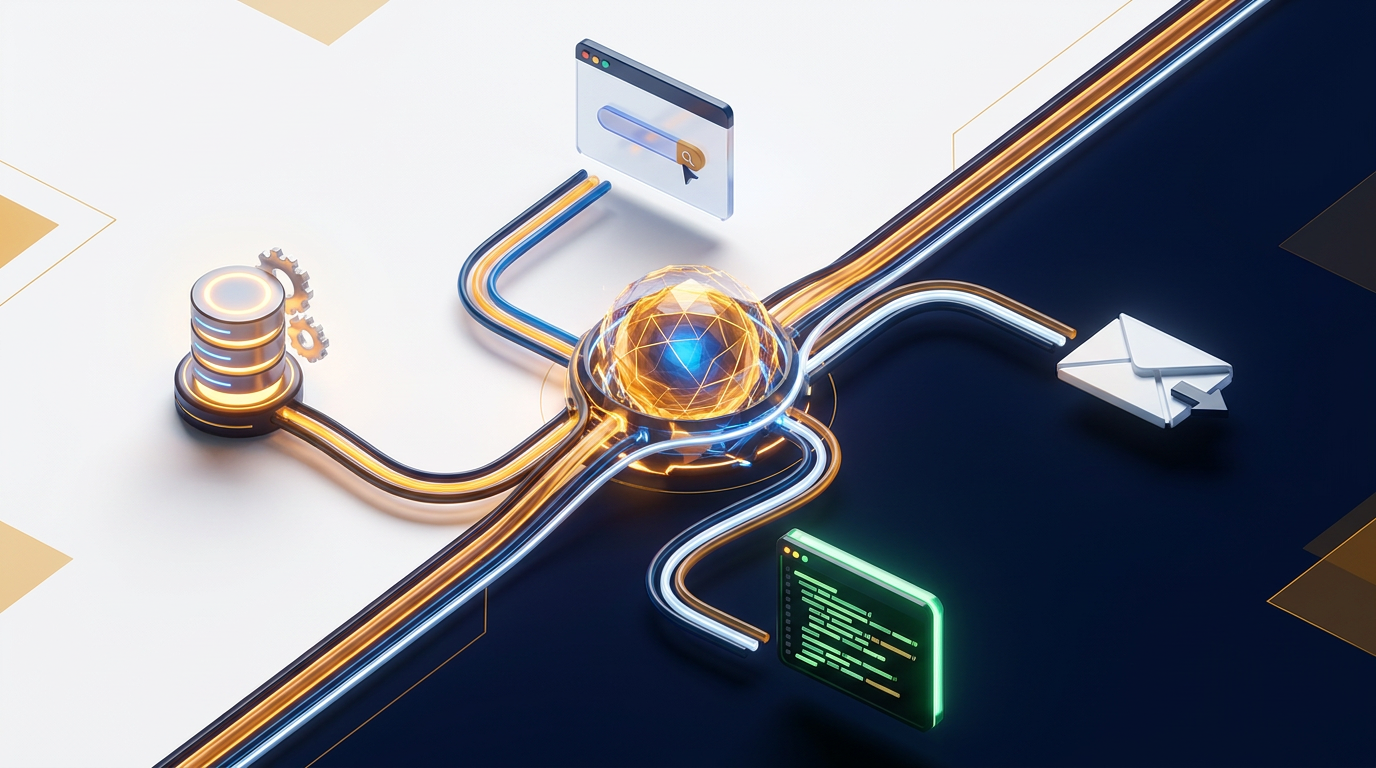
The architecture of an agentic workflow typically follows a continuous, four-stage loop: perceive, plan, act, and reflect. First, the agent perceives its environment by scanning emails, databases, or incoming requests. Next, it plans a sequence of actions based on the current context. It then acts by calling external tools—such as querying an API or drafting a document. Finally, it reflects on the outcome, checking if the action succeeded before moving to the next step.[3][4]
AI pioneer Andrew Ng has been instrumental in defining the architecture of these systems, categorizing agentic development into four core design patterns. The first is "tool use," which gives the language model digital hands. Rather than relying solely on its internal training data, an agent can be authorized to search the live web, execute Python code, or pull records from a customer relationship management (CRM) database.[1][6]
The second pattern is "reflection." In a standard chatbot interaction, the AI generates an answer in a single forward pass, with no opportunity to catch its own mistakes. In an agentic workflow, the system is prompted to critique its own output. If an agent writes a block of code, a secondary reflection step will test that code, identify bugs, and rewrite it before ever presenting the result to a human user.[6]
The second pattern is "reflection." In a standard chatbot interaction, the AI generates an answer in a single forward pass, with no opportunity to catch its own mistakes.
The third pattern, "planning," allows the AI to handle multi-step objectives that cannot be solved in one go. If an agent is asked to compile a market research report, it will autonomously generate a checklist: identify competitors, scrape their pricing pages, summarize the feature differences, and format the final document. The agent maintains a memory of its progress, checking off steps as it navigates the plan.[2][6]

The final and most complex pattern is "multi-agent collaboration." Instead of relying on a single, monolithic AI model to do everything, developers are building ecosystems of specialized agents. In a software development workflow, one agent might act as the lead programmer, another as the quality-assurance tester, and a third as the documentation writer. By dividing labor, these systems achieve higher accuracy and reduce the likelihood of hallucinations.[6][7]
These capabilities are rapidly moving from experimental labs into enterprise production. In the insurance industry, for example, carriers are deploying agentic workflows to handle First Notice of Loss (FNOL) claims. When a customer submits a claim with a mix of text, photos, and PDFs, an agentic system can read the unstructured data, recognize if a police report is missing, email the customer to request it, and route the completed file to a human adjuster.[4]
The shift is equally profound in software engineering and data analysis. Developers in 2026 are increasingly working alongside autonomous coding agents that do not just suggest snippets of code, but actively navigate file systems, run terminal commands, and debug complex repositories. This collaborative model allows human engineers to act more like project managers, reviewing the agent's architectural decisions rather than typing every line of syntax.[7]

Despite the rapid adoption, the rise of autonomous agents introduces new challenges regarding trust and governance. Giving an AI system the ability to take real-world actions—such as sending emails to clients or executing financial transactions—requires robust guardrails. A system that hallucinates in a chat window is an annoyance; an agent that hallucinates while holding the keys to a corporate database is a liability.[5][7]
To mitigate these risks, most enterprise deployments currently rely on a "human-in-the-loop" architecture. The agent does the heavy lifting of researching, planning, and drafting, but pauses to require human approval before taking high-stakes actions. As these systems prove their reliability over time, organizations are gradually expanding the boundaries of what the agents are allowed to execute fully autonomously.[2][7]
The economic implications of this transition are vast. Analysts project that by 2028, up to 40 percent of business applications will feature embedded autonomous agents. This shift promises to dramatically lower operational costs and accelerate task completion, freeing human workers from the mundane "glue work" of moving data between incompatible software systems.[5][7]

Ultimately, the agentic workflow represents the maturation of generative AI. We are moving from an era where AI was a passive oracle that answered questions, to an era where AI is an active participant that drives outcomes. As these systems become deeply integrated into the digital economy, the most valuable human skill will no longer be executing routine tasks, but rather defining the goals and orchestrating the agents that do.[1][7]
How we got here
2022-2023
The Chatbot Era begins, with AI acting primarily as a conversational assistant that requires step-by-step prompting.
2024
Early agent experiments like AutoGPT demonstrate autonomous loops but struggle with reliability and frequent hallucinations.
2025
Tooling maturation occurs as frameworks standardize multi-step reasoning and multi-agent collaboration.
2026
Agentic workflows enter enterprise production, replacing traditional RPA in insurance, finance, and software development.
Viewpoints in depth
Enterprise Integrators
Focus on how agentic workflows can replace brittle RPA systems and handle unstructured data at scale.
For enterprise IT leaders, the appeal of agentic AI lies in solving the 'unstructured data' problem. Traditional Robotic Process Automation (RPA) was highly effective for moving structured data between predictable systems, but it failed the moment a customer submitted a messy email or a non-standard PDF. Integrators view agentic workflows as the bridge that finally allows automation to handle the messy, context-heavy reality of human business. By deploying agents that can read, interpret, and route unstructured inputs, companies can automate the 70% of middle-office work that previously required human intervention.
AI Researchers & Builders
Emphasize the architectural breakthroughs that enable models to reason through complex tasks.
Researchers view the shift to agentic workflows as a fundamental unlock for existing Large Language Models. Rather than waiting for the next massive leap in raw model parameters, builders are extracting vastly superior performance from current models by wrapping them in scaffolding. By forcing an AI to plan its steps, use external tools, and reflect on its own errors, developers can achieve state-of-the-art results on complex benchmarks. This camp believes that multi-agent ecosystems—where specialized, smaller models collaborate and check each other's work—will drive the next wave of AI capability.
Governance Advocates
Stress the necessity of human-in-the-loop guardrails to prevent autonomous systems from executing harmful actions.
As agents move from drafting text to taking real-world actions, governance experts warn about the compounding risks of autonomy. If a chatbot hallucinates, a user reads a false statement; if an autonomous financial agent hallucinates, it might execute a disastrous trade or delete a critical database. This perspective argues that true autonomy is a liability in high-stakes environments. They advocate for strict 'human-in-the-loop' architectures, where the AI is restricted to preparing the work and proposing a course of action, but a human must explicitly authorize the final execution.
What we don't know
- How quickly regulatory bodies will establish liability frameworks for actions taken autonomously by AI agents.
- Whether the cost of running continuous, multi-step LLM reasoning loops will remain viable for low-margin business processes.
- The long-term impact on entry-level knowledge-worker jobs as agents take over routine digital 'glue work'.
Key terms
- Agentic Workflow
- An AI-driven process where an autonomous system makes decisions, uses tools, and adapts to complete a goal.
- Robotic Process Automation (RPA)
- Traditional software that follows strict, hard-coded rules to automate repetitive tasks.
- Multi-Agent System (MAS)
- An architecture where multiple specialized AI agents collaborate to solve a complex problem.
- Tool Use
- The ability of an AI model to interact with external software, such as searching the web, querying a database, or running code.
- Human-in-the-Loop (HITL)
- A system design where an AI agent pauses to require human approval before taking high-stakes actions.
Frequently asked
What is the difference between a chatbot and an AI agent?
A chatbot is reactive and conversational; it waits for a prompt and generates a text response. An AI agent is proactive and goal-oriented; it takes an objective, plans a multi-step approach, uses digital tools, and executes the task autonomously.
Will agentic workflows replace traditional automation like Zapier?
Not entirely, but they will handle the complex edge cases. Traditional automation is perfect for rigid, predictable tasks. Agentic workflows will take over processes that require context, reasoning, and the ability to adapt to unstructured data.
What are the risks of using autonomous AI agents?
The primary risk is that an agent might hallucinate or misinterpret a goal and execute a harmful action, such as sending an incorrect email to a client or deleting files. This is why most enterprise deployments currently require human approval for high-stakes actions.
What is a multi-agent system?
It is an architecture where several specialized AI agents work together to complete a large project. For example, one agent might research a topic, a second agent writes the report, and a third agent reviews the text for accuracy.
Sources
Source coverage
7 outlets
3 viewpoints surfaced







[1]IBMEnterprise Integrators
What are Agentic Workflows?
Read on IBM →[2]TaskadeAI Researchers & Builders
Agentic Workflows Explained: Build Self-Running AI Systems (2026)
Read on Taskade →[3]AtlassianEnterprise Integrators
Understanding AI Agentic Workflows
Read on Atlassian →[4]NotchEnterprise Integrators
Agentic AI Workflows Explained for Insurance
Read on Notch →[5]MindStudioAI Researchers & Builders
Agentic Workflows Explained: Conditional Logic, Loops & Branching
Read on MindStudio →[6]Insight PartnersAI Researchers & Builders
Andrew Ng: Why Agentic AI is the smart bet for most enterprises
Read on Insight Partners →[7]Factlen Editorial TeamGovernance Advocates
Synthesis by Factlen editorial team
Read on Factlen Editorial Team →

More in ai
See all 7 stories →Edge AI
How On-Device AI and Quantization Are Moving LLMs Out of the Cloud
6 sources

Agentic AI
Agentic AI: How Large Action Models Are Automating Digital Chores
7 sources
Global AI Governance
EU Delays Key AI Act Enforcement as 'Brussels Effect' Fractures Under US Deregulation
8 sources

Drug Discovery
New AI Model Accelerates Molecular Simulations 10,000-Fold, Promising Faster Drug Discovery
6 sources
Every angle. Every day.
Get ai stories with full source coverage and perspective breakdowns delivered to your inbox.