
How Agentic Workflows and Multi-Agent Systems Are Rewiring Enterprise Automation
AI is moving beyond answering questions to autonomously executing complex, multi-step business processes. By deploying teams of specialized AI agents, organizations are shifting from rigid task automation to dynamic, goal-driven workflows.
By Factlen Editorial Team
- Enterprise AI Developers
- Focuses on the technical infrastructure, orchestration layers, and standard protocols required to make autonomous agents reliable.
- Business Operations Leaders
- Prioritizes end-to-end process efficiency, measurable ROI, and the shift from task automation to full process automation.
- Workforce Strategists
- Emphasizes the transition to a 'human-on-the-loop' model, elevating human workers to strategic directors of digital teams.
- AI Governance Advocates
- Warns about the risks of unbounded autonomy and advocates for strict guardrails, orchestration, and escalation paths.
What's not represented
- · Frontline workers adapting to AI management
- · Legacy RPA software vendors
Why this matters
Agentic workflows are transforming how businesses operate by allowing AI to autonomously manage complex processes rather than just generating text. Understanding this shift is crucial for professionals, who will increasingly act as managers of digital AI teams rather than manual task executors.
Key points
- Agentic workflows replace rigid 'if/then' automation with dynamic reasoning loops.
- Multi-agent systems use specialized AI models working together as a coordinated team.
- Orchestrated agent systems can reduce enterprise process times by 30% to 50%.
- Without proper governance and orchestration, autonomous AI projects face high failure rates.
- Human workers are shifting to a 'human-on-the-loop' model, acting as managers of digital teams.
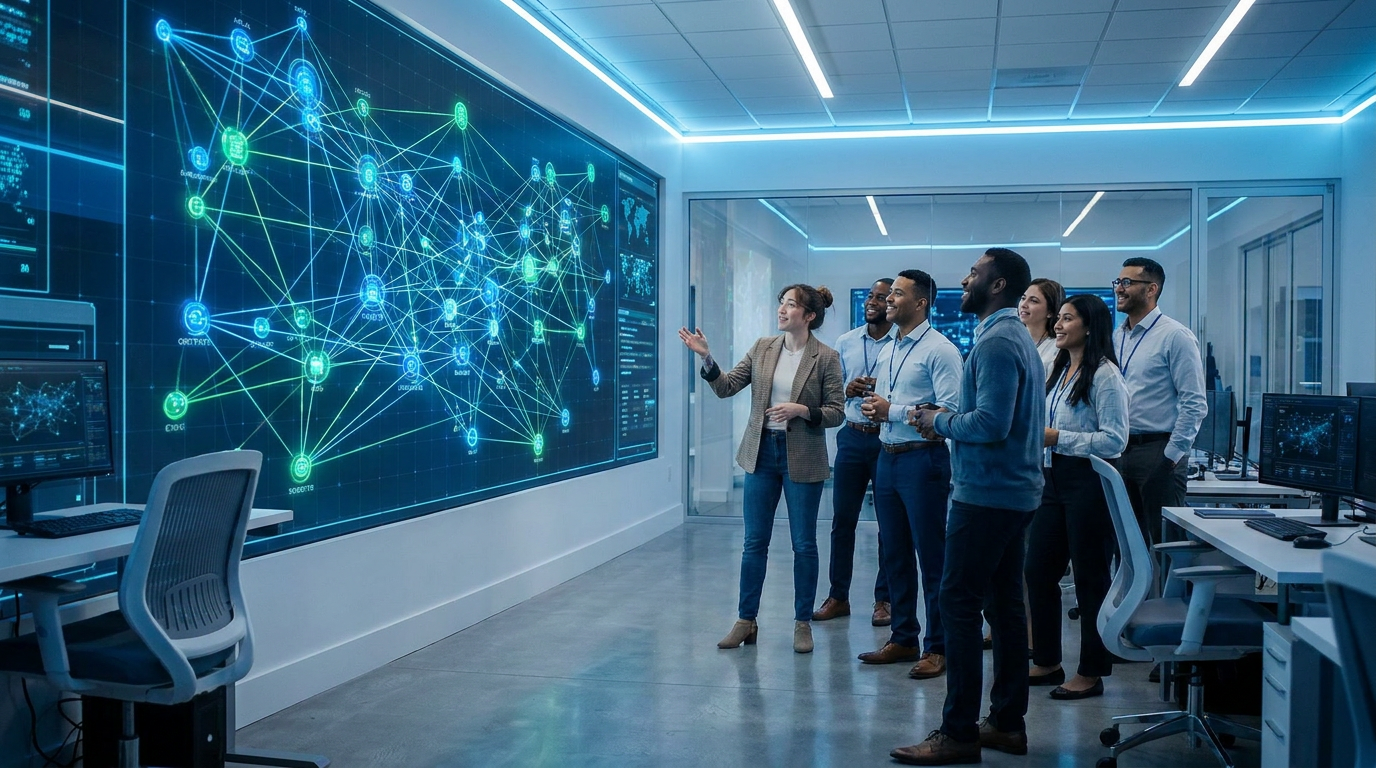
For years, enterprise automation was defined by rigid, hardcoded rules. If an invoice arrived in a specific format, a bot routed it to a designated folder. If a customer clicked a certain button, a system triggered a pre-written email. But the moment a process encountered an exception—a missing field, an ambiguous request, or a non-standard document—the automation broke, requiring immediate human intervention. In 2026, that brittle paradigm is being replaced by a fundamentally different architecture: the agentic workflow.[4][8]
Unlike traditional Robotic Process Automation (RPA), which blindly follows a fixed script, agentic workflows add a reasoning layer to software. Instead of executing a predetermined sequence of steps, an AI agent is given a specific goal, a set of digital tools, and the autonomy to figure out the best path forward. It observes its environment, reasons about the optimal next action, executes it, evaluates the result, and loops until the objective is successfully met.[2][4]
This shift from a fixed line to a dynamic loop is the defining technological leap of the year. Industry analysts note that while traditional automation effectively handles only 20% to 30% of highly structured business processes, agentic workflows can tackle the remaining 70% to 80% where context matters, ambiguity exists, and exceptions are the norm.[6][8]

The mechanism behind this capability relies on three core control structures: conditional logic, loops, and branching. When an AI agent encounters an obstacle, it does not simply crash or throw an error code. It can autonomously query a database for missing context, call an external API to verify a fact, or branch into parallel tasks to gather multiple pieces of information simultaneously before proceeding.[6]
But the true power of this architecture emerges when multiple agents collaborate. Rather than relying on a single, monolithic Large Language Model (LLM) to handle an entire enterprise process, organizations are increasingly deploying multi-agent systems. In these setups, specialized AI agents act as a coordinated team, passing context and triggering actions across connected systems without manual handoffs.[1][5]
Consider the complex process of employee onboarding. In a traditional corporate setup, Human Resources, IT, and Finance operate in silos, relying on human workers to pass emails and update spreadsheets. In an orchestrated multi-agent workflow, an HR agent first manages document collection and verification. Once complete, it passes the structured context to an IT agent, which autonomously provisions software licenses and system access. Finally, a Finance agent receives the verified data to complete the payroll setup.[5]

In a traditional corporate setup, Human Resources, IT, and Finance operate in silos, relying on human workers to pass emails and update spreadsheets.
Because each agent is specialized, it can utilize the optimal underlying model for its specific task. A creative agent might leverage OpenAI's GPT-4 for drafting communications, while a coding agent uses Anthropic's Claude for technical validation, and a reasoning agent employs Google's Gemini for complex data analysis. This multi-LLM orchestration ensures higher accuracy and prevents the hallucinations that often plague generalized models attempting to do everything at once.[7]
The economic impact of these systems is already becoming clear. Organizations implementing enterprise automation strategies through orchestrated agent systems are reporting process time reductions of 30% to 50%. By reducing the manual coordination required between business functions, companies are achieving faster execution while significantly lowering operational overhead.[3][5]
However, the transition from simple task automation to autonomous process execution is not without significant risk. The most common foundational error enterprises make is treating multi-agent AI as a simple connectivity problem. Without a robust orchestration layer—the control plane that governs how agents interact—systems risk duplication of effort, logical loops, or unbounded autonomy that diverges from business goals.[3]
Data indicates that ungoverned agentic deployments are highly vulnerable to failure. Analysts project that more than 40% of early agentic AI projects could be canceled by 2027 due to unanticipated costs, scaling complexities, or unexpected risks. The primary driver of these failures is not the underlying AI models themselves, but the absence of strict governance and clear escalation paths.[3][8]

To mitigate these risks, the industry is standardizing how agents connect to tools and to each other. Protocols like the Model Context Protocol (MCP) are becoming the universal adapter layer, allowing agents to securely interface with enterprise data sources without requiring custom, fragmented integrations. This infrastructure is what transforms autonomous components into a coherent, goal-directed collective.[3]
As these systems scale, the role of the human worker is fundamentally changing. The goal of agentic workflows is not total human replacement, but rather a shift to a "human-on-the-loop" model. Human contributions are reorienting toward higher-order judgment, strategic prompting, and exception handling, while the AI agents absorb the execution complexity.[3][8]

In this new paradigm, employees act more like managers of digital teams. They set the objectives, define the boundaries, and approve critical decisions, while the multi-agent system handles the iterative, multi-step labor required to reach the finish line. This elevates the human worker from a manual executor to a strategic director.[2][8]
Ultimately, 2026 is proving that the enterprise AI race is no longer about which underlying model is the smartest. It is about which organizations have built the infrastructure to make intelligence act safely and reliably. Those who treat agentic AI as a governed, orchestrated infrastructure are laying the foundation for the next generation of enterprise productivity.[3][8]
How we got here
Pre-2023
Traditional Robotic Process Automation (RPA) dominates, relying on rigid 'if/then' rules for highly structured tasks.
2023–2024
Large Language Models (LLMs) introduce advanced reasoning, but are mostly used as standalone chatbots requiring constant human prompting.
2025
Early experimental autonomous agents emerge, but struggle with reliability and unbounded loops in enterprise environments.
Early 2026
The focus shifts from single agents to multi-agent orchestration, introducing specialized roles and shared context.
Mid 2026
Agentic workflows become standard enterprise infrastructure, supported by robust governance and standardized tool protocols.
Viewpoints in depth
Enterprise AI Developers
Focuses on the technical infrastructure required to make autonomous agents reliable.
Developers argue that the intelligence of the underlying AI model is no longer the primary bottleneck in enterprise automation. Instead, the challenge lies in the orchestration layer—building the control planes, memory systems, and standardized protocols (like MCP) that allow agents to interact with legacy enterprise software. Without this infrastructure, even the smartest models are prone to hallucinating tool calls or breaking when encountering unexpected API responses.
Business Operations Leaders
Prioritizes end-to-end process efficiency and measurable return on investment.
Operations leaders view agentic workflows as the necessary evolution from fragmented task automation to true end-to-end process automation. By deploying multi-agent systems to handle entire lifecycles—such as procurement, customer onboarding, or financial reconciliation—they aim to eliminate the manual handoffs between departments. This holistic approach is what drives the 30% to 50% time reductions seen in early enterprise deployments.
AI Governance Advocates
Warns against the dangers of unbounded autonomy without strict oversight.
Governance experts emphasize that giving AI systems the ability to autonomously execute actions carries significant operational and security risks. They advocate for strict 'bounded autonomy,' where agents are given clear operational limits, mandatory human approval gates for high-stakes decisions, and robust audit trails. They point to the high failure rate of early, ungoverned agentic projects as proof that autonomy must be tightly controlled.
What we don't know
- How quickly legacy enterprise software vendors will adapt to support standardized agent protocols like MCP.
- The long-term impact of multi-agent systems on entry-level knowledge worker jobs.
- How regulatory frameworks will assign liability when an autonomous multi-agent system makes a costly error.
Key terms
- Agentic Workflow
- A goal-directed AI system where agents decide the sequence of actions at runtime, adapting to new information rather than following a fixed script.
- Multi-Agent System
- An architecture where multiple specialized AI agents collaborate, passing context and tasks to one another to complete a complex process.
- Orchestration Layer
- The control plane that governs how AI agents interact with each other and with enterprise systems, ensuring they stay aligned with business goals.
- Human-on-the-Loop
- An operational model where human workers do not execute every step, but instead monitor, guide, and approve the actions of autonomous AI systems.
- Model Context Protocol (MCP)
- A standardized framework that allows AI agents to securely connect to external tools, APIs, and data sources without requiring custom integrations.
Frequently asked
What is the difference between an AI agent and an agentic workflow?
An AI agent is a single autonomous system that can reason and use tools. An agentic workflow is the larger orchestrated process that coordinates one or more agents to achieve a complex, multi-step goal.
How do agentic workflows handle errors?
Unlike traditional automation that crashes when encountering an exception, agentic workflows use reasoning loops to evaluate the error, gather missing information, and try alternative paths until the issue is resolved.
Will multi-agent systems replace human workers?
No. The industry is shifting toward a 'human-on-the-loop' model, where AI agents handle repetitive execution while humans provide strategic direction, approve critical decisions, and manage the overall system.
Why do some agentic AI projects fail?
Many early projects fail due to a lack of governance. Without a proper orchestration layer to set boundaries and escalation paths, autonomous agents can duplicate efforts or diverge from business objectives.
Sources
Source coverage
8 outlets
4 viewpoints surfaced








[1]IBMWorkforce Strategists
The rise of AI agents for enterprise
Read on IBM →[2]TaskadeEnterprise AI Developers
Agentic Workflows: Paving the Path Toward AGI
Read on Taskade →[3]XcceleraEnterprise AI Developers
How Xccelera Builds Enterprise-Grade Multi-Agent Control Planes
Read on Xccelera →[4]SyncariBusiness Operations Leaders
AI Agents vs. Traditional Automation: What's the Difference?
Read on Syncari →[5]The NoahBusiness Operations Leaders
How Businesses Can Automate Cross-Department Processes With AI Agent Flows
Read on The Noah →[6]MindStudioAI Governance Advocates
Agentic Workflows Explained: Conditional Logic, Loops & Branching
Read on MindStudio →[7]BrainPathEnterprise AI Developers
The Agent Orchestration Layer: How Multi-Agent Systems Redefine AI
Read on BrainPath →[8]Factlen Editorial TeamWorkforce Strategists
Synthesis by Factlen editorial team
Read on Factlen Editorial Team →

More in ai
See all 7 stories →Edge AI
How On-Device AI and Quantization Are Moving LLMs Out of the Cloud
6 sources

Agentic AI
Agentic AI: How Large Action Models Are Automating Digital Chores
7 sources
Global AI Governance
EU Delays Key AI Act Enforcement as 'Brussels Effect' Fractures Under US Deregulation
8 sources
Drug Discovery
New AI Model Accelerates Molecular Simulations 10,000-Fold, Promising Faster Drug Discovery
6 sources

Every angle. Every day.
Get ai stories with full source coverage and perspective breakdowns delivered to your inbox.