
How Agentic AI is Transforming Enterprise Automation in 2026
AI agents are moving beyond simple chat interfaces to autonomously plan, execute, and self-correct complex business workflows. This shift is freeing human workers from repetitive digital toil and redefining enterprise productivity.
By Factlen Editorial Team

- Enterprise Automation Advocates
- Focus on measurable ROI, time savings, and replacing rigid RPA with adaptive agents.
- AI Architecture & Engineering
- Focus on the technical implementation, multi-agent orchestration, and system interoperability.
- Governance & Strategy Leaders
- Focus on human-in-the-loop safety, workforce upskilling, and strategic deployment.
What's not represented
- · Labor Unions
- · Small Business Owners
Why this matters
As AI transitions from a conversational tool to an autonomous execution engine, it is fundamentally changing how work gets done. Understanding agentic workflows is essential for professionals looking to leverage AI to eliminate routine tasks and focus on high-value, strategic work.
Key points
- AI is evolving from conversational chatbots into "agentic" systems that can autonomously plan and execute multi-step workflows.
- Unlike rigid Robotic Process Automation (RPA), AI agents can adapt to exceptions and self-correct in real time.
- Enterprises are rapidly adopting this technology, with 84% planning to increase their AI agent investments in 2026.
- Successful implementations rely on "human-in-the-loop" checkpoints to ensure safety and oversight for high-stakes decisions.
For the past three years, the corporate world has been captivated by artificial intelligence that can talk. Chatbots and copilots have drafted emails, summarized meetings, and generated code, fundamentally changing how knowledge workers interact with screens. But in 2026, the frontier has decisively shifted from conversation to execution. The new mandate is not an AI that simply tells you what to do, but an AI that actually does it for you. This is the era of "agentic AI"—systems capable of reasoning, planning, and executing multi-step tasks autonomously across a company's entire software stack, turning AI from a passive assistant into an active digital collaborator.[4][8]
To understand the magnitude of this shift, one must look at what it replaces. For a decade, enterprises relied heavily on Robotic Process Automation (RPA) to handle repetitive digital chores. RPA bots are essentially highly efficient macros; they follow rigid, rule-based scripts to move data from point A to point B. If a website button moves or a form changes, the RPA bot breaks. Agentic AI, by contrast, is goal-oriented and highly adaptive. If an AI agent is tasked with processing a vendor invoice, it does not just follow a blind script. It reads the document, navigates the procurement software, identifies missing information, emails the vendor for clarification, and updates the ledger—adapting to exceptions in real time without requiring human intervention.[2][4]
The enterprise adoption of these autonomous systems is accelerating at a breakneck pace across industries. According to recent industry data, 84 percent of enterprises plan to significantly increase their investments in AI agents this year. Research firm Gartner forecasts that by the end of 2026, 40 percent of all enterprise applications will embed task-specific AI agents, a staggering leap from less than 5 percent just a year ago. Consequently, the global market for agentic AI, valued at just over $5 billion in 2024, is now projected to surge toward $199 billion over the next decade.[6]

What makes an AI system genuinely "agentic"? The distinction lies primarily in the underlying architecture. A traditional large language model call is a single forward pass: a user inputs a prompt, the model generates an output, and the transaction ends immediately. Agentic workflows, however, introduce a continuous control loop around the model. Instead of taking one breath, the agent is programmed to plan a sequence of actions, execute the first step, observe the result, reflect on whether it succeeded, and iterate. This cognitive loop allows the system to self-correct and navigate roadblocks without human intervention.[4][7]
A critical mechanism enabling this autonomy is known as "tool calling." Modern AI agents are no longer confined to a chat window; they are granted secure, programmatic access to external software. Through Application Programming Interfaces (APIs), an agent can query a Salesforce database, execute a Python script, pull a financial report from a data lake, or trigger a Slack notification to a team channel. By treating external software as a toolbox, the agent bridges the gap between generating text and taking consequential digital actions.[3][4]
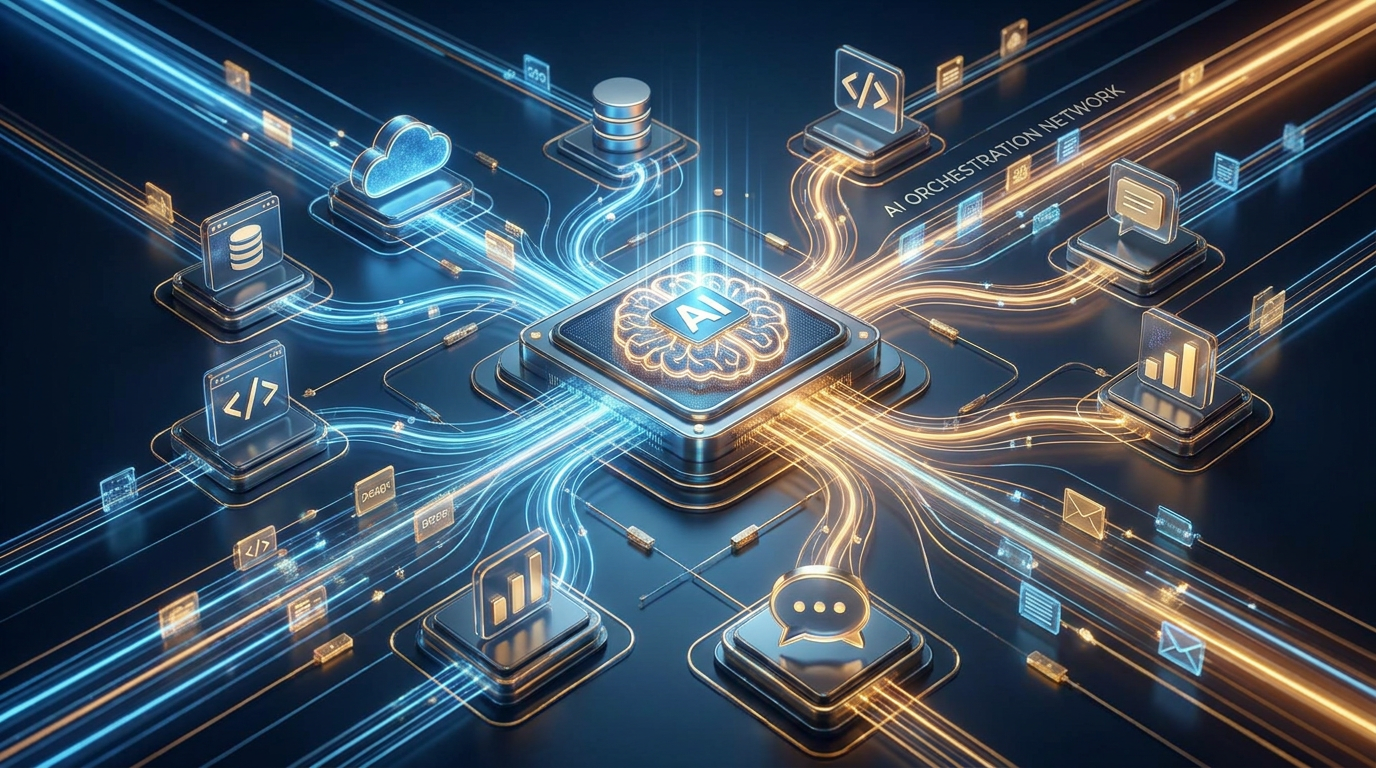
As these systems mature in 2026, developers are moving beyond single-agent setups to complex "multi-agent systems." In this advanced architecture, several specialized AI agents work collaboratively, much like a human department. A "researcher" agent might gather data from the web, pass it to an "analyst" agent that crunches the numbers, which then hands the findings to a "writer" agent to draft a comprehensive report. A "critic" agent may then evaluate the draft against company guidelines, forcing the writer to revise it before a human ever sees the final output.[3][7]

A "critic" agent may then evaluate the draft against company guidelines, forcing the writer to revise it before a human ever sees the final output.
The business value of these workflows is no longer theoretical; it is highly measurable. In operations and IT service management, agentic AI is delivering concrete returns. For example, when an employee submits a complex IT ticket, an agentic workflow can autonomously diagnose the issue, check server logs, reset permissions, and verify the fix with the user. Across various business tasks, organizations are reporting an average time savings of 66.8 percent when replacing manual execution with AI agents, freeing human workers from chronic digital toil.[5][6]
Marketing and customer service departments are also undergoing rapid transformation thanks to agentic workflows. Rather than relying on static decision trees that often frustrate customers, modern service agents can access a user's full account history, process refunds, track lost packages across third-party logistics providers, and dynamically negotiate resolutions. Because they understand intent and context, these agents handle non-linear conversations without breaking on edge cases, significantly lifting customer activation and satisfaction rates while reducing the burden on human support staff.[1][5]
However, the success of agentic AI is entirely dependent on the quality of the data it consumes. AI agents cannot perform with accuracy if their foundational data is trapped in unstructured formats like PDFs, emails, and scanned contracts. Consequently, a major prerequisite for agentic automation in 2026 is Intelligent Document Processing (IDP). By extracting and structuring the data hidden inside legacy documents, enterprises create a clean, reliable foundation that allows agents to understand the necessary context before taking any action.[2]
Despite the enthusiasm surrounding these tools, the rise of autonomous agents has necessitated strict governance frameworks. The most successful enterprise deployments rely heavily on "human-in-the-loop" checkpoints. In these carefully designed setups, the AI agent does the heavy lifting—gathering data, drafting responses, and proposing actions—but pauses to request human approval before executing high-stakes decisions, such as authorizing a large payment or sending a sensitive client communication. This ensures that the speed and efficiency of AI are always balanced with human judgment and accountability.[4][5]

There are also clear boundaries regarding where agentic AI should not be deployed. Workflows that require deep contextual judgment, empathy, or the navigation of unique, emotionally charged situations remain firmly in the human domain. A customer complaint involving multiple failed deliveries, a long account history, and a highly frustrated tone requires a human who can read the emotional subtext and respond with appropriate authority and care. Agentic systems are highly capable execution engines, but they are not replacements for human empathy.[6]
For enterprise leaders, the playbook for adopting agentic workflows in 2026 emphasizes structured, iterative scaling rather than sweeping overhauls. Experts advise starting with clearly bounded pilot use cases—processes that are repetitive, data-driven, and carry low risk if the agent makes a minor error. By mapping the current workflow in detail, documenting every decision point, and defining measurable key performance indicators before deployment, organizations can safely test the waters and build internal trust in the technology before expanding its scope.[5]
Looking ahead, the truly transformative potential of agentic AI lies in cross-platform interoperability. The ultimate goal is to automate multi-step workflows not just within a single isolated department, but across entire corporate value chains. Imagine a supply chain disruption where an agentic system autonomously identifies a delayed shipment, sources an alternative supplier, negotiates the new rate, updates the inventory forecast, and alerts the sales team—all in a matter of minutes, mitigating a crisis before a human manager even logs on.[1][3]
Ultimately, the shift toward agentic AI is not about replacing the workforce, but elevating it. As autonomous agents take over the mundane, repetitive tasks that drain daily productivity, human employees are freed to focus on strategic thinking, creative problem-solving, and relationship building. The organizations that will thrive in this new era are those that view AI not merely as a cost-cutting software tool, but as a collaborative digital partner, fostering an AI-fluent workforce ready to tackle higher-order challenges.[1][8]
How we got here
Pre-2023
Enterprise automation is dominated by Robotic Process Automation (RPA), which relies on rigid, rule-based scripts.
2023–2024
The rise of Large Language Models (LLMs) introduces conversational chatbots and copilots that assist workers but cannot execute tasks autonomously.
2025
Early agentic frameworks emerge, allowing AI to use external tools and APIs to complete simple, multi-step workflows.
Early 2026
Major enterprise platforms embed task-specific AI agents, shifting the focus from conversational AI to autonomous execution engines.
Viewpoints in depth
Enterprise Automation Advocates
Focus on measurable ROI, time savings, and replacing rigid RPA with adaptive agents.
For operations leaders and automation specialists, the primary appeal of agentic AI is its ability to handle the messy reality of business data. Traditional Robotic Process Automation (RPA) required perfectly structured inputs and broke whenever a user interface changed. Automation advocates argue that agentic systems solve this fragility by focusing on the end goal rather than a rigid script. By autonomously navigating exceptions—such as a missing invoice field or a delayed API response—these agents deliver concrete ROI, with early adopters reporting nearly 67% time savings on routine tasks.
AI Architecture & Engineering
Focus on the technical implementation, multi-agent orchestration, and system interoperability.
From an engineering perspective, the shift to agentic AI represents a fundamental change in software architecture. Rather than building monolithic applications, developers are designing multi-agent systems where specialized AI models collaborate. An orchestrator agent delegates tasks to a researcher agent, a data-entry agent, and a critic agent, creating a resilient, self-correcting ecosystem. Engineers emphasize that the true power of this paradigm lies in 'tool calling'—granting these agents secure, programmatic access to external APIs, databases, and legacy software so they can execute real-world actions.
Governance & Strategy Leaders
Focus on human-in-the-loop safety, workforce upskilling, and strategic deployment.
Strategy and security leaders view the rise of autonomous agents with a mix of optimism and caution. Their primary concern is ensuring that AI systems do not execute high-stakes decisions without human oversight. This camp strongly advocates for 'human-in-the-loop' architectures, where agents prepare the groundwork but require explicit human approval before finalizing financial transactions or sensitive communications. Furthermore, they stress that the ultimate goal of agentic AI is not headcount reduction, but workforce elevation—freeing employees from digital toil so they can focus on complex, empathetic, and strategic problem-solving.
What we don't know
- How quickly legacy enterprises with highly fragmented, unstructured data systems will be able to adopt agentic workflows.
- The long-term impact of agentic automation on entry-level knowledge worker roles, which traditionally handle the routine tasks now being automated.
- How regulatory frameworks will evolve to address liability when an autonomous AI agent makes an error in a high-stakes business transaction.
Key terms
- Agentic AI
- Artificial intelligence systems capable of autonomously planning, executing, and self-correcting multi-step tasks to achieve a specific goal.
- Robotic Process Automation (RPA)
- Traditional automation software that follows rigid, rule-based scripts to perform repetitive tasks, lacking the ability to adapt to unexpected changes.
- Tool Calling
- The capability of an AI agent to interact with external software, APIs, or databases to retrieve information or execute digital actions.
- Human-in-the-loop
- A system design where an AI agent performs the majority of a task but requires a human to review and approve the final decision before execution.
- Intelligent Document Processing (IDP)
- The use of AI to extract and structure data from unstructured formats like PDFs and emails, making it usable for automated workflows.
Frequently asked
What is the difference between a chatbot and an AI agent?
A chatbot simply answers questions or generates text based on a prompt. An AI agent can set goals, plan multi-step tasks, use external software tools, and execute actions autonomously to achieve a specific outcome.
Will AI agents replace human workers?
While AI agents automate repetitive digital tasks, they are designed to augment human workers, not replace them. The goal is to free employees from routine data entry so they can focus on strategic, creative, and empathetic work.
What is a multi-agent system?
A multi-agent system is an architecture where several specialized AI agents work together. For example, a 'researcher' agent gathers data, an 'analyst' agent processes it, and a 'writer' agent drafts a report, all coordinated by an orchestrator.
Are agentic workflows safe for enterprise use?
Yes, provided they are implemented with strict governance. Best practices require 'human-in-the-loop' checkpoints, meaning the AI must request human approval before executing high-stakes or irreversible actions.
Sources
Source coverage
8 outlets
3 viewpoints surfaced








[1]Google Cloud BlogGovernance & Strategy Leaders
5 insights to build your agentic AI advantage in 2026
Read on Google Cloud Blog →[2]UiPathEnterprise Automation Advocates
Adopting agentic AI in 2026: 5 things you can do right now
Read on UiPath →[3]IBMAI Architecture & Engineering
The 2026 Guide to AI Agents
Read on IBM →[4]FractoAI Architecture & Engineering
Agentic AI in 2026: Designing Enterprise-Grade AI Agents and Workflows
Read on Fracto →[5]Better Human AIEnterprise Automation Advocates
Guide: The Best Agentic AI Workflows in 2026
Read on Better Human AI →[6]Involve DigitalEnterprise Automation Advocates
Agentic AI for Business Workflows 2026
Read on Involve Digital →[7]MediumAI Architecture & Engineering
The AI Agentic Workflow Patterns That Actually Matter in 2026
Read on Medium →[8]Factlen Editorial TeamGovernance & Strategy Leaders
Synthesis by Factlen editorial team
Read on Factlen Editorial Team →

More in ai
See all 7 stories →Edge AI
How On-Device AI and Quantization Are Moving LLMs Out of the Cloud
6 sources

Agentic AI
Agentic AI: How Large Action Models Are Automating Digital Chores
7 sources
Global AI Governance
EU Delays Key AI Act Enforcement as 'Brussels Effect' Fractures Under US Deregulation
8 sources

Drug Discovery
New AI Model Accelerates Molecular Simulations 10,000-Fold, Promising Faster Drug Discovery
6 sources

Every angle. Every day.
Get ai stories with full source coverage and perspective breakdowns delivered to your inbox.