
How Agentic AI is Moving Automation from Conversation to Autonomous Execution
AI systems are evolving from passive chatbots into autonomous agents capable of planning and executing complex, multi-step workflows across business applications.
By Factlen Editorial Team

- Enterprise Strategists
- Focus on scaling operations, reducing coordination costs, and maximizing ROI through automation.
- Technical Architects
- Focus on the underlying mechanisms, system interoperability, and moving beyond brittle RPA scripts.
- Pragmatic Implementers
- Focus on safe deployment, human-in-the-loop governance, and practical, low-risk use cases.
- Synthesis & Context
- Focus on the overarching trend, societal impact, and the changing nature of human work.
What's not represented
- · Entry-level knowledge workers whose daily tasks are being automated.
- · Cybersecurity researchers focused on the vulnerabilities of autonomous API execution.
Why this matters
Agentic AI marks the transition of artificial intelligence from a passive conversational tool into an active digital workforce capable of executing complex tasks. Understanding this shift is critical for professionals and businesses, as those who learn to orchestrate AI agents will gain a massive productivity advantage over those still relying on manual workflows.
Key points
- Agentic AI systems move beyond answering prompts to autonomously planning and executing multi-step goals.
- Unlike rigid traditional automation, AI agents can adapt, self-correct, and navigate unexpected errors in real time.
- Multi-agent systems allow specialized AI models to collaborate, debate, and QA each other's work.
- Human-in-the-loop governance remains essential to prevent autonomous systems from making costly financial or reputational errors.
For the past three years, artificial intelligence has largely functioned as a brilliant but passive assistant. You type a prompt, and the system generates a response—a block of code, a marketing email, or a synthesized research report. But the interaction always ends there, waiting for the human user to take the next step and actually implement the output. In 2026, the technology has crossed a critical threshold from conversation to execution. Welcome to the era of agentic AI, where systems do not just answer questions; they pursue complex, multi-step goals autonomously. This evolution marks the moment AI transitions from a tool you consult to a digital colleague that actively works on your behalf, fundamentally reshaping how businesses operate and how individuals manage their daily workflows.[1][6]
The shift from generative AI to agentic AI represents a fundamental change in how software operates and how we think about automation. If generative AI is the "brain" that understands language and logic, agentic AI acts as the hands and feet that interact with the digital world. Instead of asking an AI to write a draft of an email that you will later send manually, a user can now instruct an agent to "nurture this new sales lead, research their company background, and book a meeting if they show high intent." The system then takes over, deciding the best sequence of actions, selecting the appropriate channels, and executing the outreach to achieve that specific outcome without requiring constant supervision.[4][9]
To understand how these autonomous systems actually function, it helps to break down the "agentic loop," a framework that closely mimics human problem-solving. The process always begins with perception. An AI agent gathers real-time data from its environment, reading incoming emails, scanning internal databases, or monitoring application programming interfaces (APIs) to understand the current state of play. Unlike older software that relies on static rules or predetermined triggers, an agentic system actively reads the context of the situation, parsing unstructured data to figure out exactly what is happening before it decides on a course of action.[4][5][6]

Once the agent has perceived its environment and gathered the necessary context, it moves into the reasoning and planning phase. Using a large language model as its core cognitive engine, the agent breaks down a high-level, ambiguous goal into a logical sequence of smaller, manageable tasks. For example, if the overarching goal is to resolve a customer's complex billing issue, the agent might plan to first verify the user's identity against the CRM, then query the external payment gateway to check the transaction status, and finally calculate and issue a prorated refund. It maps out this entire journey before taking a single action.[4][5]
The most defining characteristic of an agentic workflow—and what truly separates it from previous generations of software—is the action and reflection phase. The agent executes its plan by interacting directly with external tools, clicking buttons, sending messages, or writing database entries just as a human would. Crucially, if an action fails—perhaps a password is wrong, an API endpoint is down, or a file is missing—the agent does not simply crash and throw an error code. It reflects on the failure, analyzes the feedback, adjusts its approach, and tries a different path to reach the goal.[3][4][6][7]
This built-in adaptability solves the fatal flaw of traditional Robotic Process Automation (RPA), which has dominated enterprise efficiency efforts for the last decade. For years, companies relied on rigid RPA scripts to automate repetitive tasks, but these systems were notoriously brittle. If a software vendor updated their user interface and moved a "submit" button by just three pixels, the entire RPA workflow would break, requiring an engineer to fix it. Agentic AI, by contrast, understands the interface conceptually. It knows it needs to submit the form, and it will find the button regardless of where it has been moved.[1][7][8]

The impact of this autonomy on software development has been immediate and profound, changing the daily lives of engineers. Engineering teams are moving rapidly beyond using AI as a simple autocomplete coding assistant. In 2026, agentic systems are acting as autonomous team members that can run the first drafts of the entire software development lifecycle. Agents are now capable of analyzing project feasibility during the planning stage, implementing core features, expanding test coverage, and surfacing security risks during the review process, effectively compressing weeks of human coordination into continuous, autonomous workflows.[2]
The impact of this autonomy on software development has been immediate and profound, changing the daily lives of engineers.
Marketing and sales departments are experiencing a similar structural transformation, moving away from the rigid campaigns of the past. Traditional marketing automation relied on strict "if-this-then-that" decision trees, forcing customers down predefined paths based on broad, generalized segments that rarely captured individual nuance. Agentic workflows, however, enable true one-to-one personalization at an unprecedented scale. A journey orchestration agent can dynamically select the right message, the optimal channel, and the perfect timing based on a customer's real-time behavior, adapting its strategy on the fly to maximize engagement and seamlessly handing off high-intent leads to human sales representatives.[1][9]
In the realm of IT Service Management (ITSM), the days of frustrating, static chatbots that merely point users to unhelpful FAQ articles are finally ending. Autonomous service desk agents are now capable of understanding complex IT environments, reading system logs, and executing multi-step technical resolutions. By integrating directly with network monitoring tools and configuration databases, these agents can proactively resolve server degradations, fulfill routine software provisioning requests, and securely reset passwords across multiple systems with minimal human input, freeing up IT staff for higher-level strategic work.[10]
Importantly, this level of sophisticated automation is no longer restricted to Fortune 500 companies with massive engineering budgets and dedicated AI teams. The rapid commoditization of agentic capabilities means that small businesses can now deploy complex automations using simple natural language interfaces. A local accounting firm, for instance, can instruct an AI agent to monitor a shared company inbox, extract relevant financial metadata from incoming invoices, and route the data directly into their accounting software, effectively gaining a tireless digital employee without writing a single line of code.[1][7]
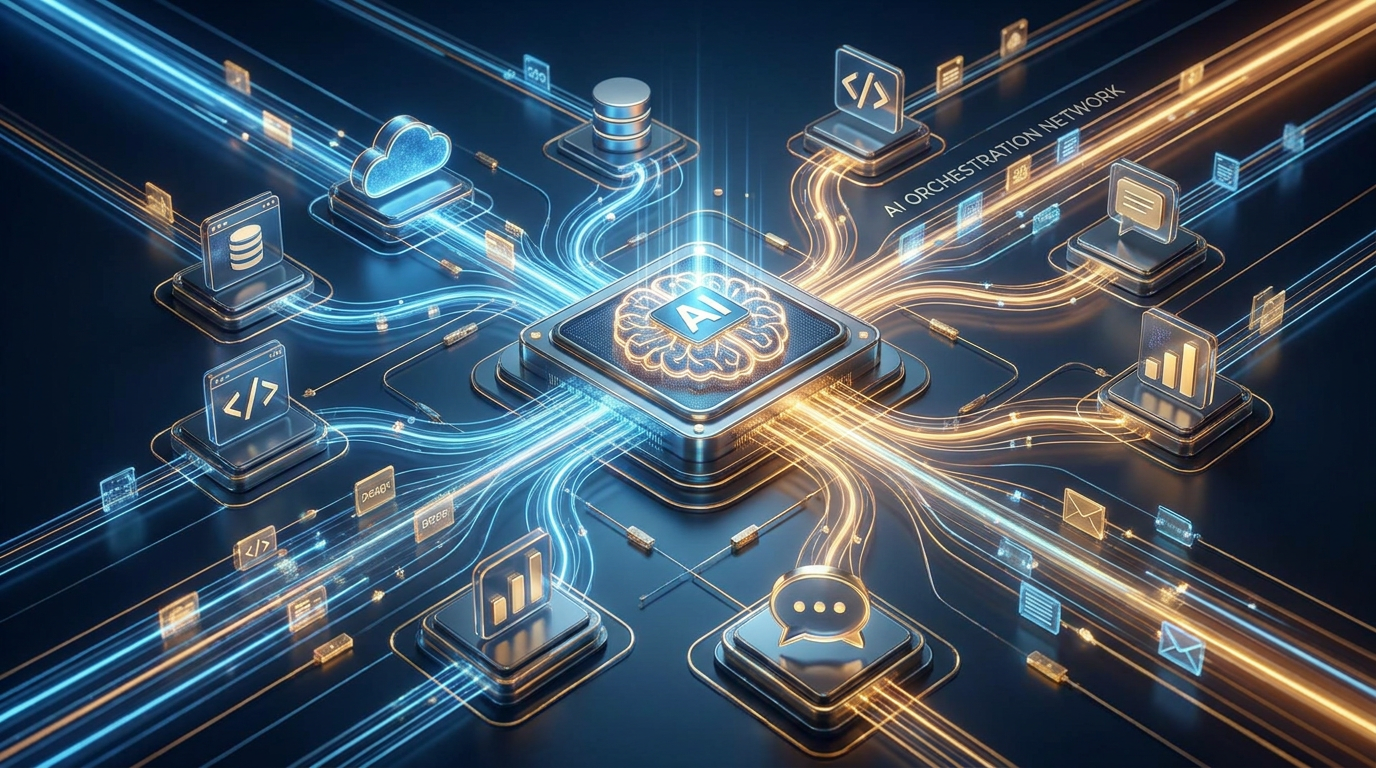
As these autonomous systems mature, the industry is moving away from single, monolithic agents and toward multi-agent collaboration. In this advanced architecture, specialized AI agents work together in a coordinated network to achieve a shared, complex objective. A human user might interact with a central "manager agent," which then delegates specific sub-tasks to a "research agent," a "coding agent," and a "quality assurance agent." These digital co-workers communicate with each other, debate potential solutions, and iteratively refine their outputs before presenting the final, polished result to the human user.[3][7][8]

However, the rise of autonomous execution brings significant new operational risks that organizations must carefully manage. When an AI system is given the ability to spend corporate money, send legally binding emails to clients, or alter production databases, the cost of an AI "hallucination" increases exponentially. An AI that writes a bad poem or a clunky paragraph is a minor novelty; an AI that autonomously issues unauthorized refunds or deletes critical customer records is a massive financial and reputational liability.[3][7]
To mitigate these severe risks, organizations are implementing strict frameworks known as automated fulfillment governance. This practice involves setting clear, hardcoded boundaries on exactly what tasks agents are allowed to execute autonomously, and establishing mandatory "human-in-the-loop" checkpoints for high-stakes decisions. An agent might be perfectly allowed to draft a complex legal contract, prepare a financial transfer, or outline a server migration plan, but a human operator must explicitly review the work and click "approve" before the final action is executed, ensuring that humans remain the ultimate arbiters of risk.[7][8][10]
The foundation of any successful agentic deployment ultimately comes down to data quality and system integration. Agents do not just analyze data in a vacuum; they act upon it to drive real-world outcomes. If an enterprise's internal knowledge base is outdated, or its data lakes are poorly governed and siloed, the AI agent will confidently execute flawed workflows based on bad information. Companies that have spent the last few years investing in clean, accessible, and well-structured data infrastructure are finding themselves at a massive advantage in the agentic era.[3][7]
The economic implications of this technological shift are staggering, promising to reshape corporate balance sheets. Industry analysts project that agentic AI will be capable of resolving up to 80% of common customer service issues without any human intervention by the year 2029. Furthermore, the market for automating the "glue work"—the manual coordination between different software systems that currently consumes millions of human hours—is estimated at $100 billion, offering massive productivity gains for organizations that successfully integrate these autonomous tools.[3][5]

Ultimately, the rise of agentic AI is not about replacing human workers, but rather elevating them above the drudgery of routine execution. As AI agents take over the repetitive, multi-step tasks that traditionally bogged down knowledge workers, human roles are rapidly shifting toward system design, strategic oversight, and complex exception handling. The worker of the future will spend significantly less time being a manual task-doer, and much more time acting as a strategic manager of a highly capable, autonomous digital team.[2][3][6]
How we got here
2022-2023
Generative AI explodes into the mainstream, focusing primarily on content creation and conversational chatbots.
2024
Early experiments with autonomous agents demonstrate potential but struggle with reliability and infinite logic loops.
2025
Enterprise platforms begin integrating basic agentic capabilities, moving beyond rigid Robotic Process Automation (RPA).
2026
Agentic AI reaches production maturity, with multi-agent systems actively executing complex workflows across industries.
Viewpoints in depth
Enterprise Strategists
Focus on scaling operations and reducing coordination costs.
For CIOs and enterprise leaders, agentic AI is primarily an economic lever. They view the technology as a way to convert labor costs into software spending, particularly in the massive market of system coordination. By deploying agents to handle the 'glue work' between disparate enterprise platforms like CRMs and ERPs, they aim to compress cycle times and achieve 20% to 40% reductions in operating costs. Their primary concern is ensuring these systems can scale reliably across thousands of daily operations.
Technical Architects
Focus on system design, interoperability, and moving beyond brittle automation.
Engineers and system architects are focused on the structural shift from deterministic scripts to non-deterministic, goal-oriented systems. They emphasize the importance of the 'agentic loop'—perception, reasoning, action, and reflection. For this camp, the true breakthrough is not better text generation, but the ability of an AI to self-correct when an API call fails or a website layout changes. They are actively building the orchestration layers and multi-agent frameworks required to make these autonomous systems robust.
Pragmatic Implementers
Focus on safe deployment, governance, and human-in-the-loop controls.
Operations managers and compliance officers are excited by the potential but highly cautious about the risks of full autonomy. They advocate for a phased approach, starting with low-risk internal workflows before exposing agents to customer-facing or financial tasks. This camp champions 'automated fulfillment governance,' insisting that any agentic system must have built-in observability, strict audit trails, and mandatory human approval checkpoints for high-stakes decisions to prevent costly hallucinations.
What we don't know
- How quickly legacy enterprise software can be updated to safely integrate with autonomous agent API calls.
- The long-term impact on entry-level knowledge worker jobs, which traditionally involve the routine tasks agents now handle.
- How regulatory bodies will assign legal liability when an autonomous agent makes a costly or harmful decision without human oversight.
Key terms
- Agentic AI
- Artificial intelligence systems that can understand a high-level goal, plan a sequence of steps, and execute them autonomously using external tools.
- Robotic Process Automation (RPA)
- Older automation technology that relies on rigid, rule-based scripts to perform repetitive tasks, often breaking if the system interface changes.
- Multi-Agent System
- An architecture where multiple specialized AI agents (e.g., a researcher, a coder, a reviewer) collaborate to complete a complex objective.
- Human-in-the-loop (HITL)
- A safeguard mechanism where an AI agent prepares an action but requires a human to review and approve it before execution.
- Orchestration
- The process of managing and coordinating multiple AI agents, data sources, and software tools to ensure a workflow runs smoothly.
Frequently asked
What is the difference between Generative AI and Agentic AI?
Generative AI focuses on creating content like text or images based on prompts. Agentic AI uses generative models as a 'brain' to take purposeful actions, use tools, and achieve goals autonomously.
Will agentic AI replace human jobs?
While it will automate many repetitive execution tasks, experts predict it will shift human roles toward system design, strategic oversight, and managing digital teams rather than outright replacement.
How does an AI agent handle errors?
Unlike traditional automation that crashes when it encounters an unexpected change, agentic AI uses a 'reflection' step to analyze why an action failed and attempts an alternative solution to reach its goal.
Do small businesses need engineers to use AI agents?
No. In 2026, many platforms offer no-code interfaces that allow non-technical users to build and deploy agentic workflows using plain English instructions.
Sources
Source coverage
10 outlets
4 viewpoints surfaced










[1]Factlen Editorial TeamSynthesis & Context
Synthesis by Factlen editorial team
Read on Factlen Editorial Team →[2]CIO MagazineEnterprise Strategists
Agentic AI will fundamentally reshape engineering in 2026
Read on CIO Magazine →[3]Bain & CompanyEnterprise Strategists
How does agentic AI work in enterprises?
Read on Bain & Company →[4]IBMTechnical Architects
What is agentic AI?
Read on IBM →[5]MendixPragmatic Implementers
Agentic AI explained
Read on Mendix →[6]AcceldataPragmatic Implementers
What is Agentic AI and How Does it Work?
Read on Acceldata →[7]CodezillaTechnical Architects
Agentic AI in Business Systems
Read on Codezilla →[8]FlotorchEnterprise Strategists
The Future of Enterprise Automation Is Agentic
Read on Flotorch →[9]The SmarketersPragmatic Implementers
Agentic AI for Marketing
Read on The Smarketers →[10]SMC ConsultingTechnical Architects
Agentic AI in ITSM
Read on SMC Consulting →

More in ai
See all 7 stories →Edge AI
How On-Device AI and Quantization Are Moving LLMs Out of the Cloud
6 sources

Agentic AI
Agentic AI: How Large Action Models Are Automating Digital Chores
7 sources
Global AI Governance
EU Delays Key AI Act Enforcement as 'Brussels Effect' Fractures Under US Deregulation
8 sources

Drug Discovery
New AI Model Accelerates Molecular Simulations 10,000-Fold, Promising Faster Drug Discovery
6 sources

Every angle. Every day.
Get ai stories with full source coverage and perspective breakdowns delivered to your inbox.