
Global Ecological Deficit Day Arrives July 30, Marking Humanity's Consumption of 1.7 Earths
Earth Overshoot Day 2026 falls on July 30, signaling that humanity has exhausted nature's resource budget for the year. However, targeted interventions in energy, food, and circular economics offer a clear mathematical path to reverse the deficit.
By Factlen Editorial Team
- Ecological Economists
- Argue that current economic models fail to account for the depletion of natural capital.
- Circular Economy Advocates
- Focus on redesigning industrial systems to eliminate waste and keep materials in use.
- Agricultural Reformers
- Highlight the food system as the primary lever for reducing humanity's ecological footprint.
What's not represented
- · Developing nations bearing the brunt of ecological debt
- · Fossil fuel industry representatives
Why this matters
The planetary ecological deficit directly drives resource scarcity, extreme weather, and food insecurity. Understanding how this debt is calculated reveals the exact levers—like reducing food waste and transitioning energy grids—needed to secure long-term economic and environmental stability.
Key points
- Earth Overshoot Day 2026 falls on July 30, marking the date humanity exhausts its annual biological resource budget.
- Sustaining current global consumption levels requires the regenerative capacity of 1.73 Earths.
- The six-day delay from 2025 is due to data revisions regarding ocean carbon absorption, not a reduction in actual human footprint.
- Decarbonizing the economy is the largest single lever to move the date, as carbon emissions make up 60 percent of the global footprint.
- Halving global food waste and shifting toward plant-based diets could push the date back by 20 days combined.
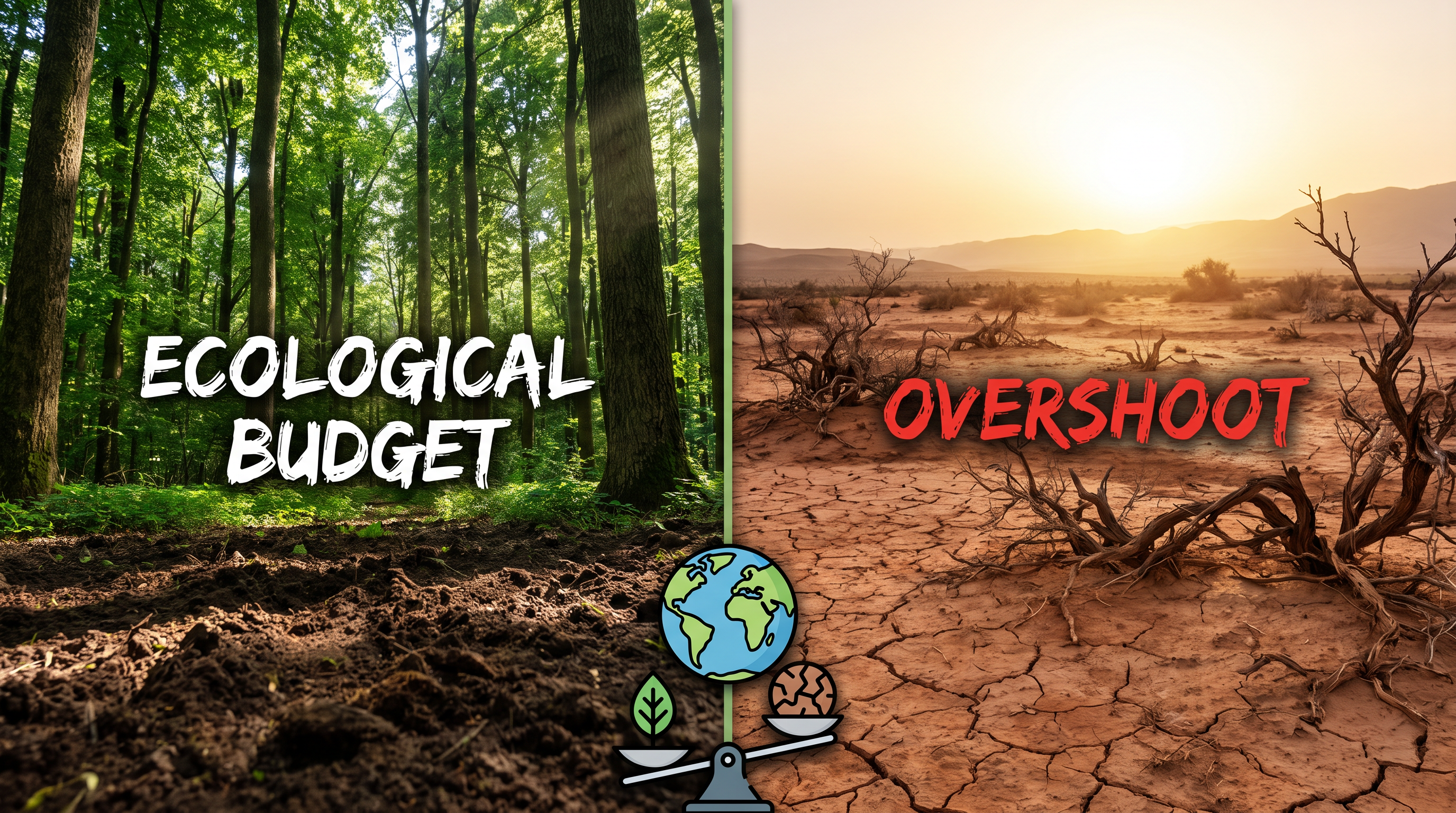
On July 30, 2026, humanity officially exhausted nature's resource budget for the entire year. This milestone, known as Earth Overshoot Day, marks the exact point in the calendar when human demand for ecological resources and services surpasses what the planet's ecosystems can naturally regenerate within a 365-day period. From this day forward, the global economy operates strictly on ecological credit, drawing down the Earth's natural capital rather than living off its sustainable interest.[1][6]
The metrics underlying this year's calculation reveal a stark reality about global consumption. According to the latest data, humanity is currently using nature 73 percent faster than the Earth's ecosystems can regenerate. In practical terms, this means that sustaining the current global lifestyle requires the biological equivalent of 1.73 Earths. This represents the highest level of global ecological overshoot in recorded human history, underscoring a compounding deficit that has been growing steadily for decades.[1]
At first glance, the 2026 date might appear to be a slight improvement. Earth Overshoot Day 2026 falls on July 30, which is six days later than the 2025 date of July 24. However, researchers caution against interpreting this calendar shift as a victory for sustainability or a sign of reduced global consumption. The underlying data tells a more complex and sobering story about how the planetary budget is tracked and measured.[1][2]
The six-day shift is almost entirely the result of revised historical data rather than actual progress in reducing humanity's footprint. Specifically, the latest datasets included an upward revision of the ocean's capacity to absorb carbon dioxide. When this new data was applied to the accounting models, it mathematically pushed the date back by several days. In reality, the actual human ecological footprint grew over the past year, meaning the gap between what humanity consumes and what the planet can regenerate actually widened.[1][2]

The mechanism used to determine Earth Overshoot Day relies on a straightforward but massive accounting equation. The date is calculated by dividing the planet's total biocapacity by humanity's overall ecological footprint. That resulting ratio is then multiplied by the number of days in the year—365 in the case of 2026. The day that corresponds to that final number becomes the official Overshoot Day, serving as a universal ledger for planetary health.[1]
On the supply side of this equation is biocapacity. This metric represents the biologically productive land and sea areas across the globe that are capable of generating resources and absorbing waste. It encompasses a wide variety of ecosystems, including dense forest lands, expansive grazing lands, active croplands, fertile fishing grounds, and the built-up land that supports human infrastructure. Biocapacity is essentially the Earth's annual biological income.[1]
On the demand side is the ecological footprint. This measures the total amount of biologically productive area required to produce the resources that a population consumes and to absorb the waste it generates. The largest and most prominent component of this footprint is carbon dioxide emissions. As industrial activity and fossil fuel consumption have surged, the carbon footprint has become the primary driver pushing Earth Overshoot Day earlier into the calendar year.[1]
The data powering these calculations comes from the National Footprint and Biocapacity Accounts, which are maintained by York University and governed by the Footprint Data Foundation. Because official United Nations statistics often have a reporting lag of several years, researchers use a technique called "nowcasting." By incorporating real-time data from sources like the Global Carbon Project and the International Energy Agency, they can accurately project the footprint and biocapacity metrics into the current year.[1]
The period between July 30 and December 31 represents a period of ecological deficit spending. Because human economies can temporarily overuse ecological resources, this deficit is physically possible in the short term. However, this overuse requires the liquidation of natural capital. Just as a business cannot survive indefinitely by selling off its core assets to cover daily operating expenses, human societies cannot indefinitely consume more than the biosphere can replenish.[1][2]
The period between July 30 and December 31 represents a period of ecological deficit spending.
The physical manifestations of this ecological debt are becoming increasingly visible across the globe. The consequences of operating in overshoot include accelerating deforestation, severe soil erosion, collapsing fisheries, and rapid biodiversity loss. Most prominently, the inability of the planet to absorb excess waste leads to the accumulation of greenhouse gases in the atmosphere, which in turn drives more frequent extreme weather events and threatens global food production.[1][2]
While July 30 represents the global average, the burden of consumption is highly unequal across different nations. To illustrate this disparity, researchers calculate "Country Overshoot Days," which determine when the global overshoot date would fall if everyone on Earth consumed resources at the rate of a specific country's residents. These national dates reveal massive differences in resource intensity and lifestyle footprints.[3]
For highly industrialized nations, the dates arrive shockingly early in the year. For example, if the entire global population lived like the residents of Canada or the United States, Earth Overshoot Day would fall in mid-March. Sustaining that level of consumption globally would require the resources of more than five Earths. Conversely, many developing nations do not reach their theoretical overshoot dates until late in the year, or they remain entirely within their biocapacity limits.[3]

Despite the daunting scale of the ecological deficit, the primary focus of the Overshoot Day initiative is on actionable solutions. The "Move the Date" campaign highlights that the tools required to bring human activity back into balance with the Earth's ecological budget already exist. These interventions are not hypothetical; they are creative, economically viable, and ready to be deployed at scale across various sectors of the global economy.[1][6]
Energy transition represents the single largest lever for moving the date. Because the carbon footprint constitutes roughly 60 percent of humanity's total ecological footprint, decarbonizing the global economy is essential. Phasing out fossil fuels in favor of renewable energy sources like solar and wind, and upgrading to energy-efficient infrastructure, could significantly reduce the deficit. Moving the date by just six days each year would bring humanity completely out of overshoot before 2050.[1]
The global food system is another critical area for intervention, as agriculture currently utilizes approximately half of the Earth's biocapacity. Resource inefficiency and food waste are massive drains on the planetary budget. According to data models, if the world could successfully cut global food waste in half—aligning with United Nations Sustainable Development Goals—it would move Earth Overshoot Day back by an impressive 13 days.[1]
Dietary shifts also offer a powerful mechanism for reducing ecological demand. Animal calories are significantly more resource-intensive to produce than plant calories, requiring vast amounts of land and water. Research indicates that if the global population replaced 50 percent of its meat consumption with plant-based alternatives, the reduced strain on agricultural land and lower emissions would move Earth Overshoot Day back by an additional seven days.[5]

In the industrial sector, transitioning to a circular economy is a highly practical response. Current "take-make-waste" supply chains are inherently designed to deplete resources. By closing the circularity gap—designing products for repair, utilizing secondary materials, embedding take-back schemes, and investing in recyclability—businesses can decouple economic growth from raw material extraction, significantly reducing the pressure on global biocapacity.[4]
Finally, classical conservation and regenerative practices are necessary to boost the supply side of the equation. Protecting biodiversity hotspots, reforesting degraded lands, and implementing regenerative agriculture can actively increase the Earth's biocapacity. These efforts not only sequester carbon but also rebuild soil health, restore water cycles, and ensure that ecosystems remain resilient in the face of a changing climate.[1]
Earth Overshoot Day serves as a vital annual ledger, quantifying the exact scale of humanity's ecological debt. While reaching this milestone in July highlights the urgency of the crisis, it also clarifies the math of the solution. The deficit is not insurmountable. By systematically implementing energy, food, and industrial reforms, humanity has a clear, mathematically proven pathway to move the date and eventually balance the planetary budget.[1][6]
How we got here
1971
Earth Overshoot Day falls on December 31, meaning humanity lived exactly within the planet's annual resource budget.
2000
The date moves to late September as global consumption and carbon emissions accelerate.
2020
The date temporarily pushes back to August 22 due to the unprecedented economic slowdown caused by the COVID-19 pandemic.
2025
Earth Overshoot Day lands on July 24, marking a severe ecological deficit.
July 2026
The 2026 date is announced as July 30, with the six-day shift attributed to revised data on ocean carbon absorption rather than reduced consumption.
Viewpoints in depth
Ecological Economists
Argue that current economic models fail to account for the depletion of natural capital.
This camp emphasizes that GDP and traditional financial metrics are fundamentally flawed because they treat the liquidation of the planet's life-support systems as income. They advocate for integrating biocapacity and ecological footprint metrics into national accounting, ensuring that economic growth is decoupled from resource extraction and carbon emissions.
Circular Economy Advocates
Focus on redesigning industrial systems to eliminate waste and keep materials in use.
Rather than focusing solely on consumer behavior, these advocates target the "take-make-waste" supply chain. They argue that Earth Overshoot Day can be significantly delayed by mandating extended producer responsibility, designing products for repair and recycling, and transitioning to business models that prioritize services over physical ownership.
Agricultural Reformers
Highlight the food system as the primary lever for reducing humanity's ecological footprint.
Because agriculture uses half of the Earth's biocapacity, this perspective argues that the fastest way to "Move the Date" is through systemic food reform. They point to data showing that halving food waste and shifting away from resource-intensive animal agriculture toward plant-based diets and regenerative farming can restore soil health and dramatically reduce land use.
What we don't know
- How rapidly emerging economies will scale their renewable energy infrastructure to offset their growing resource demands.
- Whether global policy agreements can successfully enforce the halving of food waste by 2030.
- The exact tipping point at which the accumulation of ecological debt will cause irreversible collapse in specific regional biomes.
Key terms
- Biocapacity
- The biologically productive land and sea area available to provide resources and absorb waste.
- Ecological Footprint
- A measure of human demand on nature, representing the amount of biologically productive land and sea area needed to supply the resources a population consumes.
- Ecological Deficit
- The state that occurs when the ecological footprint of a population exceeds the biocapacity of the area available to that population.
- Nowcasting
- A statistical method used to estimate current-year data by extrapolating from the most recent historical datasets using current indicators.
- Circular Economy
- An economic system aimed at eliminating waste and the continual use of resources through reuse, sharing, repair, refurbishment, and recycling.
Frequently asked
What is Earth Overshoot Day?
It is the date when humanity's demand for ecological resources and services in a given year exceeds what the Earth can regenerate in that same year.
Why did the date move to July 30 in 2026?
While the date is six days later than in 2025, this shift is due to an upward revision in data regarding the ocean's ability to absorb carbon, not a reduction in human consumption.
How is the ecological footprint calculated?
It is calculated by dividing the planet's total biocapacity by humanity's ecological footprint, and multiplying that ratio by the 365 days in a year.
How can we move the date back?
Solutions include decarbonizing the energy grid, halving global food waste, shifting toward plant-based diets, and transitioning to a circular economy.
Sources
Source coverage
6 outlets
3 viewpoints surfaced






[1]Global Footprint NetworkEcological Economists
Earth Overshoot Day 2026 lands on July 30
Read on Global Footprint Network →[2]Social Justice IrelandEcological Economists
Earth Overshoot Day 2026
Read on Social Justice Ireland →[3]Fashion Takes ActionCircular Economy Advocates
Earth Overshoot Day 2026 is July 30
Read on Fashion Takes Action →[4]ReconomyCircular Economy Advocates
Thinking circular to tackle Earth Overshoot Day
Read on Reconomy →[5]Infogr8Agricultural Reformers
5 small steps you can take to help #MoveTheDate
Read on Infogr8 →[6]Factlen Editorial TeamAgricultural Reformers
Synthesis by Factlen editorial team
Read on Factlen Editorial Team →


Every angle. Every day.
Get environment stories with full source coverage and perspective breakdowns delivered to your inbox.