
Genesis Unveils Flagship GV90 Electric SUV With 123.5 kWh Battery and Coach Doors
The 2027 Genesis GV90 Neolun introduces a B-pillarless design with dual-motion coach doors and a lounge-like interior, backed by the largest battery in Hyundai Motor Group history.
By Adrien Caron

For buyers navigating the top tier of the automotive market, the definition of a luxury vehicle is shifting away from pure driving dynamics and toward the concept of a mobile sanctuary. As electric powertrains eliminate engine noise and vibration, the battleground for high-end automakers has moved entirely to the cabin experience and structural innovation. For anyone considering a six-figure vehicle purchase in the next two years, the standard for what constitutes a flagship SUV is being rewritten to prioritize architectural space over traditional performance metrics.[1]
That shift crystallized this week in San Francisco, where Genesis unveiled the 2027 GV90, its first full-size electric flagship SUV. The vehicle arrives in two distinct configurations: a standard model with conventional doors, and the ultra-luxury GV90 Neolun, which eliminates the central B-pillar entirely to offer a massive, unobstructed opening into the cabin.
The Neolun variant represents the culmination of the brand's rapid ascent in the luxury sector, targeting established titans like the Range Rover Autobiography and the Mercedes-Maybach GLS with a design that leans heavily on traditional Korean aesthetics and cutting-edge structural engineering.[1][2][6]
The defining feature of the GV90 Neolun is what Genesis calls the Neolun Arch Gate—a set of independently opening coach doors that swing outward from the center. While rear-hinged doors are a hallmark of ultra-luxury brands like Rolls-Royce, the Genesis implementation removes the structural B-pillar that normally separates the front and rear compartments.
To make this work without the doors colliding or requiring a specific opening sequence, engineers developed a dual-motion hinge mechanism. When activated, the rear door first slides slightly outward from the body before smoothly rotating backward, allowing either door to operate completely independently of the other.[2][3][4]
Removing the B-pillar—a critical structural component in modern vehicle safety—required a complete rethink of the SUV's crash protection. To compensate for the missing central support, Genesis integrated high-strength dual steel beams directly into the doors themselves, effectively creating a virtual pillar when the doors are closed. The entire cabin hoop surrounding the door aperture is reinforced with a hidden roll-cage structure that is 50 percent thicker than conventional designs, ensuring the vehicle maintains its rigidity and crashworthiness in the event of a side impact or rollover.[1][2][3][4]
Once those massive doors open, the Neolun's cabin functions less like a traditional car interior and more like a high-end lounge. When the vehicle is parked, motorized front bucket seats can swivel 180 degrees to face the rear passengers, creating a face-to-face social or business environment.
The space is trimmed in Royal Indigo cashmere, matte leather dyed with natural Korean pigments, and real dark wood flooring. A central console between the second-row recliners houses a refrigerator, integrated tables, and a control screen, while a glass partition separates the passenger area from the cargo hold for maximum acoustic isolation.[1][2][3][6]
Beneath the lounge-like interior sits the most robust electric architecture Hyundai Motor Group has ever deployed. The GV90 is powered by a massive 123.5-kilowatt-hour high-voltage battery pack, the largest capacity unit ever fitted to one of the automaker's vehicles. This battery feeds a dual-motor all-wheel-drive system that generates a combined 657 horsepower and 590 pound-feet of torque.
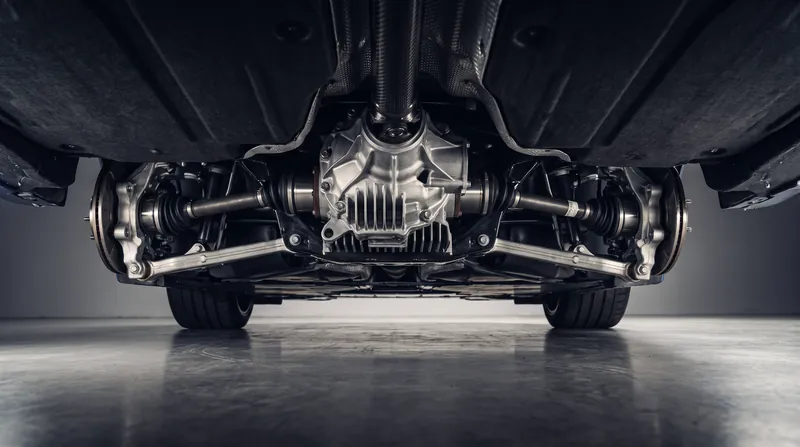
To manage this immense power, the flagship rides on an exclusive eMP platform equipped with a multi-chamber air suspension system, electronically controlled dampers, and rear-wheel steering of up to five degrees to help maneuver the 208.1-inch-long vehicle in tight urban spaces.[3][4][5][6]
The battery system itself introduces several new technologies aimed at efficiency and safety. A Wireless Battery Management System (WBMS) eliminates heavy wiring harnesses within the pack, maximizing cell packaging efficiency and allowing engineers to squeeze more capacity into the same physical footprint.
Furthermore, the pack incorporates thermal runaway protection that physically separates individual battery cells to mitigate the risk of a localized fire spreading. Despite the massive battery size, the sheer weight and aerodynamic profile of the full-size SUV mean the seven-seat variant achieves an estimated range of approximately 310 miles on a single charge.[4][5][6]
When it comes time to replenish that massive battery, the GV90 utilizes an 800-volt architecture capable of accepting 350-kilowatt DC fast charging. Under optimal conditions, this allows the vehicle to charge from 10 to 80 percent in roughly 22 minutes, keeping highway travel viable despite the vehicle's size.
Inside, the technological integration continues with a 24.6-inch display extension feature that raises the central screen by 90 millimeters when parked for multimedia viewing, while a massive 25-inch head-up display replaces the traditional instrument cluster entirely, projecting speed, navigation, and driver-assist data directly into the driver's line of sight.[3][4][5][6]
The introduction of the GV90 signals a bold pricing strategy for the Korean automaker, pushing it firmly into the ultra-luxury stratosphere. While official pricing has not been announced, industry analysts expect the standard GV90 to start north of $100,000, with the B-pillarless Neolun variant climbing toward the $150,000 mark.
An even more exclusive four-seat First Edition model, featuring two-tone paint and 24-inch forged wheels, is expected to command prices competitive with the Mercedes-Maybach GLS and the Cadillac Escalade IQ. For buyers in this rarefied air, the GV90 represents a compelling new option that prioritizes architectural innovation and bespoke comfort over legacy brand cachet.[1][2]
Beyond the structural reinforcements required by the coach doors, the GV90 introduces novel passive safety systems designed specifically for its cavernous interior. Because the front seats can swivel and the cabin space is so expansive, traditional airbag deployment trajectories had to be completely remapped. Genesis engineered a 12-airbag system that includes what the company claims is the world's first roof airbag, designed to deploy downward from the headliner to protect occupants regardless of which direction their seats are facing during an impact.[1][6]
However, the sheer scale of the GV90's engineering ambitions introduces inevitable compromises, primarily in the form of weight. While Genesis has not yet released official curb weight figures, the combination of a 123.5-kilowatt-hour battery, heavy dual-motion door hinges, a reinforced roll-cage structure, and multi-chamber air suspension guarantees this will be one of the heaviest passenger vehicles on the road.
That mass directly impacts efficiency; a 310-mile range from such a massive battery indicates a relatively high consumption rate, meaning owners will be highly dependent on the availability of top-tier 350-kilowatt fast chargers to make long-distance travel practical.[3][4]
For the luxury vehicle buyer, the arrival of the GV90 Neolun fundamentally alters the competitive landscape. It proves that the transition to electric vehicles is no longer just about swapping a gas tank for a battery, but about using the packaging advantages of an EV platform to rethink automotive architecture entirely.
Whether opting for the standard model or the coach-door Neolun, owners will be stepping into a vehicle that prioritizes the passenger experience above all else, forcing legacy luxury brands to accelerate their own interior innovations or risk being left behind in the new era of the mobile sanctuary.[1][2]
Key points
- Genesis has unveiled the 2027 GV90, its first full-size electric flagship SUV, available in a standard model and an ultra-luxury Neolun variant.
- The GV90 Neolun features B-pillarless coach doors that utilize a dual-motion hinge to open independently, creating a massive, unobstructed cabin entry.
- When parked, the Neolun's front seats can swivel 180 degrees to face the rear passengers, transforming the interior into a social lounge.
- The vehicle is powered by a 123.5-kWh battery—the largest in Hyundai Motor Group history—delivering 657 horsepower and an estimated 310 miles of range.
What we don’t know
- Genesis has not yet released the official curb weight of the GV90, which is expected to be exceptionally high given the battery size and structural reinforcements.
- Exact pricing remains unconfirmed, though industry estimates place the Neolun variant well above the $100,000 mark.
- It is unclear how the B-pillarless design will perform in independent side-impact crash testing by agencies like the IIHS or Euro NCAP.
How we got here
April 2024
Genesis reveals the Neolun Concept, teasing a B-pillarless electric SUV with lounge-style seating.
August 19, 2026
Genesis officially unveils the production-spec GV90 and GV90 Neolun in San Francisco.
First Half 2027
Expected global market launch and initial customer deliveries of the GV90.
- Luxury Consumers
- Buyers seeking maximum interior space, comfort, and novel architectural features in their vehicles.
- Automotive Engineers
- Technical experts focused on battery packaging, structural rigidity, and crash safety mechanisms.
- Industry Analysts
- Market watchers evaluating Genesis's pricing power and ability to challenge legacy European luxury brands.
Perspectives this story doesn't cover
- Independent Crash Test Agencies
- Chauffeurs and Professional Drivers
Sources
Source coverage
6 outlets
3 viewpoints surfaced






- [1]CNETLuxury Consumers
Genesis GV90 Neolun First Look: A $150,000 Electric Flagship With Coach Doors
Read on CNET → - [2]JalopnikIndustry Analysts
2027 Genesis GV90: The Korean Luxury Brand Builds a B-Pillarless Limo
Read on Jalopnik → - [3]Cars.comLuxury Consumers
2027 Genesis GV90 Unveiled: A Flagship EV With Coach Doors
Read on Cars.com → - [4]EngadgetAutomotive Engineers
Genesis' GV90 NeoLun is a luxury electric SUV with heated floors and coach doors
Read on Engadget → - [5]WardsAutoAutomotive Engineers
Genesis GV90 Debuts With 123.5-kWh Battery, Dual-Motion Doors
Read on WardsAuto → - [6]GenesisIndustry Analysts
Genesis Unveils GV90 and GV90 Neolun, Redefining the Luxury Flagship SUV
Read on Genesis →
More in Automotive & Transportation
See all →Carbon Fiber Tech
The Anisotropy of Carbon Fiber: How Fiber Orientation Dictates Strength and Stiffness in Different Directions
7 sources
EV Efficiency
How the Volkswagen Mission Efficiency Concept Extracts 9 Miles Per Kilowatt-Hour
3 sources
Suspension Tech
Magnetorheological Fluid's Microsecond Response Time: How Active Dampers Trade Comfort for Cornering Stiffness
8 sources
Torque Vectoring
How Clutch Packs and Planetary Gears Erase Understeer in Performance Cars
7 sources
Comments
Every angle. Every day.
Get Automotive & Transportation stories with full source coverage and perspective breakdowns, free every day.