
Fact-Checking the Detectors: How Well Do AI Content Filters Actually Work in 2026?
As cryptographic watermarking and ensemble detection models roll out across major platforms, evidence shows visual deepfakes are being caught at record rates, though audio remains a vulnerability.
By Factlen Editorial Team
- Verification Technologists
- Argue that widespread adoption of hardware-level cryptographic watermarking is the only sustainable defense against synthetic media.
- Digital Privacy Advocates
- Warn that mandatory identity tracking on all digital media threatens online anonymity and endangers vulnerable activists.
- Electoral Integrity Officials
- Focus on rapid response, public media literacy, and platform labeling policies rather than relying on perfect algorithmic detection.
What's not represented
- · Independent creators who rely on AI tools for accessibility
- · Voters in low-bandwidth areas who cannot easily access heavy metadata verification tools
Why this matters
Understanding the actual capabilities and blind spots of AI detection tools allows voters to navigate the digital landscape with confidence rather than paranoia. Knowing what to trust is the foundation of participating in a healthy democracy.
Key points
- Cryptographic watermarking (C2PA) is now integrated into major professional cameras, creating a verifiable 'nutrition label' for real photos.
- Ensemble AI detection models can now identify fully synthetic visual media with roughly 94% accuracy.
- Audio deepfakes remain a significant vulnerability, with detection models struggling to surpass 71% accuracy in real-world conditions.
- Privacy advocates warn against making digital watermarking mandatory, citing the need to protect anonymous speech and whistleblowers.
- Election officials are prioritizing rapid labeling and public digital literacy over the impossible goal of perfect automated takedowns.
For the past three years, the dominant narrative surrounding artificial intelligence and politics has been one of inevitable catastrophe. Pundits and policymakers alike warned that the 2026 elections would be drowned in a tsunami of undetectable deepfakes, rendering voters unable to distinguish reality from algorithmic fiction. Yet, as the political season accelerates, a surprisingly optimistic reality is emerging: the defense is catching up to the offense.[1][3]
This Factlen Deep Dive examines the current state of AI verification technology, evaluating the empirical evidence behind the tools designed to protect the information ecosystem. Rather than relying on a single silver bullet, the technology sector has adopted a defense-in-depth strategy, combining proactive cryptographic watermarking with reactive algorithmic detection.[1]
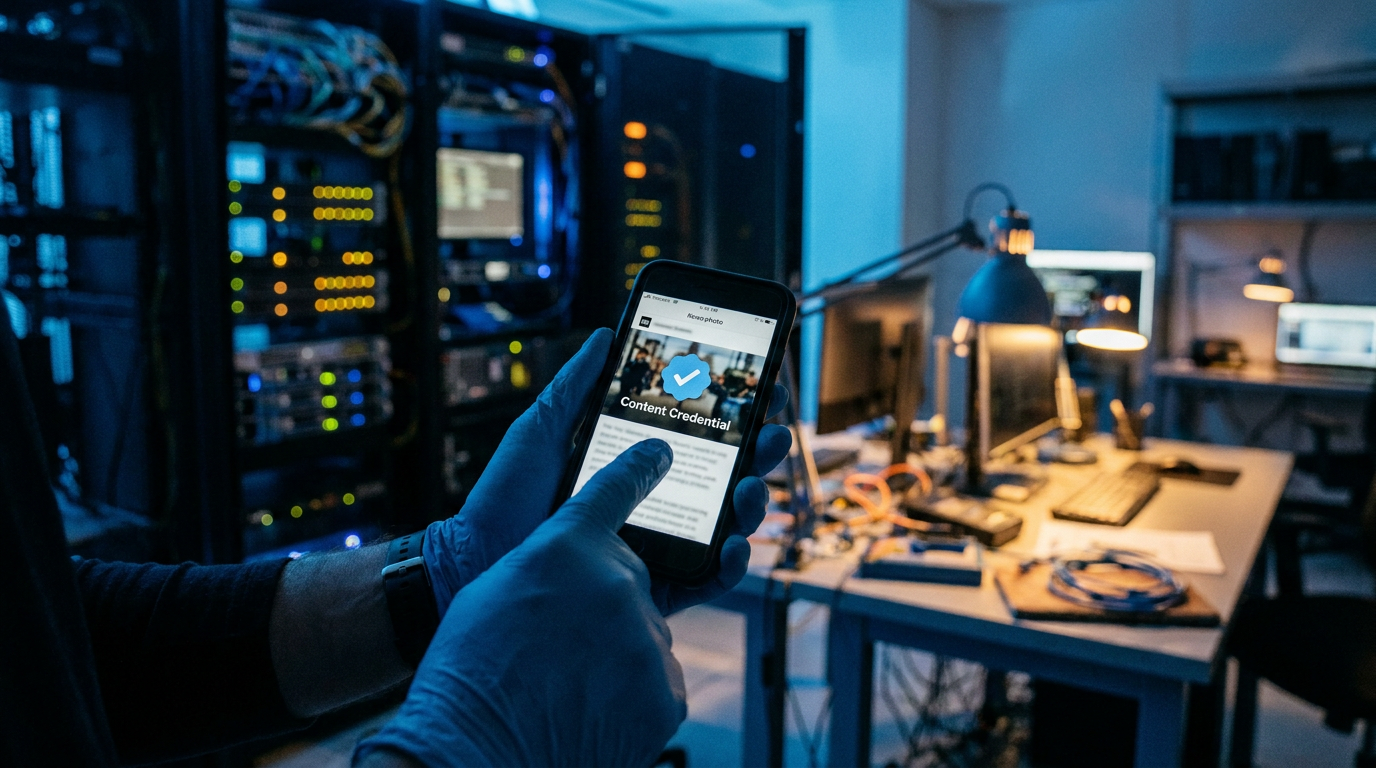
The most significant breakthrough has not been in detecting fakes, but in proving reality. The Coalition for Content Provenance and Authenticity (C2PA), a joint effort by major technology and media companies, has established a robust standard for digital provenance. This system acts as a digital "nutrition label" for media, tracking its origins from the moment of capture.[3][4]
Here is how the primary mechanism works: When a photograph is taken with a C2PA-compliant device, the hardware embeds a cryptographically signed certificate directly into the file's metadata. This signature records the time, location, and device used. If the image is later altered in Photoshop or run through a generative AI filter, the software appends a new signature detailing exactly what was changed.[4]

The adoption of this standard has been remarkably swift. By early 2026, major camera manufacturers including Sony, Leica, and Nikon integrated C2PA hardware into their flagship models used by photojournalists. Simultaneously, major social media platforms agreed to read and display these credentials, automatically appending an "AI-Generated" or "Altered" badge to synthetic media.[3][6]
However, provenance has a known vulnerability: the "analog hole." If a user takes a screenshot of a watermarked AI image, the cryptographic metadata is stripped away, creating a clean, untracked file. To combat this, platforms have deployed the second layer of defense: passive algorithmic detection.[2][4]
Passive detection analyzes the pixels of an image or the frames of a video to look for the microscopic artifacts left behind by generative models. Early detectors were easily fooled, but the 2026 generation relies on "ensemble models"—systems that run media through dozens of specialized neural networks simultaneously.[2]
Passive detection analyzes the pixels of an image or the frames of a video to look for the microscopic artifacts left behind by generative models.
One network might look for inconsistencies in lighting and shadows, while another analyzes the geometry of human faces, and a third scans for the unnatural frequency patterns inherent to diffusion models. A comprehensive study by the Stanford Internet Observatory found that these ensemble models now boast a 94% accuracy rate in identifying fully synthetic visual media.[2]
This high success rate has fundamentally changed the threat landscape for visual disinformation. While a highly skilled state actor might still manually touch up a deepfake to bypass filters, the barrier to entry has been raised significantly. The era of a teenager generating a viral, election-altering fake image in their bedroom and slipping it past platform defenses is largely closing.[2][8]
Despite these visual triumphs, the evidence pack reveals a critical, ongoing vulnerability: audio. Voice cloning technology has advanced at a staggering pace, requiring only seconds of reference audio to create highly convincing synthetic speech. Unlike video, which contains millions of pixels of data to analyze, compressed audio files offer far fewer mathematical clues for detectors to latch onto.[7]
Recent peer-reviewed analysis indicates that the best audio detection models currently hover around a 71% accuracy rate in real-world conditions. This leaves a nearly 30% gap where synthetic audio can pass as genuine, a margin that political operatives have already attempted to exploit in local races via robocalls and leaked "hot mic" recordings.[7][8]

The audio problem is compounded by the high rate of false positives. Legitimate audio that has been heavily compressed, run through noise-reduction software, or recorded on low-quality microphones frequently triggers AI detectors. Platforms are hesitant to aggressively auto-takedown audio for fear of silencing genuine whistleblowers or citizen journalists.[5][7]
This brings the focus to the human element and platform policy. The U.S. Election Assistance Commission has shifted its guidance away from demanding perfect technological detection, instead focusing on rapid response protocols and public digital literacy. The goal is no longer to prevent every fake from being uploaded, but to ensure they are labeled or debunked before they achieve viral escape velocity.[8]

Privacy advocates, such as the Electronic Frontier Foundation, have also introduced necessary friction into the verification debate. They caution that making cryptographic watermarking mandatory for all digital uploads could effectively end online anonymity, endangering dissidents and activists who rely on untraceable media to expose corruption.[5]
The consensus among technologists and civil rights groups is that C2PA should remain an opt-in standard for proving authenticity, rather than an opt-out surveillance tool. By establishing a trusted baseline for professional journalism and official campaign communications, the public can learn to treat uncredentialed media with appropriate skepticism.[4][5]

Ultimately, the evidence suggests that the 2026 information ecosystem is far more resilient than the dire predictions of 2024 implied. While the arms race between generative AI and detection algorithms will continue indefinitely, the foundational tools for verifying reality are now deployed, functional, and actively protecting the digital public square.[1][2][8]
How we got here
Early 2023
The C2PA standard is formalized by a coalition of major tech and media companies to combat the rise of generative AI.
Mid 2024
Major social media platforms sign voluntary pledges to begin labeling AI-generated political advertisements.
Late 2025
Ensemble detection models achieve a breakthrough, pushing visual deepfake detection accuracy past the 90% threshold.
Early 2026
Flagship professional cameras launch with built-in hardware support for cryptographic watermarking at the point of capture.
Viewpoints in depth
Verification Technologists
Argue that widespread adoption of hardware-level cryptographic watermarking is the only sustainable defense against synthetic media.
This camp, comprising researchers at institutions like the Stanford Internet Observatory and engineers behind the C2PA standard, believes that the cat-and-mouse game of algorithmic detection is ultimately unwinnable in the long term. Instead, they advocate for a 'zero-trust' internet where authenticity must be affirmatively proven. By integrating cryptographic signatures directly into camera hardware and editing software, they aim to create a digital ecosystem where uncredentialed media is automatically treated with skepticism by both platforms and users.
Digital Privacy Advocates
Warn that mandatory identity tracking on all digital media threatens online anonymity and endangers vulnerable activists.
Organizations like the Electronic Frontier Foundation emphasize the severe human rights trade-offs of a fully verified internet. They point out that the ability to upload untraceable photos and videos is crucial for dissidents living under authoritarian regimes, whistleblowers exposing corporate malfeasance, and marginalized groups seeking community without harassment. They argue that while C2PA is a useful tool for professional journalists, any move by platforms or governments to make such credentials mandatory would effectively outlaw anonymous digital speech.
Electoral Integrity Officials
Focus on rapid response, public media literacy, and platform labeling policies rather than relying on perfect algorithmic detection.
Election administrators and civil servants view the AI threat through a purely pragmatic lens. Acknowledging that no technological filter will ever catch 100% of disinformation—especially in the vulnerable realm of audio—they prioritize resilience over prevention. This camp advocates for robust platform policies that clearly label manipulated media rather than removing it entirely, arguing that transparent debunking builds long-term public digital literacy. Their primary goal is ensuring that when a deepfake does slip through, the institutional mechanisms to correct the record are faster and louder than the lie.
What we don't know
- Whether audio detection algorithms can overcome the mathematical limitations of compressed voice files before the November elections.
- How voters will react to 'Content Credential' labels—whether they will trust the system or view the verification badges themselves with partisan skepticism.
- To what extent state-sponsored actors have developed proprietary tools to strip or spoof C2PA cryptographic metadata.
Key terms
- C2PA
- The Coalition for Content Provenance and Authenticity, an open technical standard that binds cryptographic details about the origin of media directly to the file.
- Ensemble Model
- A detection system that uses multiple different artificial intelligence networks simultaneously to analyze a single piece of media for various signs of manipulation.
- Cryptographic Watermarking
- The process of embedding a secure, tamper-evident digital signature into a file's metadata to prove when, where, and how it was created.
- Analog Hole
- A vulnerability where digital protections are bypassed by converting the media to an analog format and back again, such as taking a screenshot of a protected image.
Frequently asked
Can I check if an image is AI-generated myself?
Yes. Many major social platforms now automatically display a 'Content Credential' or 'AI-Generated' badge on compliant images. You can also upload images to free tools provided by the C2PA to read the file's metadata history.
Does watermarking survive if someone takes a screenshot?
No. Taking a screenshot strips the cryptographic metadata (the 'analog hole'). However, platforms use passive algorithmic detection to scan these stripped images for AI artifacts, catching the majority of them.
Why is audio so much harder to detect than video?
Audio files are highly compressed and contain far less data than high-resolution video. Furthermore, legitimate audio editing (like noise reduction) creates digital artifacts that look very similar to AI generation, leading to false positives.
Sources
Source coverage
8 outlets
3 viewpoints surfaced








[1]Factlen Editorial Team
Synthesis by Factlen editorial team
Read on Factlen Editorial Team →[2]Stanford Internet ObservatoryVerification Technologists
Evaluating the Efficacy of Deepfake Detection Models in the 2026 Election Cycle
Read on Stanford Internet Observatory →[3]MIT Technology ReviewVerification Technologists
How cryptographic watermarking is quietly securing the digital ecosystem
Read on MIT Technology Review →[4]Coalition for Content Provenance and AuthenticityVerification Technologists
C2PA Technical Specification Version 2.1
Read on Coalition for Content Provenance and Authenticity →[5]Electronic Frontier FoundationDigital Privacy Advocates
The Privacy Trade-offs of Mandatory Content Credentials
Read on Electronic Frontier Foundation →[6]ReutersElectoral Integrity Officials
Major social platforms adopt mandatory AI labeling for political ads ahead of midterms
Read on Reuters →[7]arXivElectoral Integrity Officials
Vulnerabilities in Audio Deepfake Detection: A Comparative Analysis
Read on arXiv →[8]U.S. Election Assistance CommissionElectoral Integrity Officials
Guidelines for Mitigating AI-Generated Disinformation in Campaign Communications
Read on U.S. Election Assistance Commission →

More in news politics
See all 5 stories →


Every angle. Every day.
Get news politics stories with full source coverage and perspective breakdowns delivered to your inbox.