
How Bidirectional Charging is Turning EVs into Home Power Plants
Electric vehicles are evolving from simple transportation into massive mobile batteries capable of powering homes for days and stabilizing the national grid.
By Factlen Editorial Team
- Energy Resilience Advocates
- Advocates prioritize using the EV as a personal backup generator to survive grid failures and achieve energy independence.
- Grid Operators & Policymakers
- Utilities and government agencies view EVs as a decentralized solution to stabilize the grid and store renewable energy.
- Automotive Pragmatists
- Industry analysts caution that high hardware costs, utility red tape, and battery wear remain significant barriers to adoption.
What's not represented
- · Traditional fossil-fuel generator manufacturers
- · Local electricians handling the complex installations
Why this matters
The battery inside an electric vehicle holds up to ten times more energy than a standard home backup battery. Unlocking this power can save homeowners thousands of dollars during blackouts, lower daily energy bills, and accelerate the transition to a stable, renewable energy grid.
Key points
- Bidirectional charging transforms EVs from simple transportation into massive, mobile power plants.
- Vehicle-to-Home (V2H) technology allows modern EVs to power an average house for 3 to 7 days during an outage.
- The U.S. Department of Energy is pushing Vehicle-to-Grid (V2G) to stabilize the national power grid and store renewable energy.
- EV owners could potentially earn $500 to $1,500 annually by participating in utility V2G programs.
- High hardware costs ($3,500–$8,000) and complex utility permitting remain the biggest hurdles to widespread adoption.
The electric vehicle in the driveway is no longer just a car; it is a massive, mobile power plant. As EV adoption accelerates, a quiet revolution is happening in residential garages. The battery sitting idle for 90% of the day is being unlocked to power homes, stabilize local energy grids, and even generate passive income for owners.[7]
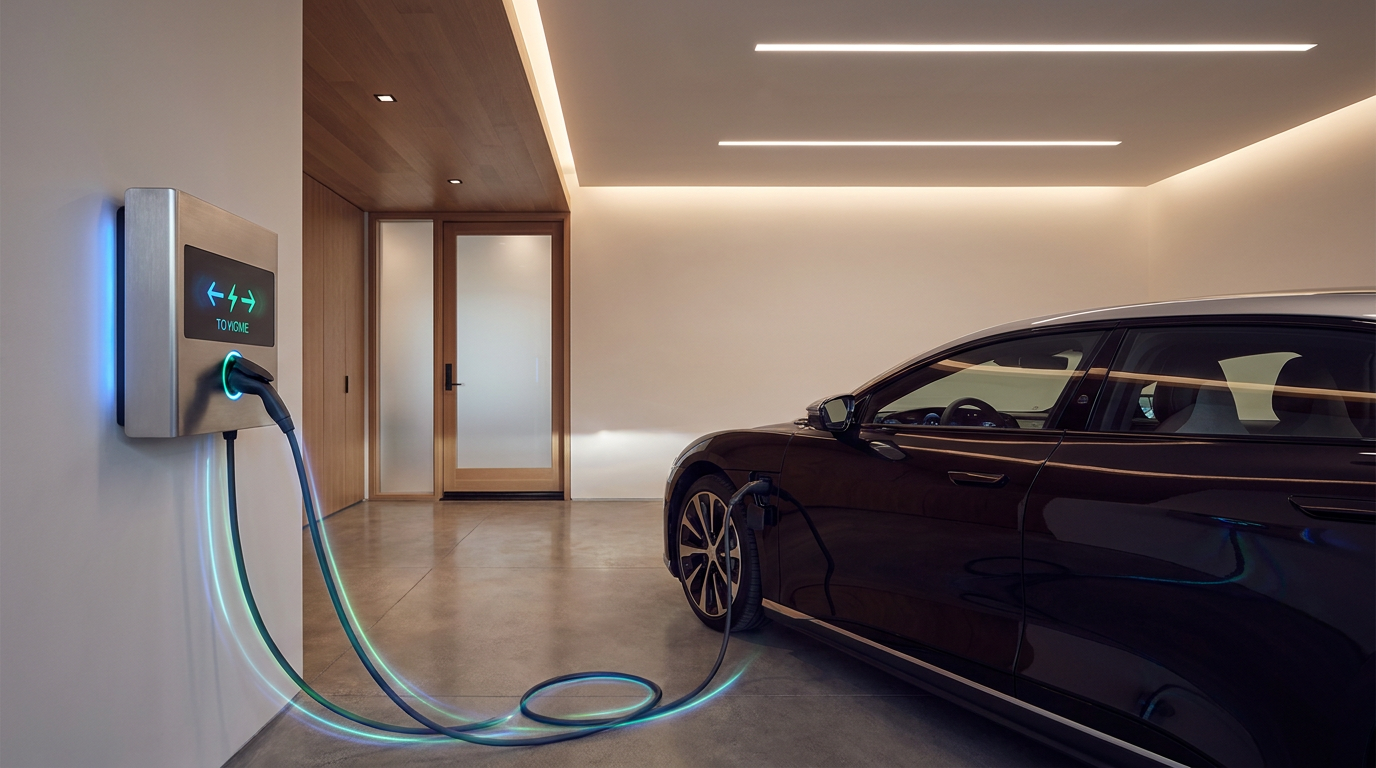
This transformation is driven by bidirectional charging, a technology that flips the traditional script on energy consumption. Instead of electricity flowing in a one-way street from the grid to the vehicle, bidirectional systems allow the car to push power back out, acting as a dynamic energy reservoir.[1]
To understand the stakes, one must look at the sheer scale of an EV battery. A standard stationary home battery, such as a Tesla Powerwall, holds about 13.5 kilowatt-hours (kWh) of energy. In contrast, modern electric vehicles carry battery packs ranging from 60 kWh to over 200 kWh. That represents an enormous reservoir of untapped energy sitting in millions of driveways.[4][6]

The automotive and energy industries categorize this two-way power flow under the umbrella term "V2X" (Vehicle-to-Everything), which breaks down into three distinct capabilities: V2L, V2H, and V2G. Each serves a different purpose, ranging from powering a campsite to supporting municipal infrastructure.[2]
Vehicle-to-Load (V2L) is the most basic and widely available form. It simply means the car has built-in 120V or 240V outlets, allowing owners to plug in power tools, camping equipment, or a refrigerator directly into the vehicle. It requires no special home hardware and is standard on many modern EVs.[2][4]
Vehicle-to-Home (V2H) is where the technology becomes a true game-changer for residential resilience. In a V2H setup, the vehicle connects directly to the home's electrical panel. During a blackout, the car automatically takes over, acting as a silent, emission-free whole-home backup generator.[5]
The backup duration V2H provides is staggering. According to 2026 industry data, a GM Silverado EV, equipped with a massive 200+ kWh battery, can power an average American home's essential loads for six to seven days. The Ford F-150 Lightning can sustain a home for three to ten days, depending on usage and battery configuration.[3][4]
According to 2026 industry data, a GM Silverado EV, equipped with a massive 200+ kWh battery, can power an average American home's essential loads for six to seven days.
Making V2H work requires heavy-duty hardware. The electrical grid and home appliances run on alternating current (AC), while EV batteries store direct current (DC). A bidirectional charger contains specialized inverters that handle this AC/DC conversion in both directions, safely managing the flow of electricity into the home's panel.[5]

Beyond the home, Vehicle-to-Grid (V2G) scales this concept to the macro level. V2G allows EVs to export their stored energy back to the municipal power grid during times of peak demand. The U.S. Department of Energy has outlined a 10-year strategy to integrate these mobile batteries into the national infrastructure, viewing them as a critical tool for grid stability.[1]
For consumers, V2G offers a compelling financial incentive. Utilities in several states and pilot programs globally are now paying EV owners to draw on their batteries during peak hours. Estimates suggest owners can earn between $500 and $1,500 annually just by leaving their cars plugged in and allowing the utility to manage the flow.[5]
Environmentally, V2G solves one of the biggest challenges of renewable energy: intermittency. Solar panels produce the most power at midday, while wind turbines often peak at night. Millions of plugged-in EVs can soak up this cheap, abundant renewable energy when it is generated, and feed it back to the grid during the evening peak, displacing the need for dirty fossil-fuel "peaker" plants.[6]
Despite the immense promise, widespread adoption faces significant hurdles, starting with cost. While a standard Level 2 home charger costs between $500 and $1,500, a full bidirectional V2H system—including the specialized charger and a required transfer switch—runs between $3,500 and $8,000 before installation.[3]

Red tape is another bottleneck. Because a V2H or V2G system can export power, utilities treat its installation exactly like a new rooftop solar array. Homeowners must navigate complex permitting processes and interconnection approvals, which can delay deployment by months and frustrate early adopters.[1]
Furthermore, automakers and consumers remain cautious about battery degradation. EV batteries are designed for a certain number of charge cycles. "Micro-cycling"—constantly draining and recharging the battery by a few percent to support the grid—could theoretically accelerate wear and complicate vehicle warranties if not carefully managed by software.[2]
As of 2026, the landscape is a mix of rapid hardware advancement and lagging software integration. While approximately 60% of new EV models possess the physical hardware for bidirectional charging, full V2H and V2G capabilities are often locked behind firmware updates or limited to specific regional utility pilot programs.[2]
Nevertheless, the trajectory is clear. With over 126 gigawatt-hours of mobile storage capacity currently on American roads, the transition from single-purpose vehicles to decentralized energy assets is inevitable. As hardware costs fall and utility standards unify, the electric car is poised to become the most important appliance a homeowner can buy.[6][7]
How we got here
2022
Early pilot programs for Vehicle-to-Grid (V2G) launch in select markets, primarily using the older CHAdeMO charging standard.
2024
Automakers like Ford and GM begin delivering the first mass-market trucks capable of full Vehicle-to-Home (V2H) backup.
January 2025
The U.S. Department of Energy publishes a 10-year strategy to integrate EV batteries into the national power grid.
2026
Approximately 60% of new EV models are manufactured with the hardware required for bidirectional charging, though software and utility support remain fragmented.
Viewpoints in depth
The Home Resilience View
Advocates prioritize using the EV as a personal backup generator to survive grid failures.
For homeowners and energy independence advocates, the primary draw of bidirectional charging is Vehicle-to-Home (V2H) capability. They view the EV not just as transportation, but as a massive, mobile insurance policy against increasingly frequent power outages. By leveraging batteries that are up to ten times larger than standard stationary home batteries, consumers can keep their lights, refrigerators, and HVAC systems running for days without relying on noisy diesel generators. For this camp, the high upfront cost of bidirectional hardware is easily justified by the security and self-reliance it provides.
The Grid Operator View
Policymakers and utilities see EVs as a decentralized solution to renewable energy intermittency.
From the perspective of the Department of Energy and municipal utilities, millions of EVs represent a vast, untapped network of grid storage. Grid operators struggle with the 'duck curve'—the mismatch between when solar energy is generated (midday) and when consumer demand peaks (evening). Vehicle-to-Grid (V2G) technology allows utilities to pay EV owners to soak up excess solar power during the day and discharge it back into the grid at night. This camp argues that scaling V2G is essential for retiring fossil-fuel peaker plants and achieving national decarbonization goals.
The Pragmatic Skeptic View
Industry analysts caution that hardware costs and battery wear remain significant barriers.
While the technology is proven, automotive pragmatists and hardware analysts warn that the economics don't yet make sense for the average consumer. They point to the steep $3,500 to $8,000 premium for bidirectional chargers and the bureaucratic nightmare of utility interconnection approvals. Furthermore, there is lingering anxiety about 'micro-cycling'—the process of constantly draining and recharging the battery for grid services. Skeptics argue that until automakers provide ironclad warranties covering V2G degradation, most owners will be hesitant to rent out their expensive EV batteries for a few hundred dollars a year in utility credits.
What we don't know
- How long it will take for all major automakers to standardize bidirectional charging hardware and software across their fleets.
- The exact long-term impact of daily V2G micro-cycling on the lifespan of various EV battery chemistries.
- Whether utility companies will streamline the complex permitting process currently required to install V2H systems.
Key terms
- Bidirectional Charging
- Technology that allows an electric vehicle not only to receive electricity from the grid but also to send stored energy back out to a home, appliance, or the power grid.
- Vehicle-to-Home (V2H)
- A system where an electric vehicle acts as a whole-home backup battery, supplying power directly to the house's electrical panel during an outage.
- Vehicle-to-Grid (V2G)
- A system that allows electric vehicles to communicate with the municipal power grid and sell stored energy back to utilities during periods of high demand.
- Inverter
- A crucial piece of electrical hardware inside a bidirectional charger that converts the direct current (DC) stored in the car's battery into the alternating current (AC) used by homes and the grid.
- Micro-cycling
- The process of repeatedly discharging and recharging a battery by small amounts, which utilities use in V2G programs but which can cause wear on the battery over time.
Frequently asked
What is the difference between V2L, V2H, and V2G?
V2L allows you to plug appliances directly into the car. V2H connects the car to your home's electrical panel to provide backup power. V2G allows the car to sell stored energy back to the municipal power grid.
How long can an electric vehicle power a house?
Depending on the vehicle's battery size and your home's energy usage, a fully charged EV can power an average home for 3 to 7 days. Models like the GM Silverado EV can provide up to a week of backup power.
Will using my EV to power my home void the battery warranty?
It depends on the manufacturer. Many automakers are updating their warranties to cover bidirectional use, but frequent micro-cycling for grid services (V2G) remains a gray area that owners should verify with their specific brand.
Do I need a special charger for bidirectional charging?
Yes. True V2H and V2G require a specialized bidirectional charger equipped with an internal inverter and a transfer switch, which typically costs between $3,500 and $8,000 before installation.
Sources
Source coverage
7 outlets
3 viewpoints surfaced







[1]U.S. Department of EnergyGrid Operators & Policymakers
Bidirectional Charging and Electric Vehicles
Read on U.S. Department of Energy →[2]Energy Solutions IntelligenceAutomotive Pragmatists
Bidirectional EV Charging 2026: Which Cars Can Power Your Home and the Grid?
Read on Energy Solutions Intelligence →[3]Eos EnergyEnergy Resilience Advocates
The Complete List of V2H Capable EVs in 2026
Read on Eos Energy →[4]NuWatt EngineeringEnergy Resilience Advocates
Vehicle-to-Home (V2H) Guide: Power Your House With Your EV
Read on NuWatt Engineering →[5]Dominion ElectricAutomotive Pragmatists
How Bidirectional EV Charging Works
Read on Dominion Electric →[6]Clean Energy WorksGrid Operators & Policymakers
The Transformative Opportunities of Vehicle-to-Grid Technology
Read on Clean Energy Works →[7]Factlen Editorial TeamEnergy Resilience Advocates
Synthesis by Factlen editorial team
Read on Factlen Editorial Team →

Every angle. Every day.
Get shopping stories with full source coverage and perspective breakdowns delivered to your inbox.