
Why National Parks Are Going Dark: The Rise of Astrotourism and Certified Night Skies
As light pollution erases the stars for 99% of the population, a booming movement to protect natural darkness is transforming national parks into certified astrotourism destinations.
By Factlen Editorial Team
- Conservationists & Ecologists
- Focusing on the biological imperative of preserving natural darkness.
- Tourism & Gateway Communities
- Viewing dark skies as a sustainable, year-round economic engine.
- Cultural Historians
- Advocating for the reclamation of Indigenous star knowledge.
- Park Management
- Balancing the logistics of retrofitting infrastructure with surging visitor demand.
What's not represented
- · Lighting Manufacturers
- · Urban Planners
Why this matters
With artificial light disrupting both human health and wildlife ecosystems, the preservation of dark skies offers a rare, immediately reversible conservation win. For travelers, it unlocks a profound way to experience nature, driving billions in economic value to rural communities.
Key points
- Astrotourism is surging as 99% of the US and European populations now live under light-polluted skies.
- DarkSky International certifies parks that rigorously retrofit their lighting and commit to public education.
- Preserving dark skies protects the circadian rhythms and migration patterns of nocturnal wildlife.
- Astrotourism is projected to generate $5.8 billion in visitor spending in the Colorado Plateau alone.
- National parks are increasingly collaborating with Indigenous groups to share Native star knowledge.
- Simple etiquette, like using red-light flashlights and visiting during a new moon, is essential for stargazing.
Driven by the 2024–2026 solar maximum and a post-pandemic hunger for unplugged wilderness, astrotourism has become one of the defining travel trends of the decade. Millions of travelers are no longer planning their national park visits around daylight hikes or scenic drives, but around moon phases and meteor showers. This surge in nighttime visitation is transforming how public lands operate, shifting the focus upward to a resource that is rapidly disappearing across the globe: natural darkness.[1][6]
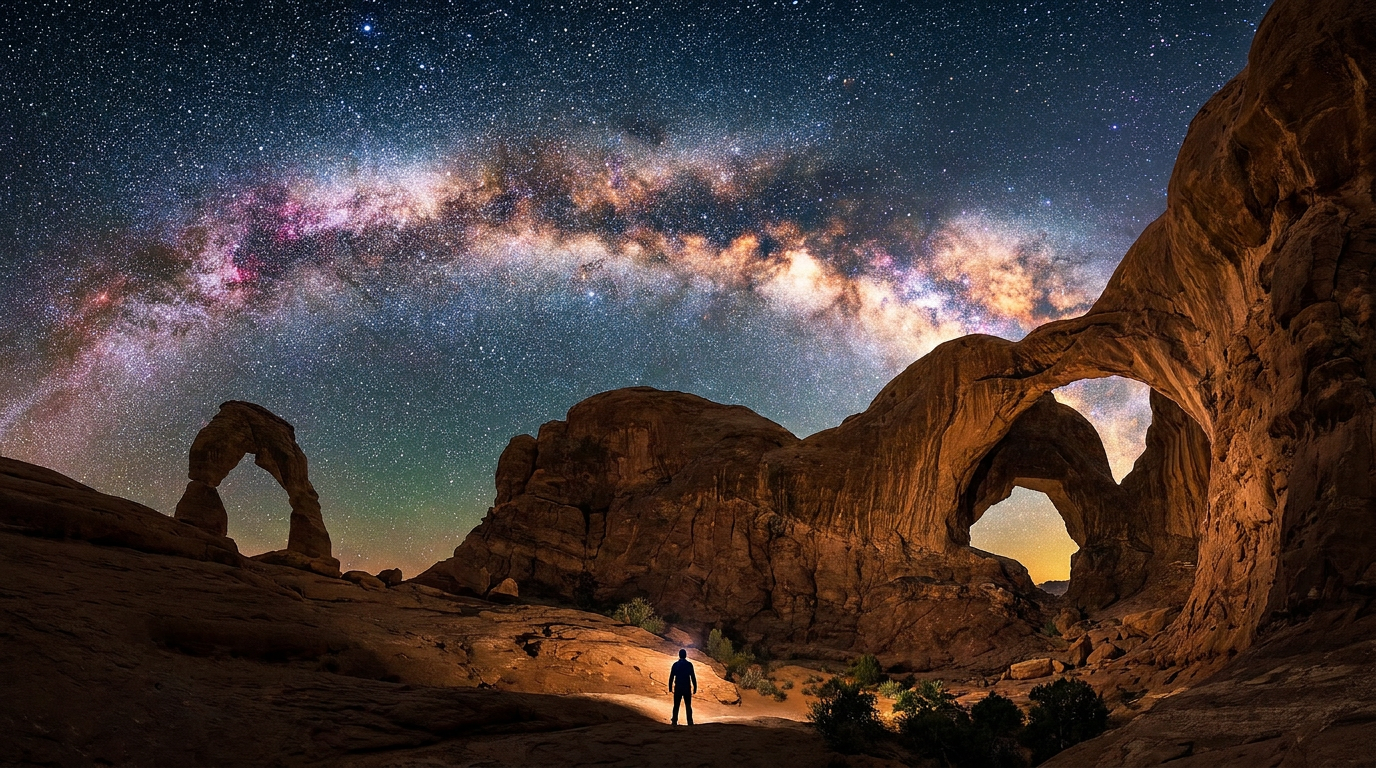
For most of human history, a sky ablaze with thousands of stars was a universal nightly experience. Today, an estimated 99 percent of the population in the United States and Europe lives under skies obscured by artificial light. The Milky Way is entirely invisible to nearly 80 percent of North Americans. In response to this creeping skyglow, a coalition of astronomers, park rangers, and conservationists has spent the last decade quietly building a network of sanctuaries where the night sky is fiercely protected.[2][4]
The vanguard of this movement is the International Dark Sky Places program, managed by the nonprofit DarkSky International. To date, the organization has certified dozens of national parks, monuments, and reserves worldwide. These designations are not merely honorary plaques handed out to remote locations; they require rigorous, multi-year audits of a park's lighting infrastructure and a binding commitment to public astronomy education.[4]

Earning certification requires a fundamental overhaul of how a park operates after sundown. When Grand Canyon National Park sought its designation, management had to inventory and retrofit more than 5,000 exterior light fixtures across the massive complex. The mechanics of light mitigation are surprisingly straightforward but highly effective: fixtures must be fully shielded to direct light downward, bulbs are swapped for energy-efficient LEDs, and color temperatures are shifted to warm amber tones that scatter less in the atmosphere than harsh blue light.[3][4]
To quantify their success, parks rely on the Bortle Scale, a nine-level numeric system that measures night sky brightness. A Class 9 sky represents an inner-city environment where only the moon and a few bright planets are visible. Certified Dark Sky Parks typically aim for Class 1 or 2, where the Milky Way casts visible shadows on the ground and thousands of individual stars, along with faint meteors and the zodiacal light, can be seen with the naked eye.[1][6]

While astrotourism is a massive draw for visitors, the push for darker skies is equally rooted in ecological survival. Artificial light wreaks havoc on nocturnal ecosystems, disrupting the deeply ingrained circadian rhythms of wildlife. Migratory birds that navigate by the stars become disoriented by city glare, sea turtle hatchlings are drawn away from the ocean toward coastal streetlights, and insect populations face catastrophic declines when drawn to artificial bulbs. By carving out massive tracts of true darkness, parks provide critical refuges for these species.[2][3]
While astrotourism is a massive draw for visitors, the push for darker skies is equally rooted in ecological survival.
Human health is also intimately tied to the light-dark cycle. Exposure to artificial light at night, particularly the blue light emitted by modern screens and unshielded streetlamps, suppresses the body's production of melatonin. Conservationists argue that preserving dark skies is not just about saving astronomy; it is a public health imperative that allows human visitors to reset their biological clocks and experience the profound psychological benefits of awe.[2][6]
This ecological mission has proven to be an unexpected economic engine for rural areas. The National Park Service estimates that astrotourism will generate $5.8 billion in visitor spending across the Colorado Plateau alone over a ten-year period. Because stargazing requires clear, long nights, it naturally drives visitation during the colder, off-season months, providing a vital year-round economic lifeline to gateway communities that historically struggled when summer crowds departed.[3]
As the infrastructure for astrotourism matures, the cultural narrative surrounding the night sky is also expanding. For decades, park astronomy programs relied almost exclusively on Greco-Roman mythology to explain the constellations. Today, a concerted effort is underway to center Indigenous astronomy, recognizing that Native communities have used the cosmos for navigation, agriculture, and storytelling for millennia.[5][6]

Organizations like Native Skywatchers, backed by recent NASA grants, are collaborating with park rangers to revitalize and share Indigenous star knowledge. In parks across the Southwest and the Great Lakes, visitors are now just as likely to learn about the Navajo or Ojibwe interpretations of the cosmos as they are to spot Orion. This shift transforms stargazing from a purely scientific observation into a profound cultural reconnection.[3][5]
For travelers looking to experience a certified Dark Sky Park, timing and etiquette are everything. Planning a trip requires consulting lunar calendars, as a full moon acts as a massive natural lightbulb that washes out the Milky Way. The most spectacular viewing occurs during the new moon phase, or in the hours before the moon rises or after it sets.[1][6]

Once inside the park, visitors are encouraged to practice dark-sky etiquette. This primarily involves ditching bright white headlamps and smartphone flashlights in favor of red-light illumination. Red light preserves the human eye's natural night vision, which takes up to thirty minutes to fully adapt to the dark but can be instantly ruined by a single bright screen.[3][6]
Ultimately, the rise of Dark Sky Parks represents one of the most accessible and optimistic branches of modern conservation. Unlike restoring a polluted river or regrowing a clear-cut forest—which can take centuries—light pollution is entirely reversible at the flip of a switch. As more parks and gateway communities embrace the dark, they are proving that the simple act of turning off the lights can instantly restore one of humanity's oldest and most awe-inspiring natural wonders.[4][6]
How we got here
1988
DarkSky International (formerly the International Dark-Sky Association) is founded to combat global light pollution.
2007
Natural Bridges National Monument in Utah becomes the world's first certified International Dark Sky Park.
2020
Native Skywatchers receives a pivotal NASA grant to revitalize and share Indigenous star knowledge across North America.
2024–2026
The solar maximum drives a massive surge in astrotourism as auroras become visible at lower latitudes.
Viewpoints in depth
Conservationists & Ecologists
Focusing on the biological imperative of preserving natural darkness.
For ecologists, the fight against light pollution extends far beyond human recreation. They emphasize that artificial light is a profound ecological disruptor that alters the evolutionary behavior of nocturnal species. By establishing dark sky sanctuaries, conservationists argue we are protecting critical habitats for migratory birds, insects, and sea turtles whose survival depends on the predictable rhythms of natural light and dark.
Tourism & Gateway Communities
Viewing dark skies as a sustainable, year-round economic engine.
Local chambers of commerce and tourism boards champion astrotourism because it fundamentally changes the economics of park visitation. Stargazing naturally encourages overnight stays, which drives revenue to local hotels, restaurants, and guide services. Furthermore, because the best viewing often occurs in the colder months when the air is crisp, astrotourism provides a vital off-season economic boost to rural gateway communities.
Cultural Historians
Advocating for the reclamation of Indigenous star knowledge.
Cultural historians and Indigenous advocates view the night sky as a living library of human heritage. They argue that for too long, park astronomy programs have been dominated by Western science and Greco-Roman mythology. By partnering with organizations like Native Skywatchers, they seek to elevate Indigenous astronomical traditions, ensuring that the original stories of the land and sky are preserved and shared with the public.
What we don't know
- How rapidly expanding satellite constellations will impact the pristine viewing conditions of certified dark sky parks.
- Whether the economic boom of astrotourism will eventually lead to nighttime overcrowding, threatening the very tranquility visitors seek.
Key terms
- Astrotourism
- Travel planned specifically around experiencing dark skies, stargazing, and celestial events.
- Bortle Scale
- A nine-level numeric scale that measures the night sky's brightness and the observability of celestial objects.
- Skyglow
- The brightening of the night sky over inhabited areas caused by artificial light scattering in the atmosphere.
- Light Trespass
- Artificial light that falls beyond the property or area it is intended to illuminate.
- Solar Maximum
- The period of greatest solar activity in the sun's 11-year cycle, resulting in more frequent and intense auroras.
Frequently asked
Do I need a telescope to visit a Dark Sky Park?
No. While telescopes enhance the view, certified parks are dark enough that the Milky Way, meteor showers, and thousands of stars are clearly visible to the naked eye.
What makes a park certified as a Dark Sky Park?
Parks must pass a rigorous audit by DarkSky International, which requires retrofitting light fixtures to be shielded and energy-efficient, alongside a commitment to public astronomy education.
When is the best time of year to go stargazing?
The Milky Way core is most visible in the Northern Hemisphere from April to September, but winter offers longer nights and clearer, less humid air for crisp viewing.
How does light pollution affect wildlife?
Artificial light disrupts the circadian rhythms of nocturnal animals, interfering with their navigation, mating rituals, and predator-prey dynamics.
Sources
Source coverage
6 outlets
4 viewpoints surfaced






[1]ForbesTourism & Gateway Communities
10 Best U.S. National Park Sites For Stargazing
Read on Forbes →[2]Field MagConservationists & Ecologists
Astrotourism Explained: Top 5 Dark Sky Zones for Stargazing
Read on Field Mag →[3]National Park ServicePark Management
Exploring Night Skies
Read on National Park Service →[4]DarkSky InternationalConservationists & Ecologists
International Dark Sky Places Program
Read on DarkSky International →[5]Native SkywatchersCultural Historians
Revitalizing Indigenous Star Knowledge
Read on Native Skywatchers →[6]Factlen Editorial TeamCultural Historians
Synthesis by Factlen editorial team
Read on Factlen Editorial Team →
Every angle. Every day.
Get travel stories with full source coverage and perspective breakdowns delivered to your inbox.