
EU Unanimously Agrees to Launch Formal Accession Negotiations With Ukraine and Moldova
All 27 member states have approved the opening of the first negotiating cluster, ending a two-year deadlock after Hungary lifted its veto.
By Factlen Editorial Team
- Pro-Integration Candidate Nations
- View EU accession as an existential security guarantee and validation of democratic reforms.
- Conditional EU Members
- Support enlargement only if strict national interests and minority rights are guaranteed.
- Strategic EU Institutionalists
- Frame enlargement as the bloc's primary tool for securing continental stability and peace.
What's not represented
- · Russian Government
- · EU Net-Contributor States
Why this matters
The formal launch of accession talks cements Ukraine and Moldova's trajectory toward the West, ensuring that their post-war futures are anchored in European democratic and economic institutions. For the EU, absorbing these nations is a massive geopolitical commitment aimed at securing the continent's eastern flank against future Russian aggression.
Key points
- All 27 EU member states unanimously agreed to open the first cluster of accession negotiations with Ukraine and Moldova.
- The breakthrough ends a two-year deadlock caused by Hungary's veto over minority rights in Ukraine.
- Kyiv and Budapest reached a deal restoring linguistic and cultural rights for 100,000 ethnic Hungarians in Transcarpathia.
- Hungary's new Prime Minister Péter Magyar warned the process could take 10 to 15 years and will require a final Hungarian referendum.
- The EU is dropping its 'package approach,' allowing Ukraine and Moldova to advance through the remaining chapters independently.
- The 'Fundamentals' cluster covers core democratic principles and will be the last chapter closed before accession.
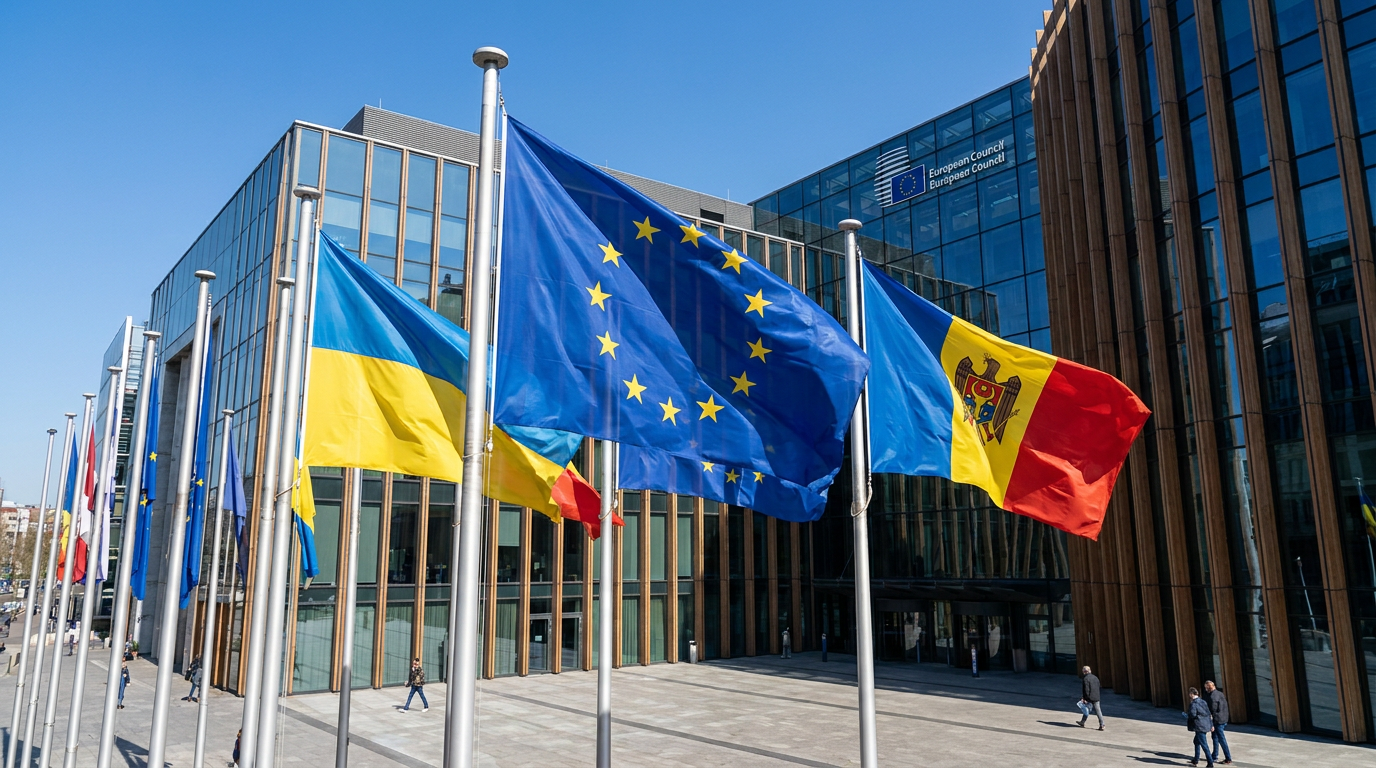
The European Union has unanimously agreed to formally open the first cluster of accession negotiations with Ukraine and Moldova, breaking a two-year diplomatic deadlock and marking a historic milestone in the bloc's eastward expansion. European Commission President Ursula von der Leyen announced that all 27 member states approved the move on June 12, setting the stage for an intergovernmental conference in Luxembourg scheduled for June 15. The opening of the "Fundamentals" cluster represents the most significant bureaucratic and political step toward EU integration for Kyiv and Chișinău since they were hastily granted candidate status in the early months of Russia's 2022 invasion. For both nations, the commencement of formal talks is a critical validation of their reform efforts, delivered against the backdrop of ongoing conflict and profound regional instability.[1][2][6]
The breakthrough in Brussels was made possible by a seismic political shift in Budapest. For nearly two years, former Hungarian Prime Minister Viktor Orbán—who maintained close ties with Moscow—had effectively vetoed Ukraine's advancement, citing deep concerns over the treatment of the ethnic Hungarian minority in western Ukraine. Because the European Commission had "coupled" Ukraine and Moldova's applications into a single package approach, Orbán's veto on Kyiv effectively froze Chișinău's progress as well, frustrating EU leadership and stalling the enlargement agenda. However, the political calculus changed dramatically following Orbán's defeat by Péter Magyar in the April 2026 elections. Upon taking office in May, Magyar's new government signaled a willingness to negotiate a compromise, initiating weeks of intense technical diplomacy aimed at resolving the minority rights dispute without derailing Ukraine's European trajectory.[4][5]
The deadlock was officially broken after Magyar and Ukrainian officials reached a comprehensive bilateral agreement designed to restore linguistic, educational, and cultural rights for the approximately 100,000 ethnic Hungarians living in Ukraine's Transcarpathia region. Under the terms of the deal, Ukraine committed to rolling back 2017 language laws and restoring a previous system of national minority schools where Hungarian can be used as the primary language of instruction. Furthermore, in Transcarpathian municipalities where the Hungarian population exceeds 10 percent, the free use of Hungarian national symbols will be legally permitted and protected. Satisfied that these concessions met Budapest's core demands, the Hungarian representative at the Committee of Permanent Representatives of the EU (COREPER) formally withdrew the country's reservations, clearing the path for unanimous consent among EU ambassadors.[4][5][7]

Despite lifting the immediate blockade, Magyar emphasized to his domestic audience that Hungary's long-term support for Ukraine's accession remains strictly conditional. The new Hungarian Prime Minister publicly rejected any notion of a fast-track membership procedure for Kyiv, projecting that the grueling process of closing all 33 accession chapters will likely drag on for 10 to 15 years. Crucially, Magyar announced that once negotiations eventually conclude, Hungary will hold a legally binding national referendum on Ukraine's membership before granting final parliamentary approval. This stipulation ensures that Budapest retains ultimate leverage over Kyiv's accession, tethering Ukraine's European future to its ongoing compliance with the minority rights agreement and the eventual approval of the Hungarian electorate.[5]
Despite lifting the immediate blockade, Magyar emphasized to his domestic audience that Hungary's long-term support for Ukraine's accession remains strictly conditional.
When representatives gather in Luxembourg on June 15, they will officially open the "Fundamentals" cluster, which is universally regarded as the backbone of the entire EU accession process. This initial cluster encompasses five critical policy chapters: economic criteria, the functioning of democratic institutions, public administration reform, the rule of law, and fundamental rights. Under the European Union's strict enlargement methodology, the Fundamentals cluster is always the first to be opened and the very last to be closed. It acts as a continuous, multi-year benchmark for a candidate country's democratic health, ensuring that prospective members do not backslide on judicial independence or anti-corruption measures while negotiating other, more technical areas like agriculture or transport.[1][2]
The upcoming intergovernmental conference will also mark a fundamental structural change in how the European Union manages the two candidate nations. By scheduling separate accession conferences for Ukraine and Moldova, Brussels is effectively terminating the "package approach" that had bound their diplomatic fates together since 2022. Moving forward, Kyiv and Chișinău will be assessed entirely independently, allowing each nation to advance through the remaining 28 policy chapters at its own distinct pace. This decoupling is a significant relief for Moldovan officials, who had successfully completed the EU's initial screening process but were forced to wait on the sidelines while the Hungarian-Ukrainian dispute played out.[1][3]

The unblocking of the process was met with immediate celebration in both candidate capitals. Ukrainian President Volodymyr Zelensky welcomed the unanimous vote, describing it as a "strong step for Europe" and a vital injection of political and moral support. Zelensky emphasized that Ukraine is defending the broader European ideal of free and united nations, noting that his government has continued to pass complex domestic reforms even as its cities remain under daily bombardment. In Chișinău, Moldovan officials echoed the sentiment, expressing readiness to open the remaining five accession clusters by the end of the summer to accelerate their integration and solidify their western trajectory amid ongoing hybrid threats from Moscow.[3][6]
Within the halls of Brussels, European Union leadership framed the expansion as a geopolitical necessity rather than merely an economic or bureaucratic exercise. In a joint statement, European Council President Antonio Costa and Commission President von der Leyen called enlargement "one of the EU's greatest success stories and our best investment in our shared future." They argued that in a world marked by growing instability and shifting alliances, bringing eastern European nations firmly into the bloc's institutional fold is a strategic choice that will ultimately strengthen peace, security, and prosperity across the entire continent.[2]

While the launch of formal talks is undeniably a historic milestone, both Ukraine and Moldova face a daunting, decades-long bureaucratic and political journey before full membership can be achieved. Aligning national laws with the European Union's vast body of legislation—the acquis communautaire—across 33 distinct policy areas requires sweeping, often painful domestic reforms. With the war in Ukraine showing no signs of immediate resolution and Moldova continuing to grapple with the Russia-backed breakaway region of Transnistria, both countries must navigate existential security threats while simultaneously overhauling their state institutions, economies, and judiciaries to meet Brussels' exacting standards.[1][2][3]
How we got here
Feb–Mar 2022
Ukraine and Moldova submit applications for EU membership following Russia's invasion.
June 2022
The European Council officially grants candidate status to both nations.
Dec 2023
EU leaders give the green light to open accession negotiations, but progress is subsequently blocked by Hungary.
April 2026
Péter Magyar defeats Viktor Orbán in Hungarian elections, shifting Budapest's diplomatic stance.
June 12, 2026
EU ambassadors unanimously agree to open the first cluster of negotiations.
June 15, 2026
Formal intergovernmental conferences scheduled to begin in Luxembourg.
Viewpoints in depth
Ukrainian and Moldovan Leadership
Candidate nations view the start of negotiations as a vital moral victory and a validation of their wartime reforms.
For Kyiv and Chișinău, advancing to formal negotiations is about far more than economic integration; it is an existential anchor to the West. Leaders like Volodymyr Zelensky argue that their nations are actively defending European democratic ideals on the battlefield, making their accession a moral imperative for the bloc. They view the opening of the 'Fundamentals' cluster as proof that their governments can deliver complex, systemic reforms—such as anti-corruption measures and judicial overhauls—even while operating under martial law and facing relentless Russian aggression.
The Hungarian Government
Budapest supports accession conditionally, prioritizing the protection of ethnic minorities and maintaining leverage over the final outcome.
Under Prime Minister Péter Magyar, Hungary has shifted from outright obstruction to conditional cooperation, but its underlying priorities remain focused on domestic and minority interests. Budapest argues that Ukraine must strictly adhere to European standards regarding the cultural and linguistic rights of the Hungarian minority in Transcarpathia before any further integration can occur. By insisting on a 10-to-15-year timeline and a legally binding national referendum before final approval, the Hungarian government ensures it retains a permanent veto card, signaling to its electorate that national interests will not be subordinated to Brussels' geopolitical ambitions.
European Union Leadership
EU officials frame enlargement as a strategic necessity to secure the continent against external instability.
For the European Commission and the European Council, the integration of Ukraine and Moldova is viewed through a lens of continental security. Officials like Ursula von der Leyen and Antonio Costa argue that leaving eastern European nations in a geopolitical gray zone invites further Russian interference and regional instability. From this perspective, the grueling, multi-year accession process is the EU's most effective tool for exporting stability, rule of law, and democratic resilience, transforming vulnerable neighbors into fortified allies.
What we don't know
- How the ongoing war with Russia will impact Ukraine's ability to implement the sweeping domestic reforms required by the EU.
- Whether the Hungarian public will ultimately approve Ukraine's accession when it is put to a legally binding referendum a decade from now.
- How the European Union plans to absorb the massive financial costs of integrating Ukraine's vast agricultural sector into the common market.
Key terms
- Accession Chapters
- The 33 specific policy areas, ranging from agriculture to foreign policy, that a candidate country must align with EU law before joining the bloc.
- Fundamentals Cluster
- The first group of accession chapters to be negotiated, covering core democratic principles like the rule of law, human rights, and public administration.
- Package Approach
- A diplomatic strategy where the progress of two candidate countries is linked, meaning one cannot advance without the other.
- Acquis Communautaire
- The accumulated body of European Union law and obligations that all member states must adopt and enforce.
- COREPER
- The Committee of the Permanent Representatives of the Governments of the Member States to the European Union, responsible for preparing the work of the European Council.
Frequently asked
Why was Ukraine's EU accession delayed?
Progress was blocked for nearly two years by former Hungarian Prime Minister Viktor Orbán, who vetoed negotiations over concerns regarding the rights of ethnic Hungarians living in western Ukraine.
What changed Hungary's position?
A new Hungarian government under Péter Magyar took office in May 2026 and reached a bilateral agreement with Kyiv to restore linguistic and cultural rights for the Hungarian minority in Ukraine.
Does this mean Ukraine and Moldova are now in the EU?
No. The opening of negotiations is just the beginning of a rigorous process to align their laws with EU standards, which Hungarian officials estimate could take 10 to 15 years.
Why are Ukraine and Moldova negotiating separately now?
The EU is ending its 'package approach,' allowing each country to advance through the remaining negotiation chapters at its own pace based on its individual reform progress.
Sources
Source coverage
7 outlets
3 viewpoints surfaced







[1]Radio Free Europe/Radio LibertyStrategic EU Institutionalists
EU Agrees To Advance Accession Talks With Ukraine, Moldova
Read on Radio Free Europe/Radio Liberty →[2]Anadolu AgencyStrategic EU Institutionalists
EU agrees to open 1st accession negotiations cluster with Ukraine, Moldova
Read on Anadolu Agency →[3]The Kyiv IndependentPro-Integration Candidate Nations
EU confirms launch of formal accession talks with Ukraine and Moldova on June 15, Zelensky welcomes move
Read on The Kyiv Independent →[4]Financial TimesStrategic EU Institutionalists
Hungary reverses 17-month veto on Ukraine's EU accession talks
Read on Financial Times →[5]EuractivConditional EU Members
Hungary's green light for Ukraine EU talks comes with strings attached
Read on Euractiv →[6]Al JazeeraStrategic EU Institutionalists
EU agrees launch of accession process for Ukraine and Moldova
Read on Al Jazeera →[7]EU NewsStrategic EU Institutionalists
Hungary signals intention to lift veto on Ukraine's EU accession
Read on EU News →
More in news politics
See all 154 stories →Media Consolidation
DOJ Approves $111 Billion Paramount-Warner Bros. Merger, Reshaping Media Landscape
9 sources

Tren de Aragua
U.S. Military Strike in Venezuela Kills Tren de Aragua Leader Niño Guerrero
7 sources
Tren de Aragua
U.S. Military Strike in Venezuela Kills Tren de Aragua Leader Niño Guerrero
7 sources
Information Integrity
The 'Mind Vaccine': How Prebunking is Winning the War Against Misinformation
6 sources

Every angle. Every day.
Get news politics stories with full source coverage and perspective breakdowns delivered to your inbox.