
Down vs. Synthetic Insulation: The Ultimate Guide for Outdoor Gear
Choosing between natural down and synthetic insulation dictates the warmth, weight, and weather resistance of your outdoor gear. This comprehensive comparison breaks down the trade-offs to help you select the right jacket or sleeping bag for your next adventure.
By Factlen Editorial Team
- Ultralight Backpackers & Alpinists
- Prioritize maximum warmth-to-weight ratio and compressibility for human-powered ascents.
- All-Weather Adventurers
- Value reliability and safety in unpredictable, wet, or highly humid environments.
- Sustainability Advocates
- Focus on the lifecycle environmental impact and ethical sourcing of outdoor gear.
What's not represented
- · Hunters and anglers who require specialized, silent fabrics alongside their insulation.
- · Urban commuters who prioritize aesthetic tailoring over technical backcountry performance.
Why this matters
Insulation is the protective barrier between your body and the elements. Understanding the precise trade-offs between down and synthetic materials ensures you stay safe, warm, and comfortable, preventing a costly gear mistake that could ruin a backcountry trip.
Key points
- Natural down offers an unmatched warmth-to-weight ratio and compresses easily, making it ideal for dry, cold conditions.
- Synthetic insulation retains up to 80% of its warmth when wet, providing a critical safety margin in damp or unpredictable climates.
- Premium goose down can achieve a 900 fill-power rating, while the best synthetic alternatives max out around a 600 fill-power equivalent.
- Responsibly sourced down has a lower carbon footprint than virgin polyester, but recycled synthetic options are closing the sustainability gap.
- There is no universal winner; the right choice depends entirely on the specific climate, activity level, and budget of the user.
The moment of truth in any outdoor gear shop inevitably arrives at the insulation rack. Whether outfitting for a weekend backpacking trip or a multi-day alpine expedition, the choice between natural down and synthetic fill dictates the warmth, weight, and weather resistance of your entire layering system.[1]
The stakes in this decision are surprisingly high. Choosing the wrong insulation can mean shivering through a damp, sleepless night in the backcountry or carrying unnecessary bulk that exhausts you on a steep ascent. This trade-off analysis breaks down the core differences, quantifying the performance of both materials to help outdoor enthusiasts make an informed, condition-specific decision.[3][4][6]
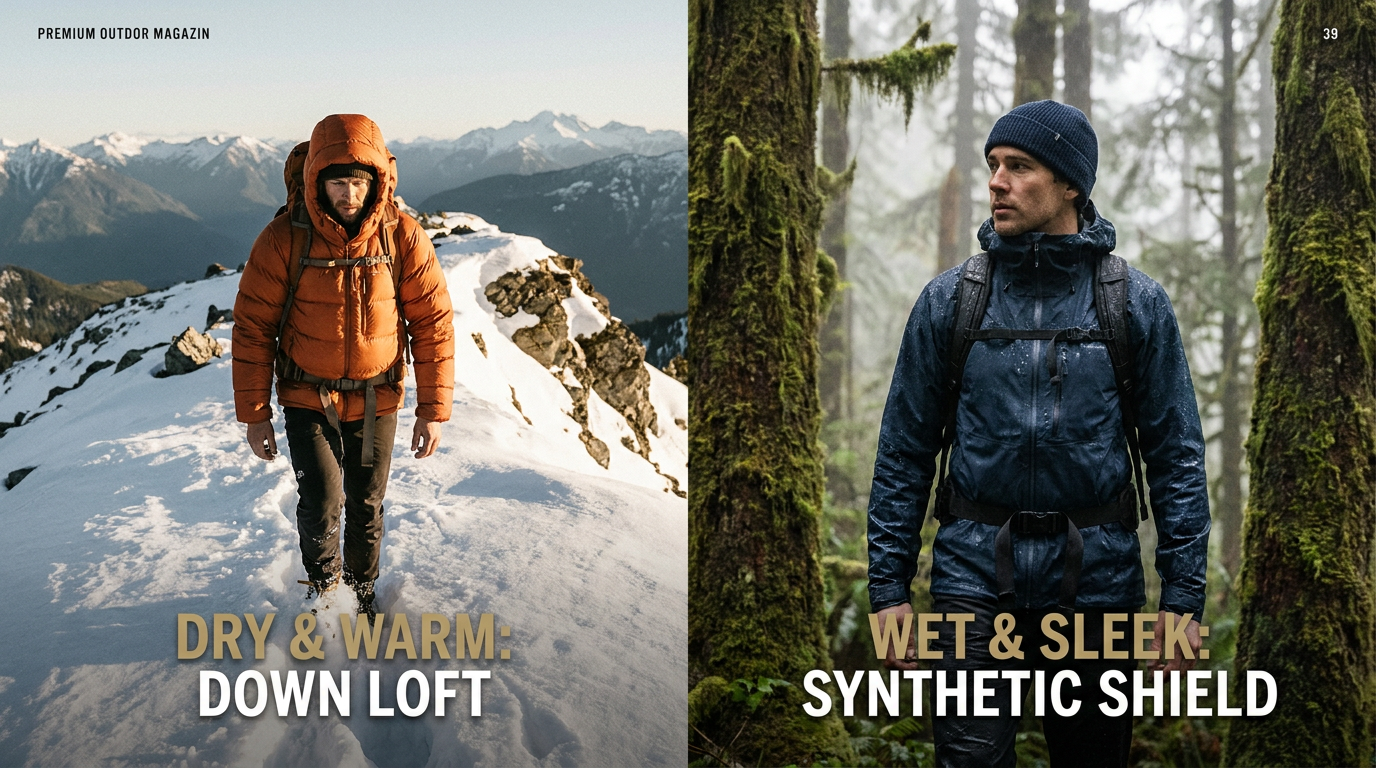
To understand the debate, one must first understand the materials. Natural down is not made of feathers, but rather the soft, wispy plumage found underneath the exterior feathers of waterfowl like ducks and geese. These three-dimensional clusters are nature's premier insulators, designed to trap body heat in tiny air pockets while remaining incredibly light.[1][3]
The case for down centers entirely on its unmatched warmth-to-weight ratio and compressibility. For ounce-counting backpackers, nothing replicates the efficiency of high-quality goose down. It compresses down to the size of a grapefruit in a stuff sack, yet lofts up to provide furnace-like warmth when unpacked at camp.[2][4]
The evidence for down's superiority in dry cold is quantified by its "fill power"—a metric measuring how many cubic inches one ounce of down occupies. Premium down garments regularly achieve 800 to 900 fill power, making them up to 50 percent lighter than synthetic equivalents offering the same temperature rating. Furthermore, with proper care, a down sleeping bag can retain its loft and insulating properties for decades, often outlasting its nylon shell.[4][5]

The case against down, however, is its catastrophic failure in the presence of moisture. When natural down gets wet, the delicate clusters collapse and clump together, entirely losing their ability to trap air. A soaked down jacket offers virtually zero insulation, and once wet, it can take days to dry in backcountry conditions.[1][3][4]
Enter synthetic insulation. Engineered in a laboratory, synthetic fill is typically constructed from fine polyester fibers designed to mimic the heat-trapping tendrils of natural down. Manufacturers weave these continuous filaments or short-staple fibers into dense sheets that provide consistent, reliable warmth.[2][5]
The case for synthetic insulation is built on its rugged reliability in unpredictable weather. Unlike down, polyester fibers do not collapse when exposed to rain, snow, or heavy perspiration. This makes synthetic gear the undisputed champion of damp, humid, or high-output environments where moisture management is critical.[2][3]
The case for synthetic insulation is built on its rugged reliability in unpredictable weather.
The evidence for synthetic performance is striking: high-quality synthetic insulation retains up to 80 percent of its thermal efficiency even when completely soaked. It also dries significantly faster than natural down, allowing adventurers to hang a damp jacket in a tent and wear it comfortably the next morning.[4][5]

The case against synthetic insulation lies in its bulk and lifespan. To achieve the same warmth as a premium down jacket, a synthetic garment requires significantly more material, making it heavier and less compressible. Industry testing shows that top-tier synthetic insulation generally maxes out at a warmth equivalent to 550 or 600 fill-power down. Additionally, the synthetic fibers gradually break down from repeated compression, meaning a synthetic sleeping bag will lose its loft years before a down equivalent.[1][2][5]
Beyond performance, the environmental evidence presents a complex trade-off. The case against down involves animal welfare concerns, though the industry has largely adopted the Responsible Down Standard (RDS) to ensure humane treatment and traceability. When sourced ethically, down is a biodegradable byproduct with a remarkably low carbon footprint—studies indicate it has an 18 times lower impact on climate change than virgin polyester fill.[2][5][6]
Conversely, the case against synthetic insulation highlights its reliance on petroleum and its contribution to microplastic pollution during washing. However, the evidence for synthetic sustainability is improving rapidly, with major brands now constructing their insulation entirely from recycled plastic bottles, significantly reducing landfill waste and energy consumption.[5][6]

To bridge the gap, the outdoor industry has introduced hybrid solutions. Hydrophobic down—natural down treated with a Durable Water Repellent (DWR) coating—resists light moisture and dries faster than untreated down, though it still falls short of synthetic performance in a downpour.[2][4]
Ultimately, there is no single winner without conditions; the right choice depends entirely on the environment. Down fits well when the climate is cold and dry, such as high-altitude mountaineering or crisp winter camping. It is the definitive choice when minimizing weight and maximizing pack space are the highest priorities.[1][2][5]
Down does not fit well when embarking on multi-day trips in the Pacific Northwest, Scotland, or other notoriously wet climates. It is also a poor choice for high-intensity aerobic activities, like backcountry skiing, where heavy perspiration can wet the insulation from the inside out.[4][5]

Synthetic insulation fits well when navigating unpredictable, wet, or humid conditions. It is the ideal choice for daily winter commutes, resort skiing, and budget-conscious buyers, as synthetic garments are generally significantly cheaper than their down counterparts.[2][3]
How we got here
1936
Eddie Bauer patents the first quilted down jacket, the Skyliner, after nearly freezing to death on a winter fishing trip.
1980s
The outdoor industry begins heavily adopting synthetic continuous-filament insulations to solve down's moisture problem.
2014
The Responsible Down Standard (RDS) is launched to ensure ethical sourcing and traceability in the global down supply chain.
2020s
Major outdoor brands shift toward using 100% recycled polyester for their synthetic insulation lines to combat plastic waste.
Viewpoints in depth
Ultralight Backpackers & Alpinists
Prioritize absolute minimum weight and maximum compressibility for human-powered ascents.
For this camp, every ounce carried requires extra calories and energy. They argue that the warmth-to-weight ratio of 800+ fill-power down is currently impossible to replicate with synthetics. They mitigate down's moisture vulnerability through meticulous packing strategies, such as using waterproof stuff sacks and specialized tent ventilation, believing the weight savings are worth the extra care.
All-Weather Adventurers
Value reliability and safety in unpredictable, wet, or highly humid environments.
This group frequently operates in climates like the Pacific Northwest or the Scottish Highlands, where staying dry is nearly impossible. They argue that the slight weight penalty of synthetic insulation is a necessary safety feature. If a river crossing goes wrong or a multi-day storm sets in, synthetic fill's ability to retain 80% of its warmth when soaked can be the difference between mild discomfort and severe hypothermia.
Sustainability Advocates
Focus on the lifecycle environmental impact and ethical sourcing of outdoor gear.
This perspective wrestles with a complex trade-off. Some advocate for synthetic insulation to avoid the animal welfare concerns associated with industrial waterfowl farming, pushing for 100% recycled polyester to mitigate the petroleum footprint. Others argue that responsibly sourced, RDS-certified down is the superior ecological choice, as it is a natural, biodegradable byproduct that lasts decades longer than synthetic garments, thereby keeping waste out of landfills.
What we don't know
- Whether future bio-based synthetic insulations can fully replicate the 900-fill-power warmth-to-weight ratio of natural down.
- How upcoming regulations on PFAS (forever chemicals) will affect the efficacy and longevity of DWR treatments used on hydrophobic down.
Key terms
- Fill Power
- A measurement of down's insulating efficiency, indicating how many cubic inches one ounce of down occupies.
- Loft
- The thickness or fluffiness of an insulating material, which creates the air pockets necessary to trap body heat.
- Baffling
- The stitched compartments in a jacket or sleeping bag that keep the insulation evenly distributed and prevent it from shifting.
- DWR (Durable Water Repellent)
- A chemical coating applied to fabrics and sometimes down clusters to make them water-resistant.
- RDS (Responsible Down Standard)
- A global certification ensuring that down and feathers come from animals that have not been subjected to unnecessary harm.
Frequently asked
What does fill power mean?
Fill power measures the loft or fluffiness of down. It represents how many cubic inches one ounce of down can fill; higher numbers mean greater warmth for less weight.
Can I wash my down jacket at home?
Yes, but it requires special care. You must use a down-specific detergent and dry it on low heat with tennis balls to break up clumps and restore its loft.
Is synthetic insulation vegan?
Yes, synthetic insulation is made from polyester fibers (often recycled plastics) and contains no animal products, making it a vegan-friendly alternative to goose or duck down.
What is hydrophobic down?
Hydrophobic down is natural down that has been treated with a Durable Water Repellent (DWR) coating, allowing it to resist light moisture and dry faster than untreated down.
Sources
Source coverage
6 outlets
3 viewpoints surfaced




[1]REIUltralight Backpackers & Alpinists
Down vs. Synthetic: Which Insulation is Right for You?
Read on REI →[2]The North FaceAll-Weather Adventurers
A guide to Down vs Synthetic Insulation
Read on The North Face →[3]Columbia SportswearAll-Weather Adventurers
Down vs. Synthetic Insulation: What's the Difference?
Read on Columbia Sportswear →[4]TrailGroove MagazineUltralight Backpackers & Alpinists
Backpacking Gear: Down vs. Synthetic Insulation
Read on TrailGroove Magazine →[5]SelvaneSustainability Advocates
Goose Down vs. Synthetic Insulation: Performance
Read on Selvane →[6]Factlen Editorial TeamSustainability Advocates
Synthesis by Factlen editorial team
Read on Factlen Editorial Team →


Every angle. Every day.
Get shopping stories with full source coverage and perspective breakdowns delivered to your inbox.