
Beyond the Controller: How 2026 Became a Tipping Point for Gaming Accessibility
Driven by granular software options and a new wave of adaptive hardware, the video game industry is dismantling long-standing barriers for players with disabilities.
By Factlen Editorial Team
- Accessibility Advocates
- Argue that gaming is a fundamental social right and push for universal inclusive design from day one of development.
- Hardware & Software Developers
- Focus on the technical and commercial implementation of accessibility, balancing complex game mechanics with customizable user experiences.
- Industry Analysts
- View the push for accessibility as both a moral imperative and a massive untapped market opportunity encompassing hundreds of millions of players.
What's not represented
- · Players with severe cognitive disabilities whose needs are often overlooked in mainstream accessibility menus.
- · Esports tournament organizers balancing competitive integrity with adaptive controller use.
Why this matters
For the hundreds of millions of people living with disabilities, video games are a crucial tool for combating social isolation. The industry's shift toward universal accessibility means that gaming is finally becoming a shared cultural space where physical limitations no longer dictate who gets to play.
Key points
- The gaming industry has shifted from basic hardware adaptations to granular, software-level accessibility features.
- An estimated 250 million gamers worldwide identify as visually impaired, driving demand for screen reader support.
- Charities like AbleGamers emphasize that disabled individuals face a 51% higher risk of social isolation.
- CES 2026 highlighted a boom in specialized peripherals, including one-handed keyboards and modular rigs.
- Major 2026 releases allow players to fundamentally reshape combat mechanics and game speed to suit their mobility.
Video games have evolved into the world's most popular form of traditional media, engaging an estimated three billion people globally. Yet, for decades, a significant portion of the population was locked out of these digital worlds by a simple, physical barrier: the standard controller. Unforgiving game design and rigid hardware meant that millions of players with disabilities were forced to watch from the sidelines.[2][7]
In 2026, that paradigm has irrevocably shifted. Accessibility is no longer treated as a post-launch afterthought or a niche philanthropic effort. Instead, it has become a foundational pillar of game development. The industry is witnessing a transition from basic hardware workarounds to deep, granular software integration, dismantling barriers that have existed since the dawn of the medium.[3][7]
The scale of the need is staggering. Industry audits estimate that approximately 250 million gamers worldwide identify as visually impaired, navigating digital spaces that have historically relied on tiny UI elements and color-based indicators. Millions more navigate motor, cognitive, or auditory disabilities that make traditional gaming setups physically painful or impossible to use.[2]
The stakes extend far beyond mere entertainment. According to AbleGamers, a leading charity celebrating its 20th anniversary this year, individuals with disabilities are 51 percent more likely to experience social isolation than their non-disabled peers. Video games serve as a vital conduit for community, allowing players to compete, explore, and connect on an even playing field.[1][6]

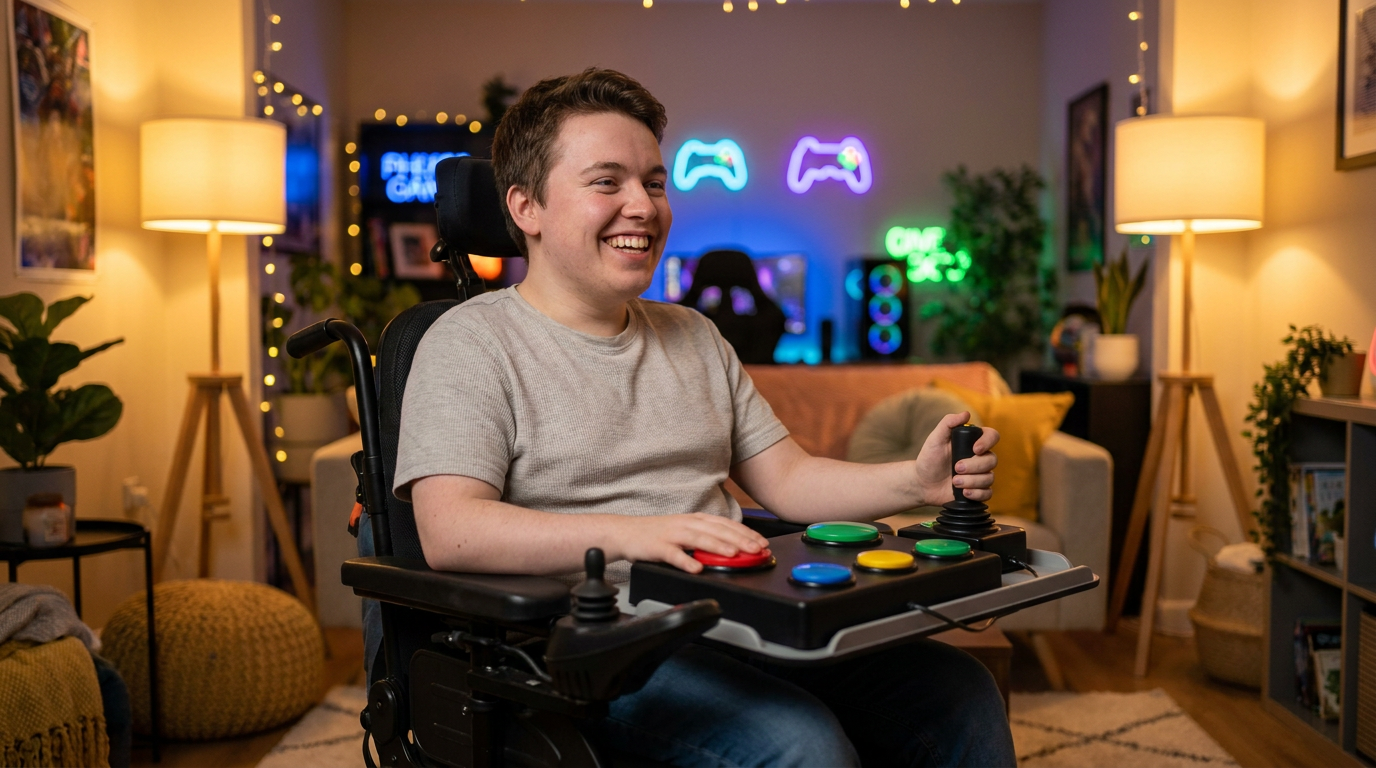
The groundwork for this inclusive era was laid by pioneering hardware like the Xbox Adaptive Controller, but 2026 has seen a specialized peripheral boom. One-handed keyboards, modular joysticks, and highly customizable adaptive rigs are now dominating the hardware space. These devices offer unprecedented ergonomic flexibility, allowing players to build setups tailored to their specific mobility needs.[5]
This hardware renaissance was front and center at the CES 2026 technology trade show. The event featured a dedicated "Gaming for All" stage, highlighting the next era of inclusive tech. The prominence of these devices at the world's largest consumer electronics show proved that accessibility is now recognized as a major commercial driver, rather than just a charitable endeavor.[4]
This hardware renaissance was front and center at the CES 2026 technology trade show.
However, hardware is only half the equation. The most significant breakthroughs this year have occurred within the software itself. Developers are moving past the concept of a simple "low difficulty" mode. Instead, modern titles are allowing players to fundamentally reshape the mechanics of the game to suit their physical capabilities.[3][7]
A prime example is Doom: The Dark Ages. Fast-paced shooters are notoriously unforgiving for players with limited stamina or reaction time, usually demanding precise aiming and split-second weapon swapping. But the latest Doom entry introduced granular combat reshaping, allowing players to adjust specific elements like parry windows and overall game speed without compromising the title's signature intensity.[3]

Visual and auditory inclusion has also seen dramatic improvements. Major 2026 releases, including Assassin's Creed Shadows and EA Sports FC 26, have raised the industry standard by integrating robust screen reader support and comprehensive audio descriptions. These titles have moved away from relying solely on visual cues, ensuring that blind and partially sighted players can navigate complex environments.[2]
The push for inclusivity is not limited to massive AAA studios. Independent developers are actively contributing to the movement, proving that inclusive design does not require a blockbuster budget. By building games with remappable controls and clear subtitles from day one, indie creators are reinforcing the expectation that accessibility is a universal standard.[3]
Despite this remarkable progress, significant hurdles remain. Blind and partially sighted players still face substantial barriers in emerging mediums like virtual reality (VR). VR experiences rely heavily on physical movement, spatial awareness, and motion tracking, which can exclude visually impaired users and players with limited mobility.[2]

Furthermore, the broader digital entertainment landscape still struggles with basic inclusion. Live streaming events and competitive esports tournaments frequently launch without accurate captions, excluding deaf audiences from shared cultural moments. Advocacy groups continue to push for systemic changes across all digital platforms.[2][7]
As the industry looks toward the rest of the decade, the baseline has been permanently elevated. Accessibility is no longer viewed as a restrictive checklist, but rather as a creative challenge that developers are eagerly embracing. The goal is to ensure that every new release is playable by the widest possible audience.[3][7]
For millions of players, the ability to remap a button, adjust a visual cue, or plug in a specialized switch is the difference between isolation and inclusion. In 2026, the gaming industry is finally delivering on the promise that play is a universal right, ensuring that everyone gets the chance to join the adventure.[1][6][7]
How we got here
2006
AbleGamers is founded to combat social isolation among people with disabilities through video games.
2018
Microsoft releases the Xbox Adaptive Controller, a watershed moment for mainstream accessible hardware.
2020
The Last of Us Part II launches with over 60 accessibility settings, setting a new benchmark for AAA software.
January 2026
CES features a dedicated 'Gaming for All' stage, cementing accessibility as a core industry pillar.
April 2026
Major releases like Doom: The Dark Ages introduce granular combat reshaping, allowing players to alter core mechanics.
Viewpoints in depth
Accessibility Advocates
Argue that gaming is a fundamental social right and push for universal inclusive design from day one of development.
Advocacy groups emphasize the profound social cost of inaccessible design. With disabled individuals facing a 51 percent higher risk of social isolation, organizations like AbleGamers argue that video games are not a luxury, but a vital lifeline for community connection. They push developers to stop treating accessibility as a post-launch patch and instead integrate it into the core architecture of every game from the earliest stages of development.
Hardware & Software Developers
Focus on the technical and commercial implementation of accessibility, balancing complex game mechanics with customizable user experiences.
For developers, the challenge lies in maintaining a game's intended artistic vision while making it playable for everyone. This has led to a shift away from blanket 'Easy' modes toward granular difficulty settings, allowing players to adjust specific variables like parry windows or enemy aggression. On the hardware side, peripheral manufacturers are racing to create modular, open-source designs that can adapt to a wide spectrum of physical needs without requiring expensive custom engineering.
Industry Analysts
View the push for accessibility as both a moral imperative and a massive untapped market opportunity encompassing hundreds of millions of players.
Market analysts point to the sheer scale of the disabled gaming population—including 250 million visually impaired players—as proof that accessibility is a major commercial driver. They note that the prominent placement of adaptive tech at events like CES 2026 signals a shift in corporate strategy. By investing in inclusive design, major publishers are not just generating positive public relations; they are actively expanding their total addressable market.
What we don't know
- How quickly virtual reality (VR) platforms can adapt to accommodate visually impaired or mobility-restricted players.
- Whether smaller indie studios can afford to implement complex accessibility features like full audio descriptions without dedicated funding.
- How the rise of AI-generated content in games will impact screen reader compatibility and automated captioning accuracy.
Key terms
- Adaptive Controller
- A customizable hardware interface that allows players to swap out standard buttons and joysticks for specialized inputs like foot pedals or bite switches.
- Granular Difficulty
- Game settings that allow players to adjust specific mechanics—like enemy speed or parry timing—rather than just choosing a blanket 'Easy' or 'Hard' mode.
- Screen Reader Support
- Software functionality that reads on-screen text and menus aloud, essential for blind or low-vision players navigating digital spaces.
Frequently asked
What is an adaptive controller?
It is a highly customizable gaming device designed for players with limited mobility, featuring large programmable buttons and ports for external switches.
How are software developers improving accessibility?
Studios are adding granular settings, such as remappable controls, adjustable game speeds, scalable UI, and audio descriptions for visually impaired players.
Why is gaming accessibility considered a social issue?
Because video games are a primary way people connect and socialize; excluding disabled players exacerbates social isolation.
Sources
Source coverage
7 outlets
3 viewpoints surfaced







[1]ForbesAccessibility Advocates
AbleGamers Celebrates 20 Years Of Combating Social Isolation Through Play
Read on Forbes →[2]Direct AccessIndustry Analysts
Digital Accessibility in Gaming: The 2026 Landscape
Read on Direct Access →[3]AinfinityHardware & Software Developers
Gaming Accessibility – Key Advances This Year
Read on Ainfinity →[4]CESIndustry Analysts
Innovation Unleashed: Highlights from Day 2 of CES 2026
Read on CES →[5]Savy AssistHardware & Software Developers
Gaming Accessibility Breakthrough: One-Handed Keyboards and Adaptive Controllers Dominating 2026
Read on Savy Assist →[6]AbleGamersAccessibility Advocates
Combating Social Isolation Through Play
Read on AbleGamers →[7]Factlen Editorial TeamIndustry Analysts
Synthesis by Factlen editorial team
Read on Factlen Editorial Team →

Every angle. Every day.
Get entertainment stories with full source coverage and perspective breakdowns delivered to your inbox.