
Beyond Sustainability: How Regenerative Travel is Rewiring the Luxury Resort Industry
Ultra-high-net-worth travelers are abandoning traditional 'sustainable' tourism in favor of regenerative models that actively heal ecosystems and mandate 5% to 15% revenue reinvestment into local communities.
By Factlen Editorial Team
- Regenerative Hoteliers
- View conservation as a core business expense, focusing on the operational shift from minimizing harm to actively restoring ecosystems.
- Conscious Travelers
- Demand transparency and measurable impact, ensuring their significant travel expenditures directly benefit local communities.
- Conservation Advocates
- Highlight the vital role high-net-worth tourism revenue plays in funding anti-poaching patrols and marine protected areas.
What's not represented
- · Local Indigenous Communities
- · Mass-Market Tourism Operators
Why this matters
The shift from extractive tourism to regenerative travel proves that high-end hospitality can be engineered to actively fund environmental defense and community infrastructure, offering a scalable blueprint for how global wealth can protect vulnerable ecosystems.
Key points
- Regenerative travel is replacing basic sustainability as the new standard in luxury tourism.
- Leading properties mandate 5% to 15% of their revenue for local conservation and community projects.
- Advanced 'invisible infrastructure' allows off-grid resorts to offer zero-waste, zero-emission luxury.
- The 'slow travel' movement is driving affluent travelers to book longer, more immersive stays.
- Third-party certifications are becoming crucial to combat sophisticated 'greenwashing' in the industry.
The era of "doing less harm" is officially over in the upper echelons of global tourism. For decades, the gold standard for high-end resorts was sustainability—a pledge to minimize negative impacts through carbon offsets, reduced plastic usage, and energy-efficient lighting. It was a model rooted in maintaining the status quo and preserving what was already there.[1][2]
But as 2026 unfolds, a profound paradigm shift has taken hold among ultra-high-net-worth travelers and the properties that cater to them. The new baseline is "regenerative travel," a model that demands a destination be left measurably better—ecologically, economically, and culturally—than it was found. Rather than simply reducing their footprint, these resorts are actively working to heal the systems they touch.[4][6]
This transition from a linear, extractive model to a circular, restorative one is not merely a marketing pivot. It represents a fundamental rewiring of how luxury hospitality operates, driven by a younger generation of affluent Millennials and Gen Z travelers who view environmental restoration and transparent impact as the ultimate amenities.[1][6]
At the heart of this movement is a radical restructuring of resort economics. Traditional sustainable tourism focused heavily on operational efficiency to save costs, but regenerative properties are treating conservation and community enrichment as their core business model, hardwiring it into their balance sheets.[2]
Industry data reveals that leading regenerative luxury properties now reinvest between 5% and 15% of their annual revenue directly into local conservation, education, and infrastructure projects. This creates a measurable, positive impact that extends far beyond the perimeter of the resort itself.[2]

This financial commitment transforms the guest experience into a direct funding mechanism for ecological defense. At Shinta Mani Wild in Cambodia, for example, a stay in a $2,500-a-night luxury tent contributes 5% of the booking to a foundation that funds armed patrols against illegal loggers and wildlife poachers in the Cardamom Mountains.[4]
Similar models are thriving across the globe. At Nihi Sumba in Indonesia, luxury travel revenues underwrite local education programs, large-scale reforestation efforts, and community health initiatives, creating a net-positive economic balance for the island's indigenous population.[2]
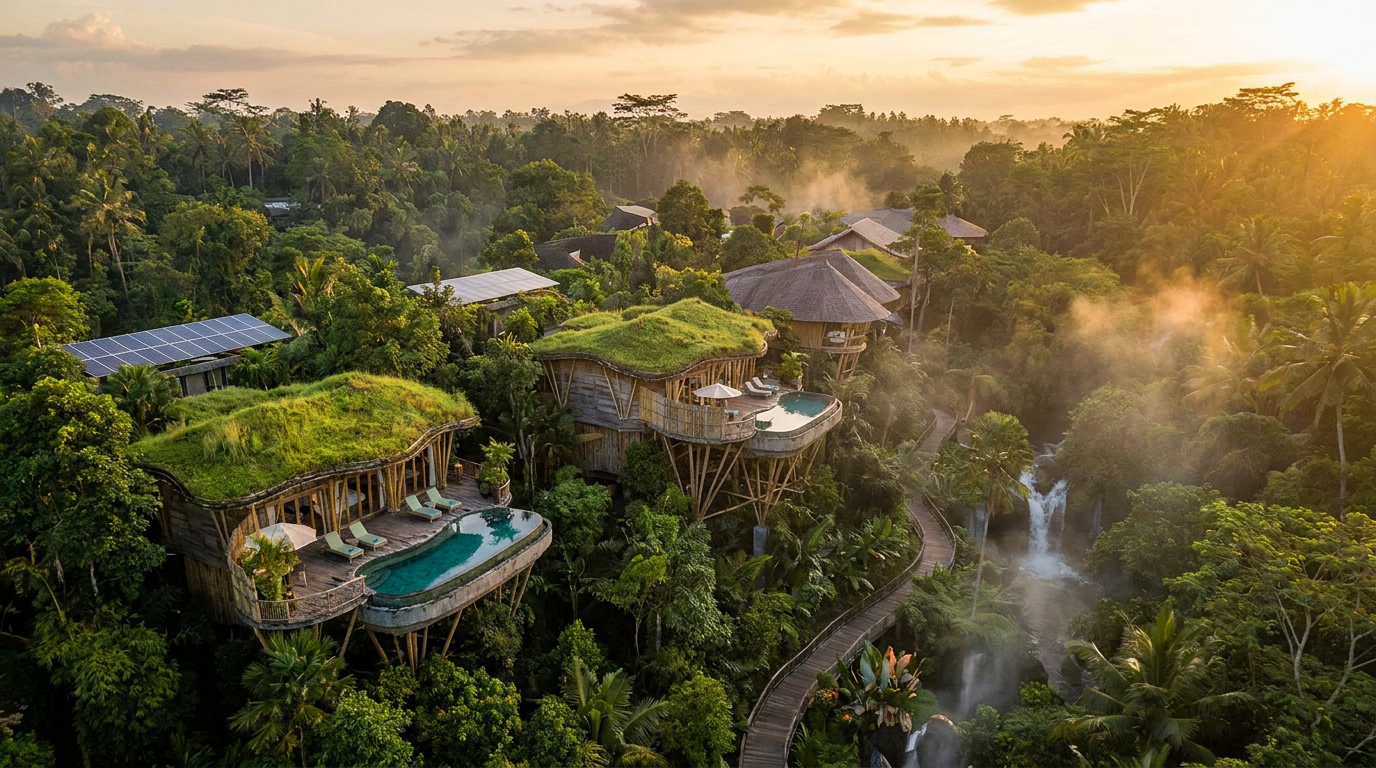
Achieving this level of impact without sacrificing the comforts of five-star hospitality requires what industry experts call "invisible infrastructure." The historic compromise between indulgence and environmentalism has been effectively engineered away by advanced technology.[3]
Today's premier eco-resorts rely on advanced, sensor-driven building management systems and closed-loop resource cycles. To maintain lush landscaping and private infinity pools in remote, water-scarce environments, properties are deploying multistage greywater recycling and solar-powered desalination plants that never drain vital local freshwater tables.[3]
Today's premier eco-resorts rely on advanced, sensor-driven building management systems and closed-loop resource cycles.
Energy grids have undergone a similar revolution. The world's finest off-grid retreats have replaced noisy, polluting diesel generators with seamlessly integrated solar arrays, vertical-axis wind turbines, and advanced battery storage systems that provide silent, renewable power around the clock.[3]

This technological sophistication allows resorts like Soneva Fushi in the Maldives and Bawah Reserve in Indonesia to operate ambitious zero-waste programs and marine conservation initiatives while delivering an uncompromisingly luxurious guest experience.[2]
The shift toward regeneration is also reshaping traveler behavior. The frantic, multi-stop itineraries of the past are being replaced by "slow travel," where guests spend weeks or even months at a single destination, often blending remote work with their stay.[6]
This extended timeframe allows for a deeper, more authentic connection with the local culture and ecosystem. It also significantly reduces the proportional carbon footprint associated with frequent air travel while ensuring that a larger, more sustained share of the economic benefit remains within the host community.[1]
The desire for profound disconnection has also fueled a surge in off-the-grid isolation. Remote lodges accessible only by helicopter and hidden desert domes offer complete digital detoxes, paired with five-star chefs, personal wellness experts, and unobstructed views of untouched landscapes.[6]

However, as the regenerative movement gains momentum, the industry faces the critical challenge of verification. Distinguishing true restorative practices from sophisticated "greenwashing" requires transparent impact reporting and rigorous third-party auditing.[1][2]
Certifications from bodies like Regenera Luxury and the Global Sustainable Tourism Council (GSTC) are becoming essential tools for travelers seeking to ensure their spending genuinely supports local ecosystems rather than merely padding corporate bottom lines.[2][3]
Ultimately, the rise of regenerative luxury travel signals a hopeful maturation of the tourism industry. By proving that high-end hospitality can be a powerful force for ecological and social healing, these pioneering properties are charting a course toward a future where exploring the world actively helps to save it.[4][7]
How we got here
2020
The concept of 'regenerative travel' begins to gain mainstream traction as the pandemic forces a global reassessment of tourism's impact.
2023
Major luxury brands begin shifting marketing language from 'sustainable' to 'regenerative,' prompting calls for stricter verification.
2025
Advanced closed-loop water systems and AI-driven energy grids become standard in new ultra-luxury off-grid developments.
2026
Regenerative practices, including mandatory 5-15% revenue reinvestment, become the defining baseline for top-tier eco-resorts globally.
Viewpoints in depth
Regenerative Hoteliers
Viewing conservation as a core business expense rather than a charitable afterthought.
For the operators of the world's most exclusive eco-resorts, the shift to regeneration is fundamentally an operational one. They argue that the traditional model of extracting value from a pristine location until it degrades is a flawed long-term business strategy. By hardwiring conservation into their balance sheets—often committing up to 15% of top-line revenue to local projects—they ensure the very asset that attracts their guests (the untouched environment) is actively defended and improved.
Conscious Travelers
Demanding transparency and measurable impact from their luxury expenditures.
A younger generation of ultra-high-net-worth individuals is driving the demand side of this equation. These travelers are highly skeptical of vague 'eco-friendly' claims and actively seek out properties that provide transparent impact reporting. For this camp, true luxury is no longer defined by excess, but by the knowledge that their significant travel spending is directly funding anti-poaching patrols, coral reef restoration, and indigenous education rather than multinational corporate dividends.
Conservation Advocates
Partnering with the private sector to fund critical ecological defense.
Environmental NGOs and local conservationists increasingly view regenerative luxury travel as a vital funding mechanism. In remote regions where government funding for environmental protection is scarce or non-existent, the revenue generated by high-end tourism provides the capital necessary to hire local rangers, build sustainable infrastructure, and enforce marine protected areas. They emphasize that when executed correctly, this model aligns the financial incentives of the resort directly with the ecological health of the region.
What we don't know
- Whether the 5-15% revenue reinvestment model can be successfully adapted by mid-tier or mass-market tourism operators.
- How effectively new certification bodies will be able to police and prevent 'greenwashing' as the regenerative label becomes more lucrative.
Key terms
- Regenerative Travel
- Tourism that actively improves and restores the ecological and social health of a destination, rather than merely minimizing harm.
- Closed-Loop Water System
- An advanced plumbing and filtration network that recycles greywater and rainwater for landscaping and pools, eliminating the need to draw from local freshwater tables.
- Greenwashing
- The deceptive practice of marketing a company or property as environmentally friendly when its actual operations do not support those claims.
- Slow Travel
- A movement emphasizing longer stays at a single destination to foster deeper cultural connections and reduce the carbon footprint associated with frequent transit.
- Invisible Infrastructure
- High-tech, sustainable backend systems—like solar desalination and AI energy grids—that operate silently without disrupting the luxury guest experience.
Frequently asked
What is the difference between sustainable and regenerative travel?
Sustainable travel aims to minimize negative impacts and maintain the status quo. Regenerative travel goes a step further by actively healing and improving the local ecosystem and community.
Does regenerative travel mean sacrificing luxury amenities?
No. Modern eco-resorts use advanced 'invisible infrastructure,' such as solar-powered desalination and closed-loop water recycling, to provide five-star amenities like infinity pools without depleting local resources.
How can travelers verify a resort's regenerative claims?
Travelers should look for transparent impact reporting, specific data on revenue reinvestment (typically 5-15%), and third-party certifications from organizations like Regenera Luxury or the Global Sustainable Tourism Council.
Why is 'slow travel' considered more environmentally friendly?
Staying in one location for an extended period reduces the carbon emissions associated with frequent flights, while ensuring a larger, more sustained economic benefit for the host community.
Sources
Source coverage
7 outlets
3 viewpoints surfaced







[1]Fit Global LifeConscious Travelers
Regenerative Travel: 5 Ethical Destinations Where Your Trip Truly Gives Back
Read on Fit Global Life →[2]MA SuiteRegenerative Hoteliers
From sustainable to regenerative luxury travel: what really changes
Read on MA Suite →[3]A'ARU CollectiveRegenerative Hoteliers
4 Core Tech Innovations Defining Modern Eco-Luxury
Read on A'ARU Collective →[4]RoadbookConservation Advocates
Regenerative travel: a salient trend that aims to leave a place better
Read on Roadbook →[5]Nina KarnikowskiConservation Advocates
Satisfy Your Wanderlust and Help the Planet with Regenerative Travel
Read on Nina Karnikowski →[6]Xpert HospitalityRegenerative Hoteliers
The Conscious Luxury Traveler: Changing Expectations
Read on Xpert Hospitality →[7]Factlen Editorial Team
Synthesis by Factlen editorial team
Read on Factlen Editorial Team →
Every angle. Every day.
Get travel stories with full source coverage and perspective breakdowns delivered to your inbox.