
Apple Unveils 'Siri AI' in iOS 27, Finally Catching Up in the Smart Assistant Race
Apple has introduced a rebuilt, context-aware version of Siri powered by Google Gemini, bringing on-screen awareness and a dedicated chat app to the iPhone.
By Factlen Editorial Team
- Apple Ecosystem Users
- Relief and excitement over a functional native assistant.
- Tech Industry Analysts
- Viewing the update as a necessary, pragmatic catch-up play.
- Privacy Advocates
- Cautious optimism regarding Apple's on-device processing architecture.
What's not represented
- · Users of older iPhones excluded from the update
- · Competitor AI companies facing native integration threats
Why this matters
For hundreds of millions of iPhone users, Siri has long been a frustratingly limited tool. This overhaul fundamentally changes how users interact with their devices, turning the iPhone into a proactive, context-aware assistant capable of complex, multi-step tasks.
Key points
- Apple introduced 'Siri AI' at WWDC 2026, powered by a custom Google Gemini model.
- The assistant features 'on-screen awareness' and can pull context from personal emails and messages.
- A new dedicated Siri app allows users to maintain persistent, cross-device chat histories.
- Siri mode in the Camera app enables visual intelligence for real-world interactions.
- The features require an iPhone 15 Pro or newer due to high memory demands.
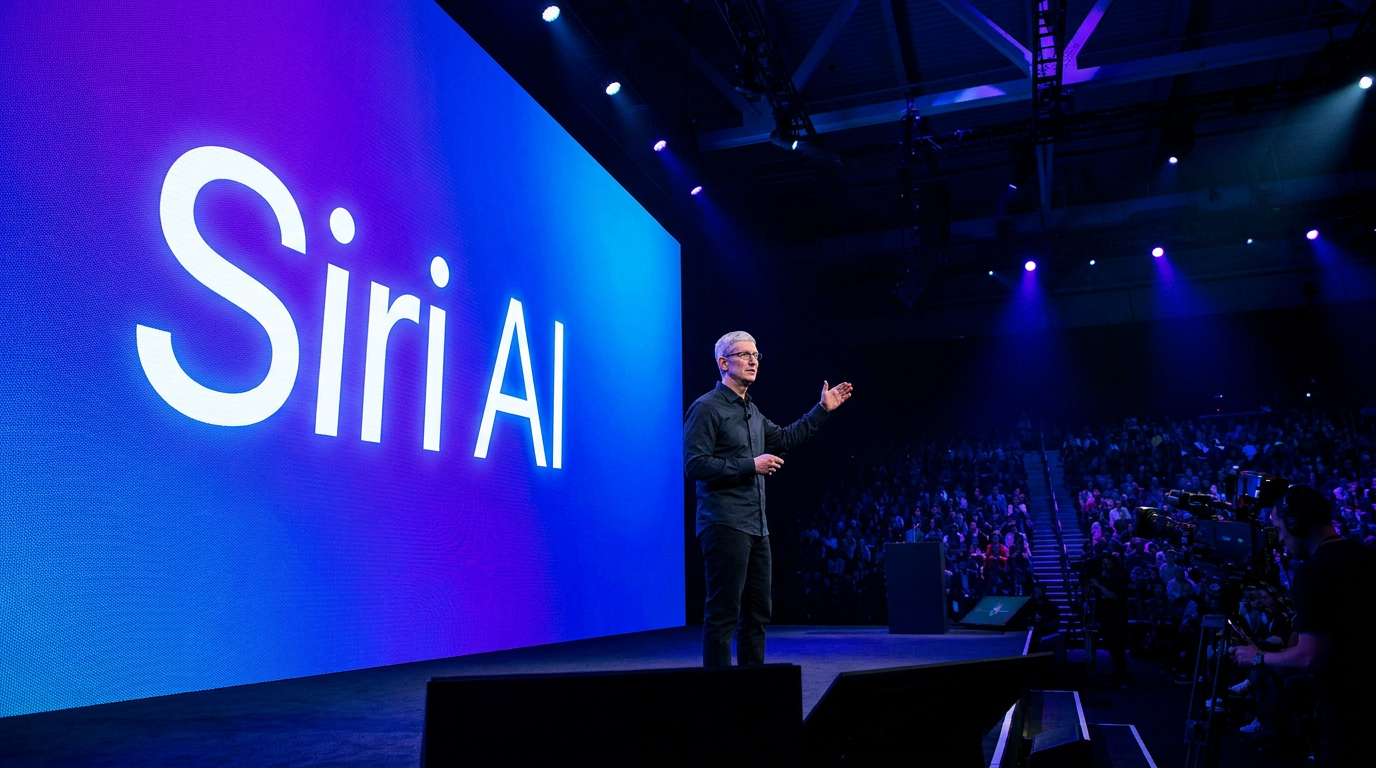
Apple has finally delivered the voice assistant overhaul iPhone users have been waiting for. At its Worldwide Developers Conference (WWDC) 2026, the company unveiled "Siri AI," a rebuilt, deeply integrated digital assistant powered by a new generation of Apple Intelligence. After years of false starts and internal delays, the new Siri arrives as a profoundly more capable tool, underpinned by custom foundation models developed in collaboration with Google's Gemini. The announcement marks a critical turning point for Apple's software ecosystem, signaling the company's readiness to make artificial intelligence the primary interface layer across its devices.[1][4][6]
For the better part of a decade, Siri has lagged noticeably behind modern generative AI chatbots like ChatGPT and Claude. Users frequently encountered frustrating limitations, with complex queries routinely met by a generic list of web search results. The new Siri AI fundamentally changes that architecture. By shifting from a rigid question-and-answer tool to a context-aware AI agent, the assistant can now process multi-step commands, remember previous interactions, and execute complex tasks across different applications without losing the thread of the conversation.[2][4][6]
The most immediate change users will notice is the interface. The familiar, colorful glowing orb at the bottom of the screen has been retired. In its place, Siri AI utilizes a sleek, dark-themed prompt that expands directly from the iPhone's Dynamic Island. Furthermore, Apple has introduced a dedicated, standalone Siri application. This app allows users to type or speak to the assistant in a continuous chat interface, complete with persistent conversation bubbles. Because the chat history syncs privately via iCloud, a user can begin a complex query on their Mac and seamlessly continue the conversation on their iPhone or Apple Vision Pro.[1][2][5]

Under the hood, Siri AI's most significant advantage over third-party chatbots is its "personal context understanding." Because the assistant operates at the system level, it can securely index and cross-reference a user's personal data. During the keynote, Apple demonstrated how a user could ask Siri to find a hotel confirmation number buried in an old email, or pull up photos from a specific weekend trip featuring specific friends, all without manually opening the Mail or Photos apps. This deep integration allows Siri to act as a true personal secretary rather than just a web-connected encyclopedia.[1][5][6]
The update also introduces a feature called "on-screen awareness," which allows the assistant to "see" and understand whatever is actively displayed on the device's screen. If a user is looking at an Instagram post featuring a local restaurant, they can simply invoke Siri and ask, "How long does it take to drive there?" or "Show me their menu." Siri AI processes the visual context of the app, identifies the restaurant, and delivers the requested information without the user ever needing to specify the business's name or leave the social media feed.[1][3]
This visual intelligence extends into the physical world through a brand-new "Siri mode" built directly into the iOS 27 Camera app. Users can point their iPhone at their surroundings to trigger contextual actions. For example, pointing the camera at a concert poster allows Siri to automatically parse the text and add the event to the user's calendar. Similarly, scanning a plate of food can instantly retrieve nutritional information. This multimodal capability bridges the gap between the digital assistant and the user's physical environment, making information retrieval nearly frictionless.[1][3]
This visual intelligence extends into the physical world through a brand-new "Siri mode" built directly into the iOS 27 Camera app.
Despite the massive leap in capabilities, privacy remains a central pillar of Apple's pitch. The company emphasized that its custom foundation models process the vast majority of requests entirely on-device. When a query is too complex and requires cloud processing, Apple's proprietary server architecture ensures that user data is cryptographically secured, never stored, and never used to train external AI models. This privacy-first approach stands in stark contrast to the data-harvesting practices often associated with cloud-first AI services, offering a distinct selling point for privacy-conscious consumers.[1][2][6]
The rollout of these advanced features, however, comes with strict hardware limitations. Because the new AI models require substantial memory and processing power, Siri AI is restricted to the iPhone 15 Pro, the iPhone 16 lineup, and iPads and Macs equipped with M1 chips or newer. Furthermore, developers have noted that some of the most advanced capabilities—such as highly customizable, expressive voice generation and enhanced dictation—will require the upcoming iPhone 17 Pro and its rumored 12GB of RAM, leaving older devices entirely out of the loop.[1][3][5]

The WWDC 2026 keynote also carried significant historical weight for the company, serving as Tim Cook's final developer conference presentation before he steps down as CEO in September 2026 to make way for John Ternus. For Cook, delivering a truly intelligent, functional version of Siri serves as a fitting capstone to his tenure, answering one of the loudest and most persistent criticisms of Apple's software ecosystem during his time at the helm.[4][6]
Siri AI is currently available for developer testing within the iOS 27 beta, with a public rollout scheduled for this fall. While some features will be subject to daily usage limits—with expanded access tied to iCloud+ subscriptions—the core experience promises to redefine how users interact with their Apple devices. After years of waiting, Apple's ubiquitous assistant finally appears ready to take its place in the modern AI era.[1][4]
How we got here
June 2024
Apple first teases a major overhaul to Siri, which is subsequently delayed.
May 2026
Apple settles a class-action lawsuit regarding Siri's previously advertised AI capabilities.
June 8, 2026
Apple officially unveils Siri AI at WWDC 2026, releasing it to developers.
Fall 2026
Siri AI is scheduled to launch to the public alongside iOS 27.
Viewpoints in depth
Apple Ecosystem Users
Relief and excitement over a functional native assistant.
For years, iPhone users have relied on third-party apps like ChatGPT or Claude to handle complex queries, switching back to Siri only for basic tasks like setting timers. This camp views Siri AI as a massive quality-of-life improvement, praising the deep OS integration that allows the assistant to pull context from personal emails and photos—something external chatbots cannot do securely.
Tech Industry Analysts
Viewing the update as a necessary, pragmatic catch-up play.
Industry watchers note that Apple was dangerously close to losing its edge in the AI race. By partnering with Google to utilize Gemini foundation models, Apple took a pragmatic shortcut to deliver a competitive product quickly. Analysts argue that while Apple may not have the best standalone AI model in the world, its unparalleled hardware integration and massive user base make Siri AI an immediate heavyweight in the space.
Privacy Advocates
Cautious optimism regarding Apple's on-device processing architecture.
Privacy-focused groups are largely praising Apple's architectural choices. By processing the vast majority of requests on-device and utilizing cryptographically secure servers for cloud queries, Apple is setting a new standard for AI privacy. However, some advocates remain cautious about the long-term implications of an AI that has unfettered access to a user's entire digital life, even if that data never leaves the device.
What we don't know
- How strictly Apple will enforce daily usage limits for non-iCloud+ subscribers.
- Exactly how much of the processing relies on Google's cloud infrastructure versus Apple's on-device models in real-world usage.
- Whether older devices will eventually receive a 'lite' version of the new Siri.
Key terms
- Apple Intelligence
- Apple's suite of generative AI features integrated deeply into iOS, iPadOS, and macOS.
- On-screen awareness
- An AI capability allowing the assistant to read and understand the text and images currently displayed on the user's screen.
- Dynamic Island
- The pill-shaped interface area at the top of newer iPhones that expands to show alerts and background activities.
- Foundation Model
- A large-scale artificial intelligence model trained on a vast quantity of data, serving as the base for specific applications like Siri.
Frequently asked
Which iPhones will support the new Siri AI?
Siri AI requires an iPhone 15 Pro, iPhone 15 Pro Max, or any model in the iPhone 16 lineup. Older iPhones do not have the necessary RAM to run the models.
Does the new Siri use ChatGPT?
No, Apple built the new Siri AI using its own foundation models, developed in collaboration with Google's Gemini, rather than OpenAI's technology.
When can I get the new Siri?
The features are currently in developer beta and will be released to the general public this fall as part of the iOS 27 update.
Sources
Source coverage
6 outlets
3 viewpoints surfaced






[1]Apple NewsroomPrivacy Advocates
Apple introduces Siri AI, a profoundly more capable and personal assistant
Read on Apple Newsroom →[2]MashableApple Ecosystem Users
Apple's new, smarter Siri AI is finally here
Read on Mashable →[3]9to5MacApple Ecosystem Users
Apple unveils new Siri AI, dedicated app, and enhanced Apple Intelligence features in iOS 27
Read on 9to5Mac →[4]The GuardianPrivacy Advocates
Apple debuts revamped 'Siri AI' and new child safety features for iPhones and iPads
Read on The Guardian →[5]LushbinaryTech Industry Analysts
WWDC 2026: iOS 27, New Siri & Dev Tools
Read on Lushbinary →[6]IDCTech Industry Analysts
WWDC 2026: Apple's AI Credibility Test
Read on IDC →
More in technology
See all 5 stories →

Every angle. Every day.
Get technology stories with full source coverage and perspective breakdowns delivered to your inbox.