
Apple Unveils iOS 27 with Major Siri AI Overhaul and Expanded Lifespan for Older iPhones
Apple's WWDC 2026 revealed iOS 27, featuring a deeply integrated 'Siri AI,' new generative photo tools, and a surprising commitment to support devices as old as the iPhone 11.
By Factlen Editorial Team
- Consumer Tech Reviewers
- Tech reviewers praise the update for prioritizing device longevity and practical daily utility over forced hardware upgrades.
- Industry Analysts
- Market analysts view iOS 27 as a necessary catch-up maneuver in the broader artificial intelligence arms race.
- Ecosystem Skeptics
- Some critics argue that the update fragments the user base based on hardware capabilities.
What's not represented
- · Third-Party App Developers
- · Environmental Advocates
Why this matters
The update brings cutting-edge generative AI to modern iPhones while simultaneously extending the usable life of seven-year-old devices, saving millions of users from forced hardware upgrades and reducing electronic waste.
Key points
- Apple announced iOS 27 at WWDC 2026, featuring a completely rebuilt Siri powered by Apple Intelligence and Gemini.
- The operating system will support devices as old as the iPhone 11, extending their lifespan with up to 30% faster app launch speeds.
- New generative AI tools in the Photos app allow users to expand image borders and change camera perspectives after shooting.
- Apple is reportedly developing an Extensions API to let users swap Siri for third-party chatbots like ChatGPT or Claude later this fall.
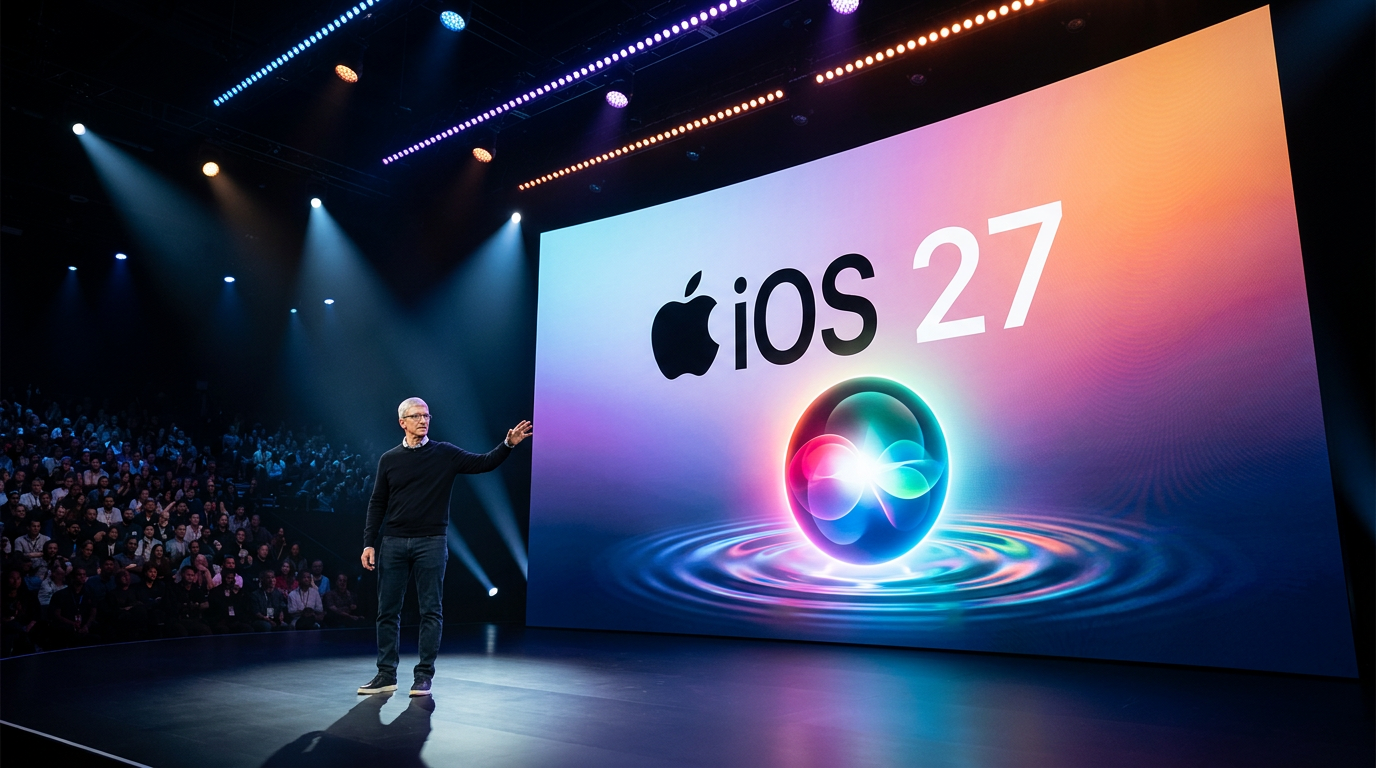
Apple has officially unveiled iOS 27 at its Worldwide Developers Conference (WWDC) 2026, placing a deeply integrated "Siri AI" at the center of the iPhone experience while surprisingly extending software support to devices as old as the 2019 iPhone 11. The announcement marks a pivotal moment for the tech giant as it attempts to balance cutting-edge generative artificial intelligence with a steadfast commitment to consumer hardware longevity. Rather than forcing millions of users to upgrade their aging smartphones to access basic software improvements, Apple is delivering a dual-track update that caters to both power users and budget-conscious consumers.[1][2]
The centerpiece of the update is a completely rebuilt Siri, now powered by a combination of Apple Intelligence and Google's Gemini models. The voice assistant features a brand-new chatbot-style interface, can be summoned via a fluid swipe down from the Dynamic Island, and boasts vastly improved natural language processing capabilities. Users can now type to Siri, upload documents for analysis, and ask complex multi-part questions without the system losing context. This overhaul is designed to transform the voice assistant from a rigid, often frustrating command processor into a fluid, context-aware digital companion that actually understands the user's intent.[1][6]
Siri can now see exactly what is on the screen and use personal context to answer queries, create calendar appointments, or draft reminders based on active conversations. For example, if a user is texting a friend about a flight, Siri can automatically pull the flight number, check the status, and draft a response without the user ever leaving the Messages app. Apple's goal is to ensure this intelligence syncs seamlessly across Macs, iPads, and iPhones, creating a unified digital assistant that follows the user across their entire hardware ecosystem.[1][5]

Beyond voice commands, generative artificial intelligence permeates the operating system's creative tools. The native Photos app gains a highly anticipated "Spatial Reframing" tool that uses AI to simulate entirely new camera angles after a shot is taken. If a user cuts off a subject's feet or wants a wider landscape view, the software generates the missing pixels to create the illusion of a repositioned camera. This is paired with an "Extend" feature that seamlessly expands image borders, giving casual photographers professional-grade editing capabilities directly in their camera roll.[1][2]
Image Playground, Apple's built-in generation tool that debuted in previous software versions, has also been significantly updated to meet the rising standards of AI art. The application can now produce highly detailed, photorealistic images rather than just the stylized, cartoonish outputs it was previously known for. Users can generate custom visuals of multiple people from their photo library directly within their message threads, and edit the generated outputs simply by circling objects and describing the desired changes in natural language. The tool also allows users to easily format these creations into specific aspect ratios, including a dedicated wallpaper mode tailored perfectly for the iPhone display.[1]

Image Playground, Apple's built-in generation tool that debuted in previous software versions, has also been significantly updated to meet the rising standards of AI art.
In a major win for consumer hardware longevity, Apple confirmed that iOS 27 will run on every single device that supported iOS 26. Thanks to a newly optimized CPU scheduler and deep performance cleanups across the operating system's architecture, applications will launch up to 30 percent faster. This focus on underlying stability ensures that the software update feels like a genuine upgrade rather than a burden on older processors, addressing a long-standing complaint among users who fear that new updates will artificially slow down their devices.[2]
This efficiency breakthrough means that seven-year-old phones like the iPhone 11 will remain active, secure, and fully supported for at least another year. While the heavy, on-device Apple Intelligence features—like the advanced Siri overhaul and generative photo tools—strictly require an iPhone 15 Pro or newer due to neural engine constraints, the baseline performance boosts ensure older hardware doesn't become obsolete. By keeping these older devices in the ecosystem, Apple is quietly executing one of the most effective e-waste reduction strategies in the consumer electronics industry.[2]

Apple is also holding back some of its most ambitious capabilities for a staggered fall release, ensuring the initial summer rollout remains stable. According to industry reports, the company is actively developing a new Extensions API that will allow users to seamlessly swap Siri's default intelligence engine for third-party chatbots. While the current developer beta only supports a basic ChatGPT integration, the upcoming system will let users route their queries to specialized models like Anthropic's Claude or Google's Gemini directly from the native Siri interface. This means users won't have to open separate applications to access the specific strengths of different AI models.[3][4]
This open-model approach marks a significant shift in Apple's historical strategy, which has traditionally favored tightly closed ecosystems. Moving away from bespoke, one-off partnerships, the company is building a modular system where users can plug their preferred artificial intelligence directly into the operating system's core interface. Developers will need to apply for a specific entitlement to integrate their models, but the end result is a highly customizable assistant that acknowledges no single tech company can dominate every single aspect of the rapidly evolving generative AI landscape. By owning the interface layer, Apple maintains control of the user experience while offloading the massive computational costs of cloud-based AI to its partners.[4]

Beyond artificial intelligence, iOS 27 introduces several practical quality-of-life improvements that cater to everyday usability. A new "Liquid Glass" customization slider for the home screen allows users to adjust the transparency and tint of their interface, offering a level of aesthetic control previously reserved for Android devices. Additionally, Apple is rolling out enhanced Screen Time controls that give parents much more granular oversight over their children's digital diets. The new tools include an "Ask to Browse" feature for specific websites and improved on-device detection algorithms that flag violent or gory content in messages alongside nudity, providing a safer environment for younger users.[1][5]
By balancing flashy generative AI tools for its newest flagship phones with fundamental performance optimizations for aging hardware, Apple is attempting to modernize its ecosystem without leaving its massive legacy user base behind. The strategy is a delicate tightrope walk: the company must provide enough exclusive, cutting-edge features to drive sales of the upcoming iPhone 18 lineup, while simultaneously proving that it respects the investment of users who hold onto their devices for half a decade or more. So far, the reception from developers and early beta testers suggests that Apple has struck the right chord, delivering a highly polished update that feels remarkably stable for a first release.[2][5]
Ultimately, iOS 27 represents a stabilizing, foundational year for Apple's software ecosystem. Rather than reinventing the wheel with experimental interfaces or confusing paradigms, the company is delivering the practical AI capabilities it has promised for years while ensuring the underlying operating system remains fast, reliable, and accessible to millions of users worldwide. As the broader tech industry continues its frantic, often chaotic race toward artificial general intelligence, Apple's decision to prioritize device longevity, parental controls, and seamless integration serves as a refreshing reminder of its core philosophy. The update proves that the most impactful technological advancements aren't always the flashiest; sometimes, they are the ones that simply make everyday tasks faster and keep old hardware running like new.[5][6]
How we got here
June 2024
Apple announces its initial foray into generative AI with the first iteration of Apple Intelligence in iOS 18.
September 2025
The iPhone 17 launches, bringing more powerful Neural Engines to the baseline models to support heavier on-device AI tasks.
June 8, 2026
Apple officially unveils iOS 27 at WWDC, showcasing the rebuilt Siri AI and expanded photo editing tools.
July 2026
The first public beta of iOS 27 is expected to become available for general users to test.
Fall 2026
iOS 27 will officially launch to the public alongside the announcement of new iPhone hardware.
Viewpoints in depth
Consumer Tech Reviewers
Tech reviewers praise the update for prioritizing device longevity and practical daily utility over forced hardware upgrades.
Reviewers highlight that extending support to the iPhone 11 is a massive win for consumers and the environment. By optimizing the CPU scheduler to deliver 30% faster app launches on older hardware, Apple is bucking the industry trend of planned obsolescence. While these older devices won't get the flashy on-device Apple Intelligence features, the baseline performance improvements ensure they remain secure and highly functional for another year.
Industry Analysts
Market analysts view iOS 27 as a necessary catch-up maneuver in the broader artificial intelligence arms race.
Financial and tech analysts note that Apple is shifting from a closed ecosystem to a more modular AI approach. By developing an Extensions API that allows users to plug third-party models like Gemini or Claude directly into Siri, Apple acknowledges that no single company can dominate every aspect of generative AI. This strategy allows Apple to own the interface and user relationship while offloading complex, cloud-heavy queries to specialized partners.
Ecosystem Skeptics
Some critics argue that the update is overly cautious and fragments the user base based on hardware capabilities.
Skeptics point out that while the software supports older phones, the heavily marketed "Siri AI" and generative photo tools are strictly gatekept behind the A17 Pro and M-series chips. This creates a bifurcated operating system where users on older devices receive a fundamentally different, less capable version of iOS 27. Furthermore, they note that several promised features, including the third-party chatbot integrations, have been delayed until the fall, continuing Apple's recent trend of announcing software that isn't ready for launch.
What we don't know
- How strict the daily usage limits will be for free iCloud users utilizing the new generative AI photo editing tools.
- Exactly which third-party AI models will be available at launch for the new Siri Extensions API.
- How severely the heavy on-device AI processing will impact the battery life of the iPhone 15 Pro and iPhone 16 models.
Key terms
- Apple Intelligence
- Apple's suite of on-device and private-cloud artificial intelligence models that power text generation, image creation, and the new Siri.
- Dynamic Island
- The pill-shaped interactive area at the top of modern iPhone displays that houses the front camera and displays live alerts and background activities.
- Generative Fill (Extend)
- An AI technique used in the Photos app to seamlessly add new, artificially generated content beyond the original borders of an image.
- CPU Scheduler
- A component of the operating system that decides which tasks the processor should handle and when, heavily impacting device speed and battery life.
Frequently asked
Will my older iPhone get the new Siri AI features?
No. While iOS 27 will run on devices as old as the iPhone 11, the advanced "Apple Intelligence" and Siri AI features require an iPhone 15 Pro or newer due to hardware constraints.
What is Spatial Reframing?
Spatial Reframing is a new AI-powered tool in the Photos app that allows you to change the perspective or camera angle of a photo after it has been taken by generating new pixels around the subject.
Can I use ChatGPT instead of Siri?
Apple is reportedly working on an Extensions API coming this fall that will allow users to seamlessly route their Siri queries to third-party chatbots like ChatGPT, Gemini, or Claude.
Does iOS 27 make older phones slower?
Actually, the opposite. Apple claims that iOS 27 includes a newly optimized CPU scheduler that makes app launches up to 30% faster on older supported devices.
Sources
Source coverage
6 outlets
3 viewpoints surfaced





[1]MashableConsumer Tech Reviewers
Everything we learned about iOS 27 at WWDC 2026
Read on Mashable →[2]EngadgetConsumer Tech Reviewers
iOS 27 Can Run On Phones As Old As The iPhone 11
Read on Engadget →[3]BloombergIndustry Analysts
Apple reportedly has three more iOS 27 features coming in the fall
Read on Bloomberg →[4]9to5MacIndustry Analysts
Apple still has three unannounced iOS 27 features in the pipeline: report
Read on 9to5Mac →[5]The New ThingsEcosystem Skeptics
WWDC 2026: Apple Plays It Safe with Siri and iOS 27
Read on The New Things →新SiriはアップルAI危機を救えるか、実機を試して見えた7つの改善例-Power On
Read on Bloomberg Japan →
More in technology
See all 5 stories →

Every angle. Every day.
Get technology stories with full source coverage and perspective breakdowns delivered to your inbox.