
Apple Unveils iOS 27 and a Rebuilt 'Siri AI' at WWDC 2026
Apple's latest software update introduces a profoundly more capable Siri powered by Google Gemini, alongside system-wide AI integration and performance boosts.
By Factlen Editorial Team
- Apple Ecosystem Enthusiasts
- Excited about deep integration, privacy, and the long-awaited Siri fix.
- Android & Google Users
- Noting that many of these features have been on Android for a while.
- Privacy Advocates
- Focused on Apple's Private Cloud Compute and on-device processing claims.
- App Developers
- Preparing for the mandatory App Intents migration and the deprecation of SiriKit.
What's not represented
- · EU Regulators
- · Hardware Supply Chain Analysts
Why this matters
The overhaul of Siri transforms the iPhone from a simple grid of apps into an agentic assistant capable of understanding personal context, fundamentally changing how millions interact with their devices daily.
Key points
- Apple introduced iOS 27 at WWDC 2026, featuring a completely rebuilt Siri AI powered by a custom Google Gemini model.
- The new Siri gains Personal Context Understanding, allowing it to securely scan emails, messages, and photos to answer specific queries.
- Siri now features On-Screen Awareness and a dedicated Camera mode to analyze and interact with visual information.
- iOS 27 brings a new standalone Siri app, a Liquid Glass customization slider, and a 30 percent boost to app launch speeds.
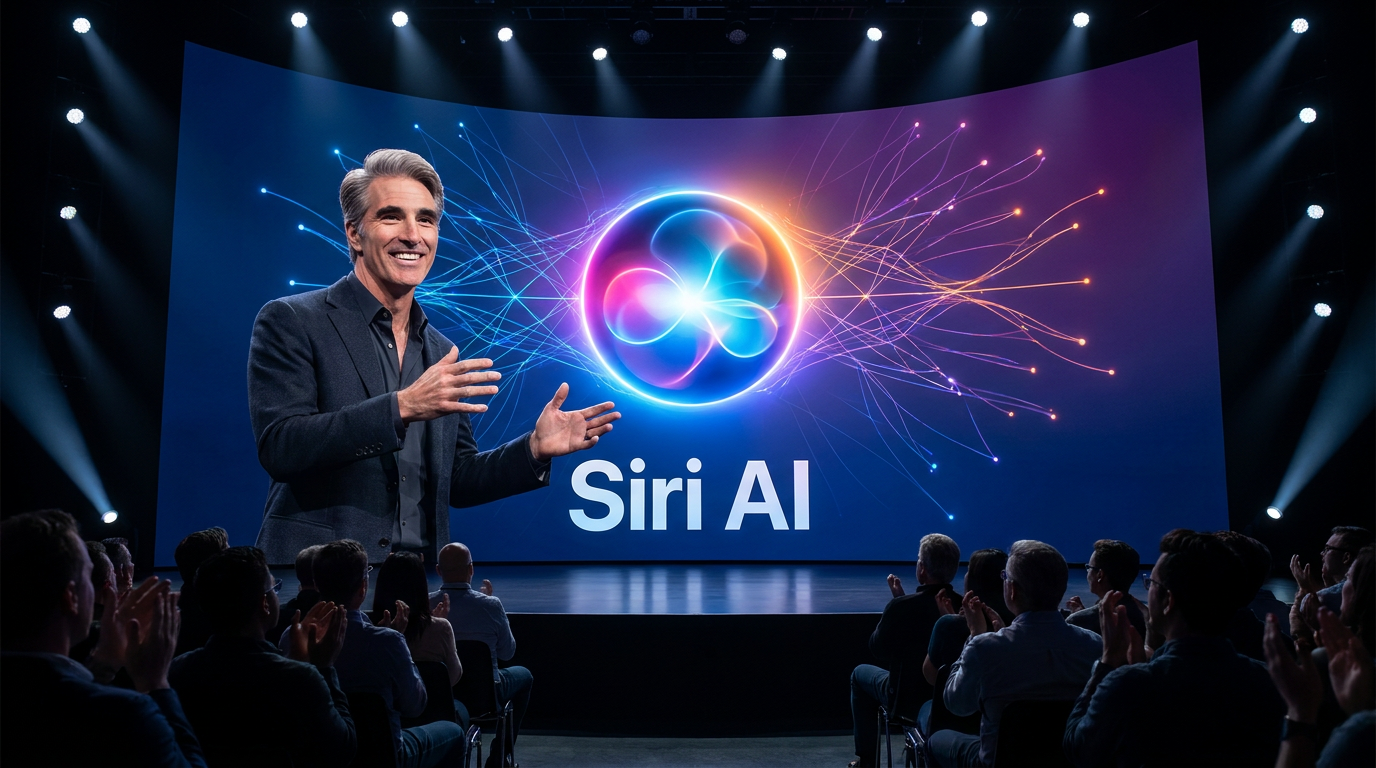
Apple has officially unveiled iOS 27, marking one of the most significant software overhauls in the iPhone's history. Announced at the company's Worldwide Developers Conference in Cupertino, the update centers on a complete reimagining of the device's digital assistant. After years of falling behind rivals in the generative AI race, Apple is introducing "Siri AI," a profoundly more capable system deeply integrated into the operating system. The update promises to transform the iPhone from a static grid of applications into an agentic device that understands personal context and on-screen content.[2][8]
The foundation of this new era is a strategic partnership with Google. Rather than relying solely on in-house technology, Apple has rebuilt Siri using a custom 1.2-trillion-parameter Google Gemini model. This collaboration allows Siri to facilitate free-flowing, organic conversations that go much deeper than the rigid voice commands of the past. The assistant now features a more expressive voice, and users can customize its pacing and tone using dedicated sliders.[2][5]
Visually, Siri is breaking out of its traditional mold. The assistant now lives within the iPhone's Dynamic Island, featuring a dark theme and a glowing cursor that replaces the old colorful edge effect. For the first time, Siri also gets its own standalone application. This dedicated app acts as a memory bank, syncing via iCloud to let users revisit past conversations, pin important chats, and upload files or photos for the AI to analyze.[3][6]
The most powerful addition to Siri's arsenal is "Personal Context Understanding." By hooking into a revamped Spotlight search index, the AI can securely scan a user's emails, text messages, calendar events, and photos. This allows users to ask highly specific questions, such as requesting a photo from a recent trip or finding a song a friend texted them weeks ago, without needing to open the respective apps. Apple emphasized that this processing relies heavily on on-device privacy and its Private Cloud Compute infrastructure.[4][7]

Siri is also gaining "On-Screen Awareness," effectively giving the assistant eyes. By tapping into Apple's Vision framework, Siri can analyze the text and images currently displayed on the iPhone's screen. If a user is looking at an Instagram post about a new restaurant, they can simply ask Siri to add the location to their maps or calendar. While the feature draws comparisons to Android's "Circle to Search," Apple's approach relies on a new API that lets third-party developers tag user interface data for Siri to find.[3][5]
The visual capabilities extend to the physical world through a new Siri mode in the Camera app. Users can point their iPhone at a concert poster and ask Siri to add the event to their calendar, or snap a photo of a receipt to split the bill with friends via Apple Cash. This multimodal understanding bridges the gap between the digital assistant and the user's immediate environment, a feature Apple calls Visual Intelligence.[3][4]
The visual capabilities extend to the physical world through a new Siri mode in the Camera app.
While Apple Intelligence is the default engine, the company is not locking users into a single ecosystem. According to reports, iOS 27 will eventually allow users to seamlessly swap Siri's underlying model for third-party chatbots. Although the current developer beta only supports switching between Siri and ChatGPT, Apple is actively working to integrate other models like Google's Gemini and Anthropic's Claude, giving users the flexibility to choose their preferred AI.[1]

Beyond AI, iOS 27 brings notable refinements to the iPhone's user interface. Following the divisive "Liquid Glass" redesign introduced in iOS 26, Apple has added a new customization slider. Users can now adjust the interface's transparency, sliding between "Ultra Clear" and "Tinted Glass" to improve readability and contrast based on their personal preferences. App icons have also been sharpened, with extra layers of detail added to core applications like Apple Maps.[4][8]
The Messages app is receiving a suite of upgrades, including AI-powered "one-tap suggestions" that proactively offer to create reminders or find relevant photos based on the context of a chat. More intriguingly, Apple has introduced a new "Drawing" iMessage app equipped with Markup tools. Industry watchers note that while the feature works on current devices, it seems purpose-built for a larger canvas, fueling rumors of an upcoming foldable "iPhone Ultra" expected later this year.[3][8]
Under the hood, iOS 27 delivers substantial performance improvements. Apple claims that apps will launch up to 30 percent faster, while new photos will load 70 percent quicker. Network management has also been overhauled; the system can now detect weak Wi-Fi networks—such as an airplane's connection upon landing—and seamlessly hand off to cellular data without waiting for the connection to time out.[4]

For developers, the update represents a massive architectural shift. Apple has officially deprecated SiriKit, making the expanded App Intents framework the mandatory method for integrating third-party apps with Siri. This forces developers to update their software to ensure compatibility with the new AI features, though Apple has promised a multi-year support window for the transition.[3]
Despite the heavy integration of advanced AI, Apple is not leaving older devices behind. The company confirmed that iOS 27 will support all models dating back to the iPhone 11, alleviating fears that older hardware would be phased out. However, the most advanced Apple Intelligence features and the standalone Siri app will be restricted to the iPhone 15 Pro, the upcoming iPhone 16 lineup, and devices equipped with M1 chips or newer.[6][8]
The rollout of iOS 27 will follow Apple's traditional staggered timeline. Developer betas are already available, with a public beta scheduled for July. The final software is expected to launch to the general public in the fall, alongside the next generation of iPhone hardware. Initially, the new Siri AI features will only be available in English and will not launch in the European Union or China due to ongoing regulatory hurdles.[2][7]
How we got here
June 2024
Apple first teases a smarter, generative Siri, which faces subsequent internal delays.
January 2026
Apple reportedly strikes a deal with Google to use Gemini models to power its AI features.
June 8, 2026
Apple officially unveils iOS 27 and Siri AI at the Worldwide Developers Conference.
July 2026
Expected launch of the iOS 27 public beta for early adopters.
Fall 2026
Anticipated general release of iOS 27 alongside the new iPhone hardware lineup.
Viewpoints in depth
Apple Ecosystem Enthusiasts
Excited about deep integration, privacy, and the long-awaited Siri fix.
For years, power users have lamented Siri's stagnation. This camp views iOS 27 as the ultimate course correction, praising Apple's decision to deeply integrate AI into the OS rather than bolting on a separate chatbot. They emphasize that features like Personal Context Understanding—processed securely via Private Cloud Compute—offer a level of utility that standalone apps like ChatGPT simply cannot match.
Android & Google Users
Noting that many of these features have been on Android for a while.
While acknowledging the polish Apple brings, this camp points out that features like On-Screen Awareness and predictive network handoffs have existed on Google Pixel devices for generations. They view iOS 27 not as a revolution, but as Apple finally catching up to the agentic capabilities Google has been touting, ironically powered in part by Google's own Gemini models.
Privacy Advocates
Focused on Apple's Private Cloud Compute and on-device processing claims.
This group is cautiously optimistic about Apple's approach to AI privacy. By keeping the majority of Personal Context Understanding on-device and routing complex queries through a verifiable Private Cloud Compute infrastructure, they believe Apple is setting a new industry standard for data protection in the generative AI era.
App Developers
Preparing for the mandatory App Intents migration and the deprecation of SiriKit.
For the developer community, iOS 27 represents a massive architectural shift. The deprecation of SiriKit forces teams to rewrite how their applications interact with the operating system. While the transition will require significant engineering hours, developers are broadly excited about the new App Intents framework, which will allow their apps to be surfaced more intelligently by the new Siri.
What we don't know
- When exactly the third-party chatbot integration (like ChatGPT and Claude) will be fully rolled out to the public.
- Whether the new 'Drawing' iMessage app is a definitive confirmation of the rumored foldable iPhone Ultra.
- How European Union and Chinese regulators will respond to the delayed rollout of Apple Intelligence in their regions.
Key terms
- Apple Intelligence
- Apple's suite of generative AI features integrated deeply across its operating systems.
- Personal Context Understanding
- An AI capability that securely scans a user's emails, messages, and photos to provide highly personalized answers.
- On-Screen Awareness
- A feature allowing an AI assistant to 'see' and analyze the text and images currently displayed on a device's screen.
- Liquid Glass
- Apple's user interface design language, which allows users to adjust transparency and contrast.
Frequently asked
Will my older iPhone get the iOS 27 update?
Yes, Apple confirmed that iOS 27 will support all devices dating back to the iPhone 11.
Is the new Siri available in all languages?
It will launch in English first, with other languages rolling out later. It will not initially launch in the EU or China due to regulatory hurdles.
Do I have to use Apple's default AI?
Apple is reportedly working on letting users switch to third-party models like ChatGPT, Gemini, or Claude for their Siri queries.
Sources
Source coverage
8 outlets
4 viewpoints surfaced








[1]EngadgetAndroid & Google Users
Apple reportedly has three more iOS 27 features coming in the fall
Read on Engadget →[2]Business InsiderApp Developers
Apple Finally Gives Siri an AI Glow-up
Read on Business Insider →[3]9to5MacApple Ecosystem Enthusiasts
Apple unveils new Siri AI, dedicated app, and enhanced Apple Intelligence features in iOS 27
Read on 9to5Mac →[4]BGRApp Developers
15 Best iOS 27 Features Coming To Your iPhone This Fall
Read on BGR →[5]PCMagAndroid & Google Users
WWDC 2026: Apple's 7 Biggest AI Upgrades, Ranked
Read on PCMag →[6]CNETApp Developers
Apple Didn't Really Say What iOS 27 Will Bring to Your iPhone, So I Guess I Will
Read on CNET →[7]MobileSyrupPrivacy Advocates
Apple's AI upgrades: New Siri, Safari changes, and more
Read on MobileSyrup →[8]MashableApple Ecosystem Enthusiasts
Everything we learned about iOS 27 at WWDC 2026
Read on Mashable →
More in technology
See all 5 stories →

Every angle. Every day.
Get technology stories with full source coverage and perspective breakdowns delivered to your inbox.