
Apple to Manufacture Chips in the US Through Landmark Intel Partnership
President Donald Trump announced that Apple has agreed to use Intel's U.S. foundries to manufacture its custom processors, sending Intel's stock soaring to record highs. The deal aims to diversify Apple's supply chain away from an overburdened TSMC while cementing Intel's turnaround as a premier domestic chipmaker.
By Factlen Editorial Team
- Supply Chain Analysts
- Focuses on Apple's strategic need to secure chip capacity away from an overburdened TSMC.
- Domestic Manufacturing Advocates
- Views the partnership as a triumph for US industrial policy and national security.
- Market Investors
- Evaluates the deal as a massive validation of Intel's turnaround strategy and foundry business model.
What's not represented
- · Taiwanese Government Officials
- · TSMC Executives
- · Consumer Electronics Pricing Advocates
Why this matters
This partnership marks a historic shift in how the world’s most popular consumer electronics are built, moving critical manufacturing from vulnerable overseas chokepoints back to American soil. For consumers, it secures the supply chain for future AI-driven iPhones and Macs, while for the U.S. economy, it represents a massive validation of billions of dollars in federal industrial investments.
Key points
- Apple has agreed to use Intel's U.S. foundries to manufacture custom processors.
- The announcement sent Intel's stock surging over 10% to record highs.
- Apple is seeking to diversify its supply chain away from TSMC, which is strained by AI chip demand.
- The deal is viewed as a major victory for U.S. domestic manufacturing initiatives.
- Intel is expected to initially produce mature or lower-end silicon for Apple, rather than flagship chips.
President Donald Trump announced on Thursday that Apple has agreed to partner with Intel to design and manufacture semiconductors within the United States. The declaration, made via a post on the Truth Social platform, sent Intel's stock soaring by more than 10% to record highs above $135 per share shortly after the market opened.[1][4]
If finalized, the arrangement represents a seismic shift in the global technology supply chain. For over a decade, Apple has relied almost exclusively on overseas partners to physically build the silicon brains powering its iPhones, iPads, and Macs. Bringing a portion of that production to American soil marks a major victory for domestic manufacturing initiatives and a strategic pivot for the world's most valuable consumer electronics company.[1][5]
Neither Apple nor Intel immediately issued official confirmations following the president's post, though rumors of a preliminary agreement have circulated since May. Still, the market reaction reflects the sheer scale of the implications: locking in Apple as a customer is widely viewed as the ultimate endorsement of Intel's ambitious corporate turnaround and its nascent contract manufacturing business.[2][3]
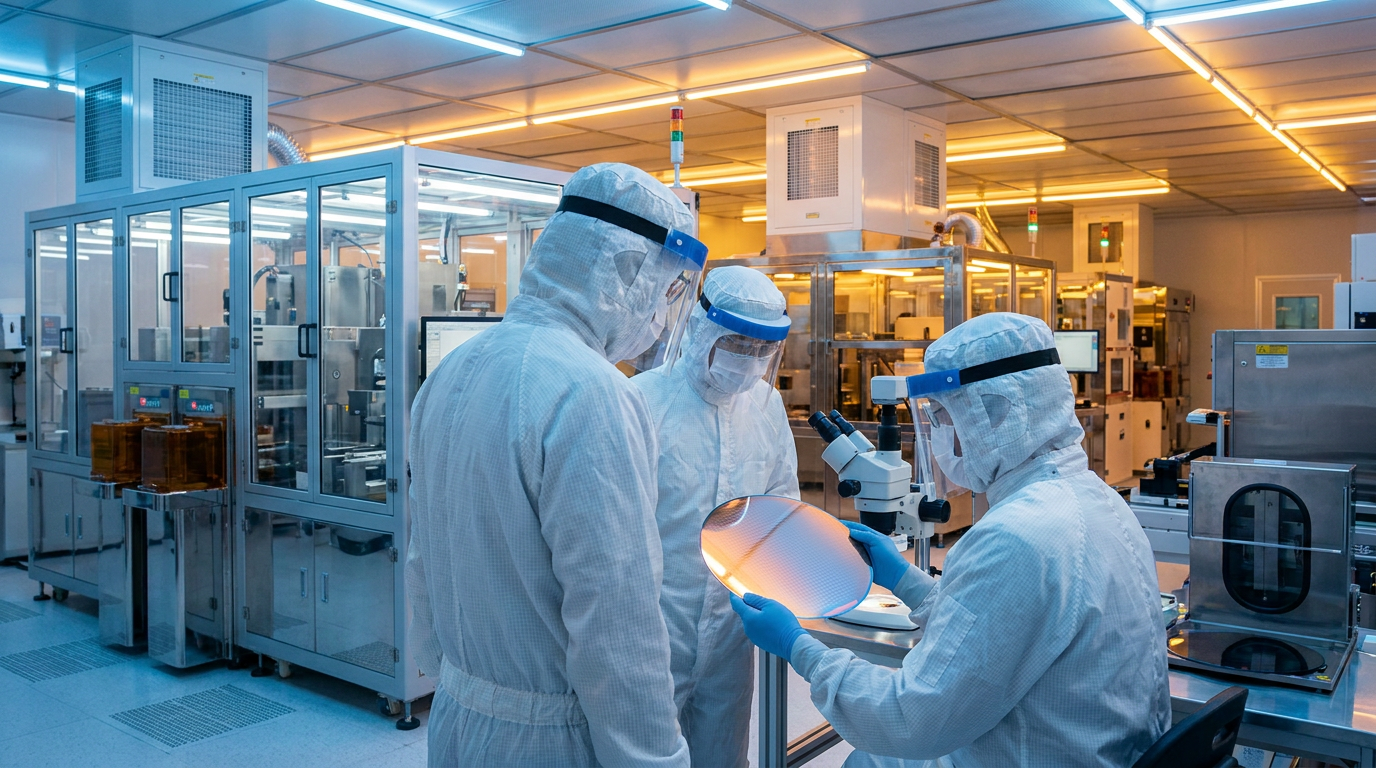
To understand the mechanics of this deal, it is essential to grasp the "foundry" model of semiconductor manufacturing. Historically, Intel designed and built its own chips in its own proprietary factories. Conversely, companies like Apple are "fabless"—they design the architecture of their custom processors, such as the M-series and A-series, but contract third-party foundries to actually fabricate the physical silicon wafers.[1]

For years, the undisputed king of the foundry business has been Taiwan Semiconductor Manufacturing Company, universally known as TSMC. Apple has long been TSMC's largest and most important client, utilizing the Taiwanese firm's cutting-edge fabrication nodes to maintain a strict performance and efficiency edge over its smartphone and computing rivals.[1][3]
However, the recent artificial intelligence boom has fundamentally altered the supply-and-demand calculus at TSMC. The foundry's advanced production lines are currently under immense strain, overwhelmed by massive, high-margin orders from AI hardware giants like Nvidia and Advanced Micro Devices.[1][6]
This AI-driven capacity squeeze has left Apple increasingly vulnerable. As the Cupertino company prepares for a multi-year hardware cycle focused heavily on on-device artificial intelligence, it requires guaranteed, uninterrupted access to silicon. Relying solely on a single, overburdened supplier in a geopolitically sensitive region is no longer a viable long-term strategy for a company of Apple's scale.[5]
This AI-driven capacity squeeze has left Apple increasingly vulnerable.
Enter Intel. Under the leadership of CEO Lip-Bu Tan, who took the helm after the ouster of Pat Gelsinger, Intel has aggressively pivoted to open its manufacturing facilities to outside customers. This "Intel Foundry" initiative aims to compete directly with TSMC by offering stateside production for fabless tech giants, effectively decoupling American innovation from Asian manufacturing bottlenecks.[1]
Securing Apple's business provides Intel with exactly what its foundries need: massive, reliable volume. Manufacturing semiconductors is a game of extreme scale; running multi-billion-dollar factories at full capacity is required to offset their staggering construction costs. An Apple contract guarantees steady demand, helping Intel refine its manufacturing yields and prove its viability to other potential clients.[2]
The partnership is also deeply intertwined with federal industrial policy. In August 2025, the U.S. government made an unprecedented $8.9 billion investment in Intel common stock, securing a 9.9% equity stake to directly subsidize the construction of domestic fabrication plants and ensure national security in the tech sector.[1][2]
President Trump highlighted the financial return on this intervention, noting that Intel's market valuation has skyrocketed from approximately $100 billion at the time of the government's investment to over $600 billion today. This dramatic growth places the value of the American taxpayers' stake at more than $60 billion, a figure the administration is eager to tout as a policy triumph.[1][4]

The Apple-Intel alliance is part of a broader White House strategy to revitalize American silicon dominance. The administration has recently championed similar domestic production arrangements, including Intel partnerships with Nvidia and Elon Musk's "Terafab" semiconductor project, framing them as essential steps toward technological independence.[1][6]
Despite the optimism, significant uncertainties remain regarding the exact scope of the Apple-Intel collaboration. Industry analysts caution that Intel is unlikely to immediately manufacture Apple's most advanced, flagship processors—the complex chips that power the newest iPhone Pro models or high-end MacBook Pros.[3][5]
Instead, the initial phases of the partnership will likely focus on mature or lower-end silicon. Intel could begin by producing the processors used in select iPads, entry-level Macs, or peripheral components. This phased approach would allow the two companies to test the waters and ensure Intel's manufacturing yields can meet Apple's notoriously strict quality standards without risking flagship product launches.[3]

Intel has recently touted the initial risk production of its "18A" manufacturing process node, a next-generation technology designed to finally close the performance gap with TSMC. Whether Apple's designs will utilize this specific advanced node or rely on older, more established processes remains a key question for industry watchers.[7]
Ultimately, TSMC is expected to remain Apple's primary global manufacturer for the foreseeable future. However, establishing Intel as a secondary, domestic option provides Apple with crucial leverage in pricing negotiations, vital supply chain redundancy, and a necessary buffer against the insatiable global appetite for AI infrastructure.[1][5]
How we got here
August 2025
The U.S. government invests $8.9 billion for a 9.9% equity stake in Intel to boost domestic production.
April 2026
Intel secures Tesla as a major customer for its upcoming 14A manufacturing process.
May 2026
The Wall Street Journal reports preliminary discussions between Apple and Intel regarding domestic chip manufacturing.
June 18, 2026
President Trump announces the Apple-Intel partnership, sending Intel shares up over 10%.
Viewpoints in depth
Supply Chain Analysts
Focuses on Apple's strategic need for manufacturing redundancy.
Analysts view this partnership primarily through the lens of risk mitigation. With TSMC's advanced nodes heavily booked by AI accelerators from Nvidia and AMD, Apple faces genuine capacity constraints for its upcoming AI-driven hardware cycle. By qualifying Intel as a secondary foundry, Apple gains leverage in pricing negotiations with TSMC and ensures a steady supply of silicon even if geopolitical tensions or demand spikes disrupt Asian supply lines.
Domestic Manufacturing Advocates
Views the deal as a triumph for U.S. industrial policy.
Proponents of federal intervention in the semiconductor industry see the Apple-Intel alliance as the ultimate validation of the government's $8.9 billion investment in Intel. By bringing the world's most valuable consumer electronics company into an American foundry, the U.S. reduces its critical reliance on Taiwan and proves that domestic facilities can compete at the highest levels of advanced manufacturing.
Market Skeptics
Questions Intel's ability to meet Apple's stringent quality and yield requirements.
Despite the soaring stock price, some industry watchers remain cautious. Intel's foundry business is still in its turnaround phase under CEO Lip-Bu Tan, and the company has historically struggled with production delays. Skeptics note that Apple is likely to only entrust Intel with mature, lower-end chips initially, keeping its flagship iPhone and Mac processors at TSMC until Intel can definitively prove its next-generation 18A process node is flawless at scale.
What we don't know
- Which specific Apple devices will be the first to feature Intel-manufactured chips.
- Whether Apple will utilize Intel's cutting-edge 18A process node or stick to older, proven technologies.
- The exact timeline for when the first Intel-made Apple chips will roll off the assembly line.
Key terms
- Foundry
- A semiconductor manufacturing plant that builds chips designed by other companies, rather than designing its own.
- Fabless
- A company that designs its own microchips but outsources the actual physical manufacturing to a third-party foundry.
- Process Node
- A specific generation of semiconductor manufacturing technology, often measured in nanometers, dictating how small and efficient the transistors on a chip can be.
- Silicon Wafer
- A thin slice of semiconductor material used as the base for fabricating integrated circuits and microchips.
Frequently asked
Is Apple completely leaving TSMC?
No. Industry analysts expect TSMC to remain Apple's primary manufacturer for its most advanced flagship chips, with Intel serving as a secondary domestic supplier.
Which Apple devices will use Intel-made chips?
While not officially confirmed, reports suggest Intel will initially manufacture lower-end processors, potentially for select iPad models or entry-level Macs, rather than the flagship iPhone Pro chips.
Why does the U.S. government own a stake in Intel?
In August 2025, the federal government invested $8.9 billion in Intel common stock to subsidize the construction of domestic semiconductor factories and reduce reliance on overseas supply chains.
Sources
Source coverage
7 outlets
3 viewpoints surfaced







[1]BloombergDomestic Manufacturing Advocates
Trump Says Apple Will Manufacture Chips in US With Intel
Read on Bloomberg →[2]ReutersMarket Investors
Trump says Apple to partner with Intel on US chip design, production
Read on Reuters →[3]MacRumorsSupply Chain Analysts
Apple to Make Chips in US With Intel, Trump Says
Read on MacRumors →[4]CBS NewsDomestic Manufacturing Advocates
Intel shares leap after Trump says it's working with Apple to make chips in the U.S.
Read on CBS News →[5]Wedbush SecuritiesSupply Chain Analysts
Apple expanding US supply chain with Intel to offset memory pressure
Read on Wedbush Securities →[6]GSMArenaDomestic Manufacturing Advocates
Trump says Intel and Apple will produce chips domestically
Read on GSMArena →[7]Simply Wall StMarket Investors
Intel (INTC) Lands Apple As A U.S. Chip Manufacturing Partner
Read on Simply Wall St →
Every angle. Every day.
Get technology stories with full source coverage and perspective breakdowns delivered to your inbox.