
AI Decodes 'Phonetic Alphabet' of Sperm Whales, Challenging Human Uniqueness in Language
Using advanced machine learning, scientists have identified a complex, combinatorial phonetic alphabet in sperm whale communication. The breakthrough paves the way for potential two-way communication and raises profound legal questions about animal rights.
By Factlen Editorial Team
- Scientific & Linguistic Researchers
- View this breakthrough as a paradigm shift that proves complex, combinatorial language is not uniquely human.
- Legal & Animal Rights Advocates
- Argue that demonstrable language capabilities should grant whales legal personhood and enforceable habitat rights.
- Maritime & Commercial Sector
- Concerned with the logistical and financial implications of operating in waters where marine life holds legal standing.
What's not represented
- · Indigenous coastal communities
- · Commercial fishing operators
Why this matters
Decoding animal communication shatters the long-held scientific belief that complex language is unique to humans. Beyond biology, this AI breakthrough could force a radical rethinking of maritime law, environmental protections, and the legal rights of conscious, communicating species.
Key points
- Machine learning algorithms have identified 156 distinct acoustic patterns in sperm whale clicks, forming a 'phonetic alphabet.'
- Researchers discovered whales actively modulate rhythm, tempo, and ornamentation to convey context-specific meaning.
- The findings challenge the long-held linguistic consensus that combinatorial language is a uniquely human trait.
- Advanced non-invasive bio-loggers and drones were deployed to capture high-fidelity audio without disturbing the whales.
- Legal scholars are preparing frameworks to grant legal personhood and habitat rights to species capable of demonstrable language.
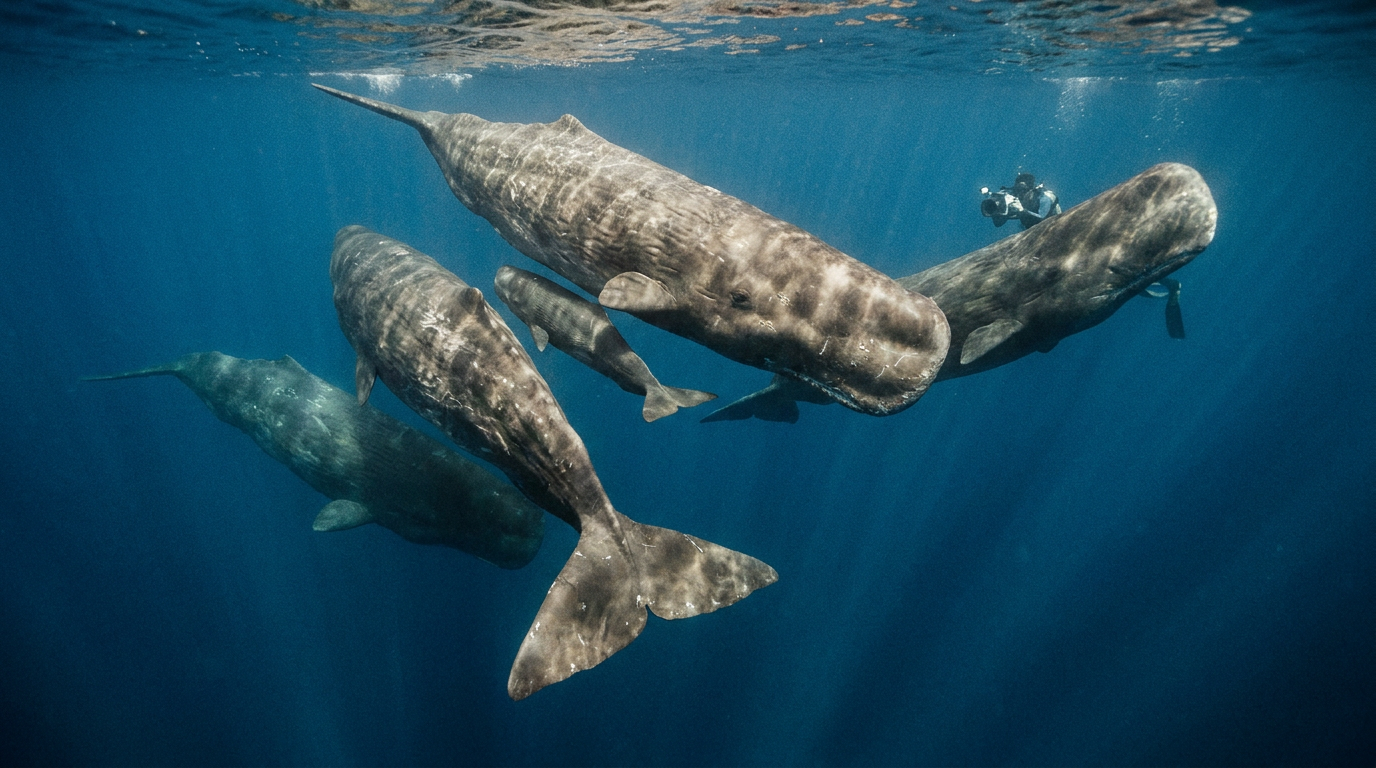
Humanity is standing on the precipice of its first genuine conversation with another species. Using advanced machine learning algorithms, an international team of marine biologists and computer scientists has successfully decoded a 'phonetic alphabet' used by sperm whales. The breakthrough reveals a communication system of staggering complexity, featuring distinct acoustic building blocks that whales combine and modulate to convey meaning. For centuries, the clicks and calls echoing through the deep ocean were a mystery, often dismissed as simple echolocation or basic social signaling. Now, artificial intelligence has peeled back the acoustic layers to expose a rich, combinatorial language, fundamentally altering our understanding of animal intelligence and our place in the natural world.[1][4]
The discovery, spearheaded by the Cetacean Translation Initiative (Project CETI) in collaboration with researchers at the Massachusetts Institute of Technology, strikes a fatal blow to a long-held scientific dogma. For decades, the prevailing consensus in linguistics—championed by foundational figures like Noam Chomsky—maintained that combinatorial language was a uniquely human evolutionary leap. The ability to take meaningless phonetic units and combine them into infinite meaningful sequences was considered the dividing line between human intellect and the rest of the animal kingdom. By proving that a species separated from humans by tens of millions of years of evolution developed a complex grammatical system, scientists are being forced to rewrite the textbooks on cognitive biology.[2][3]
Sperm whales, which possess the largest brains of any creature on Earth, spend much of their lives hunting in the pitch-black depths of the ocean where visual communication is impossible. To navigate and socialize, they rely entirely on sound, communicating through rapid-fire bursts of clicks known as 'codas.' These codas sound somewhat like a muffled underwater telegraph or a frantic Morse code transmission. While researchers have known about codas since the 1950s, the sheer volume and acoustic density of the data made it impossible for human analysts to detect the subtle grammatical rules governing the exchanges. The whales were clearly talking, but the structure of their speech remained entirely opaque.[3][4]
To break the deadlock, researchers turned to the same deep-learning architectures that power modern large language models. The team fed a massive dataset of nearly 9,000 recorded codas into pattern-recognition algorithms. These recordings were painstakingly collected over two decades by the Dominica Sperm Whale Project, which has tracked and recorded the matrilineal family units—or 'pods'—residing in the Eastern Caribbean. Because the AI models do not suffer from human auditory biases, they were able to detect micro-variations in the timing and frequency of the clicks that human ears simply blend together. The algorithms mapped the relationships between the sounds, searching for the statistical signatures of syntax.[1][4]
The sheer power of this technology was demonstrated when Project CETI researchers captured a rare, intimate event: the birth of a sperm whale calf. Using high-resolution drone footage synchronized with underwater acoustic arrays, the team recorded the pod assembling around the pregnant female. The AI software, dubbed 'Whale Tales,' analyzed the flurry of codas exchanged during the event. It revealed a highly coordinated social behavior, with the family unit actively communicating to collectively support the mother and carry the newborn calf to the surface for its first breath. This wasn't just noise; it was a family talking each other through a critical life event.[4]

The machine learning models yielded a stunning result: they identified 156 distinct codas that function as the fundamental building blocks of sperm whale communication. This 'sperm whale phonetic alphabet' operates much like human vowels and consonants. Rather than just repeating a single static call, the whales actively mix and match these 156 codas to construct complex phrases. The AI revealed that the whales manipulate four distinct acoustic variables to alter the meaning of their messages: rhythm, tempo, rubato, and ornamentation. This level of deliberate, context-sensitive modulation is unprecedented in the study of non-human communication.[1][2]
The machine learning models yielded a stunning result: they identified 156 distinct codas that function as the fundamental building blocks of sperm whale communication.
The most fascinating variables discovered by the AI are 'rubato' and 'ornamentation.' Borrowed from musical theory, rubato refers to the practice of smoothly varying the tempo of a sequence. The data showed that sperm whales will deliberately stretch or compress the duration of their codas depending on the conversational context, much like a human might draw out a word to emphasize a point or express emotion. Ornamentation involves the addition of extra, rapid-fire clicks at the very end of a standard coda. Researchers liken this to a suffix in human grammar, or a tonal inflection that changes a statement into a question. The whales use these ornaments systematically, proving the variations are intentional rather than accidental.[2][3]
Gathering the high-fidelity acoustic data required to train these AI models demanded a massive leap in marine robotics. Traditional underwater microphones, or hydrophones, capture a chaotic mix of ocean noise, making it difficult to isolate individual whale voices in a crowded pod. To solve this, engineers at Harvard University's John A. Paulson School of Engineering and Applied Sciences developed specialized 'bio-loggers.' These advanced listening devices are essentially underwater tricorders, designed specifically to capture clean, machine-learning-ready data. They record not just the audio of multiple whales talking simultaneously, but also the exact depth, temperature, and three-dimensional orientation of the whale at the moment it speaks.[6]
Deploying these bio-loggers without disrupting the whales' natural behavior was a critical ethical and logistical challenge. The Harvard robotics team designed clingfish-inspired suction cups that allow the devices to adhere gently to the whales' thick skin without causing pain or damage. Furthermore, Project CETI pioneered the use of 'tap-and-go' aerial drones to drop the tags onto the whales from above. This remote tagging method eliminates the need for researchers to approach the pods in loud, disruptive boats. By minimizing human interference, the team ensured that the AI was analyzing authentic, relaxed conversations between family members, rather than the whales' alarmed reactions to human presence.[6]

With the phonetic alphabet now decoded, the research team is rapidly advancing toward the ultimate milestone: two-way communication. Having mapped the basic syntax of the codas, scientists are preparing for a series of non-intrusive playback experiments scheduled for late 2026. Using underwater speakers, the team plans to broadcast specific, AI-generated coda sequences back to the whales and monitor their responses. The initial goal is not to debate philosophy, but to achieve basic, verifiable message exchange—such as transmitting a greeting, acknowledging a location, or identifying a specific family unit. If successful, it will mark the first time humanity has crossed the species barrier to engage in a structured dialogue.[4][5]
The implications of this breakthrough are sending shockwaves far beyond the marine biology community, straight into the corridors of international law. Legal scholars are already grappling with the profound consequences of sharing the planet with another species capable of demonstrable language. At New York University, the More-Than-Human Life (MOTH) Program has partnered with Project CETI to draft legal frameworks for a world where cetaceans possess recognized rights. Historically, the law has treated animals as property or resources, largely based on the premise that they lack the cognitive complexity and language required for legal personhood. The sperm whale phonetic alphabet shatters that legal justification.[5][7]
If whales are legally recognized as conscious, communicating entities with distinct cultures and dialects, advocates argue they must be granted enforceable rights to life and liberty. This is not merely an academic exercise; the Nonhuman Rights Project has already been fighting in courts to secure legal personhood for highly intelligent animals like elephants and chimpanzees. Armed with hard, AI-verified data proving that whales possess a complex language, lawyers could theoretically represent whale pods in international courts. They could use the whales' own translated codas as testimony to sue against commercial whaling, military sonar testing, or industrial pollution that disrupts their acoustic environment.[7]

The global maritime and commercial shipping industries are watching these developments with a mix of fascination and deep legal anxiety. The oceans are currently treated as a free-for-all transit zone, but the recognition of whale language could transform the regulatory landscape overnight. Trade analysts warn that if marine mammals gain legal standing, shipping companies could face massive liabilities for traversing known whale habitats. Future shipping routes might require acoustic monitoring and dynamic rerouting to avoid interrupting whale 'conversations' or cultural gatherings. Some legal theorists even suggest that vessels may one day need to negotiate 'acoustic consent' from resident pods before passing through their territories.[5]
Ultimately, the decoding of the sperm whale phonetic alphabet represents a profound shift in humanity's understanding of its place in the universe. For decades, we have pointed radio telescopes at the stars, desperately searching for a signal from an intelligent alien civilization. Yet, as the AI models have revealed, highly intelligent, communicating beings have been swimming alongside us in the dark oceans all along. By using our most advanced digital tools to listen to one of our oldest mammalian cousins, we are not just learning about whales; we are curing our own cosmic loneliness, discovering that the Earth has been speaking to us since the beginning.[4][7]
How we got here
2005
The Dominica Sperm Whale Project begins collecting thousands of hours of acoustic data from resident whale families.
2020
Project CETI is founded, bringing together marine biologists, AI researchers, and roboticists to decode whale communication.
May 2024
MIT and Project CETI publish findings in Nature Communications detailing the discovery of the sperm whale phonetic alphabet.
April 2025
NYU's MOTH Program publishes legal frameworks exploring the rights of animals capable of complex language.
Dec 2025
Harvard engineers successfully deploy advanced bio-loggers to capture context-rich acoustic data for machine learning models.
Late 2026
Researchers prepare for the first non-intrusive playback experiments to test two-way communication with wild sperm whales.
Viewpoints in depth
Scientific & Linguistic Researchers
A paradigm shift in how we define language and intelligence.
For decades, the prevailing consensus in linguistics—championed by figures like Noam Chomsky—held that the combinatorial structure of language was a uniquely human evolutionary leap. The discovery of the sperm whale phonetic alphabet shatters that assumption. Researchers emphasize that whales aren't just making random noises; they are actively modulating rhythm, tempo, and ornamentation to convey context-specific information. By proving that a species separated from humans by tens of millions of years of evolution developed a complex grammatical system, scientists argue we must fundamentally redefine our metrics for intelligence.
Legal & Animal Rights Advocates
Translating communication into enforceable legal rights.
Legal scholars view the AI breakthrough as the ultimate catalyst for the 'rights of nature' movement. If a species can demonstrably communicate, share cultural knowledge, and express preferences, advocates argue they meet the threshold for legal personhood. Initiatives like the NYU MOTH Program are preparing for a future where whales can be represented in court—using their own translated codas as testimony—to sue against noise pollution, commercial whaling, and shipping traffic that disrupts their communities.
Maritime & Commercial Sector
Navigating the logistical realities of 'interspecies consent.'
The shipping and commercial fishing industries are watching the rapid progress of Project CETI with a mix of fascination and legal anxiety. If whales gain recognized legal rights based on their communication abilities, the regulatory landscape of the oceans will transform overnight. Industry analysts warn that future shipping routes may require acoustic monitoring and dynamic rerouting to avoid interrupting whale 'conversations' or cultural gatherings, potentially adding billions in operational costs while forcing a more sustainable model of global trade.
What we don't know
- The exact semantic meaning of specific codas—whether they represent names, objects, or abstract concepts—remains untranslated.
- It is unclear how the whales will react to AI-generated playback experiments during upcoming two-way communication tests.
- How international courts will ultimately rule on legal personhood for communicating marine mammals is entirely untested.
Key terms
- Project CETI
- The Cetacean Translation Initiative, a multidisciplinary scientific effort using AI and robotics to decode the communication of sperm whales.
- Coda
- A distinct pattern of rhythmic clicks used by sperm whales to communicate and identify themselves.
- Combinatorial Language
- A communication system where basic meaningless units (like letters or sounds) are combined to create infinite meaningful sequences (like words and sentences).
- Rubato
- A musical term used by researchers to describe how whales smoothly vary the tempo of their clicks to alter meaning.
- Bio-logger
- A specialized, non-invasive sensor attached to a whale's skin to record high-fidelity audio, depth, and movement data.
Frequently asked
What is a sperm whale coda?
A coda is a short, rapid-fire burst of clicks that sperm whales use to communicate in the dark depths of the ocean.
How did AI help decode the language?
Machine learning algorithms analyzed nearly 9,000 recorded codas, identifying subtle patterns in rhythm and tempo that human ears and traditional software could not detect.
What does rubato mean in whale communication?
Borrowed from music, rubato refers to the whales smoothly stretching or compressing the duration of their clicks to change the context of their message.
Will humans be able to talk back to whales?
Researchers are currently planning non-intrusive playback experiments for late 2026, aiming to achieve basic two-way exchanges like greetings or location sharing.
How could this affect maritime law?
If whales are proven to have complex language, legal scholars argue they could be granted legal personhood, allowing them to be represented in court to protect their habitats.
Sources
Source coverage
7 outlets
3 viewpoints surfaced







[1]ZDNetScientific & Linguistic Researchers
AI discovers sperm whale language is much more complex than previously believed
Read on ZDNet →[2]MIT NewsScientific & Linguistic Researchers
MIT CSAIL and Project CETI researchers reveal complex communication patterns in sperm whales
Read on MIT News →[3]Nature CommunicationsScientific & Linguistic Researchers
Contextual and Combinatorial Structure in Sperm Whale Vocalisations
Read on Nature Communications →[4]Project CETIScientific & Linguistic Researchers
The Discovery of the Whale Phonetic Alphabet Using AI
Read on Project CETI →[5]Maritime InnovationsMaritime & Commercial Sector
The Race to First Contact: AI and Marine Mammal Communication
Read on Maritime Innovations →[6]AstrobiologyScientific & Linguistic Researchers
SETI/CETI Tricorder Tech: Tapping Into Whale Talk
Read on Astrobiology →[7]NYU MOTH ProgramLegal & Animal Rights Advocates
The Legal Impact of AI-assisted Studies of Animal Communication
Read on NYU MOTH Program →

More in ai
See all 7 stories →On-Device AI
The Rise of Small Language Models: How AI is Moving from the Cloud to Your Pocket
8 sources

AI Provenance
The Global Standardization of AI Watermarking: Evidence from 2026 Policy Implementation
7 sources

Medical AI
AI Medical Assistants Match or Surpass Human Doctors in Diagnostic Accuracy, Landmark Studies Show
6 sources

Oculomics
How AI Retinal Scans Are Predicting Heart Disease and Dementia
7 sources
Every angle. Every day.
Get ai stories with full source coverage and perspective breakdowns delivered to your inbox.