
The Biomechanics of Speed: How Swimmers Are Hacking Fluid Dynamics
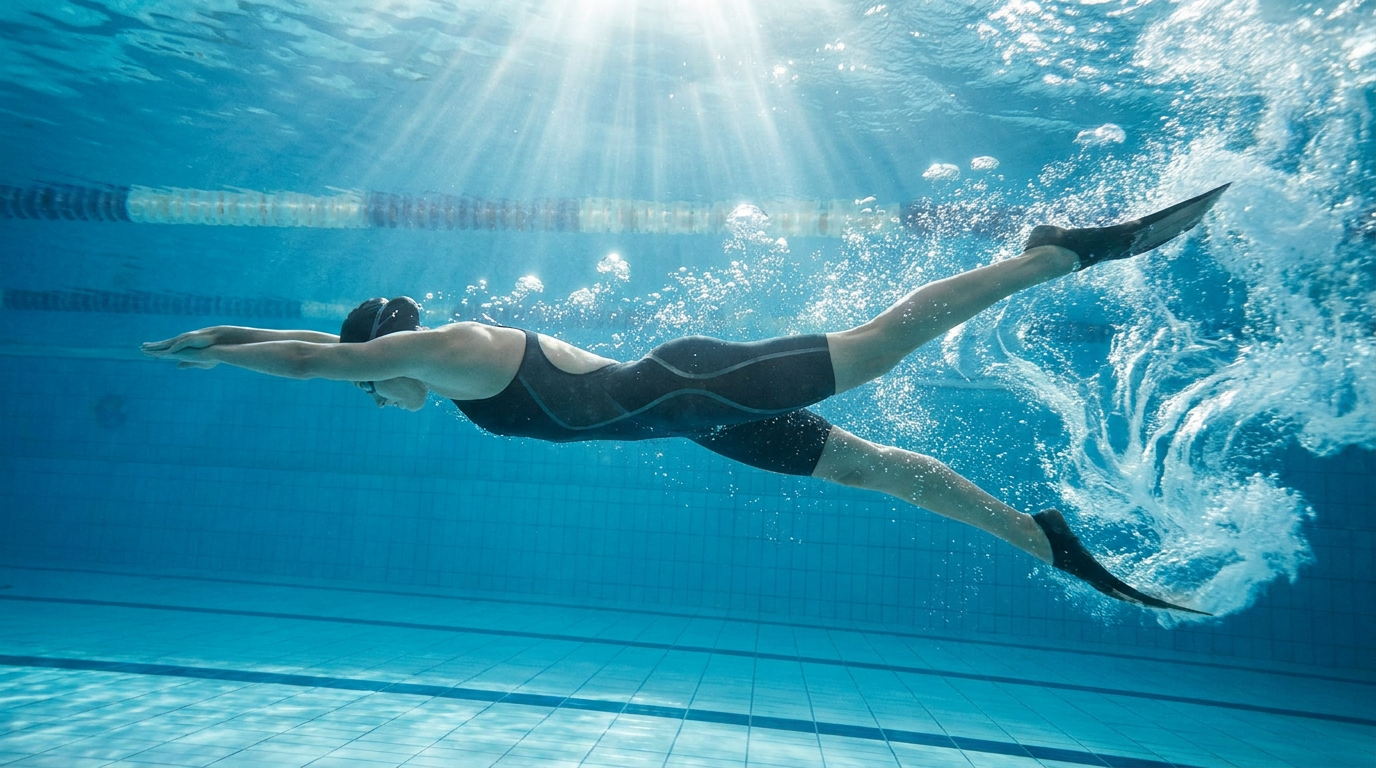
Elite swimmers are shattering records by mastering the "fifth stroke"—an underwater dolphin kick that manipulates fluid dynamics to achieve speeds impossible on the surface.
By Factlen Editorial Team
- Biomechanists & Fluid Dynamicists
- Focusing on computational models, vortex rings, and maximizing propulsive efficiency through physics.
- Elite Coaches & Athletes
- Prioritizing practical execution, core strength, ankle flexibility, and race strategy within the 15-meter rule.
- Sports Technologists
- Leveraging wearable IMU sensors to provide objective, real-time kinematic data to replace subjective visual coaching.
What's not represented
- · Recreational Swimmers
- · Swimming Regulatory Bodies
Why this matters
Understanding the physics of underwater swimming reveals how modern athletes are shattering world records not just through raw strength, but by mastering fluid dynamics and wearable technology. For recreational swimmers and fans, it demystifies the hidden, submerged phase that dictates the outcome of nearly every Olympic race.
Key points
- The underwater dolphin kick, known as the "fifth stroke," is the fastest phase of any swimming race, reaching speeds of 10-12 mph.
- Swimming at least 0.5 meters below the surface eliminates wave drag, allowing athletes to move faster than they can at surface race pace.
- Elite swimmers generate powerful 3D vortex rings with their feet, recycling water flow from the downward kick to boost propulsion.
- Human propulsive efficiency during the dolphin kick is roughly 21%, compared to 56% for actual dolphins.
- Wearable Inertial Measurement Units (IMUs) are revolutionizing training by providing real-time data on a swimmer's acceleration and drag.
The fastest part of a swimming race does not happen on the surface of the pool; it happens in the silent, submerged glide immediately following a dive or a turn. When an elite swimmer pushes off the wall, they are traveling at roughly 10 to 12 miles per hour—significantly faster than they can swim at race pace in any traditional surface stroke.[2]
This submerged phase is so critical to modern competitive swimming that coaches and athletes universally refer to it as the "fifth stroke." Officially known as undulatory underwater swimming (UUS), the dolphin kick has become the great equalizer in the pool, allowing technically proficient athletes to outpace physically larger, stronger competitors by manipulating the physics of the water around them.[2][5][6]
In short-course racing, which takes place in 25-yard or 25-meter pools, the underwater phase can account for up to 60 percent of the total race distance. Because of the immense speed advantage it provides, swimming's global governing bodies strictly cap the underwater phase at 15 meters per length to prevent races from becoming entirely submerged breath-holding contests.[5][9]
The reason the fifth stroke is so blindingly fast comes down to the physics of water resistance. Water is nearly 800 times denser than air, creating massive drag on the human body. When an athlete swims on the surface, they are fighting surface tension and actively creating waves, which act as a hydrodynamic parachute that bleeds their momentum.[5][9]

By staying entirely submerged in a tight, streamlined position, swimmers completely eliminate surface wave drag. Hydrodynamic studies verify that wave drag becomes negligible when a swimmer maintains a gliding depth of at least 0.5 to 0.75 meters below the surface. Any closer to the surface, and the violent interaction between the limbs and the water surface offsets the propulsive force generated by the kick.[5][6]
But simply hiding from surface drag is only half the equation; the other half is generating forward thrust. The dolphin kick is not a simple bending of the knees, which coaches liken to pedaling a bicycle underwater. Instead, it is a complex, full-body wave that must start from the sternum, ripple down through the hips, and snap violently at the ankles.[5]
Biomechanical models, such as the SWimming hUman Model (SWUM), have demonstrated that the feet generate the vast majority of the forward thrust during this undulatory motion. Furthermore, researchers have found a stark asymmetry in the movement: the downward extension kick produces a much larger propulsive thrust than the upward flexion recovery kick.[1][4]
To understand exactly how this thrust is created, scientists have turned to computational fluid dynamics (CFD) and particle image velocimetry—techniques traditionally used in aerospace engineering to study airflow over wings. By visualizing the colorless water flow, researchers discovered that elite swimmers generate a powerful three-dimensional vortex ring during the kicking action.[4][7]
By visualizing the colorless water flow, researchers discovered that elite swimmers generate a powerful three-dimensional vortex ring during the kicking action.
As the swimming speed increases, athletes actually recycle the water flow generated during the downward kick phase, carrying that kinetic energy into the transition of the upward kick. This fluid recycling effect becomes more pronounced at higher velocities, allowing the swimmer to maximize water-flow utilization and maintain their momentum off the wall.[7]
Despite these incredible biomechanical adaptations, humans are still relatively inefficient aquatic creatures. Direct calculations of work and power using CFD show that an Olympic-level swimmer expends about 424 watts of power during a single stroke cycle.[8]
The mean propulsive efficiency of a human performing the underwater dolphin kick is roughly 21 percent. While this is exceptionally high for human swimming—largely due to the absence of wave drag—it pales in comparison to actual marine mammals. A real dolphin achieves a propulsive efficiency of around 56 percent, benefiting from a highly articulated spine and a specialized tail fluke.[8]

Because the margins of victory in Olympic swimming are measured in hundredths of a second, optimizing that 21 percent efficiency has sparked a technological arms race. For decades, coaches relied on the "coach's eye" and underwater video analysis to correct a swimmer's form, but video requires immense computational effort to digitize and introduces a delay in providing quantitative feedback.[3][9]
Today, the sport is being revolutionized by wearable technology, specifically miniaturized Inertial Measurement Units (IMUs). These sensors pack triaxial accelerometers, gyroscopes, and magnetometers into a device small enough to be worn on the lower back or head without increasing drag resistance or altering the swimmer's natural biomechanics.[3]
IMUs provide a comprehensive set of kinematic variables in real-time, including 3D acceleration, angular velocity, and stroke rate. This allows sports technologists to measure a swimmer's intra-cycle velocity variation—the minute accelerations and decelerations that occur within a single kick cycle that are entirely invisible from the pool deck.[3]

By analyzing this continuous stream of data, coaches can pinpoint exactly where an athlete is losing speed. For example, a common error is lifting the head to look forward toward the wall, which immediately drops the hips, breaks the streamline, and creates a massive wall of drag. Wearable sensors can detect this postural break instantly, allowing for immediate correction.[5][9]
The integration of biomechanics, fluid dynamics, and wearable tech has transformed the underwater dolphin kick from an intuitive art into a precise science. Swimmers are now training their core strength and ankle flexibility specifically to manipulate the vortex rings they leave behind in the pool, turning their bodies into highly engineered hydrofoils.[5][7][9]

As technology continues to shrink and computational models become more sophisticated, the understanding of aquatic human propulsion will only deepen. The athletes who master the physics of the fifth stroke will be the ones who surface ahead of the competition, carrying blinding speed into their breakout and holding that lead to the wall.[5][9]
How we got here
1988
David Berkoff swims over 30 meters underwater in the Olympic 100m backstroke, prompting the introduction of distance limits.
1996
The 15-meter underwater limit is officially applied to butterfly and freestyle events by swimming's governing body.
2009
Researchers publish direct computational fluid dynamics (CFD) estimates of human propulsive efficiency during the dolphin kick.
2024
Advancements in particle image velocimetry allow scientists to visualize the 3D vortex rings generated by elite swimmers in real-time.
Viewpoints in depth
Biomechanists & Fluid Dynamicists
Focusing on the mathematical limits of human propulsion and fluid dynamics.
For researchers modeling human movement, the pool is a giant fluid dynamics laboratory. By using computational fluid dynamics (CFD) and particle image velocimetry, they treat the swimmer's body as a deformable object interacting with a high-drag environment. Their models reveal that the human body is inherently inefficient in water compared to marine mammals, but by manipulating 3D vortex rings and recycling the kinetic energy of the downward kick, athletes can artificially boost their propulsive efficiency. Their ultimate goal is to find the mathematical optimum for kick frequency and amplitude for any given body type.
Elite Coaches & Athletes
Prioritizing practical execution, core strength, and race strategy within the rules.
While scientists focus on the math, coaches and athletes focus on the physical toll of executing the 'fifth stroke' under extreme oxygen debt. For them, the underwater phase is a strategic weapon used to bypass the surface wave drag that exhausts competitors. Training focuses heavily on core strength, ankle flexibility, and breath control, ensuring the athlete can maintain a tight streamline for the maximum legal distance of 15 meters. They view the underwater phase as the great equalizer, where technical perfection can overcome a deficit in raw physical size.
Sports Technologists
Leveraging wearable sensors to provide objective, real-time kinematic data.
Technologists are working to eliminate the guesswork of the 'coach's eye' by bringing aerospace-grade sensors into the pool. By attaching miniaturized Inertial Measurement Units (IMUs) to swimmers, they can capture micro-fluctuations in speed, acceleration, and angular velocity that are invisible from the pool deck. This data allows them to instantly identify when a swimmer breaks their streamline or loses momentum, transforming subjective technique corrections into precise, data-driven adjustments that shave crucial hundredths of a second off lap times.
What we don't know
- The exact mathematical optimum for kick frequency and amplitude across different individual body types remains a subject of ongoing computational research.
- It is unclear how much further human ankle flexibility can be pushed before reaching anatomical limits that prevent further gains in propulsive efficiency.
- The long-term impact of highly specialized underwater training on the spinal health of young athletes is still being studied by sports medicine professionals.
Key terms
- Underwater Dolphin Kick (UUS)
- An undulatory, full-body wave motion used by swimmers while submerged to maximize speed off starts and turns.
- Wave Drag
- The resistance caused by a swimmer moving along the surface of the water and creating waves, which acts as a hydrodynamic parachute.
- Computational Fluid Dynamics (CFD)
- The use of applied mathematics and computer software to model and analyze how fluids flow around objects, such as a swimmer's body.
- Inertial Measurement Unit (IMU)
- A wearable electronic device that uses accelerometers and gyroscopes to measure a swimmer's specific force, angular rate, and velocity.
- Propulsive Efficiency
- The ratio of the useful mechanical power delivered to move the swimmer forward versus the total mechanical power expended during the stroke.
Frequently asked
What is the "fifth stroke" in swimming?
The "fifth stroke" refers to the underwater dolphin kick, an undulatory, full-body wave motion used by swimmers off starts and turns to maximize speed before surfacing.
Why is swimming underwater faster than on the surface?
Swimming at least 0.5 meters underwater eliminates surface wave drag. Without the resistance of breaking the surface tension and creating waves, a streamlined swimmer can move significantly faster.
How far can swimmers go underwater in a race?
To prevent races from becoming entirely submerged breath-holding contests, global swimming rules strictly cap the underwater phase at 15 meters per length for backstroke, butterfly, and freestyle events.
How are wearables used in swimming?
Swimmers wear miniaturized Inertial Measurement Units (IMUs) that track acceleration and angular velocity in real-time, allowing coaches to analyze stroke efficiency and pinpoint exactly where speed is lost.
Sources
Source coverage
9 outlets
3 viewpoints surfaced









[1]Biomechanics and Medicine in SwimmingBiomechanists & Fluid Dynamicists
Estimation of thrusts generated by each body part during underwater dolphin kick using SWUM
Read on Biomechanics and Medicine in Swimming →[2]Swim Like A FishElite Coaches & Athletes
All About Turns: How to Transition Faster in Every Stroke
Read on Swim Like A Fish →[3]PubMed CentralSports Technologists
Wearables in Swimming for Real-Time Feedback: A Systematic Review
Read on PubMed Central →[4]Sports BiomechanicsBiomechanists & Fluid Dynamicists
A computational method for analysis of underwater dolphin kick hydrodynamics in human swimming
Read on Sports Biomechanics →[5]Athletes UntappedElite Coaches & Athletes
Swimming Underwater Technique: How to Maximize Speed
Read on Athletes Untapped →[6]MDPIBiomechanists & Fluid Dynamicists
Hydrodynamic Characteristics of Different Undulatory Underwater Swimming Positions
Read on MDPI →[7]EurekAlert!Biomechanists & Fluid Dynamicists
Dolphin-kick swimming maximizes water-flow utilization with increasing speed
Read on EurekAlert! →[8]Journal of Biomechanical EngineeringBiomechanists & Fluid Dynamicists
Propulsive Efficiency of the Underwater Dolphin Kick in Humans
Read on Journal of Biomechanical Engineering →[9]Factlen Editorial TeamSports Technologists
Synthesis by Factlen editorial team
Read on Factlen Editorial Team →

More in sports
See all 5 stories →Knicks Championship
Millions Pack NYC's Canyon of Heroes for Knicks' First Championship Parade in 53 Years
6 sources

WTA Tour
Donna Vekic Completes 'Lucky Loser' Cinderella Run to Win Queen's Club Title
6 sources

AI Officiating
Tennis Bids Final Farewell to Line Judges as AI Officiating Takes Over the 2026 Grass Season
7 sources

Every angle. Every day.
Get sports stories with full source coverage and perspective breakdowns delivered to your inbox.