
AI-Guided Robots Are Now Tracking and Translating Sperm Whale Conversations in Real Time
Using autonomous underwater gliders and advanced machine learning, scientists are continuously tracking sperm whales by listening to their vocalizations, marking a major leap toward decoding animal communication.
By Factlen Editorial Team
- Marine Biologists & Project CETI
- Focused on understanding animal communication, social complexity, and marine conservation.
- AI & Machine Learning Researchers
- Focused on the technical challenge of translating non-human data and bridging the 'massive domain gap'.
- Conservationists & Ethicists
- Focused on the implications of animal sentience and the ethical boundaries of interactive experiments.
What's not represented
- · Commercial Shipping Operators
- · Indigenous Coastal Communities
Why this matters
Decoding the complex communication of another species fundamentally shifts our understanding of intelligence on Earth. Beyond the philosophical implications, this AI technology offers immediate tools to protect marine ecosystems by dynamically rerouting ships away from active whale habitats.
Key points
- Project CETI has deployed autonomous underwater gliders equipped with AI to track sperm whales in real time.
- The robots use onboard machine learning to isolate whale clicks from ocean noise and automatically steer toward the pods.
- A new AI model called WhAM is being used to predict and translate the sequences of whale vocalizations, known as codas.
- Recent studies utilizing this technology documented the first quantitative evidence of cooperative birth assistance among non-primates.
- The data will be used to inform dynamic conservation policies, such as rerouting shipping traffic away from active whale habitats.
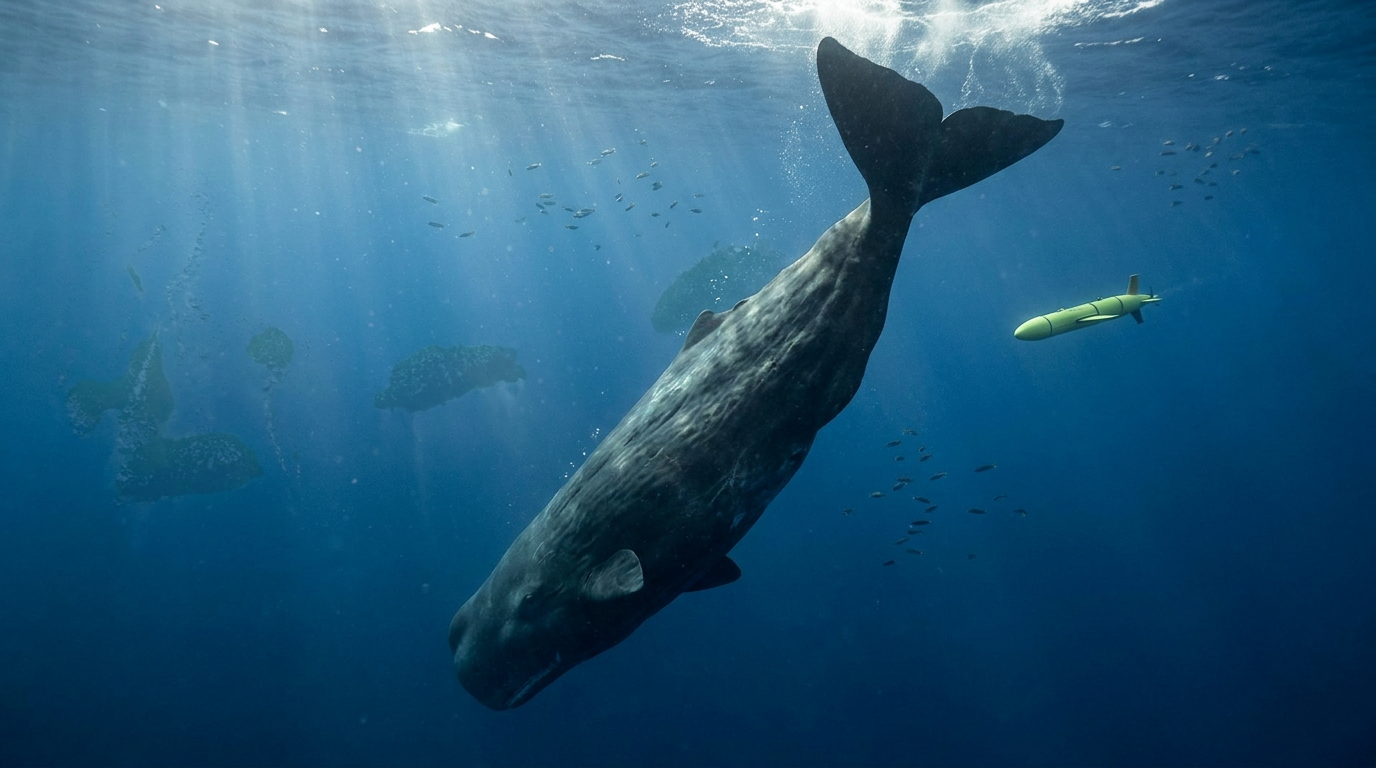
The ocean is no longer silent to artificial intelligence. Deep off the coast of the Caribbean island of Dominica, autonomous underwater gliders are currently tracking sperm whales not by sight, but by listening to their conversations in real time.[1]
For decades, marine biologists knew that sperm whales communicated using rhythmic bursts of clicks known as "codas." However, continuous observation of these highly social mammals was nearly impossible. Sperm whales routinely dive to depths exceeding 1.6 kilometers, remaining submerged in total darkness for up to 50 minutes at a time before briefly surfacing.[1][2][3]
In May 2026, Project CETI (Cetacean Translation Initiative) announced a major breakthrough: the successful deployment of AI-guided robotic gliders that can identify specific whale voices and autonomously steer themselves to follow the animals for months at a time. The technology marks a shift from brief, opportunistic encounters to continuous, sustained observation of marine life.[1][8]

The gliders operate using a "backseat driver" software system. Four onboard hydrophones capture ambient ocean audio, while embedded machine learning models instantly isolate the distinctive codas from the noise of waves and distant ships. The software calculates the origin of the vocalizations and automatically directs the glider's navigation system to change course and follow the pod.[1]
This real-time tracking is paired with a new generative AI model called WhAM (Whale Acoustics Model). Built by theoretical computer scientists and marine biologists, WhAM does not just record the clicks; it predicts the sequence of codas that will follow. The system treats the vocalizations with the same architectural approach used for human language translation, identifying patterns that were previously invisible to human analysts.[3][7]
The deployment of these AI tools follows a series of landmark discoveries published earlier in the spring. In March 2026, researchers detailed a "phonetic alphabet" in whale communication, revealing that the animals use vowel and diphthong-like spectral patterns. The structure of these codas shows close parallels to the phonetics and phonology of human languages, suggesting an independent evolution of complex speech.[2][4]

The deployment of these AI tools follows a series of landmark discoveries published earlier in the spring.
The technology has already yielded unprecedented biological insights into the lives of the ocean's largest predators. Using high-resolution drone footage, computer vision, and multiscale network analysis, Project CETI captured the first quantitative evidence of cooperative birth assistance among non-primates.[4][5]
The AI-assisted analysis documented female sperm whales from two unrelated family units coming together to support a laboring mother and her newborn calf. Researchers observed coordinated lifting and caregiving behaviors, demonstrating a level of social complexity and cooperation dating back more than 36 million years.[4][6]
Despite these rapid advancements, AI researchers emphasize that translating whale codas presents a unique hurdle known as the "massive domain gap." Unlike translating French to English—where human experiences of the physical world heavily overlap—mapping whale concepts requires the AI to infer meaning from an entirely alien, aquatic environment.[3][7]
Project CETI has set an ambitious goal: to comprehend 20 distinct vocalized expressions—such as commands for diving, hunting, or sleeping—within the next five years. While the current models are focused on listening and pattern recognition, the team hopes to eventually achieve a basic level of two-way communication.[2][8]

As the AI models become more sophisticated, the scientific community is carefully weighing the ethics of "playback" experiments. Broadcasting AI-generated codas back to the whales is ethically fraught, as past acoustic experiments in animal behavior have sometimes caused distress, prompting whales to fall silent or alter their natural migration patterns.[3]
Beyond the philosophical implications of interspecies translation, the real-time AI tracking offers immediate conservation benefits. By continuously mapping how whales respond to human-made noise, the data can inform dynamic, evidence-based policy decisions.[1]
This could include implementing temporary fishing restrictions, rerouting commercial shipping traffic, or mandating speed reductions when gliders detect a socializing pod nearby. As artificial intelligence continues to decode the deep ocean, the gap between human and cetacean intelligence may prove narrower than ever imagined, offering a powerful new tool to protect one of the planet's most enigmatic species.[1][8]
How we got here
1957
Scientists first identify that sperm whales vocalize using rhythmic clicks.
July 2023
Researchers capture rare audio and drone footage of a cooperative sperm whale birth off the coast of Dominica.
January 2026
The Whale Acoustics Model (WhAM) is introduced, demonstrating the ability to predict sperm whale click sequences.
March 2026
Landmark studies are published detailing a "phonetic alphabet" in whale communication and evidence of non-kin cooperative care.
May 2026
Project CETI announces the successful deployment of AI-guided gliders that track whale conversations in real time.
Viewpoints in depth
Marine Biologists & Project CETI
Focused on understanding animal communication, social complexity, and marine conservation.
For marine biologists, the integration of AI is a paradigm shift that solves the historical impossibility of continuous deep-ocean observation. By tracking whales for months rather than minutes, researchers can study how calves learn vocal patterns from their mothers and document rare events like cooperative births. Their ultimate goal is to prove that cetaceans possess rich, communal, and cultural lives that demand rigorous environmental protection.
AI & Machine Learning Researchers
Focused on the technical challenge of translating non-human data and bridging the 'massive domain gap'.
Computer scientists view whale communication as the ultimate test for generative AI. Unlike human languages, which share a common grounding in terrestrial life, whale codas represent an alien dataset. Researchers are building models like WhAM to find structural patterns in the noise, theorizing that the sheer complexity of sperm whale communication actually plays to machine learning's strengths by providing enough data points to map an entirely new linguistic architecture.
Conservationists & Ethicists
Focused on the implications of animal sentience and the ethical boundaries of interactive experiments.
While celebrating the conservation benefits of real-time tracking—such as rerouting ships to prevent strikes—ethicists urge caution regarding the next phase of research. They warn that 'playback' experiments, where AI-generated codas are broadcast back to the whales, carry significant risks of causing distress or disrupting natural social structures. This camp advocates for using the technology strictly for passive listening and habitat protection rather than forcing interspecies conversation.
What we don't know
- Whether the AI models will eventually be able to facilitate a genuine, two-way interactive conversation with the whales.
- How sperm whales will react long-term to the continuous presence of autonomous tracking gliders in their environment.
- The exact meaning of the majority of the "phonetic alphabet" patterns identified by the machine learning algorithms.
Key terms
- Coda
- A patterned sequence of broadband clicks used by sperm whales for social communication and identification.
- Hydrophone
- An underwater microphone designed to detect and record acoustic signals in the ocean.
- Massive Domain Gap
- A machine learning term for the challenge of translating data between two entirely different environments or species with no shared experiential context.
- Autonomous Glider
- A type of uncrewed underwater vehicle that propels itself by changing its buoyancy, allowing for silent, long-duration ocean monitoring.
Frequently asked
Are scientists actually talking to the whales yet?
Not yet. Current AI models are focused on listening, tracking, and predicting vocal patterns. Interactive "playback" conversations are a future goal that requires careful ethical consideration.
How does the AI track the whales underwater?
Autonomous gliders use four hydrophones to listen for whale clicks. Onboard AI software identifies the specific sounds, calculates their origin, and steers the glider to follow the whales.
Why is it so hard to study sperm whales?
Sperm whales spend most of their lives in the deep ocean, diving over a mile down for up to 50 minutes at a time, making continuous human observation nearly impossible without autonomous technology.
Sources
Source coverage
8 outlets
3 viewpoints surfaced








[1]Marine Technology NewsMarine Biologists & Project CETI
Project CETI Tracks Sperm Whale Conversations in Real Time
Read on Marine Technology News →[2]Mother JonesConservationists & Ethicists
Scientists Are Unlocking the Language of Sperm Whales
Read on Mother Jones →[3]AtmosAI & Machine Learning Researchers
Learning to Listen to the Ocean's Largest Brains
Read on Atmos →[4]EurekAlertMarine Biologists & Project CETI
Project CETI publishes landmark studies on sperm whale social complexity
Read on EurekAlert →[5]ScienceMarine Biologists & Project CETI
Cooperation by non-kin during birth underpins sperm whale social complexity
Read on Science →[6]Scientific ReportsMarine Biologists & Project CETI
Description of a Collaborative Sperm Whale Birth and Shifts in Coda Vocal Styles during Key Events
Read on Scientific Reports →[7]MIT Technology ReviewAI & Machine Learning Researchers
How AI models are decoding the phonetic alphabet of sperm whales
Read on MIT Technology Review →[8]National GeographicConservationists & Ethicists
Inside the audacious mission to talk to sperm whales
Read on National Geographic →

More in ai
See all 6 stories →Open-Source AI
Open-Source AI Reaches Frontier Parity With MiniMax M3 and GLM-5.2 Releases
6 sources

European AI
EU Selects EUROPA Consortium to Build 400-Billion Parameter Open-Source AI Model
6 sources

Prompt Engineering
Beyond the Chatbot: How Chain of Thought and ReAct Are Rewiring AI Reasoning
6 sources

Model Architecture
Beyond the Transformer: How State Space Models Are Rewiring Artificial Intelligence
8 sources

Every angle. Every day.
Get ai stories with full source coverage and perspective breakdowns delivered to your inbox.