
WST Men's Park Standings: Tom Schaar and Issei Sakurai Surge as the Cutthroat US Olympic Race Tightens
Following a historic showdown at WST Rome, Japan's Issei Sakurai and America's Tom Schaar have dramatically altered the Road to LA28 rankings. With the Washington D.C. World Championships looming, the battle for the three coveted U.S. national quota spots has become the most competitive race in skateboarding.
By Xia Wu


- Team USA Contenders
- Focused on surviving the brutal mathematics of the three-athlete national quota, where world-class skaters will inevitably be left home.
- International Frontrunners
- Focused on pushing the absolute scoring ceiling into the high 90s to secure top seeds and intimidate the field.
- Olympic Qualification Analysts
- Focused on the structural phases of the Road to LA28 and how upcoming events mathematically lock in the top 44.
Why this matters
For fans of action sports, the Road to LA28 is currently offering the highest level of competitive park skateboarding ever seen. Understanding the brutal math of the three-athlete national quota explains why top-ranked skaters are risking everything on the tour right now.
Key points
- Japan's Issei Sakurai won the WST Rome Park World Cup with a historic three-run 90+ point sweep.
- American Tom Schaar secured second in Rome, following a third-place finish at the São Paulo World Championships.
- Schaar's consecutive podiums have intensified the battle for the three U.S. national quota spots.
- Spain's Egoitz Bijueska remains the European frontrunner after winning in São Paulo and taking third in Rome.
- The upcoming WST Washington D.C. World Championships will offer crucial points to lock in the top 44.
August 2026. The dust has settled from the summer's major park contests, and the World Skateboarding Tour (WST) Men's Park standings have undergone a seismic shift. As the Road to LA28 enters its critical middle phase, the narrative is no longer just about who can win an individual event—it is about who can survive the brutal mathematics of national quotas. With the world's best skaters pushing the boundaries of the discipline and landing tricks that were considered impossible just a few years ago, the race to secure a spot in the upcoming Olympic Qualifier Series (OQS) has become the most thrilling storyline in action sports.[1][3]
The primary catalyst for this summer's standings upheaval was the WST Rome Park World Cup in late June. The event fundamentally redefined the scoring ceiling for the discipline, proving that the global talent pool is deeper than ever. In a historic and breathless final under the Italian lights, the top five skaters all banked scores above 90 points before the high-pressure 'Golden Run' even began—a first for the World Skateboarding Tour and a clear signal that the sport is evolving rapidly.[1]
Emerging from that Roman crucible with the definitive victory was Japan's Issei Sakurai. Delivering what analysts called one of the most complete performances in park history, Sakurai posted three consecutive runs over 90 points. His flawless execution, combined with high-amplitude tricks and incredibly technical lip-work, catapulted him up the World Skateboarding Rankings. The victory instantly transformed him from a dark horse contender into a primary frontrunner for the highly competitive Japanese Olympic squad, proving he can handle the immense pressure of the global stage.[1]
But while Sakurai's surge captured the international headlines, it is the remarkable consistency of American veteran Tom Schaar that has completely scrambled the U.S. national standings. Schaar chased Sakurai to the bitter end in Rome, securing a hard-fought second place after a heavy slam on his final roll of the dice. His performance proved that he has the stamina, the trick selection, and the competitive drive to hang with the new generation of park specialists dominating the tour.[1]
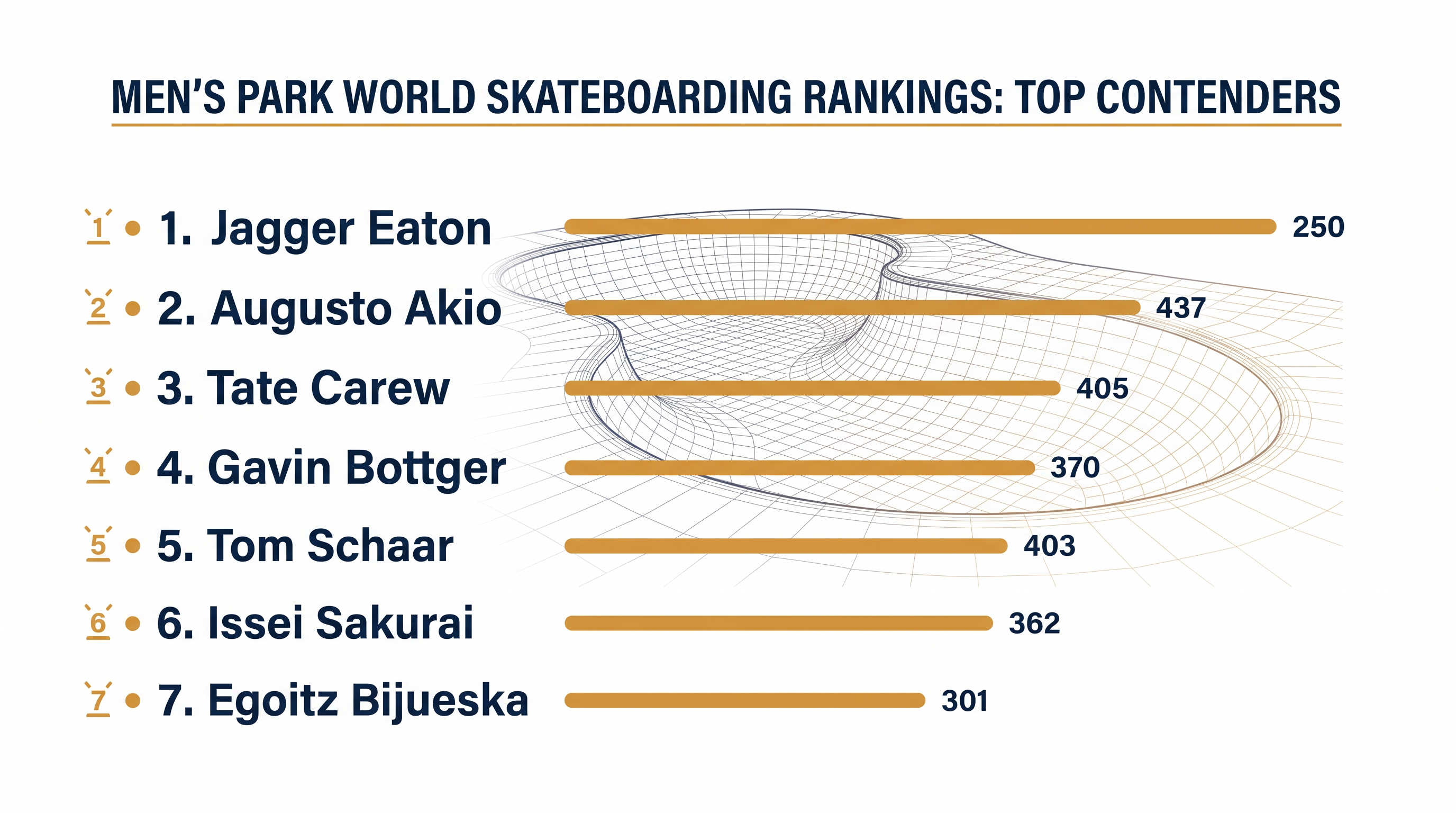
That silver medal followed Schaar's impressive bronze at the WST World Championships in São Paulo earlier in the year. By going back-to-back on the podium at the two most heavily weighted WST events of 2026, Schaar has amassed a massive points haul. He has surged from seventh in the pre-Rome global rankings into the absolute upper echelon of the sport, proving to the world that his transition from a mega-ramp specialist to a well-rounded park dominator is fully complete.[2][4]
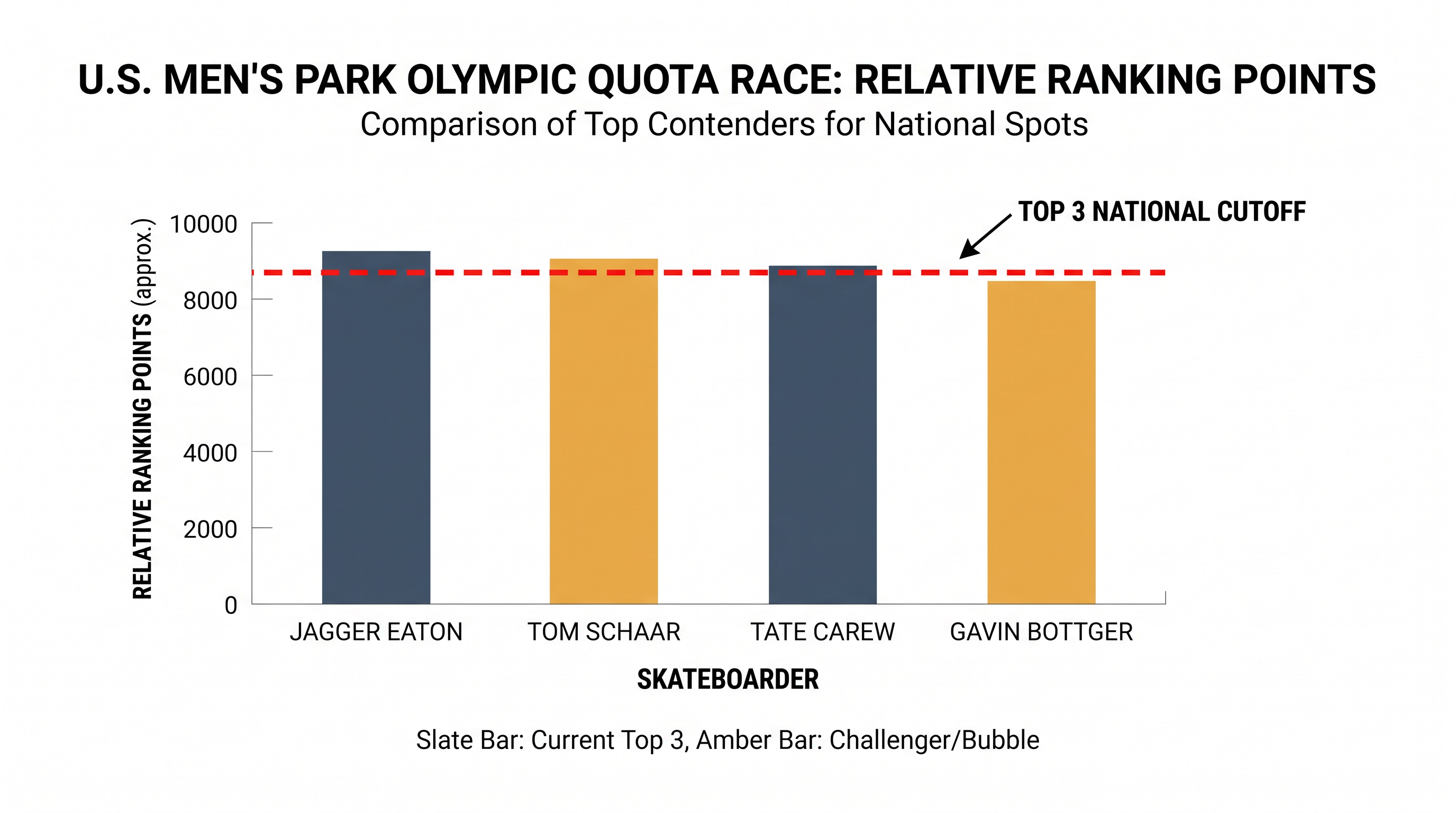
Schaar's rapid ascent has triggered a mathematical crisis for Team USA. Under the strict Olympic qualification system, a maximum of three athletes per nation can advance to the Games in each discipline. The United States currently boasts an absolute embarrassment of riches in Men's Park, turning their domestic race into a zero-sum bloodbath. It is a harsh reality of the sport that world-class American skaters, who could easily medal on the global stage, will inevitably be left home simply because they finished fourth in their own country.[3]
Before the tour arrived in Rome, the American hierarchy seemed relatively stable and predictable. Jagger Eaton held the global number one spot, riding high on early-season momentum, followed closely by Tate Carew and Gavin Bottger securely inside the top five. Further down the list, Liam Pace and Taylor Nye were lingering dangerously in the top 15, waiting for an opportunity to strike and disrupt the established order. It appeared the top three American spots were spoken for, until Schaar altered the equation.[4]
Before the tour arrived in Rome, the American hierarchy seemed relatively stable and predictable.
Now, Schaar's consecutive podiums mean he is mathematically leapfrogging his compatriots in real time. With Eaton virtually locked in thanks to his massive early-season points accumulation, Carew, Bottger, and Schaar are now trapped in a high-stakes game of musical chairs for the final two American tickets to the Olympic Qualifier Series. Every run is now a must-land scenario, and a single mistake in a preliminary heat could cost a skater their Olympic dream, amplifying the tension within the U.S. camp.[3][4]
The Americans aren't the only ones facing a domestic squeeze; the Brazilian contingent is navigating its own crowded and chaotic leaderboard. Augusto Akio, Luigi Cini, and Pedro Barros all held top-ten global rankings heading into the summer. However, Kalani Konig's spectacular second-place finish at the São Paulo World Championships has thrown a wrench into Brazil's established trio, proving that past accolades offer no protection in the current, highly volatile WST cycle where new talent is constantly emerging.[2][4]
Meanwhile, the European picture is crystallizing around a clear frontrunner. Spain's Egoitz Bijueska is sitting comfortably atop the continental standings. After winning the World Championship in Brazil with a massive score of 95.83, Bijueska proved it was no fluke by skating flawlessly to a third-place finish in Rome. He is currently the most consistent skater on the tour not named Tom Schaar, and looks poised to absolutely dominate the European qualification slots as the season progresses.[1][2]
Conversely, the reigning Olympic champion, Australia's Keegan Palmer, finds himself in a surprisingly precarious position. Palmer entered the summer ranked ninth globally, but an eighth-place finish in São Paulo and a surging Keefer Wilson—who won the quarter-finals in Brazil—means Palmer cannot afford to coast on his Tokyo gold. He needs a definitive, high-scoring result to secure his LA28 trajectory and fend off the rising talent within his own Australian ranks before the Phase 1 window closes.[2][4]
The pressure across all these national camps will reach a boiling point next month. The WST Washington D.C. Park World Championships, scheduled for September 19-26, represent the largest remaining points cache of the 2026 calendar. For skaters hovering on the qualification bubble, the American capital will serve as the ultimate proving ground. It is the last major opportunity of the year to salvage their Olympic campaigns and secure the vital points needed to survive the winter break with their dreams intact.[1]
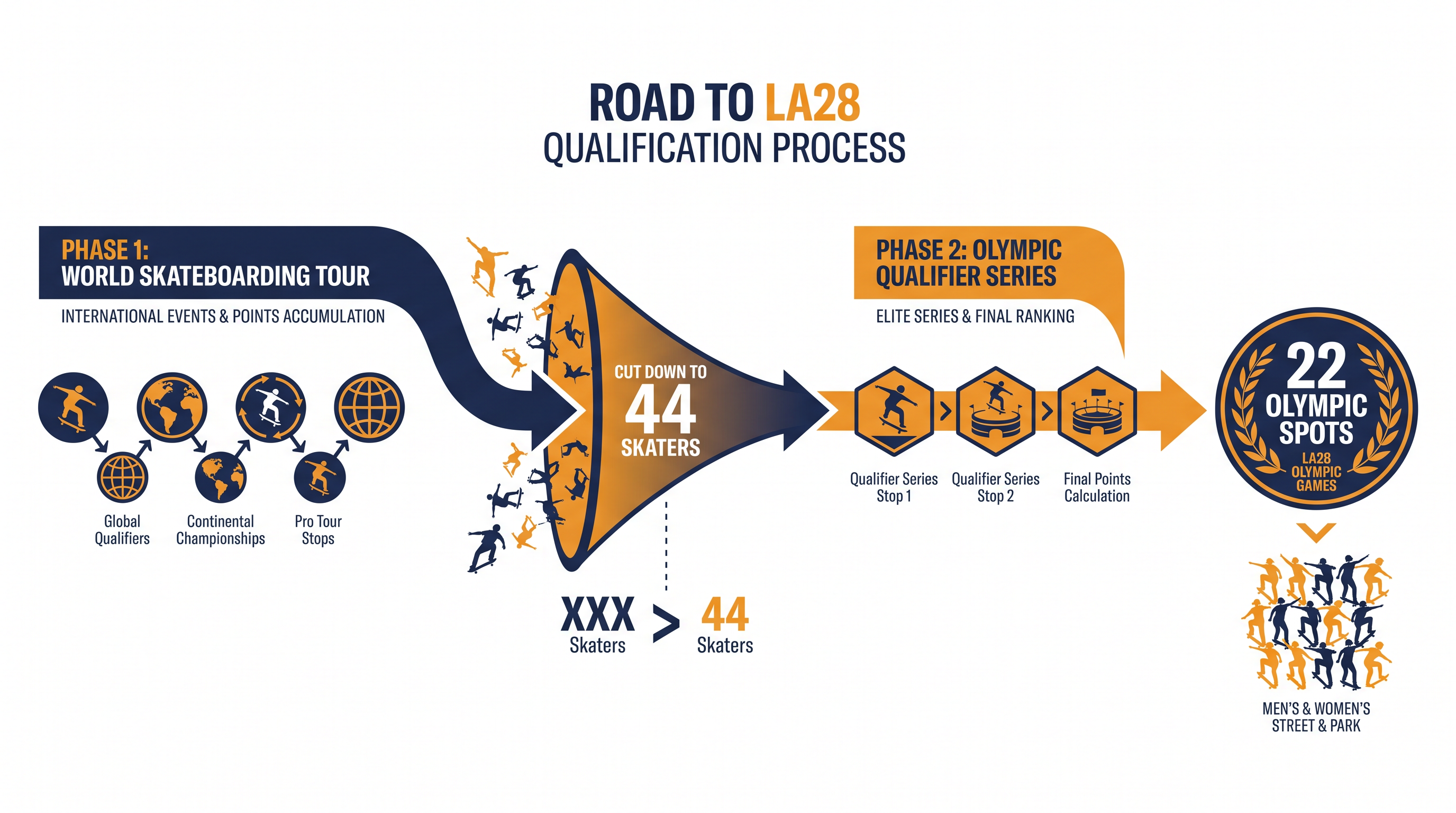
The mathematics of the Washington D.C. event are incredibly stark. A finals appearance in the capital could mathematically lock a skater into the top 44 of the World Skateboarding Rankings, guaranteeing their progression to Phase 2 of the qualification process—the Olympic Qualifier Series in 2028. Missing the cut, however, could spell the absolute end of their Olympic dreams entirely, leaving them stranded in Phase 1 while their rivals advance to the final showdown.[3]
As the tour prepares to touch down in North America, the strategic meta of competitive park skating has fundamentally changed. As demonstrated so vividly in Rome, banking a safe, mid-80s run is no longer enough to reach a podium, or even guarantee a spot in the finals. The standard has been violently dragged into the 90s, forcing skaters to risk their hardest, most technical tricks in their opening lines just to keep pace with the international frontrunners.[1]
With strict national quotas threatening to eliminate world-class talent before the Olympics even begin, the Washington D.C. World Championships will be less of a standard contest and more of a grueling survival test. Every heat will carry the weight of an Olympic final. For Schaar, Sakurai, Bijueska, and the rest of the elite pack, the race is no longer just against the skaters dropping in beside them—it is a desperate, high-flying race against the unforgiving math of the standings.[3]
How we got here
March 2026
Egoitz Bijueska wins the WST World Championships in São Paulo, with Tom Schaar taking third.
June 2026
Issei Sakurai wins the WST Rome Park World Cup with a historic 90+ point sweep, while Schaar secures second.
August 2026
The global rankings tighten significantly as the U.S. and Brazilian national quota races become mathematically cutthroat.
September 2026
The WST Washington D.C. Park World Championships will offer the largest remaining points cache to lock in the top 44.
Viewpoints in depth
Team USA Contenders
Navigating a zero-sum domestic battle where top-10 global rankings don't guarantee an Olympic spot.
For the American contingent, the Road to LA28 is less about beating the world and more about surviving each other. With Jagger Eaton, Tate Carew, Gavin Bottger, and Tom Schaar all routinely posting world-class results, the three-athlete national quota has created a ruthless internal math problem. Schaar's recent podium surge has forced the others to rethink their safety runs; simply making a final is no longer enough to secure a ticket to the Olympic Qualifier Series if two other Americans finish ahead of you. The pressure is compounding, turning every WST stop into a high-stakes domestic trial.
International Frontrunners
Pushing the boundaries of park skateboarding to establish dominance ahead of the Olympic Qualifier Series.
Skaters like Japan's Issei Sakurai and Spain's Egoitz Bijueska are operating on a different strategic plane. Unburdened by the immediate threat of being squeezed out by their own countrymen, these frontrunners are focused on raising the sport's absolute scoring ceiling. By consistently linking highly technical, high-amplitude tricks to break the 90-point barrier, they are establishing a psychological edge. Their goal is to enter the OQS phase not just as qualifiers, but as the undisputed top seeds, forcing the rest of the field to take massive risks just to keep pace.
Olympic Qualification Analysts
Tracking the vital points thresholds required to survive the Phase 1 cut down to 44 skaters.
From a purely analytical perspective, the WST circuit is a game of risk management and points accumulation. Analysts emphasize that the true cutline right now is the top 44, the threshold required to advance to Phase 2. While the podium battles capture the spotlight, the most desperate skating is happening further down the leaderboard. Skaters from non-dominant nations are fighting for every fractional point to stay inside that top 44 bubble, knowing that a single missed cut in Washington D.C. could mathematically eliminate them from LA28 contention before the year is out.
What we don't know
- Whether reigning Olympic champion Keegan Palmer can secure enough points to fend off rising Australian talent like Keefer Wilson.
- Which American skater will ultimately be squeezed out of the three-man national quota despite holding a top global ranking.
Key terms
- World Skateboarding Tour (WST)
- The primary international circuit sanctioned by World Skate, serving as Phase 1 of the Olympic qualification process.
- Olympic Qualifier Series (OQS)
- Phase 2 of the Road to LA28, where the top 44 ranked skaters compete in a final series to determine the 22 Olympic qualifiers.
- National Quota
- The rule limiting each country to a maximum of three athletes per discipline at the Olympic Games.
- Golden Run
- A finals format where the top competitors are given one final, high-pressure attempt to improve their score after the standard runs are completed.
Frequently asked
How many skateboarders can qualify for the Olympics from one country?
A maximum of three athletes per discipline and gender can qualify from a single nation, creating intense domestic competition for countries like the US, Japan, and Brazil.
What is the Olympic Qualifier Series (OQS)?
The OQS is the second phase of the Road to LA28. Only the top 44 ranked skateboarders from the World Skateboarding Tour phase will advance to the OQS to battle for the final 22 Olympic spots.
Why was the WST Rome Park event significant?
Rome redefined the scoring standard for Men's Park, marking the first time the top five skaters all banked scores above 90 points before the final 'Golden Run'.
Sources
Source coverage
6 outlets
3 viewpoints surfaced






[1]World SkateInternational Frontrunners
World Skateboarding Tour: World Cup Rome Park 2026 Results!
Read on World Skate →[2]Olympics.comInternational Frontrunners
WST Skateboarding World Championships São Paulo: All results
Read on Olympics.com →[3]BoardridersOlympic Qualification Analysts
The Road to LA 2028: Skateboarding Qualification System Explained
Read on Boardriders →[4]The BoardrTeam USA Contenders
Global Skateboarding Rankings: Men's Park
Read on The Boardr →[5]X GamesTeam USA Contenders
X Games League 2026 Standings
Read on X Games →[6]ForbesOlympic Qualification Analysts
X Games Sacramento 2026 Launches X Games League
Read on Forbes →

More in sports
See all 35 stories →Standings
The Race to Ningbo: Luo Shifang, Rafiatu Lawal, and Kamila Konotop Headline the Women's 59kg Global Standings
8 sources
Injury
Global Fencing Injury Report: Meinhardt's Arm Splint, Choi's Heroic Silver, and Catantan's ACL Battle
6 sources

Standings
FIE Women's Sabre Standings: Balzer and Emura Locked in Race for World No. 1 as France and Hungary Dominate
7 sources
Injury
Global Equestrian Injury Report: Aachen Roster Shifts and Inspiring Rider Comebacks
7 sources
Every angle. Every day.
Get sports stories with full source coverage and perspective breakdowns delivered to your inbox.