
Why Badminton is Finally Ditching the Feather Shuttlecock
Driven by soaring costs and sustainability concerns, the Badminton World Federation is accelerating the adoption of high-tech synthetic shuttlecocks. Advanced materials like carbon fiber and PEBA are closing the performance gap with natural goose feathers.
By Factlen Editorial Team
- Badminton Governing Bodies
- Organizations focused on the long-term sustainability and accessibility of the sport.
- Recreational Players & Clubs
- Amateur players who prioritize durability and cost-effectiveness over perfect tournament flight.
- Equipment Manufacturers
- Companies investing in materials science to bridge the performance gap.
- Elite Traditionalists
- Professional players who rely on the exact aerodynamic feel and control of natural feathers.
What's not represented
- · Animal rights organizations
- · Traditional feather farmers
Why this matters
For decades, the high cost and fragility of feather shuttlecocks have made badminton expensive for amateur players and local clubs. The successful development of tournament-grade synthetic alternatives promises to drastically lower the cost of playing while reducing the sport's reliance on animal agriculture.
Key points
- The BWF is accelerating the adoption of synthetic shuttlecocks to ensure the sport's sustainability.
- A decline in duck and goose farming has caused the price of natural feather shuttlecocks to nearly triple.
- New hybrid shuttlecocks use carbon fiber frames and advanced polymers like PEBA to mimic natural feathers.
- The BWF has approved specific synthetic models for use in Grade 3 and Junior International tournaments.
The crack of a badminton smash is one of the most distinctive sounds in sports, routinely generated by a projectile traveling over 400 kilometers per hour. For over a century, that projectile—the shuttlecock—has been crafted using the exact same biological blueprint: 16 overlapping goose or duck feathers embedded into a cork base. But the sport is currently undergoing a quiet, high-tech revolution. Driven by skyrocketing manufacturing costs and a global push for sustainability, the Badminton World Federation (BWF) is accelerating the transition away from animal products and toward advanced synthetic alternatives.[1][6]
To understand why the sport is abandoning its traditional equipment, one must look at the staggering inefficiency of manufacturing a natural feather shuttlecock. A tournament-grade shuttlecock requires exactly 16 premium "knife feathers," which must be harvested from either the left or right wing of a goose or duck to ensure the projectile spins uniformly in flight. Because each bird yields only a handful of suitable feathers per wing, it takes the plumage of two to three birds to produce a single shuttlecock.[2][5]
This heavy reliance on animal agriculture has collided with shifting global supply chains. China, which produces the vast majority of the world's feather shuttlecocks, has seen a steady decline in duck and goose farming over the past half-decade. According to industry data, Chinese duck output fell from nearly 49 billion birds in 2019 to roughly 42 billion by 2023. This contraction in raw material supply has sent shockwaves through the badminton equipment market.[2]
The economic fallout for players and clubs has been severe. The cost of premium feather shuttlecocks has nearly tripled in recent years. For example, a standard tube of Yonex AS-05 shuttles, which retailed for around 95 RMB (roughly $13) just a few years ago, surged to 275 RMB ($38) by mid-2024. For local badminton clubs and recreational players who burn through multiple tubes per session, the sport was rapidly becoming prohibitively expensive.[2]

Furthermore, natural feather shuttlecocks are notoriously fragile. A single mishit by a beginner, or the sheer rotational force of an elite player's jump smash, can snap a feather quill. Once a single feather is damaged, the shuttlecock's aerodynamic stability is ruined, and it must be discarded. In a standard professional match, players routinely cycle through dozens of shuttlecocks, creating a massive stream of non-recyclable waste.[4][5]
Recognizing the existential threat to the sport's accessibility, the BWF began aggressively testing synthetic alternatives. In 2021, the governing body officially approved the use of synthetic feather shuttlecocks for international sanctioned tournaments, citing the need to ensure the long-term sustainability of badminton. Early BWF testing revealed that transitioning to synthetics could reduce overall shuttlecock usage by up to 25 percent, offering a massive economic and environmental edge.[1][4]
Recognizing the existential threat to the sport's accessibility, the BWF began aggressively testing synthetic alternatives.
However, replacing the goose feather is an immense engineering challenge. Traditional plastic or nylon shuttlecocks have existed for decades, but they have historically been relegated to school gymnasiums and backyard sets. While highly durable, standard nylon plastics like PA6 lack the complex aerodynamic properties of natural feathers. They tend to feel "hard" off the racket string and fly with erratic trajectories, making them unsuitable for competitive play.[2][5]

The magic of a natural feather shuttlecock lies in its unique drag profile. When struck forcefully, the feathers compress, making the shuttle highly aerodynamic and allowing it to reach blistering speeds. As it crosses the net and slows down, the feathers flare outward, acting as a parachute that causes the shuttle to drop steeply and predictably. Replicating this dynamic expansion and contraction with synthetic materials has been the holy grail for equipment manufacturers.[2][6]
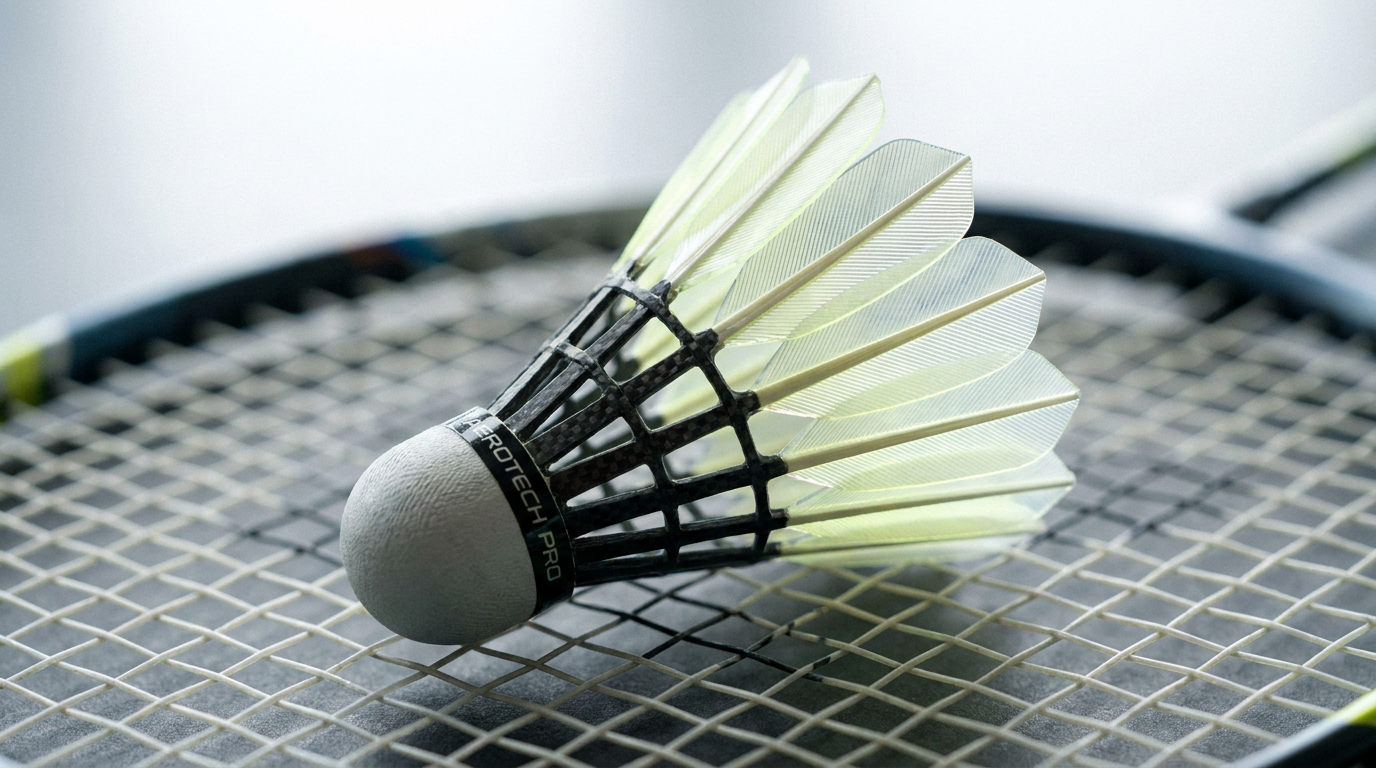
Enter the new generation of hybrid and composite shuttlecocks. Instead of molding a single piece of plastic, companies are now engineering multi-component projectiles. Recent innovations, such as Victor's Carbonsonic series, utilize a rigid carbon fiber frame to mimic the stiffness of a natural quill, paired with synthetic vanes designed to replicate the aerodynamic drag of real feathers.[3][5]

Materials science is playing a crucial role in this evolution. Manufacturers are increasingly turning to advanced polymers like Polyether Block Amide (PEBA). Unlike traditional stiff plastics, PEBA offers high resilience, outstanding fatigue resistance, and excellent low-temperature flexibility. This allows the synthetic "feathers" to snap back into shape after a 400 km/h impact without permanently deforming, closely mimicking the elastic memory of a goose feather.[2][3]
The momentum behind these high-tech alternatives is building rapidly. In early 2026, the BWF expanded its rollout by officially approving specific synthetic models—including the Victor New Carbon Sonic Max and the Yonex Crosswind 70—for use in BWF Grade 3 tournaments and Junior International events. This trial phase is designed to collect rigorous performance data and player feedback in high-stakes competitive environments.[1][3]

For the badminton community, the transition represents a delicate balancing act. Elite players possess highly calibrated muscle memory and are acutely sensitive to the slightest variations in shuttlecock flight and feel. While early feedback suggests that professionals can adjust to the slight variances of the new synthetics, winning over the sport's traditionalists will require the technology to be virtually indistinguishable from nature's design.[4][6]
Yet, for the vast majority of the sport's participants, the synthetic revolution cannot come soon enough. By combining the precise flight characteristics of a feather with the durability of a polymer, manufacturers are poised to drastically lower the barrier to entry. As these advanced shuttlecocks move from junior tournaments to the sport's biggest stages, badminton is securing its future by leaving the goose feather in the past.[4][5]
How we got here
2019
Chinese duck and goose farming output peaks, providing an abundant supply of feathers.
2021
The BWF officially approves synthetic feather shuttlecocks for international sanctioned tournaments.
2023
Feather prices begin to skyrocket due to agricultural supply shortages.
2026
The BWF expands trials to Grade 3 and Junior tournaments with new carbon-hybrid models.
Viewpoints in depth
Badminton Governing Bodies
The BWF views synthetics as essential for the sport's survival.
Organizations like the Badminton World Federation are primarily concerned with accessibility and sustainability. They recognize that if shuttlecock prices continue to soar, the sport will lose its grassroots base. By pushing for synthetic adoption, they aim to reduce waste, lower costs, and decouple the sport from the volatile agricultural sector.
Elite Traditionalists
Professional players remain highly sensitive to equipment changes.
At the highest levels of the sport, players rely on deeply ingrained muscle memory. Traditionalists argue that natural feathers possess a unique, organic flexibility that allows for unparalleled touch and control at the net. While they acknowledge the environmental benefits, many elites are hesitant to adopt synthetics until the aerodynamic 'parachute effect' is replicated flawlessly.
Recreational Players & Clubs
Amateurs prioritize durability and cost over perfect flight mechanics.
For local clubs and casual players, the nuance of a perfect drop shot is secondary to the budget. Recreational players are the strongest advocates for the synthetic transition, as highly durable polymer shuttlecocks allow them to play longer sessions without constantly replacing broken equipment, saving significant amounts of money.
What we don't know
- Whether elite players will fully accept synthetic shuttlecocks at the highest levels of competition, such as the Olympics.
- How perfectly synthetic materials can replicate the aerodynamic parachute effect under varying humidity and temperature conditions.
Key terms
- PEBA
- Polyether Block Amide, a highly resilient and flexible polymer used to replicate the elastic memory of natural feathers.
- Knife feathers
- The specific, highly aerodynamic feathers taken from the wings of geese or ducks used in traditional shuttlecocks.
- Parachute effect
- The aerodynamic phenomenon where a shuttlecock's feathers flare outward as it slows down, causing a steep and predictable drop.
Frequently asked
Why are feather shuttlecocks so expensive?
They require 16 specific wing feathers from geese or ducks. A recent decline in farming has created a severe raw material shortage, driving up prices.
Do synthetic shuttlecocks fly the same as feather ones?
Older plastic models flew erratically, but new carbon-fiber and polymer hybrids closely mimic the complex aerodynamics and parachute effect of natural feathers.
When will we see synthetic shuttlecocks in the Olympics?
The BWF is currently trialing them in Grade 3 and Junior tournaments, but a timeline for top-tier events like the Olympics has not been finalized.
Sources
Source coverage
6 outlets
4 viewpoints surfaced






[1]Badminton World FederationBadminton Governing Bodies
Use of Synthetic Shuttlecocks at Selected BWF Tournaments
Read on Badminton World Federation →[2]Tuntun PlasticEquipment Manufacturers
Feather Prices Are Driving Up Shuttlecock Costs
Read on Tuntun Plastic →[3]Racket WorldEquipment Manufacturers
Victor NEW Carbonsonic Max – Victor's First BWF-Approved Synthetic Shuttlecock
Read on Racket World →[4]Badminton OceaniaBadminton Governing Bodies
BWF approves synthetic feather shuttlecocks
Read on Badminton Oceania →[5]BashmintonRecreational Players & Clubs
Badminton Shuttlecocks Compared: Which Shuttlecock is Right for You?
Read on Bashminton →[6]Factlen Editorial TeamElite Traditionalists
Synthesis by Factlen editorial team
Read on Factlen Editorial Team →

Every angle. Every day.
Get sports stories with full source coverage and perspective breakdowns delivered to your inbox.