
U.S. Helicopters Patrol Strait of Hormuz as Tentative Deal with Iran Faces Shipping Delays and Political Pushback
Following a tentative agreement between the Trump administration and Tehran, U.S. Apache helicopters have begun policing the Strait of Hormuz to secure global oil transit. However, major shipping companies remain hesitant to resume full operations, and the deal faces fierce opposition from hawkish domestic allies.
By Factlen Editorial Team
- U.S. Administration & Military
- Focuses on restoring global commerce and avoiding full-scale war through negotiated de-escalation and active military overwatch.
- National Security Hawks
- Views the deal as a dangerous concession that emboldens Tehran and betrays regional allies like Israel.
- Commercial Shipping Industry
- Prioritizes vessel safety and insurance viability, remaining skeptical of the deal's durability until safe transit is proven.
- Iranian Leadership
- Frames the agreement as a strategic pause that asserts their leverage over the waterway without triggering a devastating U.S. military response.
What's not represented
- · Environmental groups concerned about potential oil spills from military engagements
- · European and Asian energy consumers heavily reliant on Middle Eastern imports
Why this matters
The Strait of Hormuz is the world's most critical oil chokepoint, handling roughly 20% of global petroleum consumption. A successful reopening will stabilize global energy prices and supply chains, while a collapse of the fragile deal could trigger renewed military escalation and severe economic shocks.
Key points
- U.S. Apache helicopters are actively patrolling the Strait of Hormuz to enforce a new tentative agreement.
- President Trump's deal aims to reopen the vital oil chokepoint after months of conflict.
- Major shipping companies remain hesitant to resume transit despite U.S. security guarantees.
- The diplomatic pact has sparked a severe backlash from hawkish allies within the President's political base.
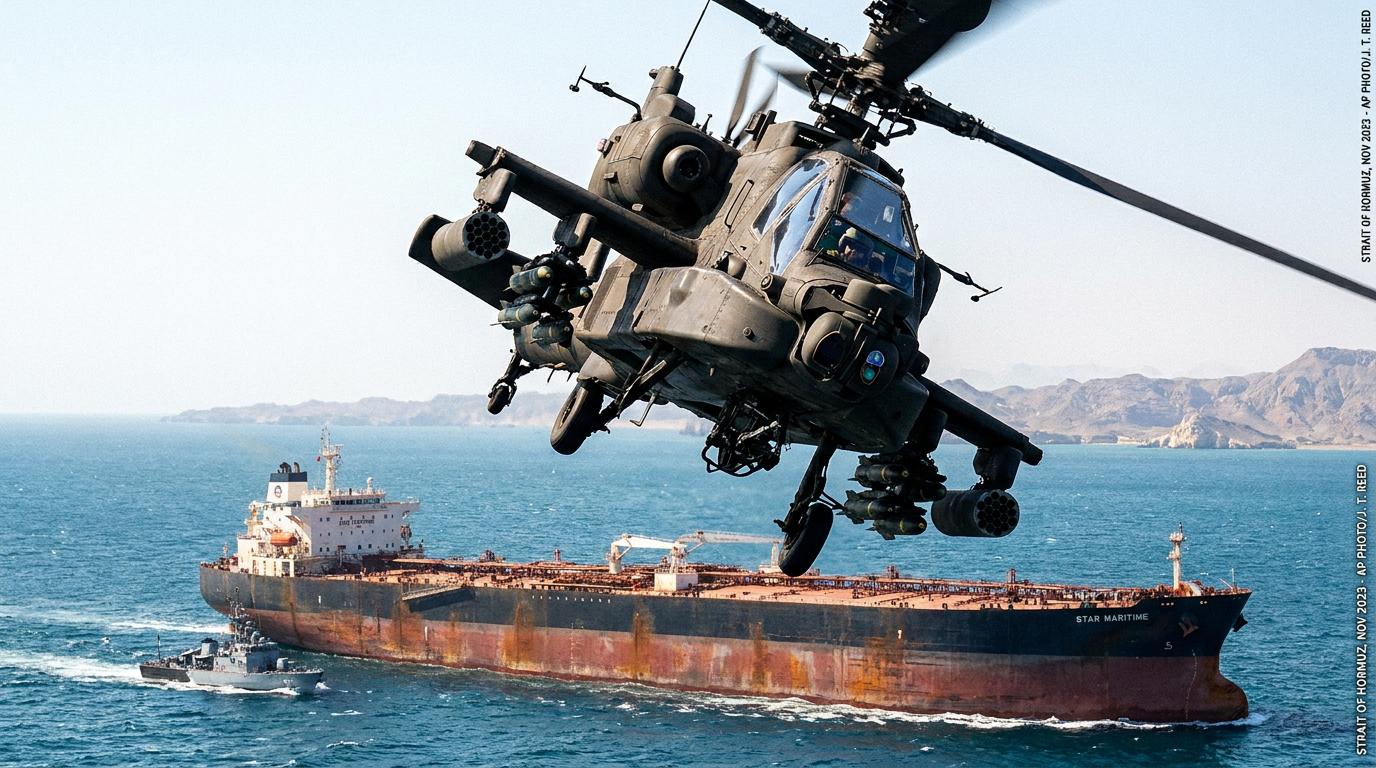
U.S. AH-64E Apache helicopters are now actively patrolling the Strait of Hormuz, marking the first physical enforcement of a tentative de-escalation agreement brokered between the Trump administration and Tehran. The deployment aims to secure the vital maritime corridor after months of conflict that choked global shipping lanes and rattled international energy markets.[3][8]
The fragile pact, which President Trump announced earlier this week, theoretically ends a protracted standoff that saw Iranian forces disrupt commercial transit. Under the new arrangement, the U.S. military has established policed lanes for oil tankers, providing a security umbrella designed to reassure international markets and restore the flow of millions of barrels of crude oil per day.[1][4]
Despite the White House urging commercial vessels to "start your engines," the maritime industry's response has been decidedly cautious. Major shipping conglomerates and insurance syndicates are holding back, waiting to see if the U.S. military presence can genuinely deter further incidents like the drone strike that targeted a vessel on June 8.[1][6]

The stakes for the global economy are immense. The Strait of Hormuz is the world's most critical energy chokepoint, facilitating the transit of roughly a fifth of the globe's petroleum consumption. Markets reacted with cautious optimism to the initiation of the patrols, with Brent crude dipping below $85 a barrel as traders priced in the potential resumption of normal flows.[4][7]
The military execution relies heavily on the AH-64E Apache gunships, which offer rapid response capabilities against fast-attack craft and asymmetric drone threats. Defense officials note that while the helicopters provide robust overwatch, the sheer volume of commercial traffic makes comprehensive protection a logistical challenge, requiring precise coordination with naval surface vessels.[3][8]
The military execution relies heavily on the AH-64E Apache gunships, which offer rapid response capabilities against fast-attack craft and asymmetric drone threats.
Back in Washington, the diplomatic breakthrough has ignited a fierce political firestorm within the President's own base. Hawkish allies and prominent figures within the "MAGA" movement have launched a mutiny against the deal, characterizing any concessions to Tehran as an existential betrayal of Israel and a retreat from the administration's historical "maximum pressure" posture.[2]
This internal fracture represents one of the most significant divides in Trump's political coalition in over a decade. Leading isolationists who typically support the President's "America First" foreign policy are clashing openly with national security hawks who view military confrontation with Iran as unavoidable and view the current pact as a dangerous capitulation.[2]

In Tehran, the government is navigating its own delicate balancing act. Iranian officials have defended the maritime agreement in domestic media, framing the de-escalation as a tactical maneuver that preserves their regional influence and economic leverage while avoiding a full-scale conventional war with the United States.[5]
The coming weeks will be a critical test of the agreement's durability. If commercial shipping companies remain unconvinced by the Apache patrols and insurance premiums remain prohibitively high, the economic benefits of the deal will stall. Conversely, any miscalculation or rogue strike in the heavily militarized waterway could instantly shatter the pact and plunge the region back into active conflict.[1][6]
Beyond the immediate tactical situation, the standoff highlights the enduring vulnerability of the global energy grid to localized geopolitical flashpoints. Even as Western nations accelerate their transition toward renewable energy sources, the sudden stabilization of Brent crude prices upon the deal's announcement underscores how deeply the global economy remains tethered to the uninterrupted flow of fossil fuels through Middle Eastern chokepoints.[4][7]
How we got here
Early 2026
Escalating conflict and Iranian disruptions choke commercial shipping in the Strait of Hormuz.
June 8, 2026
An Iranian drone strike heightens tensions and insurance premiums for commercial vessels.
Mid-June 2026
President Trump announces a tentative de-escalation deal with Tehran to reopen the waterway.
June 17, 2026
U.S. Apache helicopters begin active patrols to secure the maritime corridor for oil tankers.
Viewpoints in depth
U.S. Administration & Military
Focuses on restoring global commerce and avoiding full-scale war through negotiated de-escalation and military overwatch.
The White House and defense officials view the tentative agreement as a pragmatic necessity to stabilize the global economy. By deploying AH-64E Apache helicopters to police the shipping lanes, the administration aims to provide a tangible security umbrella that reassures international markets without committing to a massive ground war. Proponents argue this approach successfully leverages U.S. military superiority to enforce freedom of navigation while keeping the broader conflict from spiraling out of control.
National Security Hawks
Views the deal as a dangerous concession that emboldens Tehran and betrays regional allies.
A vocal faction of the President's own political base, alongside traditional national security hawks, fiercely opposes the pact. They argue that negotiating with Tehran after months of maritime disruptions effectively rewards bad behavior and signals weakness. This camp contends that any de-escalation that does not fundamentally dismantle Iran's military capabilities is a temporary band-aid that betrays key allies like Israel and abandons the administration's historical 'maximum pressure' campaign.
Commercial Shipping Industry
Prioritizes vessel safety and insurance viability, remaining skeptical of the deal's durability.
For the multinational corporations that actually move the world's oil, political declarations mean little without guaranteed physical safety and viable insurance rates. The shipping industry is taking a 'wait-and-see' approach, arguing that a few days of helicopter patrols are insufficient to offset the risk of multi-million dollar vessels being targeted by asymmetric drone strikes. Until maritime insurance syndicates lower their premiums, many fleets will continue to avoid the Strait.
Iranian Leadership
Frames the agreement as a strategic pause that asserts their leverage over the waterway.
In Tehran, the narrative is one of strategic success. Iranian officials and state media portray the deal not as a capitulation to U.S. military pressure, but as proof of their ability to force Washington to the negotiating table by demonstrating control over the world's most vital economic chokepoint. The agreement allows Iran to de-escalate on its own terms, avoiding a devastating conventional war while maintaining its regional influence and asymmetric capabilities.
What we don't know
- Exactly what diplomatic or economic concessions the U.S. made to Tehran to secure the tentative agreement.
- How long the U.S. military intends to maintain active helicopter patrols over the shipping lanes.
- When major maritime insurance syndicates will lower premiums enough to make transit economically viable again.
Key terms
- Strait of Hormuz
- A narrow, strategically vital waterway between the Persian Gulf and the Gulf of Oman, through which a massive portion of the world's oil passes.
- AH-64E Apache
- An advanced U.S. military attack helicopter equipped with sensors and weapons systems designed for close combat and maritime overwatch.
- Brent Crude
- A major trading classification of sweet light crude oil that serves as a benchmark price for purchases of oil worldwide.
Frequently asked
Why is the Strait of Hormuz so important?
It is the primary maritime route for Middle Eastern oil exports, handling about 20% of global petroleum consumption. Any disruption there immediately impacts global energy prices.
Are commercial ships using the Strait again?
While the U.S. has urged ships to resume transit, many major shipping and insurance companies are waiting to see if the military patrols can guarantee safety before risking their vessels.
Why are some U.S. politicians opposing the deal?
Hawkish lawmakers argue that negotiating with Iran rewards their disruption tactics, abandons the 'maximum pressure' strategy, and undermines the security of U.S. allies like Israel.
Sources
Source coverage
8 outlets
4 viewpoints surfaced








[1]NPRU.S. Administration & Military
With Iran deal, Trump told ships to 'start your engines.' That's not happening yet
Read on NPR →[2]AxiosNational Security Hawks
MAGA hawk mutiny deepens Trump's isolation on Iran
Read on Axios →[3]Fox NewsU.S. Administration & Military
Apache helicopter gunships showed off their power cleaning up the Strait of Hormuz
Read on Fox News →[4]ReutersU.S. Administration & Military
Oil markets stabilize as US patrols secure Strait of Hormuz transit corridor
Read on Reuters →[5]Al JazeeraIranian Leadership
Iran defends maritime agreement amid domestic scrutiny and US military presence
Read on Al Jazeera →[6]The Wall Street JournalCommercial Shipping Industry
Shipping giants delay Hormuz transit despite US security guarantees
Read on The Wall Street Journal →[7]BloombergCommercial Shipping Industry
Brent crude dips below $85 as Hormuz reopening timeline crystallizes
Read on Bloomberg →[8]BBC NewsU.S. Administration & Military
US helicopters patrol vital oil chokepoint following tentative Washington-Tehran pact
Read on BBC News →
More in news politics
See all 9 stories →US-Iran Deal
U.S. and Iran Sign Agreement to End War; Vance Lashes Out at Israeli Critics
7 sources
U.S.-Iran Deal
U.S. and Iran Sign 14-Point Agreement to End War, Sparking Fierce Backlash from Israel
6 sources
U.S.-Iran Relations
Vance Rebukes Israeli Critics of U.S.-Iran Peace Agreement, Warning Against Alienating 'Only Powerful Ally'
8 sources
Cognitive Defense
The Science of 'Prebunking': How Psychological Inoculation is Defeating Misinformation
6 sources

Every angle. Every day.
Get news politics stories with full source coverage and perspective breakdowns delivered to your inbox.