
The 'Third Place' Revival: How Communities Are Rebuilding Social Infrastructure to Combat Isolation
As loneliness reaches epidemic levels, a movement to revive 'third places'—informal gathering spots outside of home and work—is transforming urban design and social habits. From micro-communities to co-housing, people are prioritizing physical connection over digital networks.
By Factlen Editorial Team
- Civic Planners & Designers
- Focuses on the physical infrastructure, zoning laws, and accessible public spaces required to engineer social connection.
- Public Health Advocates
- Views third places primarily as a medical necessity to combat the loneliness epidemic and improve longevity.
- Digital Skeptics & Youth
- Driven by burnout from screen time and performative social media, seeking authentic, uncurated IRL interactions.
- Intentional Living Advocates
- Focuses on co-housing and deeply integrated community models that bring social spaces directly to the doorstep.
What's not represented
- · Rural residents lacking formal community centers
- · Low-income workers without time for leisure spaces
Why this matters
Strong social ties are proven to increase longevity and mental well-being, making the physical spaces where we gather a critical component of public health. Understanding how to find or build these spaces can directly improve your quality of life and community resilience.
Key points
- The 'third place' refers to informal gathering spots outside of home and work that are essential for community building.
- Public health officials now equate the physical dangers of chronic loneliness to smoking 15 cigarettes a day.
- A cultural shift, led largely by Gen Z, is driving the creation of 'micro-communities' focused on in-person, recurring activities.
- Urban planners are increasingly prioritizing 'social infrastructure,' recognizing that physical spaces are critical for civic resilience.
The modern paradox of the twenty-first century is that humanity has never been more technologically connected, yet we are experiencing a profound, global crisis of isolation. In recent years, public health officials across the world, including the U.S. Surgeon General, have officially declared loneliness an epidemic. But the proposed cure for this modern malaise isn't a medical intervention or a new pharmaceutical—it is an architectural and cultural one. Across the globe, a quiet but powerful revolution is underway to rebuild the physical spaces where human connection happens naturally, shifting the focus from digital networks back to the tangible neighborhoods we inhabit.[10]
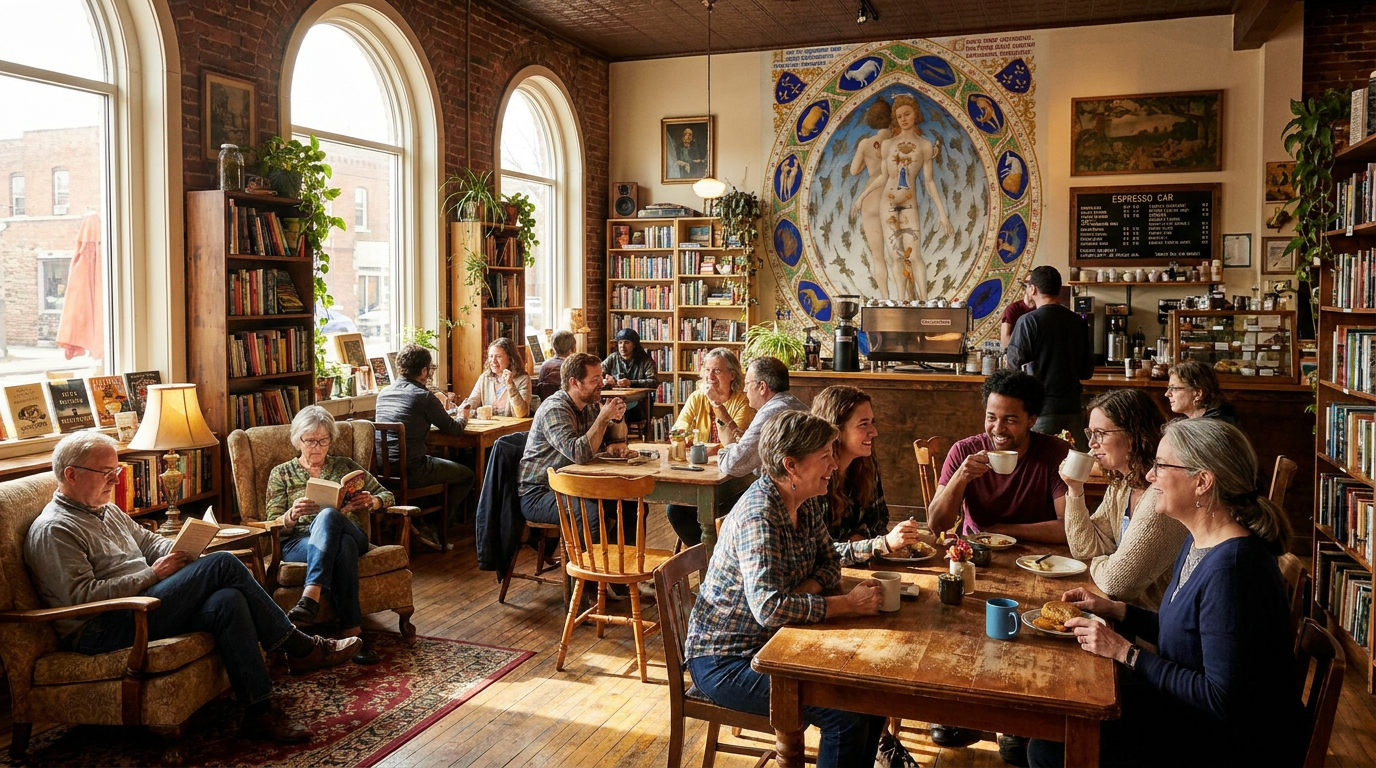
At the center of this movement is the revival of the 'third place.' Coined by American urban sociologist Ray Oldenburg in his seminal 1989 book The Great Good Place, the term describes the informal, accessible gathering spots that exist outside of the home (the 'first place') and the workplace or school (the 'second place'). These are the neighborhood diners, local barbershops, public libraries, and community parks that serve as the neutral ground of civic life. In a true third place, status is left at the door, conversation is the primary activity, and attendance is entirely voluntary. They are the essential arenas where a community's social fabric is woven.[4][9]
For decades, these vital spaces were quietly disappearing from the modern landscape. The rise of suburban sprawl, the privatization of leisure time, and the relentless creep of digital technology systematically dismantled the default arenas for casual, serendipitous interaction. The COVID-19 pandemic dramatically accelerated this decline, pushing social lives entirely onto screens and leaving a physical void that social media platforms attempted—and largely failed—to fill. As people retreated into their homes, the casual 'weak ties' of neighborhood acquaintances evaporated, leaving many isolated within their own communities. The loss of these spaces meant that making friends as an adult shifted from a natural byproduct of daily life to a scheduled, high-effort task, further discouraging casual socialization.[10]

The consequences of this societal atomization are starkly physical, moving far beyond mere emotional discomfort. A growing body of medical research equates the long-term health risks of prolonged social isolation to smoking 15 cigarettes a day. Conversely, strong social ties are associated with a roughly 50% increased likelihood of survival over time compared to those with weaker connections. Loneliness is no longer viewed merely as a fleeting emotional state, but as a critical public health vulnerability that increases the risk of heart disease, dementia, and premature death. The built environment, it turns out, is a matter of life and death.[3][6]
In response to this crisis, a cultural counter-current is pulling people back into the physical world. Young adults, particularly Generation Z, are leading a deliberate and highly visible shift away from performative online existence toward tangible, in-person communities. Burned out by algorithmic feeds, doomscrolling, and the superficiality of digital-first friendships, they are actively trading endless content streams for genuine community connection. The new frontier for socialization isn't a virtual metaverse; it is the coffee shop on the corner, the running path in the local park, and the dimly lit listening bar where the music takes precedence over the Wi-Fi password.[2]
This demographic shift is fueling the rapid rise of 'micro-communities'—small, recurring groups built around specific, low-pressure activities. Rather than seeking one monolithic friend group or relying on the intense pressure of one-on-one networking, people are assembling their social lives through weekly run clubs, community repair nights, and local book swaps. These environments prioritize consistency and shared rituals over intense, one-off events. Sociologists note that this model works because it relies on recurring, low-pressure proximity, allowing trust and familiarity to build organically over weeks and months. By committing to a shared activity on a regular schedule, participants remove the friction of having to constantly plan and invite, replacing it with the simple comfort of knowing that their community will be there waiting for them every Tuesday evening.[3]
The profound appeal of these micro-communities lies in their ability to bypass the inherent awkwardness of adult friendship-building. Activities with natural pauses, such as mending clothes at a repair cafe, resting between sets at a climbing gym, or weeding a community garden, provide built-in conversation starters and eliminate the pressure of maintaining constant eye contact. They offer a refreshing return to the freedom of simply being a person in a room with other people, free from the exhausting modern pressure of curating a personal brand. It is a rebellion against optimization, favoring spaces that simply feel human.[3]

Beyond grassroots meetups, urban planners and civic leaders are increasingly viewing third places through the lens of 'social infrastructure.' Coined by sociologist Eric Klinenberg, this concept argues that physical spaces—libraries, community gardens, and accessible sidewalks—are just as essential to a city's survival and functionality as its power grids, transit systems, and water pipes. When social infrastructure is robust, communities are demonstrably more resilient in the face of crises; when it is degraded or absent, people isolate and communities fracture. Cities are now actively rethinking zoning laws to mandate the inclusion of these spaces in new developments.[1]
Cities are now actively rethinking zoning laws to mandate the inclusion of these spaces in new developments.
A key function of effective social infrastructure is the generation of what urbanists call 'social friction.' While the term may sound negative, social friction is actually the highly valuable, often unpredictable interaction between people of different backgrounds, ages, and socioeconomic viewpoints. It forces individuals out of their carefully curated social bubbles, fostering empathy, shared trust, and a broader sense of civic duty. As one viral sentiment regarding the third place revival notes, 'annoyance is the price you pay for community.' Learning to share space with strangers is the fundamental building block of a functioning democracy.[1]
However, the relationship between physical spaces and loneliness is complex, and recent data suggests that simply building more cafes will not automatically cure isolation everywhere. The Third Place Index, a research initiative that maps access to social infrastructure against public health data, reveals a highly nuanced picture. In dense urban areas, the premise holds true: neighborhoods with the fewest third places consistently report the highest rates of loneliness, showing a significant gap in well-being compared to neighborhoods rich in accessible gathering spots. In cities, proximity to community spaces is a strong protective factor against isolation.[5]
Yet, in rural communities, this urban-centric logic completely breaks down. The data shows that lonelier rural tracts often have slightly more physical gathering spaces—like churches, parks, and community centers—than less lonely ones. In these areas, isolation is driven by vast geographic distances, the erosion of local institutions, and economic shifts that a simple zoning map cannot capture. Rural social life often relies on informal networks, family land, and traditions that evade traditional measurement. This suggests that while building third places is crucial for urban corridors, rural loneliness requires entirely different, highly localized interventions.[5]

Another pressing challenge in the modern third place revival is the creeping commercialization of public life. As traditional, free gathering spots have declined over the decades, private entities have eagerly stepped in to fill the void. Today, many de facto third places are boutique coffee shops, specialized gyms, and co-working spaces that require a financial transaction to participate. This creates a steep barrier to entry, effectively transforming what should be a democratic, universally accessible space into a luxury commodity available only to those with disposable income.[7]
The tension between inclusive community spaces and niche, identity-based commercial ventures reflects a broader societal shift in how we gather. Traditional third places, like the classic neighborhood diner or the local public square, served geographic communities where diversity occurred naturally simply through physical proximity. Modern commercial third places, by contrast, increasingly cater to specific subcultures and demographics. While this can deeply strengthen bonds among like-minded individuals, it simultaneously reduces the cross-cultural, serendipitous interactions that build broader societal cohesion. When gathering spaces are sorted by income and specific interests, the community loses the vital 'sorting areas' where people learn to interact with neighbors who look, think, and vote differently than they do.[7]
To combat this financial barrier and restore true accessibility, there is a renewed civic push to revitalize fully public, non-commercial third places. Public libraries, long written off as obsolete in the digital age, are leading this charge by transforming from quiet book repositories into vibrant, noisy community hubs. Modern libraries now offer baking classes, tool-lending programs, teen reading rooms, and community repair nights. Similarly, parks departments are rethinking green spaces to include more varied seating, shade structures, and interactive elements that actively encourage residents to linger rather than just pass through.[4]
For some, the deep desire for connection is reshaping not just where they spend their weekends, but how and where they choose to live permanently. The intentional community and co-housing movements are currently gaining unprecedented traction across multiple demographics. These innovative housing models blend the autonomy of private ownership with the intentionality of shared communal spaces. Neighborhoods are designed around large central common houses, shared gardens, and pedestrian walkways that force daily, spontaneous interaction among neighbors, effectively bringing the third place directly to the front door.[8]

Co-housing directly addresses the profound isolation inherent in modern single-family zoning and car-centric suburban design. By sharing resources, tools, and responsibilities, residents experience the tangible economic benefits of collective living alongside a built-in, unwavering social support system. This model is proving particularly vital and transformative for older adults, with senior co-housing emerging as one of the most powerful antidotes to the profound loneliness and physical decline that all too often accompanies aging in place in traditional housing. Instead of relying solely on scheduled visits from family members, residents in these communities benefit from the daily micro-interactions of cooking shared meals, tending to gardens together, and simply watching out for one another.[8]
Ultimately, the widespread revival of the third place is a profound recognition that human beings are fundamentally not designed for atomization. Whether it manifests through a weekly neighborhood walking group, a revitalized and bustling public library, or a fully integrated, multi-generational co-housing community, the underlying goal remains exactly the same: to create physical environments where people are seen, known, and valued. It is a rejection of the idea that efficiency and digital connectivity can replace the warmth of human presence.[10]
Rebuilding this essential social fabric will require a sustained, coordinated effort from city planners, policymakers, and everyday individuals willing to step out of their homes and embrace the awkwardness of saying hello. It demands a fundamental shift in how society values public space, prioritizing human connection and community resilience over pure economic efficiency. The physical spaces we build ultimately shape the societies we become, and the current movement suggests a powerful, collective desire for a much more connected, resilient, and joyful future.[10]
How we got here
1989
Ray Oldenburg publishes The Great Good Place, coining the term 'third place.'
2020-2022
The COVID-19 pandemic forces the closure of physical gathering spaces, accelerating the shift to digital socialization.
2023
The U.S. Surgeon General issues an advisory declaring loneliness and isolation a public health epidemic.
2025-2026
A surge in 'micro-communities' and intentional living models marks a cultural pushback against digital isolation.
Viewpoints in depth
Urban Planners & Civic Leaders
Focuses on the physical infrastructure required to engineer social connection.
For urban planners, the loneliness epidemic is fundamentally a design flaw. This camp argues that decades of car-centric zoning and the privatization of public space have engineered isolation into the modern city. Their solution relies on robust 'social infrastructure'—mandating mixed-use developments, expanding public library funding, and designing parks that encourage lingering rather than just passing through. They emphasize that community cannot thrive without the physical scaffolding to support it.
Public Health Officials
Views third places primarily as a medical necessity to combat the loneliness epidemic.
Public health advocates approach the third place revival through the lens of mortality and disease prevention. Citing data that equates chronic loneliness to smoking 15 cigarettes a day, this group argues that social connection is as critical to human health as diet and exercise. They advocate for community spaces not just as civic amenities, but as essential healthcare interventions capable of reducing rates of heart disease, dementia, and premature death.
The Gen Z Counter-Culture
Driven by burnout from screen time, seeking authentic, uncurated IRL interactions.
For younger generations, the return to the third place is an active rebellion against the digital-first lives they inherited. Burned out by the performative nature of social media and the exhaustion of algorithmic feeds, this camp prioritizes 'micro-communities' like run clubs and listening bars. They value consistency, low-pressure environments, and the freedom to exist in a physical space without the need to constantly curate a personal brand.
What we don't know
- How to effectively scale non-commercial third places without relying on strained municipal budgets.
- The best strategies for building social infrastructure in deeply rural areas where traditional urban models fail.
- Whether the current surge in micro-communities will result in long-term, structural changes to how neighborhoods are designed.
Key terms
- Third Place
- A neutral, accessible gathering spot outside of the home (first place) and workplace (second place) where informal social interaction occurs.
- Social Infrastructure
- The physical spaces and organizations—like libraries, parks, and community centers—that shape the way people interact.
- Social Friction
- The valuable, sometimes challenging interactions between people of different backgrounds that occur in shared public spaces.
- Micro-community
- A small, recurring social group built around a specific, low-pressure activity, such as a run club or repair cafe.
- Co-housing
- An intentional community model that combines private homes with extensive shared spaces to foster daily neighborly interaction.
Frequently asked
What makes a space a true 'third place'?
It must be a neutral, highly accessible environment where conversation is the main activity, status is left at the door, and attendance is voluntary.
Do I have to spend money to access a third place?
Not necessarily. While many modern third places are commercial (like cafes), public libraries, community gardens, and city parks serve as vital, free alternatives.
How does social connection impact physical health?
Research shows that chronic loneliness carries health risks comparable to smoking 15 cigarettes a day, while strong social ties can increase survival likelihood by 50%.
Why are micro-communities becoming so popular?
They remove the pressure of traditional networking by providing a shared, recurring activity that allows friendships to form organically over time.
Sources
Source coverage
10 outlets
4 viewpoints surfaced










[1]Project for Public SpacesCivic Planners & Designers
The Social Friction of Third Places
Read on Project for Public Spaces →[2]Young HollywoodDigital Skeptics & Youth
The Third Place Takes Over
Read on Young Hollywood →[3]WildheartsPublic Health Advocates
The 2026 'Third Place' Revival: 13 Micro-Communities That Make Adult Life More Social
Read on Wildhearts →[4]Washington MonthlyPublic Health Advocates
Bowling Alone, Still: Reviving Third Spaces
Read on Washington Monthly →[5]Third Place IndexCivic Planners & Designers
Does Social Infrastructure Track with Loneliness?
Read on Third Place Index →[6]FurnitubesCivic Planners & Designers
Designing urban third places that foster community connection
Read on Furnitubes →[7]ArchDailyCivic Planners & Designers
Third Places in the United States: Commercialized or Community-Centered?
Read on ArchDaily →[8]MediumIntentional Living Advocates
What Is an Intentional Community?
Read on Medium →[9]Smithsonian MagazineIntentional Living Advocates
The Origins of the 'Third Place'
Read on Smithsonian Magazine →[10]Factlen Editorial TeamIntentional Living Advocates
Synthesis by Factlen editorial team
Read on Factlen Editorial Team →
Every angle. Every day.
Get lifestyle stories with full source coverage and perspective breakdowns delivered to your inbox.