
The Tactile Renaissance: How Hollywood is Blending Practical Effects with LED Volumes
Audiences are rejecting weightless CGI in favor of tangible filmmaking. In response, studios are combining old-school practical effects with next-generation virtual production to save the theatrical experience.
By Joao Marques

In short
- Audiences are experiencing CGI fatigue, driving a renewed demand for tactile, physical filmmaking.
- LED volumes are replacing green screens, allowing filmmakers to capture digital environments in-camera with perfect lighting.
- The most successful modern blockbusters use a hybrid approach, blending physical animatronics with real-time digital backgrounds.
For the better part of two decades, Hollywood blockbusters were defined by what they could build inside a computer. But as algorithmic content and hyper-polished computer-generated imagery (CGI) flood our screens, audiences are signaling a profound shift in taste. Viewers are experiencing digital fatigue, increasingly able to spot weightless pixels and unnatural physics. In response, the film industry is undergoing what insiders call a 'tactile renaissance'—a deliberate return to physical craftsmanship, tangible stakes, and in-camera authenticity that grounds the fantastical in reality.
The catalyst for this shift was the staggering critical and commercial success of films like Top Gun: Maverick and Dune. These productions marketed their reliance on physical stunts, real fighter jets, and massive practical sets not just as behind-the-scenes trivia, but as a core promise to the audience.
When actors interact with physical objects and genuine gravity, mirror neurons in the viewer's brain fire off cues of weight and spatial presence. A recent industry survey found that 68% of viewers report feeling significantly more immersed during scenes anchored by tangible effects.[2]
But this renaissance is not a simple rejection of technology; it is a highly sophisticated marriage of the old and the new. The era of the ubiquitous green screen—where actors delivered emotional monologues to tennis balls on sticks while bathed in flat, artificial light—is rapidly coming to an end. In its place, Hollywood has embraced 'virtual production,' a revolutionary workflow powered by massive, high-resolution screens known as LED volumes that are fundamentally changing how movies are made from the ground up.[1]
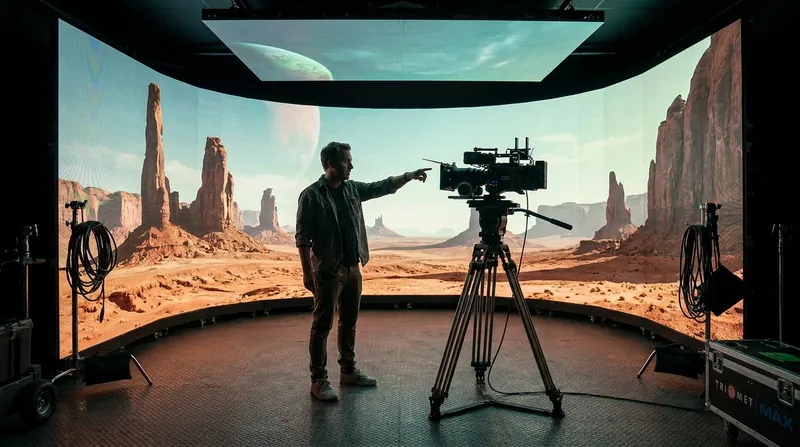
An LED volume is essentially a colossal, curved video wall that wraps around a physical soundstage. Instead of waiting months for post-production artists to digitally paint a background, filmmakers use powerful video game software, like Epic Games' Unreal Engine, to render photorealistic 3D environments in real-time. If a scene requires a sunset on Mars, the LED volume displays a mathematically accurate Martian sunset right there on the set, allowing the director and the actors to see the final frame before they even call action.
The true magic of the LED volume lies in how it seamlessly interacts with the physical camera. Through advanced tracking technology, the digital background moves in perfect synchronization with the camera lens. This creates flawless 'parallax'—the optical illusion where background objects appear to move slower than foreground objects—tricking the human eye into perceiving infinite depth on a flat screen. The result is a digital environment that behaves exactly like a physical location, responding to every pan and tilt with absolute mathematical precision.[1]
More importantly, the LED volume solves the most notoriously difficult problem in visual effects: lighting integration. When a digital explosion erupts on the LED wall, it casts genuine, flickering amber light onto the actors' faces, the shiny hood of a prop car, and the physical dirt on the floor. This level of physical integration is incredibly difficult and expensive to fake with a green screen, but an LED volume achieves it naturally, in-camera, ensuring that the digital and physical worlds share the exact same lighting ecosystem.
This is precisely where virtual production meets the practical effects resurgence. Because the lighting is now hyper-realistic, filmmakers are emboldened to bring physical creatures, prosthetics, and animatronics back to the foreground. Recent horror and sci-fi hits have earned widespread acclaim for eschewing digital monsters in favor of physical puppets and intricate makeup. Directors are proving that tangible textures—sweat, silicone, and fake blood—still provoke the most visceral reactions from audiences when they are lit perfectly by a dynamic digital background.
Today's practical effects are vastly superior to the clunky rubber suits of the 1980s. The modern creature shop operates more like a high-tech robotics laboratory. Effects artists now utilize 3D-printed clear materials, sintered metals, and advanced robotic servos that are entirely silent, allowing animatronic characters to perform complex facial expressions without ruining the on-set audio recording. In fact, leading special effects studios report that over 60% of their physical props now rely on advanced robotic manufacturing to achieve lifelike fluidity.
Artificial intelligence is also accelerating this hybrid workflow, making it more accessible to a wider range of productions. Building the massive 3D environments required for an LED volume used to take a Virtual Art Department (VAD) months of manual labor. Now, AI-driven pipelines can instantly convert 2D concept art into fully rendered, 360-degree 3D models with millions of polygons. By 2026, over half of all major productions are utilizing AI to streamline their pre-production asset generation, drastically reducing the bottleneck of world-building.[2]
The economic implications of this technological shift are profound for the studio system. While building a professional-grade LED volume requires a steep upfront investment—often ranging from $300,000 to well over $1 million—the long-term savings are undeniable. Productions no longer need to fly hundreds of crew members to remote locations, wait for the perfect weather, or spend millions 'fixing it in post.' The ability to shoot a sunrise scene for twelve consecutive hours fundamentally alters the mathematics of a production schedule.[1]
This consolidation of production also offers a massive, often overlooked win for environmental sustainability. By minimizing international travel, reducing the need for sprawling physical set construction, and cutting down on material waste, virtual production drastically lowers the carbon footprint of a major blockbuster. The film industry is slowly discovering that the most environmentally friendly location shoot is the one that never leaves the soundstage, allowing studios to hit their climate goals without sacrificing the epic scale of their storytelling.
Challenges certainly remain as the industry adapts to this new paradigm. Cinematographers must navigate latency issues, complex color calibration between the physical lights and the LED screens, and a steep learning curve for crews accustomed to traditional workflows. Furthermore, the sheer perfection of digital environments can sometimes feel sterile if not properly grounded by physical messiness. Directors must actively remember to introduce dust, smoke, and human imperfection into the frame to keep the illusion from feeling like a video game cutscene.[1][2]
Ultimately, the tactile renaissance represents a maturing of cinematic technology. For decades, visual effects were used simply because they could be; now, they are being used strategically to enhance what is physically there. By blending the boundless imagination of real-time digital rendering with the irreplaceable weight of human craftsmanship, Hollywood is ensuring that the theatrical experience remains as magical—and as real—as ever. The future of filmmaking isn't entirely digital or entirely practical; it is a seamless, beautiful hybrid of the two.[2]
Key terms
- LED Volume
- A large, curved wall of high-resolution screens that displays real-time 3D environments behind actors during filming.
- Parallax
- The optical effect where background objects appear to move slower than foreground objects as the camera moves, creating a sense of depth.
- In-Camera VFX
- Visual effects that are captured directly through the camera lens on set, rather than added months later in post-production.
- Unreal Engine
- A powerful real-time 3D creation tool, originally designed for video games, now widely used to render photorealistic film backgrounds.
- Animatronics
- The use of robotic devices and servos to emulate a human or creature, bringing physical characters to life on set.
Frequently asked
Why are movies moving away from green screens?
Green screens require actors to perform to empty space and often create lighting mismatches. LED volumes solve this by casting realistic light and reflections directly onto the set.
Does virtual production mean the end of practical effects?
No, it is actually causing a resurgence. Filmmakers are blending physical props, dirt, and animatronics in the foreground with digital LED backgrounds for maximum realism.
Are LED volumes cheaper than traditional filming?
They require a massive upfront investment, but they save millions in the long run by eliminating location travel, reducing weather delays, and drastically cutting post-production time.
Viewpoints in depth
Practical Purists
Advocates for in-camera physical effects and tangible stakes.
This camp, often led by veteran directors and horror auteurs, argues that audiences possess an innate ability to detect digital weightlessness. They point to the massive box office returns of stunt-heavy films as proof that viewers crave physical reality. For purists, the friction of the real world—unpredictable weather, the physical limitations of a stunt performer, the texture of real dirt—is what gives cinema its soul, and they warn against over-relying on even the most advanced digital screens.
Virtual Production Pioneers
Technologists who view LED volumes as the ultimate democratization of filmmaking.
Proponents of virtual production emphasize the unprecedented creative control the technology offers. By rendering environments in real-time, directors can change the time of day, move mountains, or adjust lighting with a few keystrokes, completely eliminating the dreaded 'fix it in post' mentality. They argue that LED volumes allow filmmakers to focus entirely on the actors' performances, rather than the logistics of a location shoot, ultimately serving the story better.
Hybrid Technologists
Industry pragmatists who believe the future lies in blending both disciplines.
The emerging consensus in Hollywood belongs to the hybrid camp. These professionals argue that the debate between practical and digital is a false dichotomy. The most convincing visual effects occur when a physical object—a prosthetic, an animatronic, or a physical set piece—is placed in the foreground, seamlessly blending into an LED volume background. This approach grounds the digital world in reality, providing the perfect balance of boundless imagination and tactile authenticity.
- Virtual Production Pioneers
- Technologists championing LED volumes and real-time rendering for creative control.
- Hybrid Technologists
- Pragmatists focused on blending physical craftsmanship with digital backgrounds.
- Practical Purists
- Advocates for physical effects, tangible stakes, and in-camera authenticity.
Perspectives this story doesn't cover
- Independent filmmakers priced out of the tech
- Traditional location scouts
Sources
Source coverage
2 outlets
3 viewpoints surfaced


- [1]ResearchGateVirtual Production Pioneers
Virtual Production with LED Volumes: Cinematic Paradigm Shift
Read on ResearchGate → - [2]Factlen Editorial TeamHybrid Technologists
Synthesis by Factlen editorial team
Read on Factlen Editorial Team →
More in Entertainment
See all →Hollywood Economy
Hollywood's Structural Shift: Why LA Production Remains Down 50% Post-Strike
3 sources
Box Office Record
Michael Jackson Biopic 'Michael' Becomes Highest-Grossing Biopic of All Time With $977 Million Worldwide
3 sources
Box Office Trends
Original Storytelling and Mid-Budget Films Fuel Hollywood's 2026 Box Office Resurgence
3 sources
AI Filmmaking
How AI Visual Effects Are Giving Indie Filmmakers Hollywood-Level Capabilities
4 sources
Comments
Every angle. Every day.
Get Entertainment stories with full source coverage and perspective breakdowns, free every day.