
The Supreme Court's Unanimous Decisions: Why the Justices Agree More Often Than You Think
While high-profile 5-4 splits dominate the headlines, statistical data reveals that unanimous 9-0 rulings are actually the most common outcome at the U.S. Supreme Court.
By Factlen Editorial Team
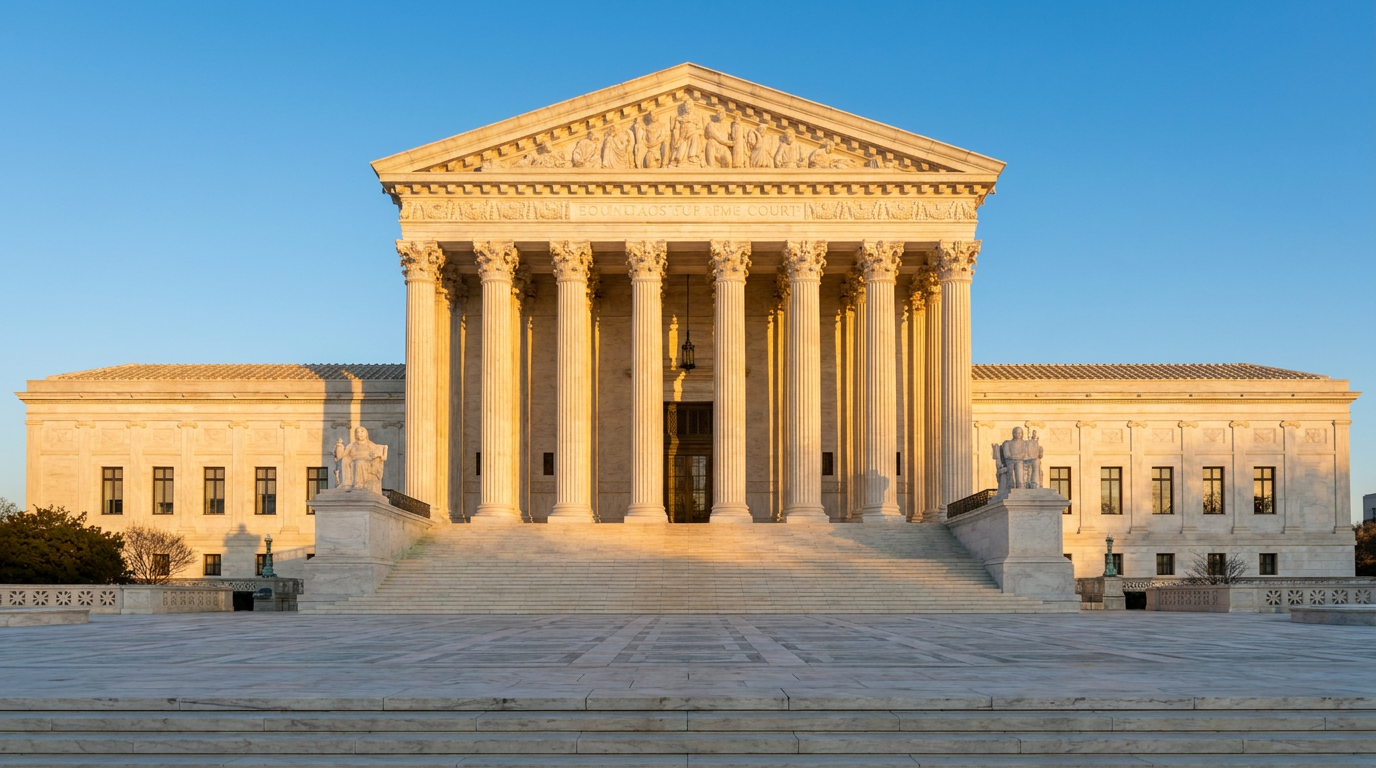
- Data Analysts & Legal Scholars
- Emphasize empirical data showing that technical statutory interpretation naturally leads to high agreement rates.
- Institutionalists
- Focus on the Court's structural design and the Chief Justice's role in forging consensus to maintain legitimacy.
- Court Watchers & Media Critics
- Argue that the media disproportionately amplifies 5-4 rulings, distorting the public's perception of a functioning judiciary.
What's not represented
- · Lower court judges who must apply these rulings
- · Litigants in technical statutory cases
Why this matters
Understanding how often the Supreme Court agrees counters the narrative of a hopelessly polarized judiciary. It provides citizens with a more accurate, reassuring picture of how the nation's highest legal institution actually functions.
Key points
- Unanimous 9-0 decisions are the most common outcome at the Supreme Court, averaging 36% to 48% of cases in recent terms.
- Highly publicized 5-4 splits account for only about 19% of the Court's merits docket.
- The high rate of consensus is driven by the Court's focus on resolving technical statutory disputes and circuit splits.
- Chief Justices actively encourage unanimous rulings to project stability and maintain public trust in the judiciary.
The popular image of the United States Supreme Court is often one of bitter, partisan division, with justices locked in perpetual 5-4 battles over the nation's most contentious and emotionally charged issues. Cable news panels and social media feeds frequently amplify the narrative of a hopelessly polarized judiciary, suggesting that every major legal question is decided by a razor-thin margin along strict ideological lines. However, the statistical reality of the nation's highest court tells a remarkably different, and far more unifying, story. When looking beyond the handful of blockbuster cases that capture the public's attention each June, the data reveals an institution where broad agreement is the norm rather than the exception.[3][7]
According to extensive data compiled by legal scholars and the Supreme Court Database, unanimous 9-0 decisions are actually the most common outcome at the Court, far outpacing the narrow splits that dominate evening news broadcasts. In a typical modern term, between 36 percent and 48 percent of all cases are decided unanimously, with all nine justices agreeing on the final judgment. By contrast, the highly publicized 5-4 or 5-3 decisions historically account for only about 19 percent to 20 percent of the Court's docket. This means that a citizen is roughly twice as likely to see the justices speak with a single, unified voice than to see them narrowly divided on a legal question.[1][4]
This strong baseline of consensus has held remarkably steady even during recent terms marked by high-profile controversies and shifts in the Court's ideological makeup. For example, during the 2022-2023 term, nearly half of the Court's decisions—48 percent—were unanimous, representing a significant increase from the previous year. The trend of broad agreement continued into the following terms; in mid-2024, the Court notably released four unanimous opinions on a single day, demonstrating a united front across a wide variety of complex legal questions. These figures consistently surprise court watchers and the general public alike, challenging the assumption that the justices are incapable of finding common ground.[2][4]

Why do justices with vastly different judicial philosophies, appointed by presidents from opposing political parties, agree so often? The answer lies largely in the mechanics of the certiorari process—the rigorous procedure by which the Court selects the cases it will hear. The Supreme Court is not primarily a trial court designed to weigh evidence or determine guilt; it is a court of review that accepts only about 60 to 70 cases from the thousands of petitions it receives each year. The justices deliberately select cases that allow them to clarify the law, often prioritizing disputes where lower courts have reached contradictory conclusions.[3][7]
The modern shape of this docket traces back to the Judges Act of 1925, a pivotal piece of legislation championed by Chief Justice William Howard Taft. This act fundamentally transformed the Supreme Court by giving the justices far greater discretion to choose which cases they would review, rather than being forced to hear every appeal. By allowing the Court to focus primarily on novel, thorny legal questions of national importance, the legislation shifted the Court's role toward clarifying federal law. While this initially caused a drop in the astronomical unanimity rates of the 19th century, it established the modern baseline where the Court actively seeks out the most complex legal puzzles to solve.[3][6]
The modern shape of this docket traces back to the Judges Act of 1925, a pivotal piece of legislation championed by Chief Justice William Howard Taft.
Today, many of these selected cases are chosen specifically to resolve "circuit splits," situations where different federal appeals courts have interpreted a federal law or agency regulation in conflicting ways. When a law means one thing in California and something entirely different in New York, the Supreme Court steps in to ensure federal law is applied uniformly across the country. In these instances, the justices are frequently tasked with interpreting highly technical, complex statutes—such as the Employee Retirement Income Security Act (ERISA), arcane tax provisions, or intricate bankruptcy codes.[3][7]

In these deeply technical arenas, the text of the law often points to a clear, albeit dry, legal answer. When applying standard tools of statutory interpretation to these less glamorous cases, the justices frequently arrive at the exact same legal conclusion, regardless of their personal or political philosophies. The rigorous process of textual analysis, combined with the extensive research provided by their law clerks and the specialized arguments presented by expert appellate advocates, naturally drives the Court toward a single, legally sound resolution.[6][7]
Furthermore, there is a strong institutional drive toward consensus that shapes how the justices deliberate and draft their opinions. Chief Justices historically view unanimous opinions as vital for maintaining the Court's legitimacy and projecting stability to the lower courts and the American public. Behind the scenes, the justices frequently negotiate over the precise wording of an opinion, narrowing the scope of their rulings to find common legal ground that all nine members can accept. When the Court speaks with one voice, it signals that the issue was decided on firm, objective legal principles rather than partisan preferences, which helps to build and sustain public trust in the judiciary as an independent institution.[1][4][6]
However, legal scholars and seasoned court watchers caution that unanimity does not always mean the cases were simple, nor does it imply that the justices agreed on every single detail of the law. As the late Justice Antonin Scalia once noted, there is often no relationship between the difficulty of a case and its public importance; a seemingly insignificant statutory dispute can be incredibly difficult to resolve. Justices frequently issue concurring opinions in 9-0 cases, meaning they agree with the final outcome for the specific litigants involved, but they fundamentally disagree with the broader legal reasoning used by the majority to arrive at that destination.[3][5]

Additionally, it is important to recognize that the statistics on unanimity primarily reflect the Court's merits docket—the carefully selected cases that receive full written briefing, amicus curiae support, and hours of oral argument. The data does not fully capture the dynamics of the so-called "shadow docket," which consists of emergency orders and summary decisions where the Court often rules quickly, sometimes late at night, and occasionally with less visible consensus. Nevertheless, the sheer volume of unanimous rulings on the merits serves as a powerful reminder that the American judicial system functions largely on agreement, shared legal frameworks, and a profound commitment to the rule of law. For citizens navigating a polarized political climate, the data offers a reassuring perspective: the highest court in the land is defined far more by its quiet consensus than its loud divisions.[1][6][7]
How we got here
1925
Congress passes the Judges Act, giving the Supreme Court greater discretion to choose which cases it hears, focusing on novel legal questions.
1946-2000
The Court averages a roughly 40-50% unanimity rate as it shifts toward resolving complex circuit splits.
2000-Present
Unanimous decisions remain the most common outcome, averaging 36% of all rulings over two decades.
2022-2023 Term
The Court reaches a recent high in consensus, deciding 48% of its merits docket cases unanimously.
Viewpoints in depth
Institutionalists
Focus on the Court's structural design and the Chief Justice's role in forging consensus.
Institutionalists argue that the Supreme Court's high rate of unanimity is a deliberate feature of its design. Chief Justices historically work behind the scenes to narrow the scope of rulings, finding common legal ground that all nine justices can accept. This consensus-building is viewed as essential for maintaining the Court's legitimacy, as unanimous rulings project stability and provide clear, unambiguous guidance to lower federal courts.
Data Analysts & Legal Scholars
Emphasize empirical data showing that technical statutory interpretation naturally leads to high agreement rates.
Legal scholars point to the data to explain the consensus: the vast majority of the Court's docket does not involve hot-button constitutional crises. Instead, the justices spend most of their time interpreting dense, highly technical federal statutes like tax codes or employment regulations. In these cases, the justices apply standard tools of statutory interpretation, which frequently lead them to the exact same legal conclusion regardless of their personal or political philosophies.
Court Watchers & Media Critics
Argue that the media disproportionately amplifies 5-4 rulings, distorting the public's perception.
Media critics contend that the public's perception of a bitterly divided Court is largely an artifact of news coverage. Because 5-4 decisions typically involve the most emotionally resonant and politically charged issues, they dominate headlines and cable news debates. This disproportionate coverage obscures the quiet, everyday functioning of the judiciary, leaving the public unaware that 9-0 is actually the most common outcome.
What we don't know
- Whether the recent trend of the Court taking fewer cases overall will eventually lead to a higher percentage of divided rulings.
- The exact degree of consensus on the 'shadow docket,' where emergency orders are issued without full briefing or public vote breakdowns.
Key terms
- Certiorari (Cert)
- The formal process by which the Supreme Court agrees to hear a case from a lower court.
- Circuit Split
- A situation where two or more different federal appeals courts issue contradictory rulings on the same legal issue.
- Concurring Opinion
- An opinion written by a justice who agrees with the final outcome of a case but relies on different legal reasoning than the majority.
- Shadow Docket
- Emergency orders and summary decisions issued by the Supreme Court outside of its regular, fully briefed merits docket.
- Merits Docket
- The primary group of cases the Supreme Court agrees to hear, which receive full written briefs and oral arguments.
Frequently asked
Does a 9-0 decision mean the case was easy?
Not necessarily. Unanimous decisions often involve highly complex, technical interpretations of federal statutes where the justices ultimately find a single correct legal answer after extensive deliberation.
Why do we only hear about the 5-4 decisions?
Narrowly divided cases usually involve the most culturally or politically controversial issues, which naturally draw the most media attention and public debate.
Do justices appointed by different presidents ever agree?
Yes, frequently. The data shows that justices appointed by presidents from opposing political parties regularly join the same majority opinions, especially in cases involving business law, administrative procedures, and statutory interpretation.
Sources
Source coverage
7 outlets
3 viewpoints surfaced







[1]The Washington PostData Analysts & Legal Scholars
Those 5-to-4 decisions on the Supreme Court? 9 to 0 is far more common.
Read on The Washington Post →[2]NewsweekCourt Watchers & Media Critics
Supreme Court Just Dropped Four Unanimous Opinions in One Day
Read on Newsweek →[3]National ReviewCourt Watchers & Media Critics
The Supreme Court Isn't as Divided as You Think
Read on National Review →[4]The Federalist SocietyInstitutionalists
The Numbers Reveal a United Supreme Court, and a Few Surprises
Read on The Federalist Society →[5]Constitution DailyInstitutionalists
In the Supreme Court, unanimous decisions aren't necessarily the 'easy' cases
Read on Constitution Daily →[6]Stanford University PressData Analysts & Legal Scholars
The Puzzle of Unanimity: Consensus on the United States Supreme Court
Read on Stanford University Press →[7]Factlen Editorial TeamData Analysts & Legal Scholars
Synthesis by Factlen editorial team
Read on Factlen Editorial Team →
Every angle. Every day.
Get law justice stories with full source coverage and perspective breakdowns delivered to your inbox.