
The Solid-State Battery Revolution: How 2026 Became the Turning Point for Next-Gen Energy
After decades of laboratory research, solid-state batteries are crossing the threshold into commercial reality in 2026. While mass-market electric vehicles remain a few years away, breakthroughs in semi-solid designs and premium EV testing are fundamentally reshaping the future of global energy storage.
By Factlen Editorial Team
- Commercial Battery Manufacturers
- Focused on scalable production, yield rates, and cost-efficiency.
- Materials Scientists & Researchers
- Focused on fundamental physics, interface resistance, and unlocking maximum energy density.
- Consumer Electronics Innovators
- Focused on immediate, smaller-scale applications where premium costs are acceptable.
What's not represented
- · Raw material mining sector
- · End-of-life battery recyclers
Why this matters
Solid-state batteries promise to double the range of electric vehicles, slash charging times to minutes, and eliminate the risk of battery fires. As this technology moves from the laboratory to the assembly line, it marks the most significant leap in energy storage since the invention of the lithium-ion battery, poised to accelerate the electrification of everything from cars to aviation.
Key points
- Solid-state batteries replace flammable liquid electrolytes with solid ceramics or polymers.
- The technology eliminates the risk of thermal runaway and battery fires.
- Solid separators allow for lithium metal anodes, potentially doubling energy density.
- Manufacturing the solid-solid interface remains a significant engineering bottleneck.
- Semi-solid hybrid batteries are serving as a commercial stepping stone in 2026.
For over a decade, the solid-state battery has been the white whale of the energy sector—a theoretical marvel promising to double the range of electric vehicles while entirely eliminating the risk of fire. It has been the subject of countless breathless headlines and delayed timelines, often feeling perpetually five years away.[1]
In 2026, that theoretical marvel is finally crossing the threshold into commercial reality. While mass-market electric vehicles powered entirely by solid-state cells remain a few years away, the technology is no longer confined to laboratory testing. It is actively reshaping industrial roadmaps and appearing in early-stage commercial products.[1][5]
The shift is already generating real-world milestones that were impossible just a few years ago. In a landmark test, a Mercedes-Benz EQS equipped with lithium-metal solid-state cells developed by Factorial recently drove 1,205 kilometers (748 miles) from Stuttgart to Malmö on a single charge, operating on ordinary highways rather than a closed test track.[4]
To understand why this matters, one must look inside the battery cell itself. Traditional lithium-ion batteries, which power everything from smartphones to the current generation of electric vehicles, rely heavily on a liquid electrolyte.[7]
This liquid acts as a chemical highway, allowing lithium ions to shuttle back and forth between the battery's cathode (the positive side) and anode (the negative side) during the charging and discharging process.[7]
However, liquid electrolytes come with inherent vulnerabilities. They are composed of volatile organic solvents that can ignite if the battery is punctured, overcharged, or exposed to extreme heat. This can trigger a dangerous chain reaction known as thermal runaway.[7]

Solid-state batteries replace this flammable liquid with a solid material, typically a ceramic, sulfide, or polymer-based compound. This solid layer acts as both the electrolyte and the physical separator between the electrodes.[2][7]
This single architectural change unlocks a cascade of benefits. By eliminating the liquid solvent, the battery becomes fundamentally safer. Thermal events in solid-state systems require significantly higher temperatures to trigger, and even when they do occur, they develop far more slowly and with less intensity.[2]
This single architectural change unlocks a cascade of benefits.
But the most lucrative prize for automakers is energy density—the amount of power a battery can hold relative to its weight, measured in watt-hours per kilogram (Wh/kg). Higher energy density means a vehicle can drive further without adding extra weight.[2]
Because the solid electrolyte is mechanically rigid, it acts as a physical barrier against "dendrites." These are microscopic, needle-like metallic whiskers that can grow from the anode during fast charging, eventually piercing the separator and causing a short circuit in liquid batteries.[7]
With dendrite growth suppressed by the solid barrier, engineers can replace the heavy graphite anodes used in standard batteries with pure lithium metal. This is the "golden combination" that battery chemists have been chasing for decades.[7]
This substitution drastically shrinks the size and weight of the cell. While today's best lithium-ion batteries max out around 250 to 300 Wh/kg, solid-state designs are targeting 400 to 500 Wh/kg, effectively doubling the energy capacity in the same physical footprint.[2]

State-owned manufacturer Dongfeng Motor is already advancing production plans for an oxide-polymer cell scheduled for integration in late 2026. This proprietary pack achieves 350 Wh/kg and drops total battery pack weight by 30% compared to conventional liquid lithium assemblies.[6]
Despite these breakthroughs, true all-solid-state batteries face a formidable manufacturing bottleneck: the solid-solid interface. Building a prototype in a lab is one thing; manufacturing millions of them flawlessly is another.[5][6]
In a liquid battery, the electrolyte naturally flows into every microscopic crevice of the electrodes, ensuring perfect electrical contact. In a solid-state battery, pressing two rigid solid materials together leaves microscopic gaps, which increases internal electrical resistance and degrades performance.[6]
To solve this, manufacturers must use extreme measures. CATL chairman Dr. Robin Zeng recently noted that engineers currently utilize warm isostatic pressing at 6,000 atmospheres to bind the components together—a process that is difficult, slow, and expensive to scale to millions of vehicles.[6]

Because of these engineering constraints, the industry is embracing a phased rollout. The immediate commercial solution in 2026 is the "semi-solid" or hybrid battery, which uses a mostly solid electrolyte but retains a tiny amount of liquid or gel to bridge the interface gaps and ensure conductivity.[5][8]
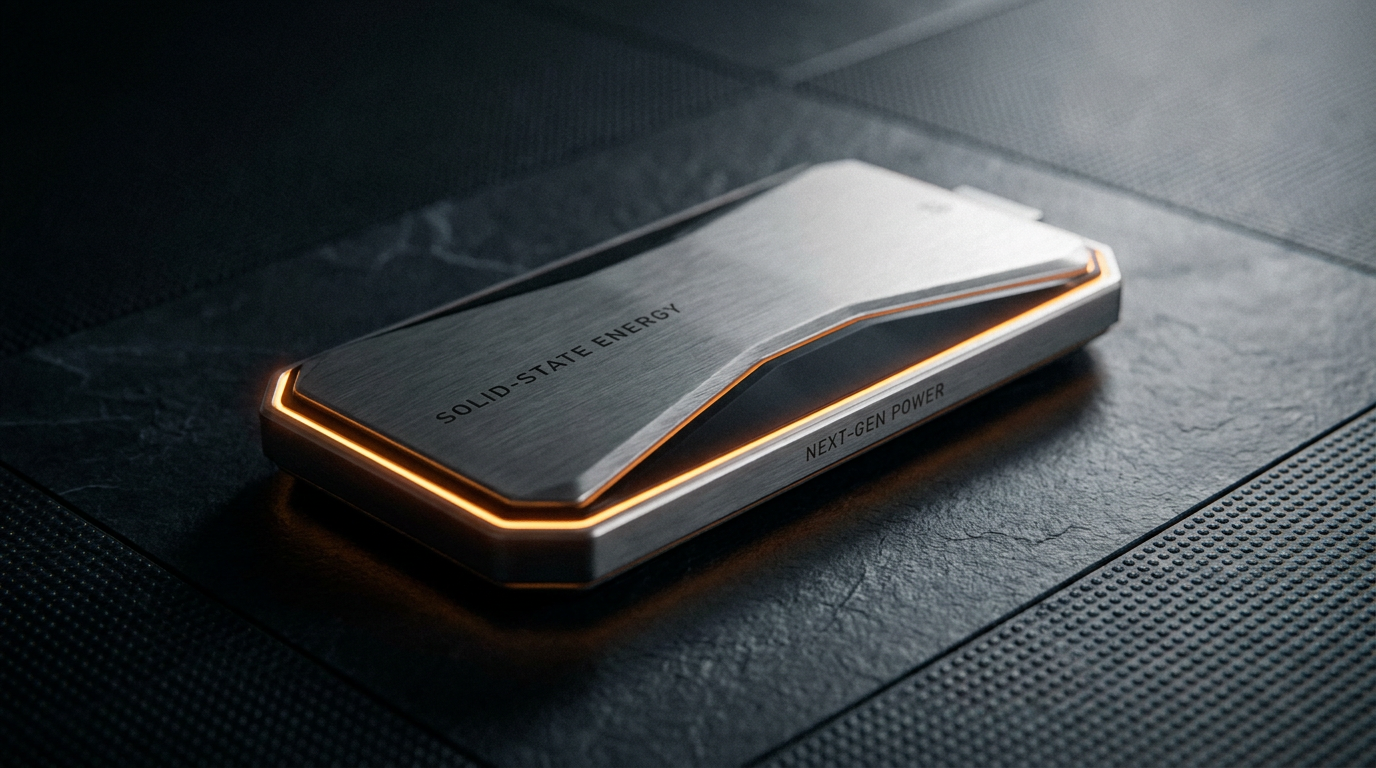
These semi-solid cells are already hitting the market in high-margin, low-volume applications. At CES 2026, consumer brands debuted ultra-slim power banks utilizing semi-solid tech, while industrial sectors are actively deploying them in commercial drones and specialized robotics where safety and weight are paramount.[3][8]
How we got here
1991
Sony commercializes the first lithium-ion battery, setting the standard for portable electronics.
2010s
Research into solid electrolytes accelerates as the limitations of liquid lithium-ion become apparent.
2024
Early semi-solid battery prototypes begin appearing in specialized industrial applications.
August 2025
A Mercedes-Benz EQS completes a 1,205 km highway test using lithium-metal solid-state cells.
January 2026
Consumer brands debut the first ultra-slim power banks utilizing semi-solid technology at CES.
July 2026
China is scheduled to release its first official industry standard for solid-state batteries.
Viewpoints in depth
Commercial Battery Manufacturers
Focused on scalable production, yield rates, and cost-efficiency.
For giants like CATL and traditional automakers, the solid-state transition is viewed through the lens of manufacturing reality. They argue that while the chemistry is proven, the mechanical challenges of mass-producing solid-solid interfaces at scale remain daunting. Their strategy relies on a phased approach, prioritizing semi-solid hybrid batteries that can be produced using modified versions of existing liquid-battery assembly lines, rather than waiting for pure solid-state perfection.
Materials Scientists & Researchers
Focused on fundamental physics, interface resistance, and unlocking maximum energy density.
The academic and research community views solid-state technology as a fundamental paradigm shift in electrochemistry. Their primary focus is on solving the 'interface problem'—finding novel ways to ensure perfect contact between rigid solid materials without requiring extreme pressure. They champion the use of pure lithium metal anodes, arguing that once the dendrite problem is fully solved by solid separators, the resulting leap in energy density will render current liquid-based architectures obsolete.
Consumer Electronics Innovators
Focused on immediate, smaller-scale applications where premium costs are acceptable.
While the automotive industry waits for economies of scale, consumer electronics and specialized industrial manufacturers are moving aggressively. They argue that solid-state and semi-solid batteries are already viable for high-margin products like ultra-slim power banks, industrial drones, and specialized robotics. For this camp, the technology doesn't need to reach price parity with standard lithium-ion to be successful; it simply needs to offer a unique performance advantage in size or safety.
What we don't know
- Whether the extreme manufacturing pressures required for solid-solid interfaces can be cost-effectively scaled for mass-market vehicles.
- Exactly how long true solid-state batteries will last over thousands of charge cycles in harsh, real-world winter conditions.
- Which specific solid electrolyte material (sulfide, oxide, or polymer) will ultimately dominate the global market.
Key terms
- Electrolyte
- The medium inside a battery that allows ions to flow between the positive and negative ends during charging and discharging.
- Anode
- The negative electrode of a battery, which stores lithium ions when the battery is fully charged.
- Energy Density
- A measure of how much power a battery can store relative to its weight, typically expressed in watt-hours per kilogram (Wh/kg).
- Dendrites
- Microscopic, needle-like metallic structures that can grow inside a battery and cause short circuits; solid-state batteries are designed to block them.
- Thermal Runaway
- An unstoppable chain reaction inside a battery where excess heat causes further heating, often resulting in a fire or explosion.
Frequently asked
What exactly is a solid-state battery?
It is a battery that replaces the flammable liquid electrolyte found in traditional lithium-ion batteries with a solid material, such as a ceramic or polymer, to conduct ions.
Why are solid-state batteries considered safer?
By eliminating volatile liquid solvents, solid-state batteries remove the primary fuel source for battery fires and thermal runaway, allowing them to operate safely at much higher temperatures.
When will solid-state electric vehicles be widely available?
While premium EVs with semi-solid batteries are entering the market now, industry leaders expect true, mass-market all-solid-state vehicles to arrive in the early 2030s.
What is a semi-solid battery?
A transitional technology that uses a mostly solid electrolyte but retains a small amount of liquid or gel to ensure good electrical contact between the battery's internal components.
Sources
Source coverage
8 outlets
3 viewpoints surfaced








[1]Factlen Editorial Team
Synthesis by Factlen editorial team
Read on Factlen Editorial Team →[2]IDTechExMaterials Scientists & Researchers
Solid-State and Polymer Batteries 2026-2036
Read on IDTechEx →[3]The American Ceramic SocietyConsumer Electronics Innovators
Solid-state batteries turn heads at CES 2026
Read on The American Ceramic Society →[4]EleportCommercial Battery Manufacturers
New Battery Technologies 2026 Delivered
Read on Eleport →[5]Battery Tech OnlineMaterials Scientists & Researchers
Reality Check: Solid-State Batteries in 2026
Read on Battery Tech Online →[6]CarNewsChinaCommercial Battery Manufacturers
CATL Chairman: Solid-State Battery Mass Production Before 2030 Unlikely
Read on CarNewsChina →[7]WikipediaMaterials Scientists & Researchers
Solid-state battery
Read on Wikipedia →[8]XT BatteryConsumer Electronics Innovators
Semi Solid Batteries: The Real Commercial Solution in 2026
Read on XT Battery →
Every angle. Every day.
Get guides stories with full source coverage and perspective breakdowns delivered to your inbox.