
The Science of the Maillard Reaction: How Heat Transforms Flavor
The Maillard reaction is the complex chemical process responsible for the browned crust on a steak, the golden color of baked bread, and the rich aroma of roasted coffee. Understanding this interaction between amino acids and sugars is the key to unlocking professional-level flavor in home cooking.
By Factlen Editorial Team
- Culinary Scientists
- Focus on the chemical mechanisms, temperature control, and the generation of volatile flavor compounds.
- Nutritional Researchers
- Focus on the balance between flavor enhancement and the generation of potentially harmful byproducts.
- Home Cooks & Educators
- Focus on practical kitchen applications, such as drying meat before searing and understanding oven temperatures.
What's not represented
- · Industrial Food Manufacturers
- · Flavor Chemists
Why this matters
Mastering the Maillard reaction allows home cooks to intentionally manipulate heat, moisture, and pH to build complex flavor profiles that elevate everyday meals. By understanding the science behind browning, you can stop relying on guesswork and start cooking with precision.
Key points
- The Maillard reaction is a chemical process between amino acids and reducing sugars that creates hundreds of flavor compounds.
- It requires temperatures between 280°F and 330°F, which is why boiling or steaming food does not produce browning.
- The reaction is distinct from caramelization, which involves the breakdown of sugars alone without the presence of proteins.
- While it enhances flavor, cooking at excessively high temperatures can produce potentially harmful byproducts like acrylamide.
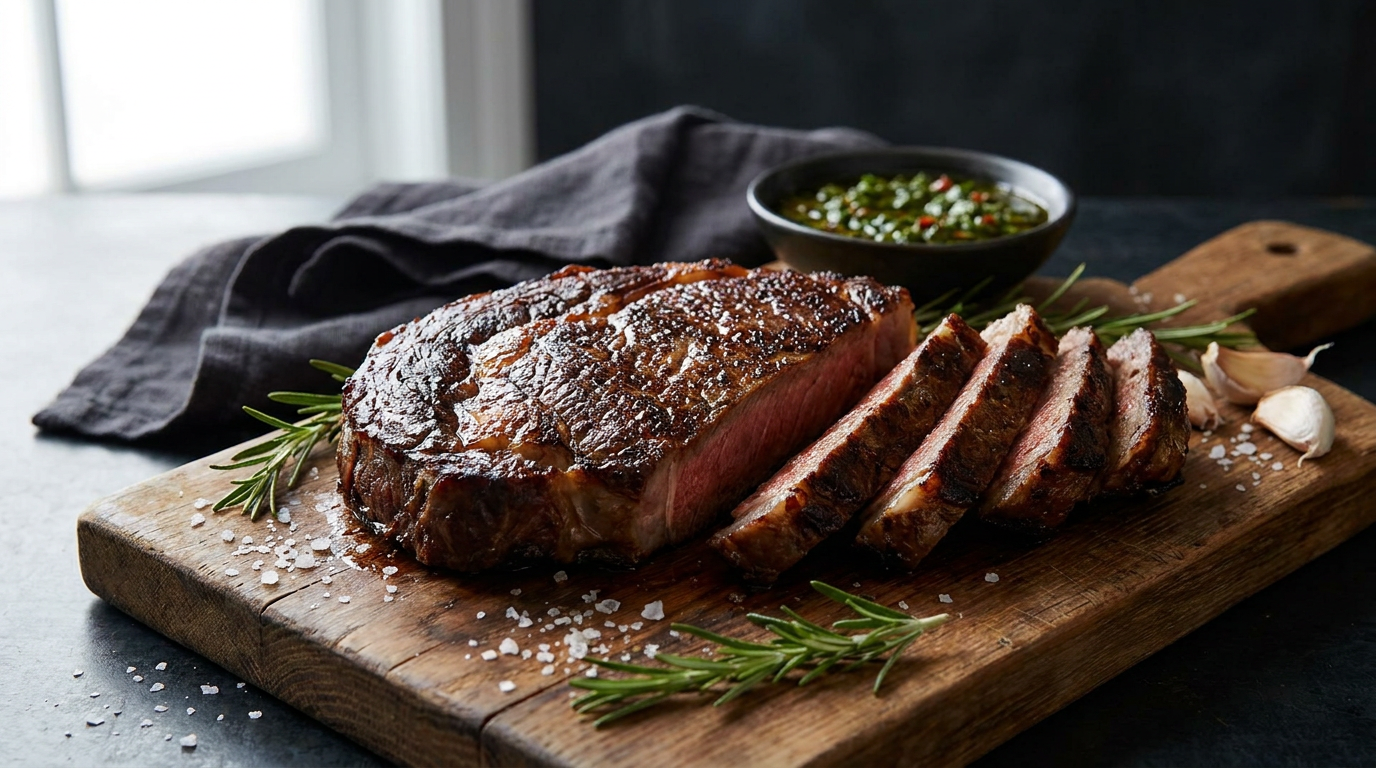
Every time a steak hits a hot cast-iron pan, a loaf of bread turns golden in the oven, or coffee beans are roasted to a deep brown, a microscopic transformation occurs that fundamentally alters the way we experience food. This process is not merely a change in color, but a cascade of chemical interactions that generate hundreds of entirely new flavor and aroma compounds. Known as the Maillard reaction, this phenomenon is the dividing line between food that is merely cooked and food that is profoundly flavorful. It is the culinary engine behind the savory depth of roasted vegetables, the malty notes of dark beer, and the irresistible scent of toasted marshmallows.[2][3]
Despite its ubiquity in kitchens around the world, the Maillard reaction was not discovered by a chef, but by a French chemist and physician named Louis-Camille Maillard. In 1912, Maillard was attempting to reproduce biological protein synthesis in a laboratory setting when he observed that heating a solution of amino acids and sugars resulted in a distinct browning effect. While he was focused on cellular biology, his discovery inadvertently unlocked the scientific explanation for why humans have preferred the taste of roasted and seared foods since the discovery of fire.[1][4]
At its core, the Maillard reaction is a form of non-enzymatic browning that requires two primary building blocks: amino acids, which are the structural components of proteins, and reducing sugars, such as glucose or fructose. When these two elements are subjected to heat, the reactive carbonyl group of the sugar binds with the nucleophilic amino group of the amino acid. This initial collision forms an unstable intermediate compound known as an N-substituted glycosylamine, alongside a molecule of water.[4][5]

This initial step is only the beginning of a highly complex and somewhat unpredictable chain reaction. The glycosylamine quickly undergoes a structural rearrangement to become a ketosamine. From there, the ketosamines break down and recombine in myriad ways, producing a vast array of volatile flavor compounds. Depending on the specific amino acids and sugars present in the raw ingredient, the reaction can yield pyrazines that taste roasted or toasted, furans that impart a sweet or caramel-like aroma, and thiophenes that provide a meaty, savory depth.[3][4]
Ultimately, these pathways converge to form melanoidins, the large, complex polymer molecules that give browned foods their characteristic dark pigmentation. Melanoidins do more than just alter appearance; they actively participate in flavor expression. Recent research into coffee roasting, for example, has demonstrated that melanoidins can actually bind with caffeine molecules, modifying their sensory impact and suppressing the intense bitterness that caffeine would otherwise impart to the brew.[5][6]
For the Maillard reaction to occur at a rapid, noticeable pace, the cooking environment must reach a specific temperature threshold, typically between 280°F and 330°F (140°C to 165°C). This temperature requirement explains why boiling or steaming food—which caps the surface temperature at the boiling point of water, 212°F (100°C)—will never produce a browned crust or the associated savory flavors. The surface of the food must exceed the boiling point of water for the reaction to thrive.[2][3]

This temperature dependence is also the scientific reason why nearly every baking recipe instructs the cook to preheat the oven to 350°F. While the internal temperature of a cake or a loaf of bread remains much lower as its moisture slowly evaporates, the ambient heat of a 350°F oven ensures that the exterior surface quickly reaches the 280°F to 330°F sweet spot. This triggers the Maillard reaction to create a golden, flavorful crust before the interior overbakes.[1]
This temperature dependence is also the scientific reason why nearly every baking recipe instructs the cook to preheat the oven to 350°F.
Moisture is the natural enemy of the Maillard reaction. Because the initial chemical bonding between the sugar and the amino acid releases a molecule of water, the presence of excess surface moisture pushes the chemical equilibrium backward, inhibiting the reaction. Furthermore, any water on the surface of a steak or a vegetable must be boiled off before the surface temperature can rise above 212°F. This is why culinary scientists and professional chefs emphasize the importance of thoroughly patting meat dry with a paper towel before searing it in a hot pan.[2][3]
A common point of confusion in both home and professional kitchens is the distinction between the Maillard reaction and caramelization. While both processes result in browning and are promoted by heat, they are fundamentally different chemical mechanisms. Caramelization is the pyrolysis, or thermal decomposition, of sugars in the absence of amino acids. It requires significantly higher temperatures—often above 338°F (170°C)—and produces a different set of flavor compounds, primarily sweet, nutty, and slightly bitter notes.[3][4]

In many cooking scenarios, such as baking a brioche or roasting a sweet potato, both the Maillard reaction and caramelization occur simultaneously, layering savory and sweet complexities. However, if the temperature is pushed too high, both processes will eventually give way to pyrolysis in its final form: burning. When food is charred black, the delicate flavor compounds are destroyed, leaving behind acrid, bitter carbon.[3][4]
Beyond temperature and moisture, the pH level of the cooking environment plays a crucial role in regulating the speed of the Maillard reaction. The chemical bonding process is significantly accelerated in alkaline conditions. When the environment is basic, the amino groups are deprotonated, increasing their nucleophilicity and making them far more eager to react with sugars.[4][5]
Food manufacturers and bakers frequently exploit this pH sensitivity to achieve specific results. The dark, glossy, mahogany crust of a traditional Bavarian pretzel is achieved by briefly dipping the raw dough in a highly alkaline lye solution before baking. Similarly, adding a small pinch of baking soda to a pan of slowly cooking onions will dramatically accelerate their browning, reducing the time required to achieve a deep, savory flavor profile.[4]

While the Maillard reaction is overwhelmingly celebrated for its culinary benefits, food scientists and nutritionists also monitor its potential drawbacks. When foods, particularly those high in carbohydrates like potatoes, are subjected to very high temperatures for extended periods, the reaction can produce a compound called acrylamide. Acrylamide is classified as a probable human carcinogen, prompting the food industry to develop mitigation strategies, such as cooking at slightly lower temperatures or utilizing enzymes like asparaginase to break down the specific amino acids that lead to acrylamide formation.[3][4][5]
Additionally, the advanced stages of the Maillard reaction can generate advanced glycation end-products (AGEs). In human biology, the accumulation of dietary AGEs is associated with oxidative stress and inflammation. While the intake of AGEs from heavily browned foods is just one factor in overall health, nutritional researchers continue to study how these compounds interact with the body's metabolic processes over time.[5]
Despite these nutritional nuances, the Maillard reaction remains the most powerful tool in a cook's arsenal. It is the invisible bridge between raw sustenance and culinary delight. By understanding the precise interplay of proteins, sugars, heat, moisture, and pH, anyone can harness this century-old chemical discovery to transform simple ingredients into extraordinary meals.[7]
How we got here
1912
French chemist Louis-Camille Maillard first describes the reaction while studying biological protein synthesis.
1953
Chemist John E. Hodge establishes the complex multi-step mechanism of the Maillard reaction, mapping how flavor compounds form.
2002
Researchers discover that acrylamide, a potential carcinogen, can form in starchy foods via the Maillard reaction at very high temperatures.
2026
Recent studies, such as those on coffee melanoidins, continue to reveal how Maillard products actively mask bitterness and alter sensory perception.
Viewpoints in depth
Culinary Scientists
Focus on the chemical mechanisms and flavor compound generation.
For culinary scientists and modernist chefs, the Maillard reaction is a tool of precision. They view cooking not as an art of intuition, but as applied chemistry. By strictly controlling variables like surface moisture, ambient temperature, and pH, they can isolate specific flavor pathways. Their research emphasizes that the reaction is not a single event, but a cascading tree of hundreds of volatile compounds—pyrazines, furans, and thiophenes—that can be manipulated to create entirely new sensory experiences.
Nutritional Researchers
Focus on the health implications of advanced browning byproducts.
Nutritional researchers approach the Maillard reaction with a degree of caution. While acknowledging its role in making food palatable, they focus on the downstream consequences of high-heat cooking. Their studies highlight the formation of acrylamides in starchy foods and the accumulation of advanced glycation end-products (AGEs) in heavily seared meats. This camp advocates for a balanced approach, suggesting techniques like lower-temperature roasting or the use of marinades to mitigate the formation of these potentially inflammatory compounds.
Home Cooks & Educators
Focus on practical kitchen applications and accessible techniques.
For culinary educators and home cooks, the science of the Maillard reaction is translated into practical, everyday rules. They focus on actionable advice: patting a steak dry with paper towels before searing, preheating the oven to 350°F, and not crowding the pan to avoid steaming. This perspective values the reaction for its ability to elevate simple, affordable ingredients into restaurant-quality meals, using the science to build confidence and intuition in the home kitchen.
What we don't know
- The exact sensory impact of every single volatile compound produced during the reaction remains unmapped due to the sheer complexity of the chemical cascade.
- Long-term human health impacts of dietary advanced glycation end-products (AGEs) compared to endogenous AGEs produced naturally in the body are still being actively researched.
Key terms
- Amino Acids
- Organic compounds that combine to form proteins; one of the two essential building blocks for the Maillard reaction.
- Reducing Sugars
- Sugars, such as glucose and fructose, that can act as reducing agents and react with amino acids under heat.
- Melanoidins
- Complex, brown-colored polymer molecules formed at the end of the Maillard reaction that give seared and roasted foods their dark pigmentation.
- Pyrolysis
- The thermal decomposition of materials at elevated temperatures; in cooking, this is the stage where food burns and turns to carbon.
- Acrylamide
- A chemical compound that can form in some starchy foods during high-temperature cooking processes like frying or baking.
Frequently asked
Why doesn't boiled meat turn brown?
Water boils at 212°F (100°C), which caps the surface temperature of the food. The Maillard reaction requires temperatures of at least 280°F (140°C) to occur rapidly.
Is the Maillard reaction the same as caramelization?
No. Caramelization is the breakdown of sugars alone under high heat. The Maillard reaction requires both sugars and amino acids (proteins) to interact.
Does the Maillard reaction only happen to meat?
Not at all. It occurs in almost any food containing proteins and sugars, including bread crusts, roasted coffee beans, toasted marshmallows, and fried potatoes.
Can I speed up the browning process?
Yes. Removing surface moisture by patting food dry helps the temperature rise faster. Additionally, adding a small amount of an alkaline ingredient, like baking soda, accelerates the chemical reaction.
Sources
Source coverage
7 outlets
3 viewpoints surfaced







[1]PBS North CarolinaHome Cooks & Educators
The Golden Rule, or Why We Bake Everything at 350 Degrees
Read on PBS North Carolina →[2]Modernist CuisineCulinary Scientists
The Maillard Reaction
Read on Modernist Cuisine →[3]MasterClassCulinary Scientists
Maillard Reaction Explained: What Is the Maillard Reaction?
Read on MasterClass →[4]WikipediaNutritional Researchers
Maillard reaction
Read on Wikipedia →[5]PMCNutritional Researchers
Maillard Reaction: Mechanism, Influencing Parameters, Advantages, Disadvantages, and Food Industrial Applications: A Review
Read on PMC →[6]American Council on Science and HealthHome Cooks & Educators
Coffee Doesn't Taste Like Caffeine. Here's Why
Read on American Council on Science and Health →[7]Factlen Editorial TeamHome Cooks & Educators
Synthesis by Factlen editorial team
Read on Factlen Editorial Team →
Every angle. Every day.
Get food drink stories with full source coverage and perspective breakdowns delivered to your inbox.