
The Science of the Maillard Reaction: How Heat Transforms Flavor
Understanding the chemical reaction between amino acids and sugars can help home cooks unlock professional-level flavors and perfect browning.
By Factlen Editorial Team
- Culinary Scientists
- Focus on the molecular pathways and the generation of specific flavor compounds.
- Home Cooks & Chefs
- Focus on the practical manipulation of heat, moisture, and pH to maximize flavor.
- Public Health Researchers
- Focus on the toxicological byproducts of high-heat cooking.
What's not represented
- · Industrial Food Manufacturers
Why this matters
Mastering this single chemical principle allows home cooks to dramatically improve the flavor, texture, and appearance of their meals. Understanding how to manipulate heat and moisture separates average cooking from professional-level cuisine.
Key points
- The Maillard reaction is a chemical process between amino acids and reducing sugars that creates browned food and complex flavors.
- The reaction requires temperatures between 140°C and 165°C (280°F to 330°F) to proceed rapidly.
- Surface moisture halts browning because water cannot exceed its boiling point of 100°C (212°F).
- Caramelization is a distinct process that involves only the breakdown of sugars, not proteins.
- Alkaline environments, such as those created by baking soda, significantly accelerate the browning process.
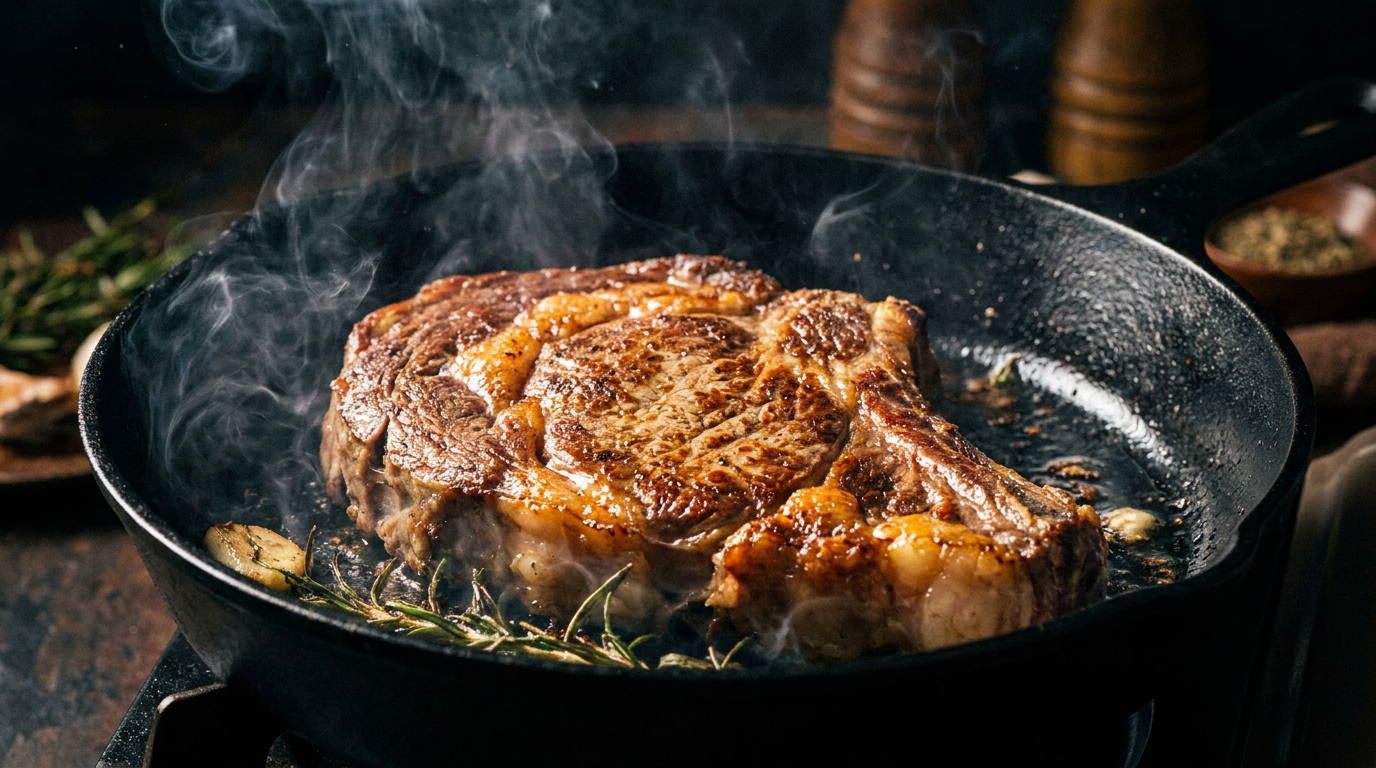
The magic of cooking is often perceived as an art, but at its core, it is a series of complex chemical transformations. When a pale, raw steak hits a blistering cast-iron skillet, or a soft ball of dough enters a hot oven, a profound metamorphosis occurs. The surface darkens into a rich, golden-brown crust, and the air fills with an intoxicating, savory aroma. This transformation is not merely the result of food getting hot; it is the signature of one of the most important chemical processes in the culinary world.[1][4]
Known as the Maillard reaction, this phenomenon is responsible for the complex flavors and appetizing colors of roasted coffee, toasted bread, seared meats, and fried onions. First described in 1912 by French chemist Louis-Camille Maillard, the reaction was initially observed while he was attempting to reproduce biological protein synthesis in a laboratory. He noted that when amino acids and sugars were heated together, the mixture turned brown. For decades, the culinary implications of his discovery went largely unnoticed by the broader public, but today, it is the foundational principle taught in culinary schools and food science programs worldwide.[2][3][5]
At a molecular level, the Maillard reaction is a form of non-enzymatic browning. It begins when the nucleophilic amino group of an amino acid attacks the reactive carbonyl group of a reducing sugar, such as glucose or fructose. This initial collision, driven by heat, forms an unstable intermediate compound known as a glycosylamine. From there, the chemistry cascades into a dizzying array of rearrangements and breakdowns, fundamentally altering the molecular structure of the food.[3][5]
The unstable glycosylamine undergoes what chemists call the Amadori rearrangement, converting into a ketosamine. This is where the true flavor-building begins. The ketosamines break down into hundreds of distinct, highly aromatic volatile compounds. Pyrazines emerge, delivering the unmistakable scent of roasted nuts and toasted bread. Furans contribute meaty, savory notes, while furanones provide a subtle, sweet caramel-like undertone. Ultimately, the reaction produces large, complex polymers called melanoidins, which act as pigments, painting the surface of the food in shades of deep brown.[1][2][4]

However, this chemical symphony does not occur under just any conditions. The Maillard reaction is highly temperature-dependent, operating in a specific thermal sweet spot. It begins to proceed rapidly only when the surface temperature of the food reaches between 140°C and 165°C (280°F to 330°F). Below this threshold, the reaction is too sluggish to produce meaningful browning or flavor development in a typical cooking timeframe. Above 170°C, the delicate flavor compounds begin to undergo pyrolysis, breaking down entirely and resulting in bitter, acrid, burnt flavors.[1][3][4]
This temperature requirement explains why moisture is the ultimate enemy of the Maillard reaction. Water has a hard thermodynamic ceiling: under normal atmospheric pressure, it cannot exceed its boiling point of 100°C (212°F). As long as liquid water is present on the surface of a steak or a vegetable, the temperature of that surface will remain capped at 100°C as the water evaporates. Only after the surface moisture has completely boiled away can the temperature climb into the 140°C to 165°C zone required to trigger the browning cascade.[2][4][5]
This principle dictates the fundamental techniques of high-heat cooking. It is the reason culinary instructors insist on thoroughly patting meats dry with a paper towel before searing them. If a steak is dropped into a pan while wet, the initial heat energy is entirely consumed by boiling the surface water, effectively steaming the meat rather than searing it. By the time the water evaporates and browning can finally begin, the interior of the steak is often overcooked.[1][4]
This principle dictates the fundamental techniques of high-heat cooking.
The moisture rule also explains the danger of overcrowding a roasting pan or a skillet. When too many vegetables or pieces of meat are packed tightly together, they release their internal moisture into a confined space. The trapped steam creates a humid microclimate, dropping the ambient temperature and preventing the dry heat necessary for the Maillard reaction. Giving ingredients ample space ensures that escaping steam dissipates quickly, allowing the surface temperatures to soar.[1][5]

A common misconception in both home kitchens and restaurants is the conflation of the Maillard reaction with caramelization. While both are forms of non-enzymatic browning that require high heat, they are entirely distinct chemical processes. Caramelization is the pyrolysis of sugars; it involves only carbohydrates breaking down under intense heat, typically starting around 170°C. The Maillard reaction, by contrast, strictly requires the presence of amino acids—the building blocks of proteins.[3][4][5]
This distinction explains why a plain sugar syrup heated in a pan turns into caramel, but a piece of bread toasted in an oven develops a vastly more complex, savory flavor profile. The flour in the bread contains proteins, providing the necessary amino acids to interact with the dough's sugars. Vegetables, which naturally contain both sugars and amino acids, undergo both caramelization and the Maillard reaction simultaneously when roasted, resulting in their deep, sweet, and savory complexity.[1][4]
Beyond temperature and moisture, the Maillard reaction is also highly sensitive to the pH level of the cooking environment. The reaction proceeds significantly faster and more intensely in alkaline, or basic, conditions. In an alkaline environment, the amino groups in the proteins are deprotonated, increasing their nucleophilicity and making them far more reactive with the sugars.[3][5]
Food manufacturers and savvy chefs frequently exploit this pH sensitivity to manipulate browning. The iconic dark, glossy crust of a traditional soft pretzel is achieved by dipping the raw dough into a highly alkaline lye or baking soda bath before baking. Similarly, home cooks can accelerate the browning of caramelized onions by adding a tiny pinch of baking soda to the pan, which raises the pH and forces the Maillard reaction into overdrive, cutting cooking time in half.[3][4]

While the culinary benefits of the Maillard reaction are universally celebrated, the process has also attracted scrutiny from public health researchers. In the early 2000s, scientists discovered that when certain starchy foods—particularly potatoes and grains—are subjected to the high temperatures of the Maillard reaction, a byproduct called acrylamide can form. Acrylamide is classified by the World Health Organization as a probable human carcinogen based on animal studies.[2][4][5]
The discovery of acrylamide in french fries, potato chips, and toasted bread sparked widespread media concern. However, the context of these findings is crucial. The doses of acrylamide that caused cancer in rodent studies were exponentially higher than the amounts humans consume through a typical diet. To date, extensive epidemiological studies have failed to find consistent evidence linking dietary acrylamide intake to an increased risk of cancer in humans.[2][4]
Furthermore, the Maillard reaction is not entirely a nutritional negative. The same complex chemical cascade that produces acrylamide also generates a variety of novel antioxidant compounds. These melanoidins and other byproducts have been shown in some studies to possess free-radical scavenging properties, potentially offering protective health benefits that offset the theoretical risks of acrylamide.[3][4][5]
For the home cook, understanding the mechanics of the Maillard reaction is perhaps the single most effective way to elevate everyday meals. It transforms cooking from a process of blindly following recipes into an exercise in applied chemistry. By controlling surface moisture, managing pan temperatures, and occasionally tweaking pH, anyone can unlock the deep, savory flavors that define professional cuisine.[1][5]

Ultimately, the Maillard reaction is a testament to the hidden complexity of the everyday world. A simple sear on a piece of protein represents a microscopic ballet of molecules, colliding and rearranging to create hundreds of new compounds in a matter of seconds. It is a reminder that the kitchen is a laboratory, and every meal is a successful experiment in the science of flavor.[2][3][5]
How we got here
1912
French chemist Louis-Camille Maillard first describes the browning reaction between amino acids and sugars.
Early 2000s
Researchers discover that high-heat cooking of starchy foods produces acrylamide, sparking health debates.
2020s
The science of the Maillard reaction becomes a staple concept in mainstream home cooking education and media.
Viewpoints in depth
Culinary Scientists
Focus on the molecular pathways and the generation of specific flavor compounds.
For food chemists and culinary scientists, the Maillard reaction is a complex web of organic chemistry. They focus on the Amadori rearrangement and the subsequent breakdown of ketosamines into hundreds of volatile aromatics like pyrazines and furans. Their goal is often to isolate these pathways to understand exactly how different amino acid and sugar pairings produce distinct flavor profiles, which is crucial for the commercial flavoring industry.
Home Cooks & Chefs
Focus on the practical manipulation of heat, moisture, and pH to maximize flavor.
In the kitchen, the focus shifts from molecular theory to practical application. Chefs view the Maillard reaction as a tool that requires strict environmental control. Their primary concerns are managing surface moisture—ensuring proteins are bone-dry before searing—and maintaining high pan temperatures. They also utilize practical tricks, such as adding baking soda to onions, to manipulate the pH and accelerate browning during a busy service.
Public Health Researchers
Focus on the toxicological byproducts of high-heat cooking.
Public health experts view the Maillard reaction through the lens of toxicology, specifically concerning the formation of acrylamide in starchy foods cooked at high temperatures. While they acknowledge that human epidemiological data has not definitively linked dietary acrylamide to cancer, they advocate for moderation in high-heat cooking methods and research into mitigation strategies, such as lowering cooking temperatures or using specific enzymes in industrial food production.
What we don't know
- The exact long-term health impact of dietary acrylamide in humans remains debated, as epidemiological studies have not matched the cancer risks seen in animal models.
- The complete catalog of the hundreds of volatile flavor compounds produced during the reaction is still being mapped by food chemists.
Key terms
- Maillard reaction
- A chemical reaction between amino acids and reducing sugars that gives browned food its distinctive flavor.
- Amino acids
- Organic compounds that combine to form proteins, essential for the Maillard reaction to occur.
- Reducing sugars
- Simple sugars, such as glucose and fructose, that act as the reactive counterpart to amino acids in browning.
- Melanoidins
- Large, complex polymer molecules produced at the end of the Maillard reaction that give food a brown pigment.
- Pyrazines
- A class of aromatic organic compounds produced during browning that provide roasted, toasted, and nutty flavors.
- Caramelization
- The browning of sugar, a process distinct from the Maillard reaction because it does not involve proteins.
- Acrylamide
- A chemical compound that can form in some starchy foods during high-temperature cooking processes.
Frequently asked
What is the difference between the Maillard reaction and caramelization?
Caramelization involves only the breakdown of sugars under high heat. The Maillard reaction requires both sugars and amino acids (proteins) to create its complex, savory flavors.
Why doesn't boiled food turn brown?
Water boils at 100°C (212°F), which acts as a temperature ceiling. The Maillard reaction requires temperatures of at least 140°C (280°F) to proceed rapidly, which cannot be reached while surface moisture is present.
Does browning meat seal in the juices?
No, that is a common culinary myth. Searing meat does not lock in moisture, but it does create hundreds of new flavor compounds that make the meat taste significantly better.
Is the Maillard reaction dangerous to my health?
At very high temperatures, the reaction can produce acrylamide, a probable carcinogen in animal studies. However, extensive human studies have not found a consistent link between dietary acrylamide and cancer, and the reaction also produces beneficial antioxidants.
Sources
Source coverage
5 outlets
3 viewpoints surfaced




[1]BBC Good FoodHome Cooks & Chefs
What is the Maillard reaction?
Read on BBC Good Food →[2]Science FocusPublic Health Researchers
What is the Maillard reaction?
Read on Science Focus →[3]National Institutes of HealthCulinary Scientists
The Maillard Reaction in Food Chemistry
Read on National Institutes of Health →[4]MasterClassHome Cooks & Chefs
Guide to the Maillard Reaction: 5 Phases of the Maillard Reaction
Read on MasterClass →[5]Factlen Editorial TeamCulinary Scientists
Synthesis by Factlen editorial team
Read on Factlen Editorial Team →
Every angle. Every day.
Get food drink stories with full source coverage and perspective breakdowns delivered to your inbox.