
The Science of the 'Fifth Stroke': Why Swimming's Fastest Phase Happens Completely Underwater
The underwater dolphin kick has revolutionized competitive swimming, allowing athletes to bypass surface drag and achieve speeds impossible above water. Mastering this technique requires a delicate balance of fluid dynamics, extreme core strength, and severe oxygen deprivation.
By Factlen Editorial Team
- Sports Biomechanists
- Focus on the fluid dynamics and mathematical advantages of reducing wave drag through submerged laminar flow.
- Elite Coaches & Athletes
- Focus on the practical execution, balancing the speed advantage against the severe oxygen debt and muscle fatigue.
- Governing Bodies
- Focus on regulating the sport to ensure traditional strokes maintain their identity rather than becoming purely underwater breath-holding contests.
What's not represented
- · Amateur Swimmers
- · Spectators and Broadcasters
Why this matters
Understanding the physics of the underwater kick transforms how you watch competitive swimming, revealing a hidden, high-stakes battle of breath control and biomechanics beneath the surface. It highlights how human innovation continuously pushes the boundaries of athletic performance.
Key points
- The underwater dolphin kick is the fastest method of human propulsion in water, bypassing surface wave drag.
- Swimmers must balance the immense speed advantage against severe oxygen deprivation and muscle fatigue.
- World Aquatics enforces a strict 15-meter limit to prevent races from becoming entirely submerged events.
- The kick relies on a full-body whip motion originating in the core, requiring extreme ankle flexibility.
- A flawless 'breakout' is required to transfer underwater momentum into the surface stroke without stalling.
The paradox of competitive swimming is that the fastest way to move through the water is to avoid the surface entirely. When elite swimmers dive off the blocks or push off the wall, they do not immediately begin their designated stroke. Instead, they transition into a streamlined, undulating motion known as the underwater dolphin kick. Often referred to as swimming's "fifth stroke," this technique has become the single most critical differentiator in modern short-course and long-course racing. By staying submerged, athletes can achieve velocities that are physically impossible to maintain once they break the surface and begin pulling with their arms.[6]
The fundamental reason the underwater dolphin kick is so effective comes down to fluid dynamics and the concept of wave drag. When a swimmer moves along the surface of the pool, they collide with the water, pushing it forward and creating a bow wave. The energy required to push this water out of the way increases exponentially with speed. According to sports biomechanists, wave drag can account for up to sixty percent of the total resistance a swimmer faces. By diving just a few feet below the surface, a swimmer completely eliminates wave drag, moving through a state of laminar flow where the water glides smoothly over their streamlined body.[1][5]
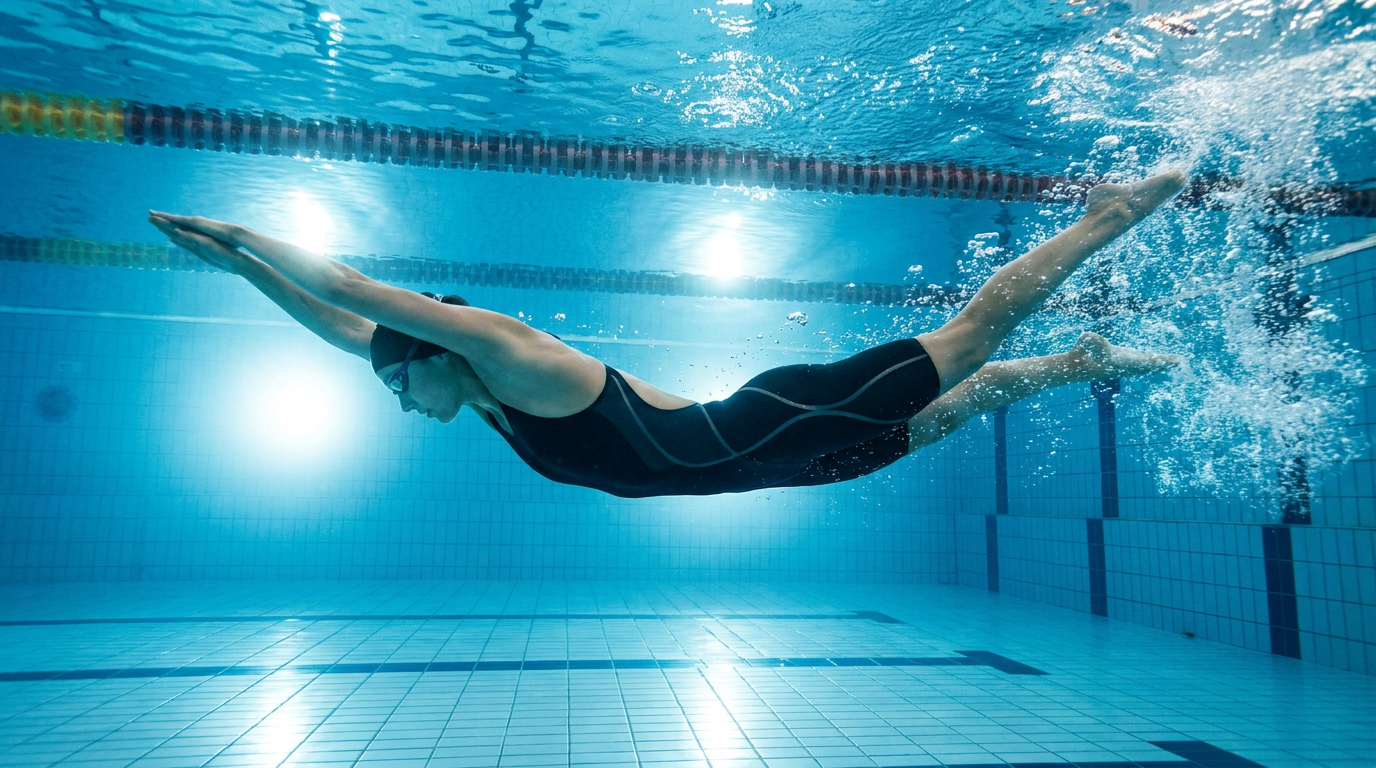
To capitalize on this hydrodynamic advantage, the swimmer must maintain a rigid, torpedo-like posture known as a streamline. The arms are locked tightly behind the ears, one hand stacked over the other, while the head is tucked neutrally. From this rigid upper-body position, the propulsion is generated entirely by the core and the legs. Unlike a traditional flutter kick, which relies heavily on the quadriceps and hamstrings, the dolphin kick is a full-body whip that originates in the chest and sternum, ripples down through the abdominal muscles and hips, and finally snaps at the ankles.[2]

The mechanics of this whip-like motion are highly complex and require immense flexibility, particularly in the ankles. Sports science research indicates that elite underwater kickers possess a degree of plantar flexion—the ability to point the toes downward—that far exceeds the average human range of motion. This flexibility allows the tops of the feet to act like a pair of flippers, catching a massive volume of water and thrusting it backward. The kick consists of two phases: the powerful down-kick, which generates the primary forward thrust, and the up-kick, which repositions the legs while maintaining momentum.[5]
However, the immense speed of the fifth stroke comes with a severe physiological cost. Because the swimmer is entirely submerged, they are operating in a state of apnea, or breath-holding, while simultaneously executing one of the most metabolically demanding movements in sports. The large muscle groups of the core and legs consume oxygen at a rapid rate. As the swimmer undulates down the pool, carbon dioxide builds up in their bloodstream, triggering an agonizing physiological urge to breathe. Managing this oxygen debt is the primary limiting factor for how long an athlete can sustain the underwater kick.[3]
However, the immense speed of the fifth stroke comes with a severe physiological cost.
The trade-off between speed and oxygen depletion is a constant mathematical calculation for elite coaches and athletes. Staying underwater longer means moving faster and avoiding surface drag, but it also means arriving at the surface with heavily fatigued muscles and a desperate need for oxygen. If a swimmer pushes their underwater phase too far, they risk "tying up"—a sudden, catastrophic accumulation of lactic acid that destroys their stroke technique for the remainder of the lap. Consequently, training the fifth stroke is as much about expanding lung capacity and carbon dioxide tolerance as it is about building leg strength.[2][3]
The strategic application of the underwater kick varies significantly depending on the format of the race. In a long-course pool, which measures fifty meters in length, swimmers only have one wall to push off per lap. In a short-course pool, which measures twenty-five meters or yards, the number of turns is doubled. This makes the short-course format heavily reliant on the fifth stroke. In a twenty-five-yard race, an elite swimmer might spend more than sixty percent of the total race distance completely submerged, turning what is nominally a freestyle or backstroke event into an underwater kicking contest.[6]

To prevent the sport from losing its traditional identity, the global governing body for aquatic sports, World Aquatics, instituted strict regulations on how far a swimmer can travel underwater. Following a period in the late 1980s and 1990s where athletes began swimming nearly entire lengths of the pool submerged, officials implemented the fifteen-meter rule. This regulation mandates that a swimmer's head must break the surface of the water at or before the fifteen-meter mark off every start and turn. The rule applies to the freestyle, backstroke, and butterfly events, fundamentally shaping modern race strategy.[4]
The fifteen-meter mark is vividly indicated by a brightly colored marker on the lane ropes, serving as a visual cue for both the athletes and the officials. Pushing the absolute limit of this boundary is a high-stakes gamble. Swimmers meticulously count their kicks off every wall—often executing exactly six or seven undulations—to ensure they maximize their underwater advantage without crossing the fifteen-meter line. A miscalculation of even a few inches can result in immediate disqualification, a heartbreaking outcome that frequently occurs even at the highest levels of international competition.[4][6]
The transition from the underwater kick to surface swimming, known as the breakout, is arguably the most technically demanding fraction of a second in a race. As the swimmer approaches the surface, they must perfectly time their first arm pull to coincide with their head breaking the water. If they pull too early, their arms meet the massive resistance of the water above them, killing their momentum. If they pull too late, they lose the speed they generated off the wall and stall on the surface. A flawless breakout seamlessly transfers the high velocity of the underwater phase into the rhythm of the surface stroke.[2]

The evolution of the fifth stroke has driven significant advancements in sports technology and biomechanical analysis. Today, elite swimming programs utilize high-speed underwater cameras, wearable accelerometers, and computational fluid dynamics software to analyze an athlete's kick down to the millisecond. Coaches look for microscopic inefficiencies in the amplitude of the kick, the angle of the hips, and the tightness of the streamline. By quantifying these variables, sports scientists can help swimmers shave hundredths of a second off their turns, a margin that frequently determines the difference between a gold medal and missing the podium entirely.[5][6]
Looking ahead, the mastery of the underwater dolphin kick will only become more critical as surface swimming techniques approach their theoretical biomechanical limits. While athletes continue to refine their arm pulls and body rotation, the most significant remaining frontier for time drops lies beneath the waves. As training methods for hypoxia and core strength continue to advance, the next generation of swimmers will likely push the fifteen-meter boundary with even greater power and efficiency, cementing the fifth stroke as the ultimate weapon in aquatic sports.[3][6]
How we got here
Late 1980s
Swimmers like David Berkoff begin exploiting the underwater dolphin kick, swimming vast portions of backstroke races entirely submerged.
1988
The governing body (FINA, now World Aquatics) implements the first distance limits to curb excessive underwater swimming in backstroke.
1998
The 15-meter underwater limit is standardized across freestyle, backstroke, and butterfly events.
2000s
Michael Phelps popularizes the aggressive use of the fifth stroke in freestyle and butterfly, dominating the Olympic landscape.
Present Day
Advanced biomechanical tracking and fluid dynamics software are used to optimize the kick down to the millisecond.
Viewpoints in depth
Sports Biomechanists
Focus on the mathematical and physical advantages of avoiding the water's surface.
From a purely physical standpoint, the surface of the water is the most inefficient place to swim. Biomechanists point out that wave drag acts as an exponential multiplier on resistance; the faster you try to swim on the surface, the harder the water pushes back. By submerging, athletes enter a state of laminar flow where water slips cleanly over their bodies. Researchers argue that if the 15-meter rule did not exist, the mathematically optimal way to race a 50-meter sprint would be to swim the entire distance underwater.
Elite Coaches & Athletes
Focus on the physiological toll and the risk-reward calculation of the 15-meter limit.
While the physics are clear, the human body has limits. Coaches view the fifth stroke as a delicate balancing act between speed and oxygen debt. The core and leg muscles required to generate the whip-like motion consume massive amounts of oxygen. Pushing the kick to the absolute 15-meter limit off every wall in a 200-meter race can lead to catastrophic lactic acid buildup, causing a swimmer's technique to fall apart in the final stretch. Training focuses heavily on hypoxia tolerance—teaching the brain to stay calm while carbon dioxide alarms ring in the bloodstream.
Governing Bodies
Focus on preserving the visual and historical identity of competitive swimming strokes.
For World Aquatics, the 15-meter rule is an existential necessity for the sport. Regulators argue that without strict limits, events like the backstroke and butterfly would become indistinguishable from one another, devolving into pure breath-holding contests. The rule ensures that while athletes can use the fifth stroke to gain an advantage off the walls, the core of the competition remains a test of traditional surface swimming technique. Enforcing this boundary requires intense scrutiny from deck officials, as a violation of mere inches results in disqualification.
What we don't know
- The absolute biomechanical limit of human ankle flexibility and how much further it can be pushed for propulsion.
- Whether future advancements in hypoxia training will allow distance swimmers to utilize the 15-meter limit as aggressively as sprinters.
Key terms
- Wave Drag
- The hydrodynamic resistance created when a swimmer moves along the surface and pushes water forward, forming a bow wave.
- Laminar Flow
- A fluid dynamics state where water glides smoothly in parallel layers over a submerged object, resulting in minimal resistance.
- Apnea
- The temporary cessation of breathing; in swimming, the act of holding one's breath during the high-exertion underwater phase.
- Breakout
- The precise moment a swimmer transitions from the underwater kick to their first surface arm pull, requiring perfect timing to maintain momentum.
- Plantar Flexion
- The biomechanical ability to point the toes downward, crucial for turning the feet into effective flippers during the kick.
Frequently asked
Why is the underwater kick faster than regular swimming?
Swimming on the surface creates wave drag, which acts like a wall of resistance. By staying completely underwater, swimmers enter laminar flow, bypassing the surface friction and moving much faster.
Why can't swimmers stay underwater for the whole race?
World Aquatics rules mandate that a swimmer's head must break the surface by the 15-meter mark off every start and turn to preserve the identity of the traditional strokes.
Is the underwater kick used in all four strokes?
It is heavily used in freestyle, backstroke, and butterfly. Breaststroke has its own unique, highly regulated underwater pullout sequence that differs from the continuous dolphin kick.
Sources
Source coverage
6 outlets
3 viewpoints surfaced





[1]Journal of BiomechanicsSports Biomechanists
Hydrodynamic evaluation of the underwater dolphin kick in elite competitive swimmers
Read on Journal of Biomechanics →[2]USA SwimmingElite Coaches & Athletes
Technique and Biomechanics: Mastering the Underwater Breakout
Read on USA Swimming →[3]International Journal of Sports Physiology and PerformanceElite Coaches & Athletes
Metabolic demands and oxygen debt during maximal underwater swimming
Read on International Journal of Sports Physiology and Performance →[4]World AquaticsGoverning Bodies
World Aquatics Competition Regulations: The 15-Metre Rule
Read on World Aquatics →[5]Sports BiomechanicsSports Biomechanists
Kinematic analysis of ankle flexibility and thrust generation in the fifth stroke
Read on Sports Biomechanics →[6]Factlen Editorial TeamElite Coaches & Athletes
Synthesis by Factlen editorial team
Read on Factlen Editorial Team →

Every angle. Every day.
Get sports stories with full source coverage and perspective breakdowns delivered to your inbox.