
The Science of the Calf Kick: How a Single Strike Rewrote the Rules of MMA
Once a niche technique, the calf kick has evolved into the most devastating weapon in mixed martial arts, fundamentally altering how fighters stand, move, and defend.
By Factlen Editorial Team
- Striking Analysts
- Focus on the anatomical vulnerability of the peroneal nerve and the kick's high efficiency.
- Traditional Martial Artists
- Highlight the technique's evolution from Muay Thai and its adaptation to MMA stances.
- Fighters & Coaches
- Emphasize the strategic advantages, particularly the reduced risk of being taken down.
What's not represented
- · Sports Medicine Physicians treating long-term nerve damage
- · Athletic Commissions evaluating scoring criteria for localized leg damage
Why this matters
Understanding the mechanics of the calf kick provides a deeper appreciation for the tactical chess match of modern combat sports. It highlights how a single anatomical insight can force an entire global sport to evolve its defensive fundamentals.
Key points
- The calf kick targets the exposed common peroneal nerve, causing temporary paralysis known as 'drop foot'.
- Unlike traditional thigh kicks, calf kicks require less energy and are harder for grapplers to catch for takedowns.
- The technique gained mainstream prominence after high-profile victories by fighters like Dustin Poirier and Douglas Lima.
- MMA's wide, boxing-centric stances make the lead leg particularly vulnerable to low strikes.
- Defending the calf kick requires a precise 'check' by turning the shin outward, forcing a rapid evolution in defensive tactics.
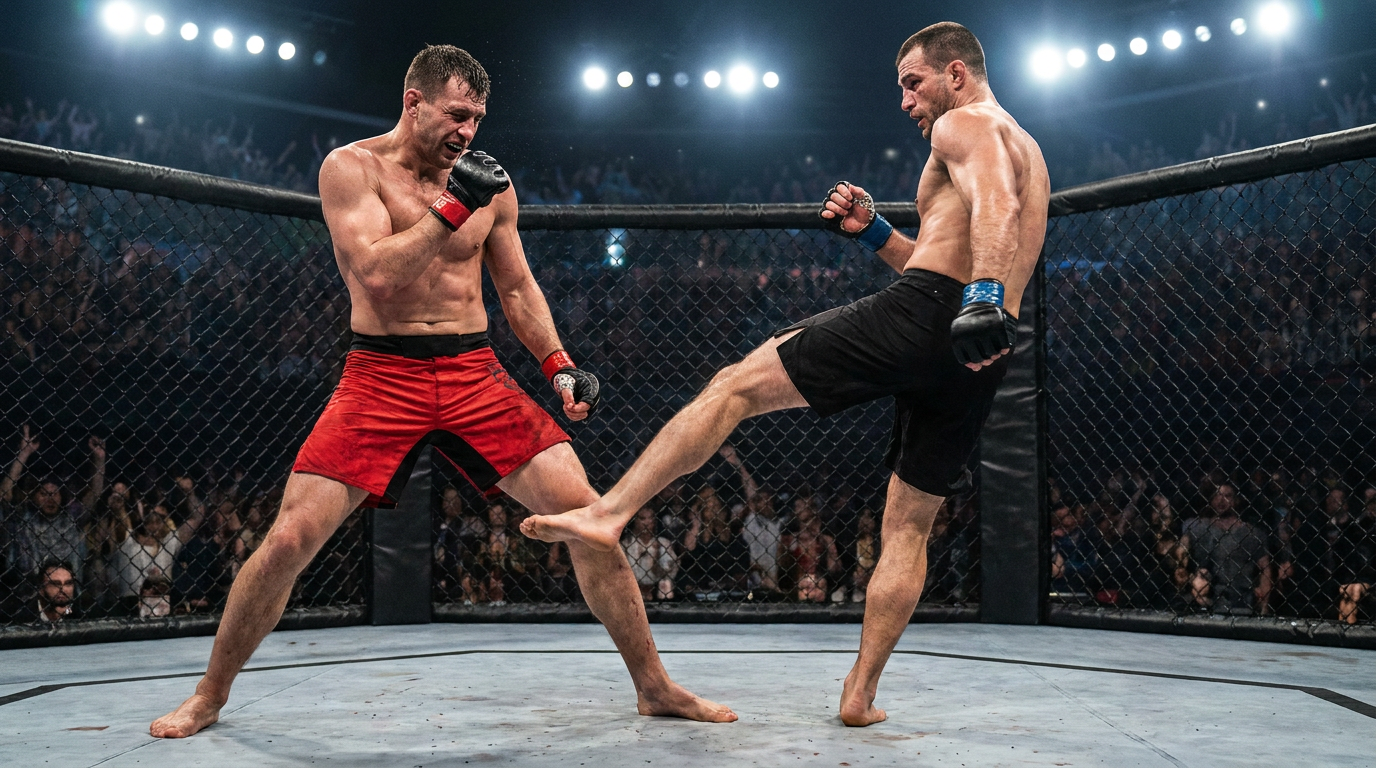
In the high-stakes chess match of modern mixed martial arts, the margin for error is razor-thin. Over the past decade, a single technique has emerged from relative obscurity to fundamentally alter the landscape of the sport: the calf kick. Once considered a niche strike utilized primarily by specific styles of kickboxers, it has evolved into a primary weapon for champions and contenders alike. It is a technique that acts as the great equalizer, capable of immobilizing elusive footwork and ending fights without a single blow to the head.[1][9]
For decades, the primary target for leg kicks in MMA and kickboxing was the quadriceps—the large, dense muscle group of the thigh. While effective, the traditional thigh kick requires significant power and the accumulation of damage over multiple rounds to stop a fight. Furthermore, aiming high on the leg exposes the attacker to counter-punches and takedowns. The calf kick, however, operates on an entirely different physiological and strategic principle, shifting the target down to the lower half of the leg.[1][8]
To understand why the calf kick is so devastating, one must look beneath the skin to the neurological infrastructure of the lower leg. The primary target of this strike is the common peroneal nerve, also known as the fibular nerve. This nerve, a branch of the larger sciatic nerve, runs superficially along the lateral side of the knee and down the lower leg, sitting exposed against the fibula bone.[1][4][5]
Unlike the thigh, which is protected by thick layers of muscle and fat, the outer calf offers almost no anatomical shielding. According to medical experts at institutions like the Mayo Clinic and Mount Sinai, the peroneal nerve supplies movement and sensation to the lower leg, foot, and toes. When a fighter lands a hardened shin bone accurately across this unprotected nerve, the result is often immediate and catastrophic for the recipient.[2][5]

The most visible consequence of a clean calf kick is a condition known as "drop foot." The blunt force trauma causes temporary paralysis of the dorsiflexors, making it impossible for the fighter to lift their foot. The recipient's foot literally drags across the canvas, instantly destroying their ability to retreat, pivot, or generate explosive power. It turns a highly mobile, elusive striker into a stationary target.[1][2]
Beyond the mechanical failure, the strike induces severe sensory disruption. Fighters describe the impact as an electric shock or a deadening sensation that travels down to the toes. Because the lower leg has minimal muscle mass to absorb the impact, the localized swelling has nowhere to go, further compressing the nerve. Even if the nerve isn't completely shut down, the rapid swelling alone can compromise a fighter's base within just two or three well-placed strikes.[2][5]
Strategically, the calf kick offers massive advantages over traditional strikes. Because the target is lower to the ground, the kick requires less hip rotation than a standard roundhouse to the thigh or body. This makes the strike faster to execute, harder for the opponent to see coming, and significantly lower risk. The attacker does not need to expose their back or compromise their balance to the same degree.[1][4]
Strategically, the calf kick offers massive advantages over traditional strikes.
Crucially, the calf kick is highly "wrestler-proof." In the past, fighters throwing high thigh kicks or body kicks risked having their leg caught by grappling specialists, resulting in a swift takedown. By targeting the calf, the kicking leg remains far below the opponent's grasping range. This allows strikers to safely dismantle grapplers from the outside without fear of ending up on the mat.[4][8]

The history of low kicks is deeply rooted in Muay Thai and Dutch Kickboxing, but the specific application of the calf kick in MMA is a more recent phenomenon. In traditional Muay Thai, fighters stand tall with square hips, allowing them to instantly lift their knees to block, or "check," incoming kicks. Because of this stance, the calf kick was historically seen as a mere setup or sweep rather than a finishing blow.[1][9]
The translation to MMA occurred because of the sport's unique stance requirements. As MMA evolved, fighters adopted wider, more boxing-centric stances to defend against wrestling takedowns and generate punching power. This wide stance places the lead leg further forward and plants it firmly on the canvas, turning it into a stationary and highly vulnerable target for low strikes.[2][9]
Early MMA pioneers like Benson Henderson began experimenting with the strike, but it wasn't until the late 2010s that the technique truly revolutionized the sport's meta. High-profile bouts brought the devastating potential of the calf kick to the mainstream. In 2018, Bellator welterweight champion Douglas Lima utilized the strike to brutal effect against Rory MacDonald, severely compromising MacDonald's mobility and dictating the pace of the championship fight.[2][6]
The watershed moment for the calf kick arguably occurred at UFC 257 in January 2021, during the highly anticipated rematch between Dustin Poirier and Conor McGregor. Poirier systematically attacked McGregor's wide, boxing-heavy stance with repeated calf kicks. McGregor's lead leg eventually gave out, leading to a noticeable loss of function and paving the way for Poirier's knockout victory. The fight definitively proved that the technique could dismantle even the most elite strikers.[3][4]

Today, the calf kick is a mandatory component of modern MMA strategy. Fighters like Marlon "Chito" Vera have openly credited the technique for major victories, noting how it forces opponents to completely abandon their game plans. Champions across all weight classes now rely on it; recent title fights, including Islam Makhachev's title defense at UFC 322 and Ilia Topuria's striking masterclass at UFC 308, prominently featured the calf kick as a primary tool for distance management.[3][6][7]
As the calf kick has proliferated, the defensive meta has been forced to adapt. The traditional defense against leg kicks is "checking"—raising the leg and turning the shin outward to meet the attacker's kick bone-on-bone. However, checking a calf kick is significantly more difficult than checking a thigh kick. It requires a faster reaction time and a more precise outward rotation of the shin to protect the vulnerable outer muscle.[1][8]
If a fighter fails to turn their shin sufficiently, they risk taking the impact directly on the side of the calf even while their leg is raised, which can still cause nerve damage. As a result, fighters are now exploring alternative defensive strategies. Some are squaring up their stances to make checking easier, while others rely on rapid stance-switching to hide their lead leg or pull it back entirely when they anticipate the strike.[8][9]

The evolution of the calf kick perfectly encapsulates the rapid, iterative nature of mixed martial arts. A technique that was virtually ignored a decade ago has forced a complete reevaluation of how fighters stand, move, and defend. As coaches and athletes continue to study the anatomy and physics of combat, the sport's tactical landscape will undoubtedly keep shifting, but the calf kick has permanently secured its place in the martial arts pantheon.[1][3][9]
How we got here
Early 2010s
Pioneers like Benson Henderson begin experimenting with low calf kicks in MMA competition.
January 2018
Douglas Lima uses devastating calf kicks to compromise Rory MacDonald's leg in their Bellator title fight.
August 2020
Marlon Vera utilizes the calf kick to defeat rising star Sean O'Malley, highlighting the strike's fight-ending potential.
January 2021
Dustin Poirier shocks the world by using calf kicks to dismantle Conor McGregor's stance and secure a knockout victory at UFC 257.
2024-2026
The calf kick becomes a mandatory strategic tool, heavily featured in championship bouts across all major MMA promotions.
Viewpoints in depth
Striking Analysts
Focus on the anatomical vulnerability of the peroneal nerve and the kick's high efficiency.
Analysts point out that the calf kick is a masterpiece of anatomical targeting. By aiming for the common peroneal nerve, fighters bypass the thick muscle armor of the thigh. This turns a relatively low-power strike into a fight-ending weapon. Analysts argue that the kick's true value lies in its efficiency; it requires less energy and hip rotation than a high kick, allowing fighters to systematically dismantle their opponents' mobility without exhausting their own gas tank.
Traditional Martial Artists
Highlight the technique's evolution from Muay Thai and its adaptation to MMA stances.
For practitioners of traditional striking arts like Muay Thai and Dutch Kickboxing, low kicks have always been a staple. However, they note that the calf kick specifically gained prominence in MMA due to the sport's unique stance requirements. Because MMA fighters must adopt wider, lower stances to defend against wrestling takedowns, their lead legs become stationary targets. Traditionalists view the calf kick not as a new invention, but as a necessary adaptation to the modern MMA meta.
Fighters & Coaches
Emphasize the strategic advantages, particularly the reduced risk of being taken down.
From a coaching perspective, the calf kick is invaluable because it is largely 'wrestler-proof.' Throwing high kicks or body kicks against a grappling specialist carries the constant risk of having the leg caught, resulting in a takedown. By keeping the strike below the knee, fighters can inflict severe damage while staying out of grappling range. Coaches are now forced to dedicate significant training time to both executing and defending the strike, fundamentally changing how sparring sessions are conducted.
What we don't know
- Whether the ongoing evolution of defensive stances will eventually render the calf kick less effective at the championship level.
- The long-term neurological effects on fighters who repeatedly suffer peroneal nerve trauma throughout their careers.
Key terms
- Calf Kick
- A low roundhouse strike targeting the outside of an opponent's lower leg, specifically below the knee.
- Peroneal Nerve
- A branch of the sciatic nerve running along the outside of the calf, responsible for lifting the foot.
- Drop Foot
- A temporary condition caused by nerve trauma where a fighter loses the ability to flex their ankle upwards.
- Checking
- A defensive technique where a fighter lifts and turns their leg to block an incoming kick with the thicker part of their shin.
- Dorsiflexion
- The backward bending and contracting of the foot and ankle, which is disabled when the peroneal nerve is struck.
Frequently asked
What nerve does the calf kick target?
The calf kick targets the common peroneal nerve, which runs along the outside of the lower leg just below the knee.
Why is the calf kick so hard to defend?
It requires a faster reaction time to 'check' (block) because the strike is lower and faster than a traditional thigh kick, and MMA fighters often stand in wide stances that make their lead leg vulnerable.
What is 'drop foot' in MMA?
Drop foot is a temporary condition caused by trauma to the peroneal nerve, making a fighter unable to lift their foot, causing it to drag on the canvas.
Who popularized the calf kick in MMA?
While early pioneers like Benson Henderson used it, it became a mainstream weapon after high-profile fights like Douglas Lima vs. Rory MacDonald and Dustin Poirier vs. Conor McGregor.
Sources
Source coverage
9 outlets
3 viewpoints surfaced









[1]MMaailmStriking Analysts
The Rise of Calf Kicks in MMA: Anatomy of a Game-Changer
Read on MMaailm →[2]mmaguidrStriking Analysts
The Rise of the Calf Kick: Analyzing MMA's Game-Changing Strike
Read on mmaguidr →[3]FightstyleStriking Analysts
Why the Calf Kick Is the Biggest Game Changer in Modern MMA
Read on Fightstyle →[4]Evolve DailyTraditional Martial Artists
The Rise Of The Calf Kick In MMA
Read on Evolve Daily →[5]TheSportsterFighters & Coaches
Why Calf Kicks Are So Effective In MMA, Explained
Read on TheSportster →[6]ESPNFighters & Coaches
Marlon Vera talks win vs. Sean O'Malley, calf kicks and more
Read on ESPN →[7]CBS SportsFighters & Coaches
UFC 322 results, highlights: Islam Makhachev earns second title with dominant win
Read on CBS Sports →[8]MMA FightingTraditional Martial Artists
How to Use Kicks | MMA Fighting
Read on MMA Fighting →[9]Factlen Editorial TeamStriking Analysts
Synthesis by Factlen editorial team
Read on Factlen Editorial Team →

More in sports
See all 13 stories →Olympic Sustainability
How the LA 2028 Olympics Will Run Entirely on Existing Stadiums
0 sources

NBA Finals
New York Knicks Win 2026 NBA Finals, Ending 53-Year Championship Drought
0 sources

NBA Finals
New York Knicks Capture First NBA Championship Since 1973
0 sources

Hockey Strategy
How the PWHL's 'Jailbreak' and 'No Escape' Rules Are Rewriting Hockey Strategy
0 sources
Every angle. Every day.
Get sports stories with full source coverage and perspective breakdowns delivered to your inbox.