
The Science of Tendon Stiffness: Why Runners Are Using Plyometrics to Unlock 'Free Energy'
By training the Achilles and patellar tendons to act like rigid springs, distance runners are improving their running economy and speed without having to increase their cardiovascular fitness.
By Aylin Aksoy

When runners hit a plateau, the traditional prescription is almost always cardiovascular: run more miles, run longer intervals, or push the heart rate higher. The prevailing logic treats the human body strictly as an aerobic engine. But running is not just a test of oxygen delivery; it is fundamentally a mechanical act of bouncing from one leg to the other. And in the physics of bouncing, the engine matters less than the springs.[3]
This mechanical efficiency is quantified as 'running economy'—the amount of oxygen a runner consumes at a given speed. If VO2 max is the size of an athlete's engine, running economy is their fuel efficiency. Two runners can have identical cardiovascular fitness, but the one with better running economy will cross the finish line minutes ahead. For years, improving this metric was thought to require thousands of accumulated miles. Today, biomechanists are pointing to a much faster shortcut: tendon stiffness.[1]
In everyday fitness culture, 'stiffness' is usually a pejorative term, something to be cured with yoga and foam rolling. But in the context of running biomechanics, leg stiffness is highly desirable. When a runner's foot strikes the ground, it absorbs forces equal to two-and-a-half to three times their body weight. If the leg is too compliant—if it yields deeply upon impact—that kinetic energy is absorbed by the muscles and lost as heat.
However, if the leg acts like a rigid spring, it captures that impact energy and uses it to propel the runner forward. This phenomenon is governed by the Stretch-Shortening Cycle (SSC). When the foot lands, the Achilles tendon and the plantar fascia stretch rapidly, storing elastic energy. Milliseconds later, as the runner pushes off, those tissues recoil, releasing the stored energy to assist the calf muscles.[3]
The efficiency of this system is staggering. Research indicates that a healthy, well-trained Achilles tendon can return up to 50 percent of the mechanical energy generated during a running stride. This is literally 'free energy'—propulsion that does not require the heart to pump more blood or the lungs to process more oxygen. The stiffer the tendon, the faster it recoils, and the less time the foot spends on the ground.[1][2]
The problem for many recreational runners is that traditional, slow-paced distance running does not adequately train this elastic system. Long, slow miles build the aerobic engine but can leave the tendons compliant and 'mushy.' To build a stiffer spring, the tissues must be subjected to rapid, high-impact forces that force them to adapt structurally.
Enter plyometrics. Originally developed by Soviet track and field coaches in the 1960s under the name 'shock training,' plyometrics involve explosive movements like bounding, depth jumps, and rapid pogo hops. While sprinters and jumpers have used these drills for decades, endurance coaches have historically shied away from them, fearing they would add unnecessary fatigue to high-mileage training plans.[3]
That paradigm has shifted dramatically over the last few years. Clinical trials published in sports medicine journals have consistently demonstrated that integrating just two small sessions of plyometrics per week can improve a distance runner's economy by 5 to 8 percent. Crucially, these improvements occur without any measurable change in the athletes' VO2 max or lactate threshold. The runners simply become more efficient machines.[1]
The adaptations driving this improvement are both structural and neurological. Structurally, explosive loading stimulates the synthesis of collagen within the tendon, increasing its cross-sectional density and making it physically stiffer. Neurologically, plyometrics train the central nervous system to recruit motor units more rapidly. The brain learns to pre-activate the calf muscles just milliseconds before the foot hits the ground, bracing the leg for impact.[1][2]
This pre-activation is critical for reducing ground contact time. Elite marathoners spend significantly less time on the ground per stride than amateur runners, allowing them to maintain a high cadence and 'float' over the pavement. Plyometrics teach the amateur nervous system to mimic this elite firing pattern, resulting in a lighter, snappier stride.[3]
However, the pursuit of tendon stiffness carries inherent risks. Tendons are avascular—they have very little blood supply compared to muscles. Because of this, they adapt to stress much more slowly. If a runner introduces high-intensity plyometrics too quickly, the muscles may generate forces that the tendons are not yet structurally prepared to handle, leading to micro-tears and Achilles tendinopathy.[2]
Physical therapists emphasize that plyometrics must be earned. Before a runner begins explosive bounding or depth jumps, they need a foundation of basic strength. Protocols often start with heavy, slow resistance training—such as weighted calf raises—and isometric holds to build baseline tendon capacity. Only when the tissue can handle heavy, slow loads is it ready for light, fast loads.[2][3]
The modern approach to implementing this science is 'micro-dosing.' Rather than dedicating an entire exhausting 45-minute workout to jump training, coaches now prescribe three to five minutes of low-amplitude plyometrics—like A-skips and pogo jumps—as a dynamic warm-up immediately before a run. This provides the necessary stimulus to the nervous system and tendons without generating systemic fatigue.
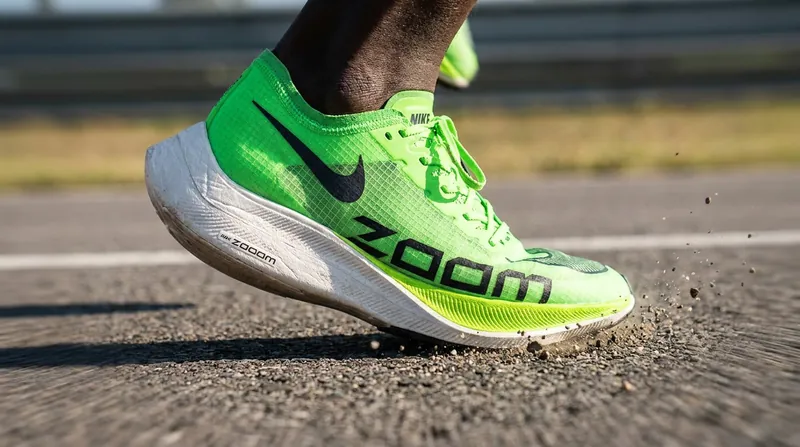
This shift in training philosophy mirrors the technological revolution happening in running footwear. The 'super shoes' that have rewritten marathon record books over the last decade rely on ultra-resilient PEBA foam and rigid carbon-fiber plates. These shoes essentially act as an external, artificial Achilles tendon, enhancing the exact same energy-return mechanics that plyometrics train biologically.[3]
Ultimately, the science of tendon stiffness is democratizing speed. By recognizing that running is a mechanical skill reliant on elastic energy, everyday athletes are discovering that they don't necessarily need to run more miles to run faster. By spending just a few minutes a week upgrading their biological springs, they are unlocking performance gains that aerobic training alone could never reach.[3]
Definitions
- Running Economy
- The energy demand (usually measured in oxygen consumption) required to maintain a given running speed; essentially a runner's 'fuel efficiency.'
- Stretch-Shortening Cycle (SSC)
- An active stretch (eccentric contraction) of a muscle followed immediately by a shortening (concentric contraction) of that same muscle, allowing it to produce more force.
- Tendon Stiffness
- The structural resistance of a tendon to deformation. In running, a stiffer tendon acts like a tighter spring, returning more energy upon impact.
- Plyometrics
- Exercises involving repeated rapid stretching and contracting of muscles (like jumping and bounding) designed to increase power and utilize the stretch-shortening cycle.
Questions & answers
Do I need to be a fast runner to benefit from plyometrics?
No. The stretch-shortening cycle applies to all running speeds. Improving tendon stiffness will make whatever pace you currently run feel easier and require less energy.
How often should I do plyometric exercises?
Most sports science protocols recommend two short sessions per week. Coaches increasingly advise 'micro-dosing'—doing 3 to 5 minutes of light hops and skips immediately before a run.
Are plyometrics safe for older runners?
Yes, but they must be introduced gradually. Because tendon elasticity decreases with age, older runners benefit highly from plyometrics but should build baseline calf strength with heavy resistance training first to prevent injury.
Analysis by camp
Sports Biomechanists
Focus on the physical properties of connective tissue and mechanical efficiency.
For biomechanists, the human body during a run is essentially a mass-spring model. They view the leg not just as a collection of muscles, but as a series of levers and elastic bands. Their research focuses on quantifying exactly how much energy is lost to heat when a foot strikes the ground, and how much is successfully captured by the Achilles tendon and plantar fascia. From this perspective, improving running economy is an engineering problem: you must increase the stiffness of the biological spring so that it deforms less and recoils faster, thereby reducing the metabolic cost of forward propulsion.
Endurance Coaches
Focus on practical application and managing overall training load.
Endurance coaches recognize the value of tendon stiffness but are primarily concerned with the 'cost of doing business.' Distance runners already carry a high baseline of neuromuscular fatigue from logging miles. Coaches argue that prescribing heavy, exhausting jump sessions can compromise a runner's ability to complete their primary aerobic workouts. Therefore, the coaching perspective heavily favors 'micro-dosing'—sneaking small amounts of plyometric stimulus into warm-ups to trigger neurological adaptations without generating the systemic fatigue that would derail a marathon training block.
Clinical Physical Therapists
Emphasize tissue tolerance and the prevention of tendinopathy.
Physical therapists view the stretch-shortening cycle through the lens of injury risk. They caution that while muscles can adapt to new loads in a matter of weeks due to rich blood supply, tendons take months to remodel their collagen structures. When runners adopt aggressive plyometric routines too quickly, the muscles generate explosive forces that the tendons cannot yet withstand, leading to micro-trauma and Achilles tendinopathy. Therapists advocate for a phased approach, insisting that runners must first build baseline tissue capacity through heavy, slow resistance training (like weighted calf raises) before earning the right to perform high-velocity jumps.
- Sports Biomechanists
- Focus on the physical properties of connective tissue, measuring how structural stiffness and the stretch-shortening cycle dictate mechanical efficiency.
- Endurance Coaches
- Focus on practical application, seeking ways to integrate explosive drills into high-mileage training plans without causing excessive fatigue.
- Clinical Physical Therapists
- Emphasize injury prevention, warning that tendons adapt slower than muscles and require baseline strength before undertaking explosive loads.
Perspectives this story doesn't cover
- Shoe manufacturers designing footwear to mimic these biological mechanisms
Sources
Source coverage
3 outlets
3 viewpoints surfaced



- [1]Journal of Applied PhysiologySports Biomechanists
Effects of plyometric training on tendon architectural properties and running economy
Read on Journal of Applied Physiology → - [2]National Institutes of HealthClinical Physical Therapists
Achilles Tendon Adaptation to Explosive Loading Protocols
Read on National Institutes of Health → - [3]Factlen Editorial TeamEndurance Coaches
Synthesis by Factlen editorial team
Read on Factlen Editorial Team →
More in Fitness
See all →Carb Loading
New Research Establishes Higher Optimal Carbohydrate Loading Dose for Endurance Athletes
6 sources

Marathon Expansion
London Marathon to Expand to Two-Day Event in 2027, Doubling Field to 100,000 Runners
3 sources

Running Tech
The Science of Super Shoes: How Carbon Plates and New Foams Boost Running Economy
5 sources
Marathon Majors
Cape Town Officially Named Eighth World Marathon Major, Bringing the Circuit to Africa
2 sources

Comments
Every angle. Every day.
Get Fitness stories with full source coverage and perspective breakdowns, free every day.