
The Science of Acoustic Cavitation: How Ultrasonic Cleaners Are Replacing the Kitchen Scrub Brush
High-frequency sound waves are moving from industrial labs to home kitchens, using microscopic imploding bubbles to strip pesticides and dirt from produce without chemicals.
By Factlen Editorial Team
- Acoustic Physicists
- Focuses on the fluid dynamics and energy transfer of cavitation.
- Consumer Health Advocates
- Focuses on reducing household chemical exposure through mechanical cleaning.
- Industrial Manufacturers
- Focuses on scaling and miniaturizing piezoelectric technology for consumer safety.
What's not represented
- · Traditional appliance manufacturers
- · Chemical detergent companies
Why this matters
By replacing chemical detergents with high-frequency sound waves, ultrasonic appliances offer a way to strip pesticides from produce and grime from household items using only water and physics.
Key points
- Ultrasonic cleaners use piezoelectric transducers to generate high-frequency sound waves in water.
- These sound waves create alternating pressure zones, forming microscopic vacuum bubbles.
- When the bubbles implode, they release localized shockwaves that physically blast dirt away.
- Home appliances operate at 40 kHz, providing gentle cleaning suitable for produce and glasses.
- The process removes pesticides and grime mechanically, reducing the need for chemical detergents.
The challenge of cleaning complex surfaces in the home—like the tightly packed florets of a broccoli crown, the dimpled skin of a strawberry, or the intricate microscopic links of a watchband—has long frustrated consumers. Traditional scrubbing is either too abrasive, risking damage to delicate items, or physically too large to reach into microscopic crevices where dirt and agricultural chemicals hide.[7]
For decades, hospitals, laboratories, and automotive garages have solved this exact problem using sound. Heavy-duty ultrasonic cleaning tanks have served as the gold standard for stripping hardened carbon from engine carburetors and sterilizing intricate surgical instruments. Now, miniaturized versions of this industrial technology are migrating onto residential kitchen counters, promising to remove pesticides, waxes, and daily grime without the use of harsh chemical detergents.[3][6]
The mechanism powering these devices is often misunderstood by consumers as simply 'vibrating water.' In reality, ultrasonic cleaners do not clean by shaking dirt loose; they rely on a violent, microscopic fluid dynamic phenomenon known as acoustic cavitation.[2]
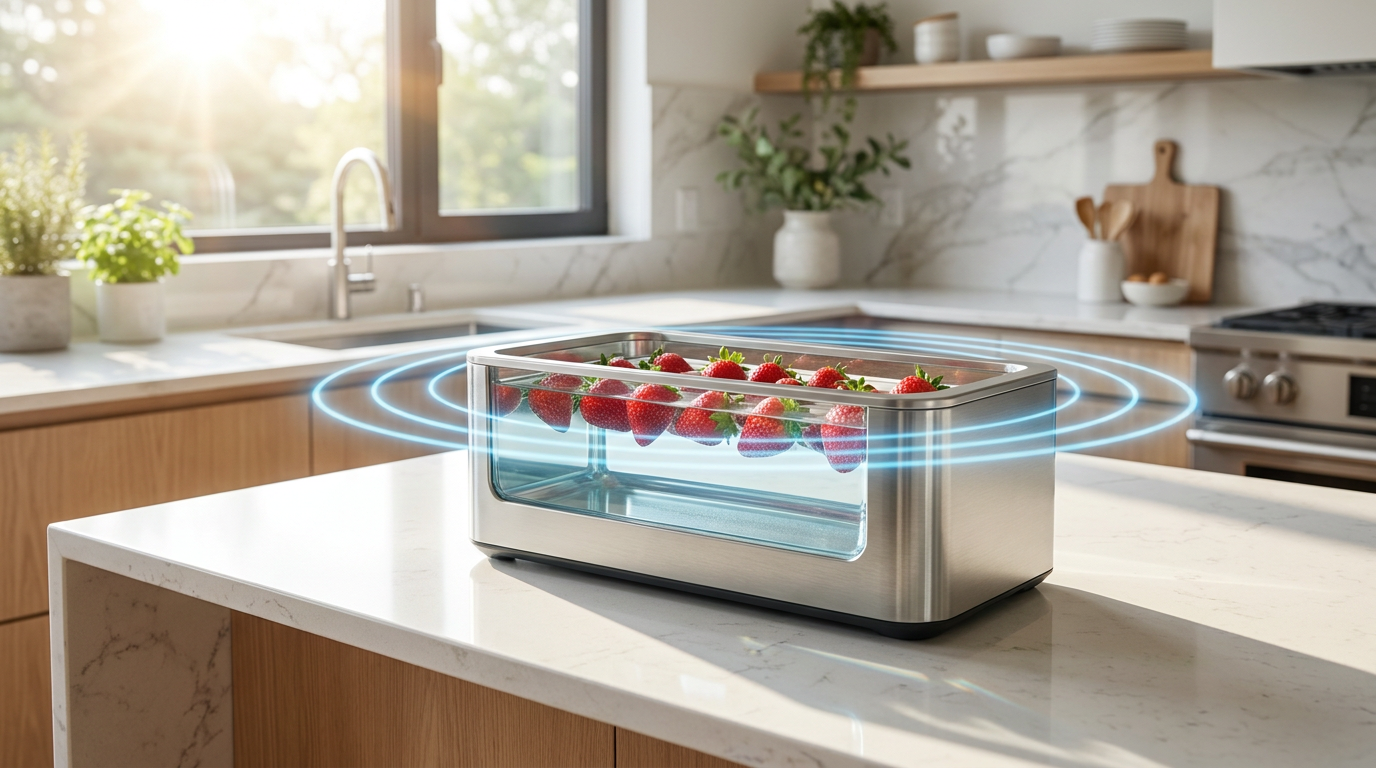
The process begins beneath the stainless steel basin of the appliance, where a component called a piezoelectric transducer is securely mounted. When an alternating electrical charge is applied to this transducer, its internal piezoelectric crystals rapidly change shape, converting electrical energy into intense mechanical vibrations.[5]

These mechanical vibrations are transmitted directly through the water as high-frequency sound waves. Home appliances typically operate at 40,000 Hertz (40 kHz)—a frequency well above the 20,000 Hz upper limit of human hearing. As these ultrasonic waves travel through the liquid bath, they create rapidly alternating zones of high and low pressure.[1][3]
During the low-pressure phase of the sound wave, the physical structure of the water is literally torn apart. The localized pressure drops so rapidly that microscopic voids, or vacuum bubbles, form within the liquid. Because these bubbles are essentially empty space surrounded by water, they are inherently unstable and cannot maintain their structure.[2][7]
Fractions of a millisecond later, the high-pressure phase of the sound wave crashes into the void. Unable to withstand the crushing force, the vacuum bubble collapses, or implodes, in approximately 0.4 milliseconds.[5]
Fractions of a millisecond later, the high-pressure phase of the sound wave crashes into the void.
This microscopic implosion is the engine of ultrasonic cleaning. When the cavitation bubble collapses against a solid surface—whether a metal gear or a blueberry—it releases a localized shockwave and a high-velocity stream of water known as a microjet.[1]

These microjets act like millions of invisible, microscopic scrub brushes. Because the bubbles are smaller than a human hair, they can easily penetrate the tiniest pores, threaded screws, and biological hinges that physical bristles could never reach, physically blasting away surface contaminants.[3]
The physics of this cleaning action are highly dependent on the frequency of the sound waves. Lower frequencies, such as 25 kHz, create larger cavitation bubbles because the voids have more time to grow during the longer low-pressure phase. When these larger bubbles collapse, they release massive amounts of localized energy—ideal for stripping rust from heavy machinery, but disastrous for delicate items.[3][4]
Home appliances are calibrated to 40 kHz, which produces a much higher volume of smaller, gentler cavitation bubbles. This specific frequency provides enough mechanical force to dislodge dirt and pesticide residues from produce without bruising the flesh of a tomato, or to clean a delicate pair of eyeglasses without pitting the glass.[4][6]

To maximize this microscopic scrubbing effect, the chemistry of the water bath plays a supporting role. While plain tap water works, adding a tiny amount of surfactant—like a single drop of dish soap—lowers the water's surface tension. This allows the cavitation bubbles to form more easily and implode with greater kinetic force.[1]
Another crucial operational step is 'degassing.' Fresh tap water contains dissolved oxygen and nitrogen. If these dissolved gases get trapped inside a forming cavitation bubble, they act as a microscopic cushion, softening the implosion. Running the machine for a few minutes before adding items forces these gases out, ensuring the bubbles are true vacuums that collapse with maximum energy.[2]
Despite its impressive mechanical power, the technology has distinct limitations. Acoustic cavitation is a physical removal process, not a chemical one. While the shockwaves effectively dislodge bacteria and viruses from surfaces—often reducing surface microbes by up to 94% in independent tests—the process does not inherently kill pathogens unless the water is heated to sanitizing temperatures or paired with a chemical disinfectant.[6]

Furthermore, ultrasonic cleaning is only effective on hard, non-porous surfaces. Soft materials like fabrics, rubber pacifiers, or certain porous plastics absorb the sound waves, dampening the acoustic energy and preventing the cavitation bubbles from forming effectively.[5]
As consumers become increasingly wary of chemical residues on their food and in their living spaces, physics-based cleaning offers a compelling, sustainable alternative. By harnessing the violent collapse of microscopic bubbles, the modern home is quietly adopting one of the most sophisticated cleaning mechanisms in fluid dynamics.[7]
How we got here
1950s
Ultrasonic cleaning becomes standard in aerospace and medical fields for precision parts.
1990s
Smaller, benchtop ultrasonic cleaners become ubiquitous in jewelry stores and dental clinics.
2020s
Advances in affordable piezoelectric transducers bring 40kHz cleaners to home kitchens.
2026
Ultrasonic produce washers see surging adoption as consumers seek alternatives to chemical food washes.
Viewpoints in depth
Acoustic Physicists
Focuses on the fluid dynamics and energy transfer of cavitation.
For physicists, ultrasonic cleaning is an exercise in energy conservation and fluid dynamics. They emphasize that the cleaning power comes not from the water moving, but from the localized vacuum energy released during bubble collapse. Their research focuses on how varying the frequency alters the maximum size of the cavitation bubble, dictating whether the resulting microjet will gently lift a wax coating or aggressively pit a metal surface.
Consumer Health Advocates
Focuses on reducing household chemical exposure.
This camp views ultrasonic technology as a critical tool for reducing the chemical burden in modern homes. Rather than using specialized produce washes or harsh soaps to remove agricultural pesticides and waxes, they advocate for mechanical removal. They highlight independent testing showing significant reductions in surface-level residues, arguing that physics-based cleaning is inherently safer for food preparation.
Industrial Manufacturers
Focuses on scaling and miniaturizing piezoelectric technology.
Manufacturers who built their businesses cleaning engine blocks and surgical tools are now navigating the consumer market. Their primary challenge is calibrating piezoelectric transducers to deliver consistent cavitation in a compact, affordable appliance. They emphasize the importance of tank geometry, side-mounted transducers, and automated degassing cycles to ensure the technology works reliably without requiring users to understand the underlying physics.
What we don't know
- The exact long-term impact of daily ultrasonic cleaning on the structural integrity of certain delicate produce items.
- How quickly traditional appliance manufacturers will integrate ultrasonic basins directly into standard kitchen sinks.
Key terms
- Acoustic Cavitation
- The formation and rapid collapse of microscopic vacuum bubbles in a liquid caused by high-frequency sound waves.
- Piezoelectric Transducer
- A device that converts electrical energy into mechanical sound vibrations using specialized crystals.
- Microjet
- The microscopic, high-velocity stream of liquid created when a cavitation bubble implodes against a surface.
- Degassing
- The process of removing dissolved gases from water before ultrasonic cleaning to ensure bubbles are true vacuums, which collapse with more force.
- Frequency (Hz)
- The number of sound waves produced per second; higher frequencies create smaller, gentler cavitation bubbles.
Frequently asked
Can I use regular tap water in an ultrasonic cleaner?
Yes, tap water works perfectly. However, running the machine empty for a few minutes first to 'degas' the water, or adding a single drop of dish soap, will significantly improve the cleaning power.
Does ultrasonic cleaning kill bacteria?
The physical shockwaves dislodge bacteria and viruses from surfaces, but they do not inherently sterilize or kill pathogens unless the water is heated to sanitizing temperatures or paired with a chemical disinfectant.
Why can't I place items directly on the bottom of the tank?
Placing items directly on the bottom blocks the transducers from vibrating properly. This reduces the machine's cleaning power and can permanently damage the piezoelectric crystals.
What materials should never go in an ultrasonic cleaner?
Soft plastics, fabrics, and porous stones like pearls or opals should be avoided. Soft materials absorb the sound waves, and delicate porous stones can be shattered by the microjet shockwaves.
Sources
Source coverage
7 outlets
3 viewpoints surfaced







[1]DCM UltrasonicAcoustic Physicists
What is Cavitation in Ultrasonic Cleaning?
Read on DCM Ultrasonic →[2]Best UltrasonicAcoustic Physicists
How Cavitation Forms Micro-bubbles
Read on Best Ultrasonic →[3]Yunyi SonicIndustrial Manufacturers
The Role of Cavitation in Cleaning
Read on Yunyi Sonic →[4]Blackstone-NeyAcoustic Physicists
Frequency and Bubble Size in Ultrasonic Cleaning
Read on Blackstone-Ney →[5]SafetykleenIndustrial Manufacturers
Ultrasonic Cleaning and Cavitation Explained
Read on Safetykleen →[6]Roots and HarvestConsumer Health Advocates
Ultrasonic Produce Cleaner for the Home
Read on Roots and Harvest →[7]Factlen Editorial TeamConsumer Health Advocates
Synthesis by Factlen editorial team
Read on Factlen Editorial Team →
Every angle. Every day.
Get home stories with full source coverage and perspective breakdowns delivered to your inbox.