
Smart Ring vs. Smartwatch: The 2026 Evidence-Based Buyer's Guide
As smart rings achieve parity with wrist wearables, the choice between the two form factors comes down to a trade-off between passive sleep tracking and active workout coaching.
By Factlen Editorial Team
- Passive Recovery Advocates
- Argues that health tracking should be invisible, prioritizing sleep data and minimal screen time.
- Active Performance Athletes
- Argues that health data is only useful if it can guide behavior in real-time during workouts.
- Clinical Accuracy Researchers
- Focuses strictly on sensor placement, noting the finger's advantage for resting data and the wrist's necessity for ECGs.
What's not represented
- · Traditional watchmakers losing wrist real estate to smartwatches
- · Medical professionals relying on patient-generated wearable data
Why this matters
Choosing the right wearable dictates whether you actually use the health data you collect. Understanding the structural differences between rings and watches prevents buyers from wasting hundreds of dollars on a device that doesn't fit their daily habits.
Key points
- Smart rings offer superior sleep tracking accuracy due to denser finger capillaries and less nighttime movement.
- Smartwatches dominate active fitness tracking with real-time GPS, pacing data, and heart rate zone displays.
- Rings achieve a 98% overnight wear compliance rate, compared to 67% for bulkier wrist wearables.
- Only smartwatches currently offer FDA-cleared ECG capabilities and sleep apnea detection.
- Many dedicated athletes now use a hybrid approach: a watch for workouts and a ring for recovery.
The wearable health technology market in 2026 has fractured into two distinct philosophies: the active companion and the passive observer. For years, the smartwatch was the undisputed king of biometric tracking, strapping miniature computers to the wrists of millions. But the rapid maturation of the smart ring—led by the Oura Ring 4 and the Samsung Galaxy Ring—has turned the form factor debate into the most common question among health-conscious consumers. Buyers are no longer just choosing an ecosystem; they are choosing how they want to interact with their own biological data. The decision hinges on a fundamental trade-off between real-time coaching and invisible, frictionless monitoring.[6][7]
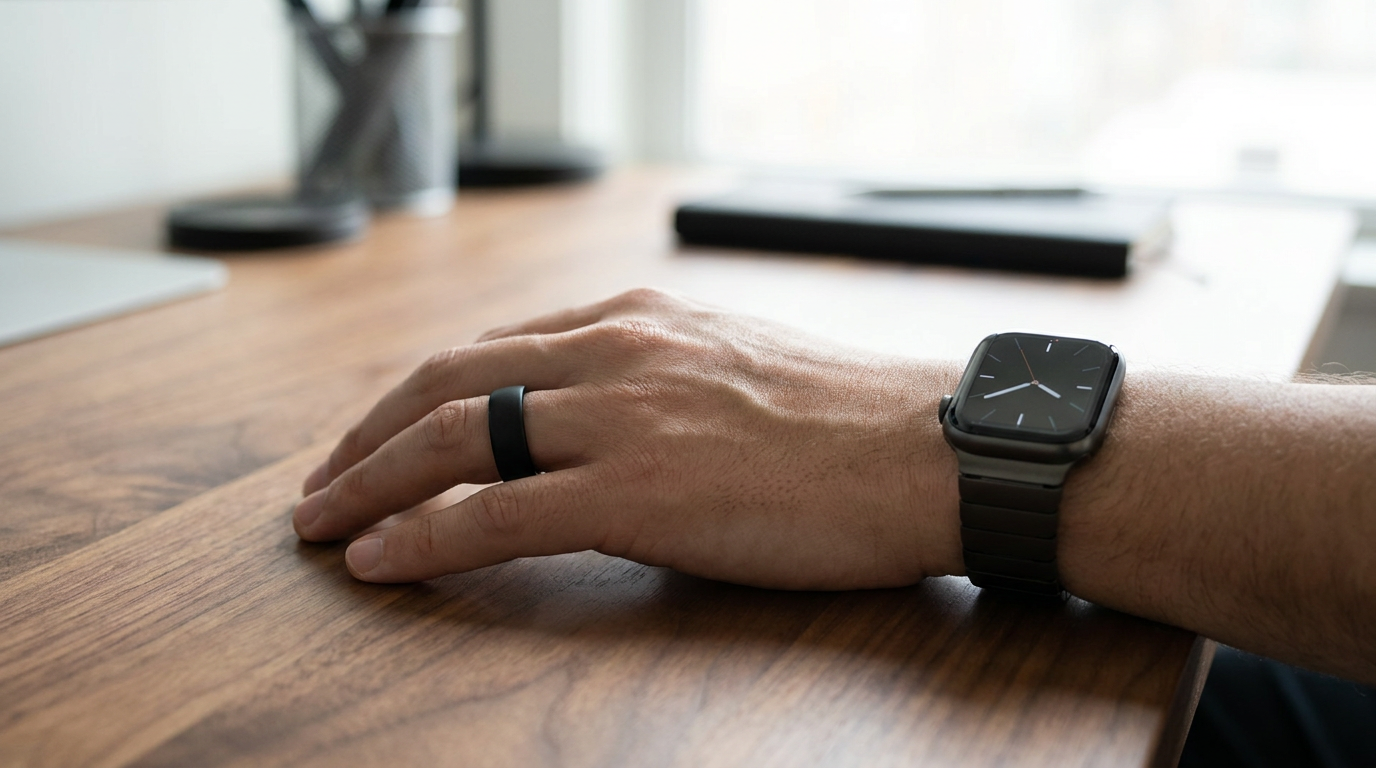
The strongest argument for the smart ring lies in its physical footprint. Weighing between 2.3 and 3 grams, a premium ring is a fraction of the weight of an Apple Watch Series 11 or a Garmin Fenix 8. This near-invisibility solves the biggest hurdle in continuous health monitoring: user compliance. Industry data shows that 98 percent of smart ring owners wear their devices consistently overnight, compared to just 67 percent of smartwatch users, many of whom find wrist wearables too bulky for sleep or need the night hours to recharge their device's battery. For users who want to track their health without abandoning their classic mechanical watches, the ring offers a discreet compromise.[3][4][6]
When it comes to resting accuracy, the evidence heavily favors the finger. The arteries in the human finger are closer to the skin surface and feature a denser capillary network than the wrist. This anatomical advantage gives the optical photoplethysmography sensors in rings a significantly cleaner signal with less ambient noise. A landmark study conducted by Brigham and Women's Hospital and published in the journal Sensors found that the Oura Ring achieved 79.5 percent accuracy in deep sleep detection, outperforming wrist-worn competitors. Because fingers move less than wrists during the night, rings consistently deliver superior data on resting heart rate, heart rate variability, and subtle temperature shifts.[1][5]

However, the case against smart rings becomes glaringly obvious the moment the user starts a workout. Rings are entirely screenless, meaning they cannot provide real-time feedback, pacing data, or heart rate zones during a run. Furthermore, the very design that makes them comfortable at rest makes them vulnerable during exercise. Activities that require gripping—such as weightlifting, rowing, or cycling—can push the ring's sensors away from the skin, disrupting the optical reading. Independent testing of the Samsung Galaxy Ring also revealed that its pedometer algorithms can overestimate daily step counts by up to 10 percent compared to wrist-based trackers, highlighting the limitations of finger-based motion sensing.[2][3]
This is where the smartwatch asserts its dominance as the ultimate active companion. Devices like the Apple Watch Series 11 and Garmin's high-end sports watches are built to guide behavior in the moment. They feature built-in dual-band GPS that can track outdoor runs with 1.2-meter accuracy, independent of a smartphone. During high-intensity interval training, where heart rates spike above 160 beats per minute, wrist devices maintain 88 to 95 percent accuracy, whereas rings often fail to capture the rapid fluctuations. For the athlete who needs to know exactly when to push harder and when to pull back, the glowing screen on the wrist is an irreplaceable tool.[3][6]
This is where the smartwatch asserts its dominance as the ultimate active companion.
Smartwatches also retain a monopoly on clinical-grade cardiovascular screening. While rings excel at passive optical tracking, they cannot take a medical-grade electrocardiogram. The Apple Watch and its premium competitors feature electrical heart sensors capable of detecting atrial fibrillation and, more recently, FDA-cleared algorithms for identifying signs of moderate to severe sleep apnea. These devices are not just fitness trackers; they are active medical monitors that can alert users to life-threatening arrhythmias in real time, a capability that the screenless, optical-only ring form factor simply cannot match.[3][6][7]

The trade-offs extend to battery life and ongoing costs, forcing buyers to weigh convenience against their wallets. A typical smart ring lasts five to eight days on a single charge, allowing users to capture a full week of uninterrupted baseline data. In contrast, feature-rich smartwatches demand daily or every-other-day charging, creating inevitable gaps in the user's health profile. Yet, the financial math is complex. While a smartwatch is a one-time purchase, the leading smart ring, Oura, requires a monthly subscription fee to unlock its most valuable insights. Samsung's Galaxy Ring eliminated the subscription model, but carries a steeper $400 upfront price tag, making the long-term cost of both form factors surprisingly comparable.[2][4][6]
Ultimately, the smart ring fits perfectly for a specific type of user: the sleep optimizer and the screen-fatigued. It is the ideal choice for individuals whose primary goals are tracking overnight recovery, monitoring menstrual cycles via temperature trends, and gathering long-term biometric data without the distraction of notifications. If the goal is to wake up, check a readiness score on a smartphone, and go about the day unbothered by digital alerts, the ring is the superior tool. It quietly collects the data and gets out of the way.[4][6][7]

Conversely, the smartwatch remains the definitive choice for the data-hungry athlete and the connected professional. It fits best when the user needs to leave their phone at home but remain reachable, or when their training requires precise, glanceable metrics. Runners, cyclists, and anyone who relies on timers, live weather updates, or on-wrist music controls will find a ring entirely inadequate. The smartwatch is designed to be interacted with constantly, serving as both a fitness coach and a triage center for daily digital life.[3][6]
As the 2026 wearable landscape matures, the most dedicated health enthusiasts are increasingly refusing to choose just one. A growing cohort of users now employs a hybrid approach, wearing a Garmin or Apple Watch for the one hour of the day they are actively training, and relying on a smart ring for the remaining twenty-three hours of recovery and sleep. While this dual-device strategy requires a higher budget, it perfectly illustrates the reality of modern health tracking: the wrist is for the workout, but the finger is for the recovery.[6][7]
How we got here
2015
The first generation of consumer smart rings launches, primarily focused on basic step tracking and NFC payments.
2020
Peer-reviewed studies begin validating finger-based PPG sensors as highly accurate for resting heart rate and sleep.
2024
Samsung enters the market with the Galaxy Ring, validating the screenless wearable category for mainstream Android users.
2026
Smart rings achieve near-parity with medical-grade sleep trackers, while smartwatches integrate advanced FDA-cleared sleep apnea and AFib detection.
Viewpoints in depth
The Passive Recovery Camp
Argues that health tracking should be invisible and frictionless.
Advocates for passive tracking emphasize that the best wearable is the one you forget you have on. They point to the 98% overnight compliance rate of smart rings as proof that form factor dictates utility. By removing the screen, rings eliminate the psychological burden of constant notifications and battery anxiety, allowing users to focus purely on long-term recovery trends like HRV and temperature without engaging with another digital interface.
The Active Performance Camp
Argues that health data is only useful if it can guide behavior in real-time.
For athletes and data-driven users, a wearable must be an active coach. This camp argues that reviewing a sleep score the morning after is less valuable than seeing a heart rate spike mid-run and adjusting pace accordingly. They rely on the smartwatch's ability to display complex metrics, track precise GPS routes without a phone, and provide haptic feedback during interval training—features that a screenless ring fundamentally cannot support.
The Clinical Accuracy Camp
Focuses strictly on sensor placement and medical validation.
Researchers evaluating wearables look past the software interfaces and focus entirely on anatomy. They note that while the finger's dense capillary network provides a superior signal-to-noise ratio for resting optical measurements, the wrist remains the only viable location for consumer electrocardiograms. Because rings cannot currently house the electrical sensors required for FDA-cleared AFib detection, this camp views watches as superior for clinical cardiovascular screening, even if rings win on sleep staging.
What we don't know
- Whether smart rings will eventually incorporate FDA-cleared ECG sensors despite their small surface area.
- How the long-term durability of smart rings compares to smartwatches over a multi-year lifespan.
Key terms
- Photoplethysmography (PPG)
- The optical sensor technology used in both rings and watches that shines light into the skin to measure blood flow and heart rate.
- Heart Rate Variability (HRV)
- The fluctuation in the time intervals between adjacent heartbeats, used as a key metric for physical recovery and stress.
- Four-Stage Sleep Classification
- The clinical standard for measuring sleep, dividing rest into awake, light, deep, and REM stages.
Frequently asked
Can a smart ring replace a smartwatch for marathon training?
No. Smart rings lack built-in GPS and real-time pacing displays, making them unsuitable for active run tracking where live feedback is required.
Which device is more accurate for heart rate?
Rings are slightly more accurate for resting heart rate and HRV due to finger capillary density, while watches are far more accurate during active, high-motion exercise.
Do all smart rings require a monthly subscription?
No. While the Oura Ring requires a monthly fee for full data access, alternatives like the Samsung Galaxy Ring and RingConn do not charge ongoing subscriptions.
Sources
Source coverage
7 outlets
3 viewpoints surfaced







[1]Sensors JournalClinical Accuracy Researchers
Accuracy of Consumer Wearable Devices in Sleep Staging
Read on Sensors Journal →[2]ZDNETActive Performance Athletes
Samsung Galaxy Ring review: Smarter software than my Apple Watch
Read on ZDNET →[3]CNETActive Performance Athletes
Galaxy Ring vs. Apple Watch: Which Wearable Is Right for You?
Read on CNET →[4]InversePassive Recovery Advocates
The Galaxy Ring Is Finally Here to Save Me From Smartwatches
Read on Inverse →[5]Sleep ReviewClinical Accuracy Researchers
Oura Ring Outperforms Apple Watch, Fitbit in Sleep Staging
Read on Sleep Review →[6]SmartRingHQPassive Recovery Advocates
Smart Ring vs Smartwatch: The 2026 Buyer's Guide
Read on SmartRingHQ →[7]Factlen Editorial TeamPassive Recovery Advocates
Synthesis by Factlen editorial team
Read on Factlen Editorial Team →

Every angle. Every day.
Get meta stories with full source coverage and perspective breakdowns delivered to your inbox.